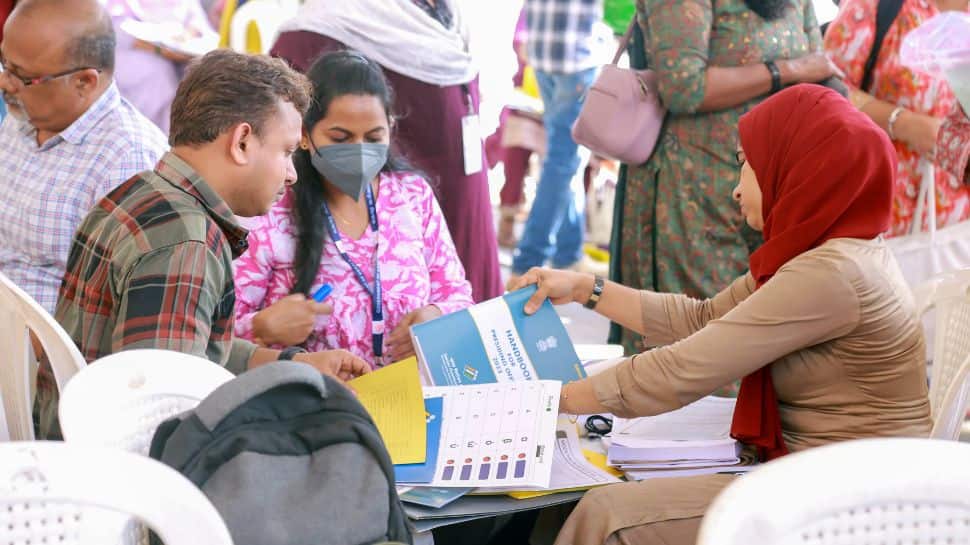
Kerala election 2026: Kerala’s 140 Assembly constituencies are set to go to election in less than 24 hours for voting to commence in Kerala, and a total of 883 candidates are in the fray.
Notably, several constituencies have turned into crowded battlefields with rebels and Independents adding to the mix.
According to an IANS report, the electorate stands at 2.7 crore voters, spread across more than 30,000 polling stations, setting the stage for a high-turnout election.
Kerala politics
Beyond the numbers lies a far more nuanced political story of Kerala.
The ruling Left Democratic Front (LDF), led by Chief Minister Pinarayi Vijayan, had already rewritten political convention by retaining power in 2021, breaking the state’s long-standing pattern of alternating governments.
The LDF is banking on continuity, welfare delivery, and a disciplined organisational network, arguing that there is no overarching anger against them.
The United Democratic Front (UDF), meanwhile, is reading the same landscape differently, betting on a silent, seat-by-seat shift driven by local dissatisfaction and a consolidation of its traditional support base.
For the Bharatiya Janata Party (BJP), the election is less about forming a government and more about expanding relevance. In a tightly contested environment, even marginal vote swings could open doors in select constituencies.
However, LDF being in power for a decade is bound to bring its own pressures. IANS reported that what is visible on the ground is not a tidal wave against the incumbent but rather pockets of discontent, a form of micro anti-incumbency directed more at local representatives than at the leadership itself. Issues of governance fatigue, constituency-level grievances, and unmet expectations linger beneath the surface.
All three fronts know that their fortunes will depend more on which way the minority communities comprising the Muslims and Christians, which together constitute around 42 per cent, go. This was clearly evident in the 2024 Lok Sabha polls and at the December local body polls.
Each political front is interpreting this mood to its advantage. However, interestingly, the real wildcard, as always in Kerala, is voter turnout.
With participation historically hovering between 70 and 80 per cent, even a very minor swing can decisively alter outcomes across multiple seats.
In essence, this is not an election defined by a single wave, but by fine margins and fragmented signals.
(with IANS inputs)
Also read- Assembly Elections 2026: What to carry to polling booth? Voter ID, slip and rules explained







