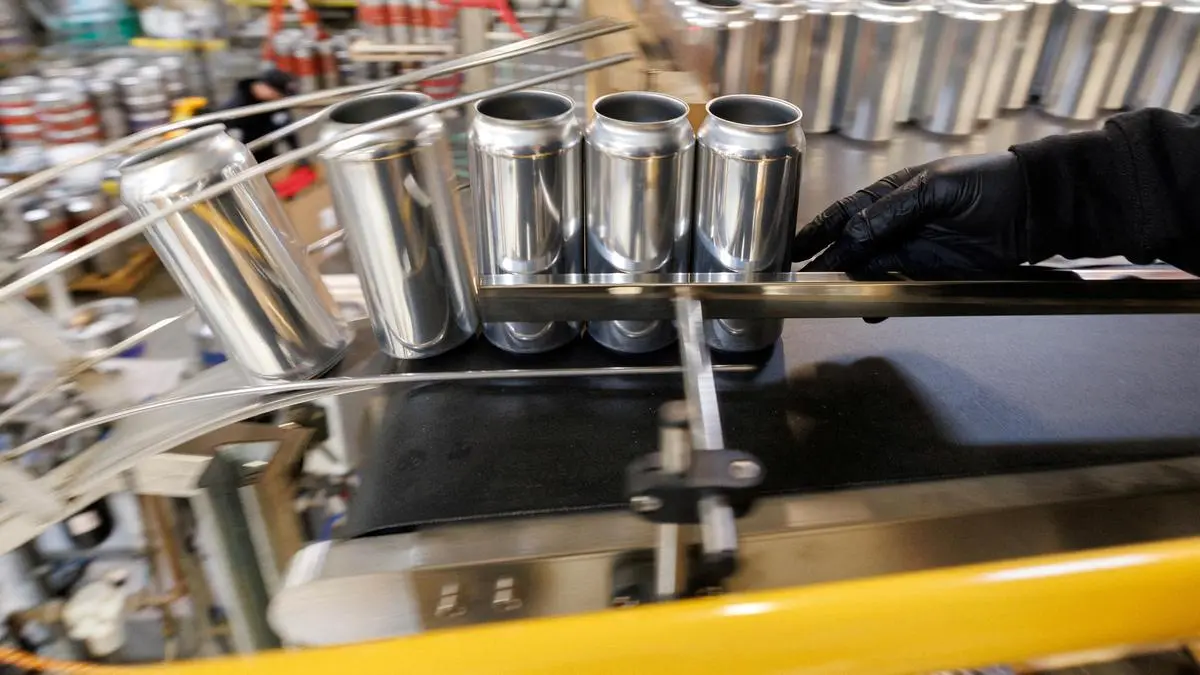
India’s beverage industry is staring at a potential ₹11,500 crore disruption as a deficit of 12–13 crore aluminium cans builds up, with domestic supply from key manufacturers such as Ball and CANPACK falling to just 10–20% of normal capacity. The crunch follows a global aluminium price surge of about 47–50% year-on-year to around $3,600 per tonne, sharply raising import costs in a market dependent on overseas can-grade aluminium.
The impact is now visible across bars, retail, and quick-commerce platforms. Diet Coke has begun disappearing in several markets, while Monster Energy Zero Ultra (white can), a top-selling zero-sugar variant with no equivalent outside the can format, has also seen supply disruptions across urban channels. Shelves across metros such as Mumbai, Bengaluru, and Pune are thinning, with visible gaps in high-demand categories, including canned beers. The industry is now approaching a supply cliff as pre-disruption inventory runs out.
Anish Varshnei, co-founder and chief production officer at Goa-based Latambarcem Brewers
Supply breakdown
The crisis is being driven by three simultaneous shocks—input costs, disrupted imports, and regulatory constraints—leaving India’s import-dependent supply chain exposed. A CANPACK official told BusinessLine that while production exists, moving material into India has become increasingly difficult.
“There is production, but getting it into India is a challenge right now. We are trying to manage through imports, but timelines are uncertain. We don’t know by when the situation will stabilise.”
With CANPACK supplying Coca-Cola, United Breweries (Heineken), Carlsberg, AB InBev, PepsiCo, and Parle Agro, disruptions are cascading simultaneously across alcoholic and non-alcoholic categories.
Another issue pointed out by the Canpack Official is the complexities in the total number of can packs in India. The most popular beverage can sizes in India are 250 ml, 330 ml/350 ml (standard/sleek), and 500 ml (tallboy), driven by growing demand for convenience, e-commerce, and functional beverages.
While 330ml/350ml is common for soft drinks, 500ml is widely used for beer and energy drinks, with 250ml gaining popularity for functional drinks.
“With raw material constraints, can makers prioritise larger pack sizes for beer over smaller, more complex formats, driving shortages in Diet Coke and other functional drinks,” he said, indicating that the with the onset of summer, companies’ orders are bursting at the seams and its a tough one to start supplies to anyone new for the next 12 months as our existing customers are already getting less, he indicated
Market reality
The industry is currently being cushioned by a production cycle that is about to expire. Most cans in circulation were manufactured in January–February, before the disruption fully hit.
“Some products are not always available, especially in key canned categories. Supply is coming, but not consistently,” a senior retail executive said, adding that availability gaps are becoming more frequent.
Demand trap
“Much of the stock currently available in stores reflects pre-disruption inventory,” said Dhairyashil Patil, National President, AICPDF, warning that supply constraints and rising costs are beginning to pressure distributors and could trigger pricing instability if shortages persist.
The disruption is most acute in categories where the can is not just packaging but the product itself. Products such as Diet Coke and Monster Zero Ultra have no equivalent formats, meaning stock-outs translate directly into lost sales as consumers skip purchases entirely.
This dynamic is particularly visible in quick-commerce channels, where even short stock-outs can shift purchases across platforms. Companies had been pushing small-format cans, including ₹10 price points, to drive penetration—making the disruption a setback for a key growth strategy.
Inventory challenges
The impact is most acute in the beer industry. In several large markets, cans account for 75–80% of sales, while industry estimates suggest 60–70% of the ₹51,000 crore beer market now relies on cans.
Brands such as Kingfisher, Budweiser and Tuborg are staring at a supply cliff as pre-disruption inventory runs out over the coming weeks.
“Cans are easier to transport, there’s less breakage, and margins are better across the supply chain,” said Anish Varshnei, co-founder and chief production officer, Latambarcem Brewers (LBB), when we visited his brewery in Goa last week. “Distributors are asking specifically for 500ml cans over 650ml bottles as the margins are better in cans and liquid less making customers ask for more .”
Companies are scrambling to secure supply. Varshnei said mid-sized players are pivoting to imports from China, Korea, and Vietnam, while larger brewers with rigid supplier approvals have far less flexibility, he said, showcasing a can that the company has recently imported from China.
“The cost difference is negligible—maybe 1–2 paise either way. Availability—not pricing—is the real constraint. adds Anish of LBB.
It is not customers who find cans cool, a 500 ml aluminium can allows up to 1.5 times more volume per truck, making any disruption disproportionately damaging—not just to volumes, but to the economics of the entire route-to-market.
Normal packaging inventory levels of 50–60 days are now running at 20–30 days as companies drain stocks. Emergency imports from China, Sri Lanka, Vietnam, and Korea require upfront payment, a cash outflow at precisely the moment seasonal revenues should be peaking. For brewers already unable to raise prices without state excise approval, the pincer is complete.
In a category driven by peak seasonal demand, missed sales are never recovered.
United Breweries MD Vivek Gupta had earlier flagged the shortage as already impacting growth, estimating a 1–2% hit with no immediate resolution in sight.
Alternatives fall short
The shortfall is translating into a combined hit of over ₹11,500 crore—about ₹6,250 crore in revenue losses (₹1,200–1,300 crore in beer and nearly ₹5,000 crore in non-alcoholic beverages), along with margin pressure of roughly ₹5,300 crore.
“It is going to be a ripple effect,” said Varshnei. “The beer you are seeing today was produced two to three months earlier. This summer is going to be very difficult.”
CRISIL estimates an additional ₹1,500 crore hit to brewer profitability, with EBITDA margins likely to compress by 250–300 basis points. “Packaging itself accounts for about 35% of revenues for brewers, so any disruption hits margins directly,” Varshnei added Unlike most sectors, brewers have limited ability to raise prices due to state-level excise controls.
Glass bottles are also under pressure, with prices rising nearly 20%, while higher weight increases handling costs and breakage risks. Consumers, meanwhile, may defer purchases rather than switch formats, limiting recovery.
No quick fix
PET is emerging as a partial buffer. “Companies are becoming more flexible, moving between cans and PET depending on cost and availability,” said Rahul Gupta, Whole-Time Director at Bharat PET Ltd, though substitution remains limited in premium categories.
A dedicated can facility linked to Reliance’s Campa Cola is not supplying the broader market, restricting incremental supply, with Reliance unlikely to face any challenges, as examples include partnerships with Ceylon Beverage promoted by cricketer Muthiah Muralitharan for Campa, at the Multimodal Logistics Park at Mappedu near Chennai, and acquisitions like Netmeds for manufacturing Campa soft drinks.
The summer of 2026 is turning the aluminium can, once the beverage industry’s most efficient growth format, into its most acute liability. “At best, it will take close to a year for supply to normalise,” Varshnei said. “Right now, we are just fighting for survival.”
Published on April 28, 2026







