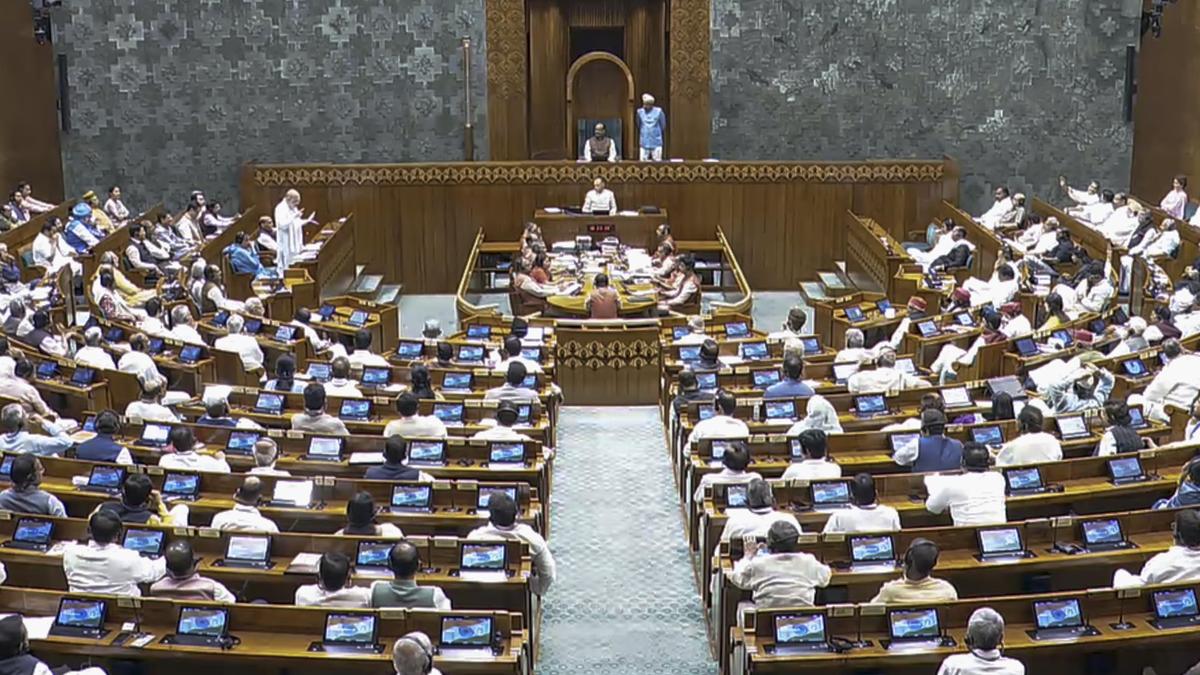
New Delhi: Union Home Minister Amit Shah speaks in the Lok Sabha during the Special session of Parliament, in New Delhi, Friday, April 17, 2026. (Sansad TV via PTI Photo)
| Photo Credit:
PTI
The Constitution (131st Amendment) Bill, 2026, intended to prepone 33 per cent reservation for women in Parliament and State Assemblies, was defeated in the Lok Sabha on Friday evening. The government failed in its last-ditch effort to push the bill by promising in the House to introduce an amendment related to a 50 per cent proportional increase of seats across States in the legislation.
Lok Sabha Speaker Om Birla announced that 298 members voted in support of the Bill, while 230 MPs voted against it. Of the 528 members who voted, the Bill could not get the required 352 votes to constitute the two-thirds majority needed for a Constitutional amendment.
Parliamentary Affairs Minister Kiren Rijiju subsequently requested the Speaker to withdraw the two accompanying legislations — the Delimitation Bill, 2026, and the Union Territories Bill, 2026 — as they became infructuous after the pivotal bill for their implementation failed to pass the House of Representatives. “You have lost a historic opportunity to give 33 per cent reservation to women,” Rijiju said while accepting that the opposition did not support the bill.
Lok Sabha seats were proposed to be increased to 850 from the existing 543 after carrying out delimitation on the basis of the 2011 Census to “operationalise” the women’s reservation law before the 2029 parliamentary polls.
The Opposition erupted in celebration after the division of votes. Their leaders privately stated that this is the second major political embarrassment for the Modi government after the rollback of farm laws.
Leader of the Opposition Rahul Gandhi, speaking to reporters after the House verdict, said the Opposition defeated the legislation since it was an attack on the Constitution. “We clearly said that this is not a women’s bill but an attempt to change India’s electoral structure,” he remarked.
Earlier during the proceedings, Rahul Gandhi said, “The government is telling the southern, northeastern, and smaller States that for the BJP to remain in power, ‘we are going to take away representation from you’.”
“We won’t allow you to do it. The entire Opposition will defeat this attempt. I want to assure the southern, northeastern, and smaller States that we will not allow the government to touch your representation in the Union of India,” he said.
Replying to the debate, Home Minister Amit Shah dug into history to establish that this is the fifth time Congress and the INDIA bloc were opposing the women’s reservation bill. “Those who opposed the bill will be greeted with strong protest from women during elections,” Shah said, repeating Prime Minister Narendra Modi’s assertion during the intervention in the debate a day before.
Shah indicated that the government was aware that the bill would fall. “If they don’t vote, this bill will be defeated,” he said, telling the Opposition MPs, “you might win here but won’t be able to face women on the ground.”
To salvage the bill, Shah proposed that the government was ready to write the promise of a 50 per cent increase of seats for all States into the legislation. Shah had made this promise in the House on Thursday, but the Opposition said it had no meaning since it had not been written in the proposed bill. Speaking earlier, Congress MP Shashi Tharoor said Shah’s promise of 50 per cent was “a precarious political assurance and not a legislative certainty”, since the proposed law leaves wide discretion to the delimitation commission.
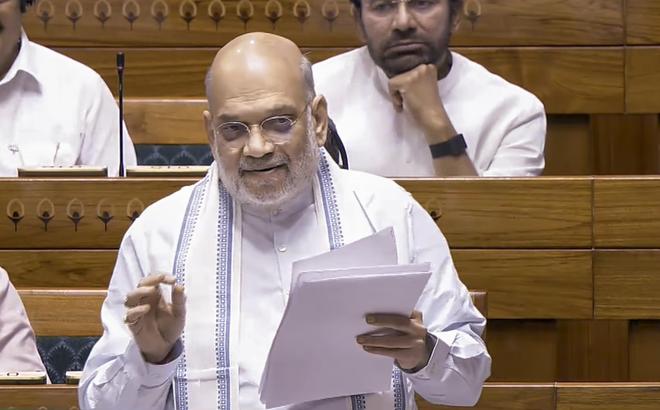
New Delhi: Union Home Minister Amit Shah speaks in the Lok Sabha during the Special session of Parliament, in New Delhi, Friday, April 17, 2026.
| Photo Credit: PTI
But Shah persisted, saying, “Give us an hour, we will bring an amendment to this effect. But do you promise that you will then help pass the bill,” he asked the Opposition.
To this, Congress MP KC Venugopal said the women’s reservation bill should be delinked from the delimitation bill. Shah did not agree, and the attempt for building the last-minute consensus failed.
The Opposition also questioned the government on a Union Law Ministry notification issued late on Thursday night to enforce the 2023 women’s reservation law with effect from April 16 this year. This was two years and six months after a bill to amend the Act was passed by Parliament on September 21, 2023.
Published on April 17, 2026







