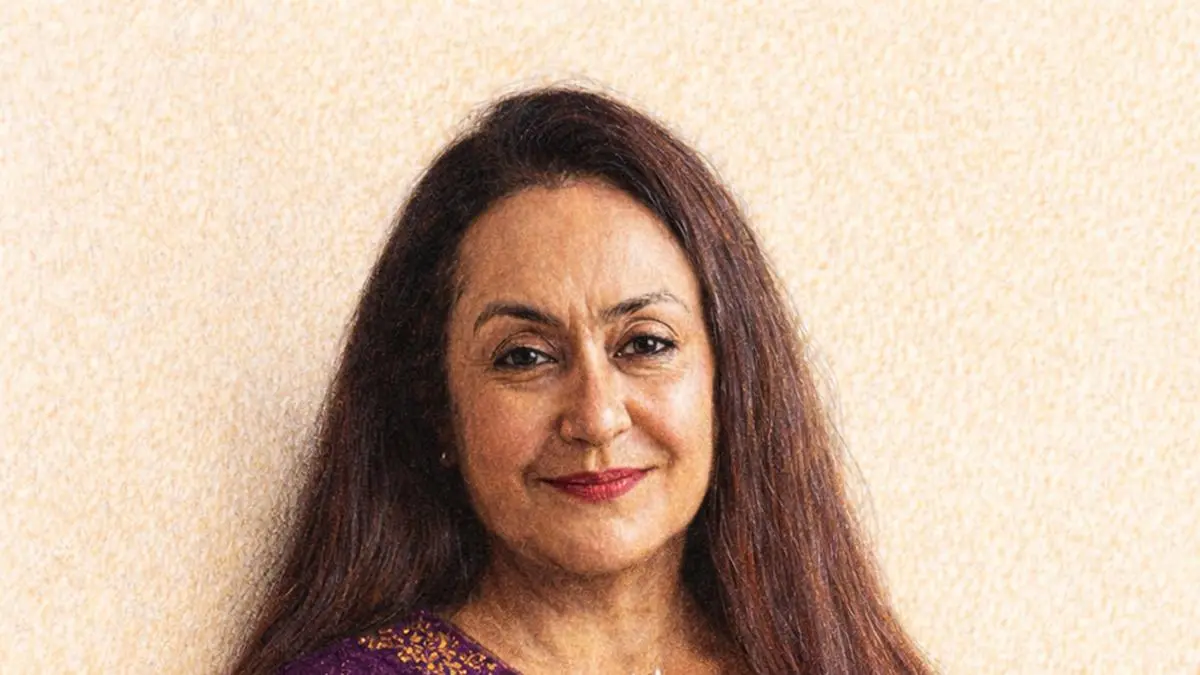
This April, the Lalit Suri Hospitality group embarked on a major transformation. Lalit 2.0 will be the second such change exercise of the group, says Jyotsna Suri, Chairperson and MD. Founded in 1988 as Bharat Hotels by her late husband, Lalit Suri, the group’s first makeover came about after the charismatic Lalit Suri passed away in 2006 and his wife had to take over the reins. She rebranded the group as The LaLiT in his honour, creating a distinctive identity — the L in the LaLiT logo is designed to resemble the trunk of Lord Ganesha. “We were six hotels when he passed away. Today we are 12 hotels, plus two in the mid-segment.”
Explaining the need for the current exercise, Suri says that during the Covid-19 pandemic the group went through a financial crunch and some projects, including an ambitious new hotel in Ahmedabad, were stalled. “We’re out of that financial crunch now and sitting in a very good position. And, therefore, we are raring to go forward,” she says.
But why is The LaLiT only at 14 hotels when chains like The Taj, Radisson and Marriott are talking of 500 properties in a few years? “Every hotel chain has a right to decipher and discern what they want to do in terms of their business planning. We’ve never been in the business of growing inventory. As a matter of fact, we are very uniquely placed because we own and manage all our hotels,” says Suri.
“We are hoteliers to the core, and we like it like that,” she asserts, although she adds that the group does intend to pick up some management contracts. “But we are not in a race at all. Whatever hotels we do pick up for management, they would be selective,” she says, adding they would be mid-market, under the Lalit Traveller brand.
I am meeting the dynamic head of the hotel chain, who is also a big force at FICCI (she was president of the chambers in 2015 and now mentors the tourism and culture as well as DEI committees), at The LaLiT on Barakhamba Road. But the table across which we are seated is not at any of their famous restaurants — it’s in her private office, which is filled with enchanting art works. Two particularly catch my eye. One is a painting by a Tihar jail inmate (the hotel group had organised an art workshop for the prisoners, which led to this work), and the other is a series of political cartoons by Raj Thackeray.
“I don’t like talking and shovelling food at the same time,” Suri says, explaining why we cannot do the usual format of an interview over a meal for this Table Talk. Instead, we chat over tea served elegantly with gourmet cookies. Suri says she is only interested in food as fuel, except for Delhi’s chaat, which she loves.
Developing destinations
Suri’s philosophy of hoteliering is quite different from that of other chains, which tend to focus on the most trending places. The LaLiT has instead gone to difficult areas, choosing to develop the destination from scratch. Case in point is Bekal, in north Kerala, where The LaLiT was one of the first to set up a hotel; but the destination took over 15 years to develop as accessibility was a big issue. Ditto Khajuraho, where connectivity is still a problem. Or Mangar, an Aravalli wildlands, off the beaten track, between Faridabad and Gurgaon, where The LaLiT has set up an eco-friendly resort. In Chitrakoot, in Bundelkhand, the chain is again a pioneer, with a Lalit Traveller property about to come up.
Suri’s reasons may sometimes defy logic. Since her husband died in London, she was determined to have a property in that city and acquired a former grammar school, St Olave, at a cost of £15 million and turned it into a boutique hotel. She is a quaint mix of pragmatism and emotion. “I don’t develop hotels because I am adding numbers, but because I want to make a hotel in a particular city,” she says. As happened with the hotel in Ahmedabad, which she assures will be ready in time for the Commonwealth Games. “It is a half-done hotel and it’s on the Sabarmati. It’s going to be a beautiful hotel, inspired by Gandhi’s era,” she says.
“We have always created destinations, not hotels,” she says, explaining that the idea is to play up local festivals and traditions, and invest in the cultural rejuvenation of the place. For instance, in Khajuraho, the chain used to organise an annual Shiv Vivah festival to attract tourists. “Name any noted dancer and they have performed there — it’s perhaps the only place where Raja Reddy performed with both his wives,” she says.
At FICCI, too, she is driving the idea of culture dovetailing into tourism. “Though we don’t call it culture — we call it the creative industry,” she says.
An early riser and highly disciplined (she walks 7 km daily and swims regularly), Suri often takes calculated risks — not a surprising trait really, as she comes of entrepreneurial stock. Her dad moved from Rawalpindi to Delhi during Partition and built a profitable Mercedes-Benz truck business in far-flung Kutch, and was nonconformist enough to send Suri to a co-ed boarding school — Lawrence School at Sanawar. Suri does a lot for her alma mater. The group does a lot for education, for that matter — it runs Step by Step, a well regarded school in NCR. She also runs the Lalit Suri Hospitality School, set in a large beautiful campus in Faridabad, which trains future leaders in the sector.
Suri has given a free rein to her children to experiment with new ideas. Two daughters, Divya and Deeksha, and son, Keshav, are part of the management, while another daughter, Shraddha, runs Subros, the family’s auto parts business. Keshav was one of the petitioners against Section 377 and The LaLiT was among the first few hospitality chains to endorse the UN’s LGBTQ standards at work,
Asked to list the hotel’s strengths and weaknesses, Suri does it with clinical precision. “If you want me to do a SWOT analysis, I’m going to begin with location. Every single hotel of ours has a fabulous location, starting with the hotel we are sitting in. Be it Kashmir, or Kolkata, or Udaipur, Jaipur, or Mumbai, where we are literally one minute from the airport, we have the best location. Our Kerala hotel sits on an estuary between the sea and a river, and in Khajuraho we are walking distance from a World Heritage Site.”
The other distinctive feature, she says, is that “we are completely homegrown and deeply rooted in Indian culture. We were the first ones to begin a ‘Namaskar’ tradition of greeting the guest.”
The third thing, she says, is that the group is inclusive. “We’re not just ticking a box, but genuinely inclusive. That’s why we have approximately 200 transgenders working for us. We’ve got differently abled people working for us and people from marginalised communities as well,” says Suri.
What about challenges? “We are very cyclical. And affected by external events very quickly. When fuel prices go up, we get into trouble; when war breaks out, we get into trouble; during Covid we were in deep trouble. So, we are a very fragile industry.
“But I won’t call it a challenge — it’s part and parcel of the industry, and one has to accept it,” she says.
More Like This
Published on April 13, 2026







