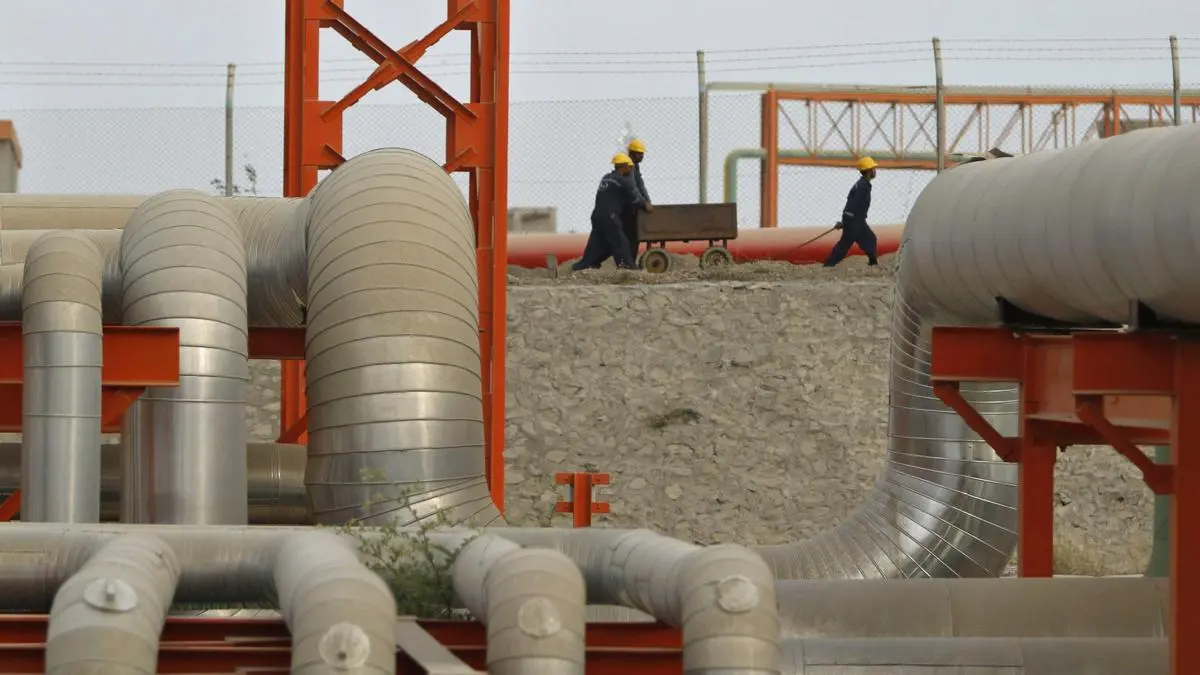
India set to receive first Iranian crude oil after seven years

India set to receive first Iranian crude oil after seven years


India is set to receive its first consignment of crude oil from Iran—after almost seven years—an indication that the world’s third largest importer is making use of the 30-day window offered by the United States for buying Iranian oil “on water”.

Global data and analytics provider Kpler’s Marine Traffic told businessline that an Aframax, Ping Shun (IMO 9231901) is loaded with around 600,000 barrels of Iranian crude oil from Kharg Island in early March and has emerged as the first vessel observed signalling a destination of Vadinar (Gujarat) in India.

This is the first crude oil cargo “since May 2019”, following sanctions being re-imposed on Iranian oil by the first Trump administration, it added.

It is not immediately clear which refiner has contacted the Iranian crude oil cargo.

Vadinar is home to the 405,000 barrels per day (b/d) refinery, which is owned and operated by Rosneft-backed Nayara Energy. However, sources said that the cargo is not for Nayara as its refinery is going into a 35-day maintenance from April1-2.

Amid the Middle East Gulf (MEG) conflict and subsequent oil price volatilities, the US administration temporarily lifted sanctions for over 30 days against Iranian oil on water loaded before March 20th, explained Sumit Ritolia, Kpler’s Lead Research Analyst for Refining & Modeling.

“The Indo-Iranian oil trade has flickered back to life. Following the US administration’s decision to grant a 30-day window for Iranian oil ‘on the water’ due to regional conflict. The vessel Ping Shun is now en route to Vadinar with 600,000 barrels of crude. This is the first such delivery since May 2019 and comes at a critical time for Indian refiners facing tightening inventories,” he added.

The tanker is left from Kharg Island around March 4th, with a declared ETA to Vadinar on April 4th, Marine Traffic said.

Published on March 31, 2026


Source link

India faces fertilizer risk the most if Iran war prolongs, say analysts

India faces fertilizer risk the most if Iran war prolongs, say analysts


A prolonged conflict between the US-Israel axis and Iran will have a far-reaching impact on the global fertilizer market, and India faces the most imminent risk, analysts say.

“In our view, of the major agricultural markets, India faces the most imminent risk. The timing is particularly critical: while the current disruption falls outside peak import season for several major markets, India’s fertilizer demand window is fast approaching, late March through April, with the peak phosphate production season beginning in June,” said research agency BMI, a unit of Fitch Solutions. 

“Deprived of their natural gas supplies from Qatar, fertilizer firms in India, Bangladesh, and Pakistan have had to shut down production. Egypt, another important producer, has lost its gas imports from Israel and must turn to the ever-pricier LNG market,” said Carnegie Endowment fellows Noah Gordon and Lucy Corthell. (India termed the closure of fertilizer firms as maintenance shutdowns a month ahead since there was a shortage of LPG). 

Reduced utilisation

“Should the conflict extend beyond one month, we anticipate reduced fertiliser application rates. This risk is compounded by the emerging likelihood of an El Nino event, where reduced fertiliser application amid already stressed growing conditions could significantly impact yields and potentially trigger export restrictions,” said BMI.

Australia’s Bureau of Meteorology, in its latest update, said  El Nino will likely set in before the Southern Hemisphere winter ends (August) and there are chances of the drought-bearing event emerging as early as May.  

The Iran war has affected shipments of crude, gas and fertilizers across the Strait of Hormuz, which accounts for 30 per cent of fertilizer and its feedstock shipments.

The Strait of Hormuz closure has shut in Gulf natural gas production, the feedstock for ammonia and urea. “With no strategic fertilizer reserves and no pipeline bypass for ammonia, urea prices are skyrocketing, arriving precisely at the Northern Hemisphere spring planting window,” said Viewpoint Investment Partners.

Urea up 30%

BMI said India’s corn plantings begin in May. Corn is the most fertilizer-dependent crop and it could be among the first to feel the impact if the war prolongs. 

The Carnegie Endowment fellows said the benchmark price of urea, the most widely traded fertilizer, is up about 30 per cent in the past month and the damage extends beyond nitrogen to phosphorus. 

“Gulf countries produce around 20 per cent of phosphate fertilizers, and as well as a quarter of global sulfur, which is largely an oil and gas byproduct. Fertilizer producers need sulfur (sulfuric acid, to be precise) to turn phosphate rock into a liquid that plants can absorb,” they said.

Viewpoint said farmers, especially in the US, who don’t have enough fertilizer face three choices. “They can pay the higher price, reduce application rates and accept lower yields, or shift to less nitrogen intensive crops. All three have consequences for grain prices, and the market is beginning to reflect them,” it said.

BMI said India accounts for 15 per cent of global fertilizer use and 80 per cent of fertilizer use in South Asia. “In India, government supports fertilizer purchases by farmers where urea is the main used product,” it said.

Resumption will take weeks

However, India is undergoing a revival of its nitrogen fertilizer industry, which will lead to lower imports in the coming years, it said.

Carnegie’s Gordon and Corthell said the fertilizer crisis will cast a spotlight on the inefficiencies in the tremendously productive food system. “Even if the Strait of Hormuz does open soon, restarting production and transport for fertilizers and their components could take weeks,” they said.

Moscow Times said Russia stands to reap gains from surging global fertilizer prices, adding to Kremlin’s windfall from higher oil and gas revenues.

Prices for Russian fertilizers have already climbed to levels not seen since 2022, when uncertainty over Western sanctions on Moscow following the invasion of Ukraine rattled global markets, it said

Baltic FOB urea increased to $418 a tonne in February after averaging about $375 in 2025. By March 13, it climbed to $563-$586 — a 40 per cent increase over pre-crisis levels — with some deals concluded at around $600.

Published on April 1, 2026


Source link

Piyush Goyal accuses DMK govt of ruining Tamil Nadu finances ahead of polls

Piyush Goyal accuses DMK govt of ruining Tamil Nadu finances ahead of polls


TN BJP President Nainar Nagendran, BJP’s Tamil Nadu election in-charge Piyush Goyal, leaders K Annamalai and Vanathi Srinivasan, at the release of the book Kutravaali Goondil Stalin Arasu (Stalin Government in Accused Dock) in Chennai
| Photo Credit:
Bijoy Ghosh

Union Minister Piyush Goyal on Tuesday launched a sharp attack on the Dravida Munnetra Kazhagam (DMK) government led by Chief Minister MK Stalin, alleging that the State’s financial administration has been completely ruined and warning that Tamil Nadu is being pushed towards debt.

Releasing a ‘chargesheet’ prepared by the BJP ahead of the Assembly elections, Goyal claimed the State is among the most debt-burdened in the country, with total debt exceeding ₹10 lakh crore and a rising revenue deficit. He said only about 12 per cent of the State’s budget is being spent on capital expenditure, alleging inadequate focus on infrastructure, MSMEs, and farmers.

He further alleged that ₹50,700 crore received from the Centre as GST compensation had not been passed on to local bodies, and accused the State government of failing to fulfil a majority of its electoral promises, including subsidies and job creation.

Goyal described the DMK government as being run by a single family and accused it of corruption, citing alleged irregularities in sectors such as sand mining and liquor distribution through TASMAC. He also claimed that attempts by Central agencies to act on corruption were stalled due to lack of sanction from the State government.

Framing the upcoming Assembly elections as a ‘turning point,’ Goyal criticised the DMK-led alliance, and said voters are seeking change. He expressed confidence that the NDA alliance would restore governance and economic stability in the State.

Goyal added that people are looking to the leadership under Edappadi K Palaniswami of the All India Anna Dravida Munnetra Kazhagam for an alternative government in Tamil Nadu.

Published on March 31, 2026


Source link

RBI defers capital market exposure norms by 3 months to July 1

RBI defers capital market exposure norms by 3 months to July 1


New framework. The amended directions were aimed at enabling bank funding for corporate acquisitions and rationalising loans against financial assets 
| Photo Credit:
FRANCIS MASCARENHAS

The Reserve Bank of India has deferred the implementation of its revised capital market exposure norms by three months to July 1, 2026, while introducing key clarifications to address industry concerns around acquisition financing and lending to market participants.

The amended directions, originally scheduled to come into force from April 1, were aimed at enabling bank funding for corporate acquisitions, rationalising loans against financial assets and shifting towards a more principle-based framework for exposures to capital market intermediaries (CMIs). However, the RBI said it received representations from banks and industry bodies highlighting operational and interpretational challenges, prompting the extension.

Acquisition finance

Among the most significant changes are those related to acquisition finance. The RBI has expanded the definition to include mergers and amalgamations, while tightening the framework by allowing such financing only for acquisitions that result in control over non-financial target companies. In cases where the target is a holding company, lenders must ensure that “potential synergy” conditions are met at a group level.

In another significant clarification, the central bank has said banks can now fund proprietary trading activities of CMIs provided the exposure is fully backed by cash or cash equivalents. It has also removed the earlier prohibition on financing market makers against the same securities in which they operate.

“This is a confidence boosting measure. This could lead to better volumes in the market in the coming days,” said independent market analyst Arun Kejriwal, adding that this will give a breather to prop trading desks already under stress due to market volatility.

The revised norms also permit acquisition finance to be routed through subsidiaries — domestic or overseas —of the acquiring entity, providing greater structuring flexibility for corporate deals. At the same time, safeguards have been strengthened: refinancing of acquisition loans will be allowed only after completion of the transaction and establishment of control and must be used solely to retire the original debt. Additionally, banks must obtain corporate guarantees where loans are extended to special purpose vehicles or subsidiaries.

Vijay Mulbagal, Group Executive, Axis Bank, observed that in general, funding of M&A by banks is treated as a capital market exposure as they are funding equity shares.

“Till now, banks could only fund assets. Now, they have allowed Indian banks to fund domestic acquisition of shares also. They (RBI) are allowing us to go to the board and define how much we want to cap it.

“So, we are going to work on our guardrails — who we want to lend to, what kind of structures we want to lend to and all of that. Hopefully, in the next three months, we should be able to understand how this market is evolving,” he said.

Mulbagal said that foreign banks have been doing M&A financing, for a very long time. Now, for domestic players, there is another alternative in rupee financing.

As per SBI’s economic research department M&A deals in FY24 were valued at over $120 billion (₹10 lakh crore). Assuming debt component of 40 per cent of M&A and 30 per cent of this could be financed by banks, this translates into a potential credit growth of ₹1.2 lakh crore.

Loan against financial assets

In the retail segment, the RBI clarified that caps on loans against shares and other eligible securities — ₹1 crore per individual — and limits for IPO, FPO and ESOP subscriptions — ₹25 lakh —will apply at the banking system level rather than per lender, a move aimed at preventing regulatory arbitrage.

Further, specific short-term facilities extended to mutual funds — such as intraday funding backed by government securities receivables — will no longer be classified as capital market exposure.

Published on March 31, 2026


Source link

RBI continues with its Nov 2025 trade relief measures

RBI continues with its Nov 2025 trade relief measures


Exporters may continue to avail the facility in accordance with the conditions stipulated therein, RBI said in a circular.

Exporters will heave a sigh of relief as the Reserve Bank of India (RBI) on Tuesday said some of the November 2025 trade relief measures will continue due to ongoing geopolitical uncertainties and logistical disruptions.

So, exporters will continue to benefit from extension in the time period for realisation and repatriation of full export value of goods/software/services exported from nine months to 15 months from the date of export from India.

Exporters may continue to avail the facility in accordance with the conditions stipulated therein, RBI said in a circular.

Additionally, as part of the November 2025 trade relief measures, the period for realisation of both pre-shipment and post-shipment export credit was enhanced to 450 days, for disbursals made till March 31, 2026.

Given the continuing logistical disruptions due to the West Asia crisis, RBI extended the enhanced export credit period of 450 days for all disbursals made till June 30, 2026.

Published on March 31, 2026


Source link

Bots in the poll battlefield – from sentiment tracking to targeted messaging

Bots in the poll battlefield – from sentiment tracking to targeted messaging


AI ethics laws and regulations, artificial intelligence legal standards and policy
| Photo Credit:
anyaberkut

As campaigning gathers pace in the Assembly polls, the war rooms of major political parties have leaned into Artificial Intelligence (AI) to get the message across in a hyper-social media world. From recreating the voices of late leaders to producing targeted content and analysing public sentiment, AI is now a mainstream campaign tool.

Take the way the Left Front used it in Kerala. When allegations surfaced about a supposed understanding with the NDA, the CPI(M) fired out an explainer reel on the LDF government’s decade-long achievements, using AI to generate the report card. Not to be outdone, BJP handles pushed viral content suggesting the CPI(M) and Congress were “two sides of the same coin”.

PR Shiva Shankar, the BJP candidate of Ernakulam Assembly constituency, said that AI was reshaping political campaigning by enabling more informed, data-led strategies. Not only did AI offer a deeper understanding of public sentiment, it brought a cost and time effective dimension to outreach, he said.

Deepak Joy, the Congress candidate from Thripunithura, said that while there is nothing inherently wrong in using AI to communicate party promises or highlight opponents’ shortcomings, it must be used carefully. 

Digital drive

In Tamil Nadu, TRB Rajaa, Secretary, DMK IT Wing, said the party was actively integrating AI into its work, and found it useful. “It helps us craft digital content swiftly, analyse feedback and data, and also helps us interpret data better,” he said. However good AI gets, in politics, human intelligence will continue to be the driving force, he noted.

BJP has brought its national might to the TN polls with a central team sharing findings from its AI-powered sentiment analysis tool to help local teams create campaigns. Meanwhile, SG Suryah, State President Youth Wing, BJP TN, has a separate team working on AI strategies during these polls. His team says creating digital posters and video content is now done in minutes with the correct prompts. We also use AI for booth analysis; to automate workflows and get reports on key constituencies, he adds.

Digital marketer Shubho Sengupta says that in 2024, AI was a production tool used for faster creatives, but in 2026, it’s operating at the strategy layer — for real-time constituency sentiment, micro-targeted messaging, candidate positioning adjusted mid-campaign on live data.

 While the tech is a powerful enabler, the rise of deepfakes and misinformation is a concern.

“It places greater responsibility on political parties,” DMK’s Rajaa said. “The irony is the more AI is used for content, the more premium authentic human voice becomes,” Sengupta noted.

(With inputs from Vinson Kurian and V Sajeev Kumar)

Published on March 31, 2026


Source link

YouTube
Instagram
WhatsApp