Reliance boosts LPG output as India faces gas shortage amid Hormuz disruption

Reliance boosts LPG output as India faces gas shortage amid Hormuz disruption


Reliance Industries has reduced alkylate output and redirected feedstock to sharply increase LPG production as India faces a severe cooking gas shortage triggered by disruptions linked to the Strait of Hormuz amid the Iran war.
| Photo Credit:
H.VIBHU

​India’s Reliance Industries
is cutting output ‌of alkylates and diverting feedstock
to ​ramp up production of ⁠liquefied petroleum gas (LPG) as India
battles shortages of the cooking fuel due to ‌the Iran war, the
company said on Monday.

The operator ‌of the world’s biggest ‌refining ⁠complex is
running its alkylation ⁠unit at minimum rates, curtailing exports
of the gasoline-blending component.

Reliance typically exports alkylates to ​the U.S. ‌from its
704,000 barrels-per-day export-focused refinery.

The company said LPG production has increased more than
threefold from pre-war ‌levels.

“This has been done to ​bridge part of the gap in loss of ⁠LPG
imports from Middle Eastern countries,” the company said in a
statement to ‌Reuters.

In March, the federal government directed refiners to
maximise LPG production as India faced shortages after the
closure of the Strait of Hormuz.

India, the world’s ‌second-largest LPG importer, is grappling
with its worst ​gas crisis in decades, with the government
cutting supplies ⁠to industry to protect household cooking ⁠fuel
needs.

The country had relied on the Middle East for ‌about 90% of
its LPG imports.

Published on May 5, 2026


Source link

Mamata Banerjee loses high-stakes battle against BJP’s Suvendu Adhikari in Bhabanipur

Mamata Banerjee loses high-stakes battle against BJP’s Suvendu Adhikari in Bhabanipur


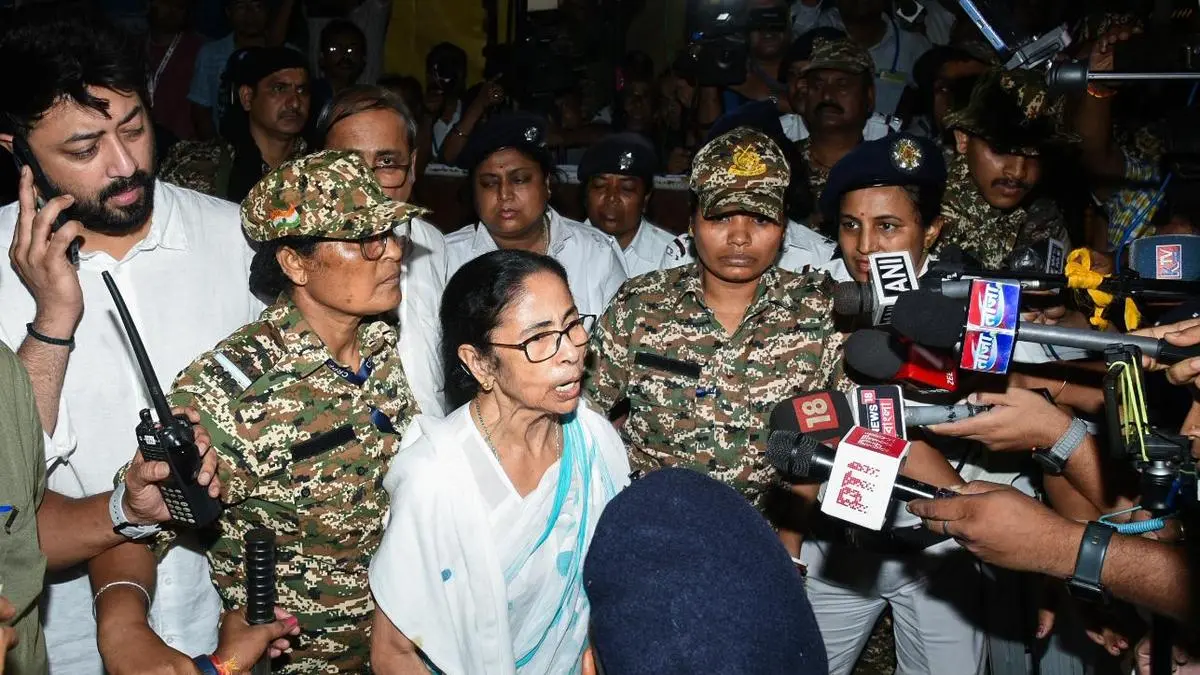
West Bengal Chief Minister and TMC Supremo Mamata Banerjee speaks to media after she concedes the elections to the BJP, in Kolkata, West Bengal, on Monday, May 4, 2026.
| Photo Credit:
ANI

Mamata Banerjee had exhorted her party leaders and workers last Saturday claiming that her Trinamool Congress party was coming to power for a fourth consecutive time by winning more than 200 seats, accusing the BJP of misleading people with “fictitious” exit poll results for financial gains.

Even on Monday afternoon when the trends in the West Bengal Assembly elections showed the saffron party surging ahead, she struck a defiant note. Releasing a video message on X titled “Urgent Message”, the Trinamool Congress supremo appealed directly to the party’s counting agents and candidates, asking them to remain vigilant and not lose hope despite early setbacks.

“Requesting everyone not to leave the counting centres… they will show where BJP will lead… stay at the counting centre,” she said, alleging that initial rounds may be skewed. Mamata Banerjee has always been a street fighter even when her party recorded a historic loss against her arch rival BJP.

“I want to tell our counting agents, don’t feel bad. Fight is not over yet. Wait and watch,” she added.

Crumbling fortress

As the day progressed, Bengal saw the outgoing Chief Minister’s fortress crumble. Moreover, the high-voltage contest at Bhabanipur Assembly seat turned on its head, with Banerjee slipping behind BJP’s Suvendu Adhikari after sharp swings, capping a steady erosion of her early lead in one of the state’s most closely watched battles.

Eventually, she lost the battle. After 17 rounds of counting, Banerjee was trailing by 6,226 votes, polling 54,728 votes against Adhikari’s 60,954, according to Election Commission data.

It’s the second time Adhikari, once her close aide, defeated the Trinamool Supremo. In the 2021 Assembly elections, Adhikari defeated Banerjee in Nandigram in Purba Medinipur district by a slender margin of 1,956 votes.

However, Banerjee had led the Trinamool Congress to a sweeping victory statewide and later re-entered the Assembly through a by-election in Bhabanipur, winning by a margin of 58,000 votes, reaffirming the seat as one of her strongest bastions. In the last Assembly elections, the BJP won 77 seats, while the Trinamool Congress won in 215 constituencies in the 294 West Bengal Assembly.

The saffron sweep

The BJP, however, drew confidence from the 2024 Lok Sabha elections, when the Trinamool Congress secured a relatively modest lead of 8,291 votes from the Bhabanipur Assembly segment amid allegations of corruption and signs of anti-incumbency.

Significantly, the saffron party this time breached South Bengal and Kolkata, considered TMC’s stronghold and heartland, ending the party’s 15-year rule.

Riding on the strong anti-incumbency wave and major corruption allegations against Trinamool, the opposition BJP has completely reversed its slide in Bengal in the 2024 Lok Sabha elections when it had led in 90 Assembly segments with a vote share of 38.7 per cent and won 12 seats. Till the time of going to press, the BJP had cornered a vote share of 45.76 per cent and was ahead or winning a whopping 207 seats in the total 293 seats for which elections were held. The incumbent TMC was at 80 seats with a vote share of 40.81 per cent, a steep fall from 45.8 per cent vote share it had garnered in 2024 Lok Sabha elections.

Mamata Banerjee’s Trinamool Congress had registered a historic victory in West Bengal in 2011, ending the 34-year rule of the Left Front.

Published on May 4, 2026


Source link

Is Vijay’s TVK a game-changer? What its policy say

Is Vijay’s TVK a game-changer? What its policy say


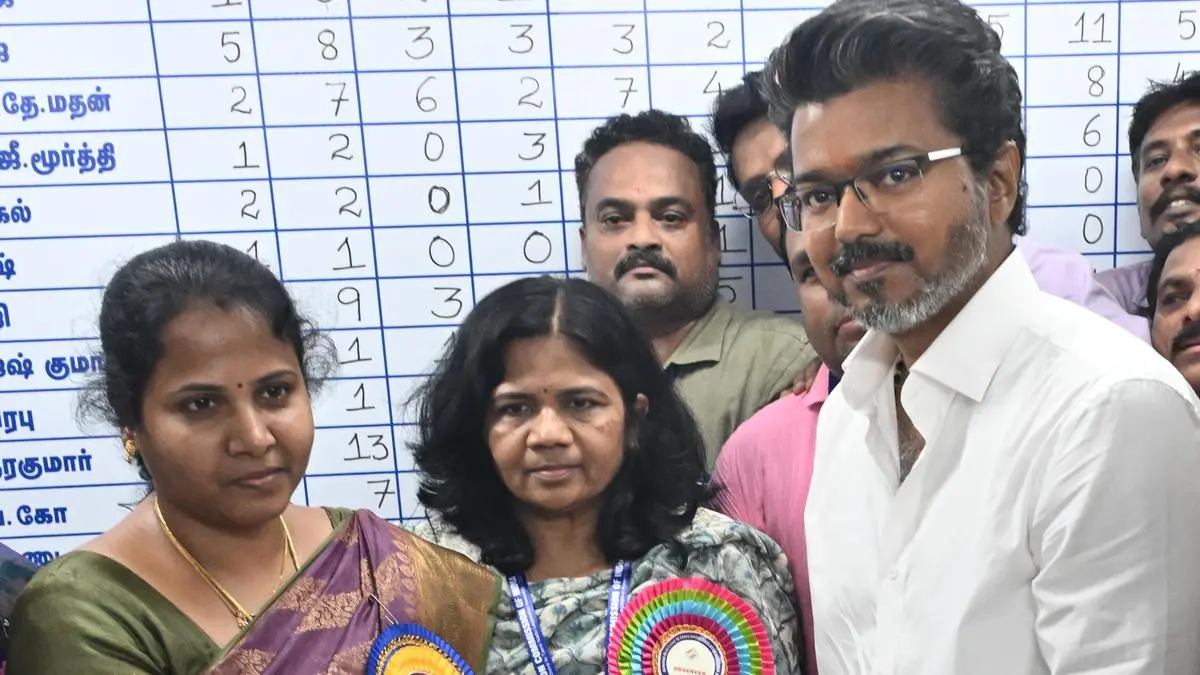
TVK President Vijay receives his certificate from the Returning Officer for Perambur Constituency, at Loyola College on Monday.
| Photo Credit:
RAGU R

As actor-politician C Joseph Vijay’s sweeping popularity takes TVK to the cusp of power in Tamil Nadu, questions remain on the party’s vision for the State. Based on the TVK’s manifesto, Vijay and his party seem inclined to continue the welfare model that brought much success to his predecessors. Like the DMK and AIADMK, the party had promised direct benefit schemes for women, including a ₹2,500 monthly transfer to the women heads of households, alongside six free LPG cylinders annually and marriage assistance that includes gold and sarees. 

Alongside women and youth, among the party’s strongest bases, the party has promised a host of schemes, including ₹4,000 per month for unemployed graduates and ₹2,500 to diploma holders, alongside interest-free loans of up to ₹25 lakh for both higher education and honest entrepreneurial activities.

The two-year-old party has also promised resolutions to critical issues in the State that had often posed challenges to its Dravidian predecessors.

For instance, on the Cauvery dispute, Vijay, who had been vocal about the issue even prior to his political fray, has accused the ruling DMK government in Tamil Nadu and the Central government of failing to protect the farmers interest in the Cauvery delta. He has said the TVK will address the challenges around Cauvery, focusing on “practically possible” solutions.

On the controversial three-language policy under NEP, Vijay holds the same stance as DMK, and has explicitly rejected the Central government’s proposals, arguing that it is an attempt to force Hindi. He has maintained that while he is not against any language by itself, he will not allow “thrusting” one language over other.

He also condemned the Central Government’s recent move to bring in a Delimitation Bill in Parliament, calling it an infringement on State rights.

He has expressed solidarity with Eelam Tamils, and has accused the DMK government of remaining silent on the problems faced by Eelam Tamils and fishermen. He has formally called for an independent referendum among Sri Lankan Tamils to determine their political future.

On governance, TVK’s pitch diverged from the traditional parties with some unusual policies like allowing people to decide 10 per cent of the State’s budget allocation and dedicating one day of the Assembly sessions for hearing public appeals.

Interestingly, it has also proposed the use of Artificial Intelligence for administrative work and even floated the idea of a dedicated AI ministry. 

Importantly, political observers credit TVK’s success to its emphasis on working-class inclusion, including offering a seat to an auto driver Vijay Dhamu, who also won. This is in sharp contrast to the lack of professionals and first-time candidates in DMK and AIADMK.

drug menace

TVK also ran a focused campaign against the drug menace and violence against women, both of which it attributed to the DMK rule. It has floated dedicated task forces and stricter enforcement mechanisms to tackle the situation.

As for the economy, the party has one upped the incumbent DMK’s $1-trillion economy vision by 2030, by pushing the goals to a $1.5-trillion economy by 2036, promising support for MSMEs and quick business licences for investors.

A defining feature of the incumbent DMK regime was its persistent friction with the BJP-led Central Government. While Vijay has repeatedly called the BJP his “ideological enemy,” it looks to be seen on how he handles relations with New Delhi. 

Published on May 4, 2026


Source link

Oil rises on signs of heightened tensions in Strait of Hormuz

Oil rises on signs of heightened tensions in Strait of Hormuz


Oil rose on signs of heightened tensions in the Strait of Hormuz as Iran attacked a tanker with drones and the US said it’s working to evacuate stranded ships through the vital waterway.  

Brent spiked more than 5 per cent to trade above $114 a barrel, before paring some of the gain as prices fluctuated sharply. Futures reached intra-day highs following Iranian media reports claiming two missiles hit an American patrol boat, which the US Central Command denied.

The escalation comes after President Donald Trump said the US would guide vessels out of Hormuz, framing the plan as a “humanitarian gesture.” Iran said US forces would be attacked if they entered the waterway and Iran’s semi-official news agency later said Tehran “redefined the control zone” in the strait, effectively setting out a wider area to regulate shipping in the region.

The US move was followed by increased tensions. A unit of the UAE’s Abu Dhabi National Oil Co. said its oil tanker Barakah, which wasn’t carrying any cargo, was targeted by two Iranian drones off the coast of Oman. On Sunday, there was a report of a bulk carrier being attacked by small boats, according to the UK Maritime Trade Operations.

Meanwhile, US Central Command said that two American-flagged merchant vessels successfully navigated the strait, adding that the military is actively working to restore commercial flow. There were five US-flagged commercial vessels in the Persian Gulf at the end of February, but none of them have turned on their Automatic Identification System signal for weeks.

The renewed risks come after weeks of stalemate and failed attempts to reach a peace deal in the conflict, with Tehran keeping a tight grip over Hormuz and the US enforcing a blockade of Iran’s ports to choke its oil exports.

The deadlock threatens to prolong the oil market’s worst-ever supply disruption, as traffic remains at a near standstill and attacks on commercial vessels continue.

“The market is clearly nervous that the events today further weaken the prospect of a reopening of the strait,” said Jens Naervig Pedersen, a strategist at Danske Bank AS.

Hormuz was the chokepoint for about a fifth of the world’s oil shipments before the war erupted with US-Israeli attacks on Iran at the end of February. Its closure has sent energy prices surging, triggered fuel shortages in several parts of the world and is stoking fears of higher inflation and slower global growth. Soaring fuel prices are also a political headwind for Trump. 

US Central Command said Sunday it would provide military support, including guided-missile destroyers, aircraft and drones to ships transiting the strait. 

But several shipowners and a ship manager contacted by Bloomberg said more concrete details would be needed, as well as assurances around key concerns including mines and safety from Iranian attacks. They asked not to be named given the sensitivity of the issue.

“Not many believe that the Strait will reopen anytime soon,” said Arne Lohmann Rasmussen, chief analyst at A/S Global Risk Management Ltd., adding that the US plan marks the first attempt to reopen the chokepoint by military means. “The market will closely monitor Iran’s response.”

In his comments on Hormuz, Trump also said that representatives were having discussions with Tehran that could lead to something “very positive,” but didn’t offer additional details.

Iran gave the plan a cool reception. Any US interference in the strait would constitute a violation of the ceasefire, Al Mayadeen reported, citing Ebrahim Azizi, head of the Iranian parliament’s National Security Commission. The country’s new control zone will stretch from south of Mount Mobarak in Iran to south of UAE’s Fujairah, and from west of Qeshm Island in Iran to Umm al-Quwain in the UAE, Iran’s semi-official news agency Tasnim reported.

Over the weekend, OPEC+ agreed to a symbolic rise in June quota levels, as the group sought to send a business-as-usual message after the exit of the United Arab Emirates. Abu Dhabi, meanwhile, touted its own growth plans.

Published on May 4, 2026


Source link

Aditya Birla Capital reports 31% increase in Q4FY26 consolidated net profit at ₹1,129 crore

Aditya Birla Capital reports 31% increase in Q4FY26 consolidated net profit at ₹1,129 crore


Aditya Birla Capital Ltd (ABCL) reported a 31 per cent year-on-year (yoy) increase in fourth quarter (Q4FY26) consolidated net profit at ₹1,129 crore against ₹865 crore in the year ago quarter.

The consolidated results include the results of 16 entities such as Aditya Birla Housing Finance, Aditya Birla Sun Life Insurance, Aditya Birla Sun Life AMC and Aditya Birla Health Insurance within the ABCL fold.

ABCL (in which the promoter and promoter group, including Grasim Industries, hold 68.51 per cent stake) is a listed systemically important non-deposit taking Non-Banking Financial Company – Investment Credit Compamy (NBFC-ICC).

ABCL clocked a 19 per cent yoy increase in Q4FY26 standalone net profit at ₹776 crore (₹654 crore in Q4FY25). This came on the back of a 23 per cent yoy rise in loans, including retail, SME and HNI, to ₹1,50,635 crore as at March-end 2026.

Overall assets under management (standalone), including business loans – secured and unsecured, personal & consumer loans and Corporate / Mid-market loans was up 27 per cent yoy to ₹1,59,916 crore.

ABCL’s shares closed at ₹348.10apiece, up 0.80 per cent over the previous close on BSE.

Published on May 4, 2026


Source link

RBI cautions members of the public against false and misleading campaigns promising loan waivers

RBI cautions members of the public against false and misleading campaigns promising loan waivers


The central bank has observed, with serious concern, the continued occurrence of such unauthorised and misleading campaigns, through various media channels and direct outreach, by certain individuals and entities.
| Photo Credit:
FRANCIS MASCARENHAS

The Reserve Bank of India (RBI) on Monday cautioned members of the public against false and misleading campaigns promising loan waivers.

Such campaigns not only mislead the general public but also interfere with the orderly functioning of the credit system of the country, according to a central bank statement. The RBI last issued a similar caution on December 11, 2023.

Serious concern

The central bank has observed, with serious concern, the continued occurrence of such unauthorised and misleading campaigns, through various media channels and direct outreach, by certain individuals and entities.

These campaigns, among others, involve false promises of waiver of outstanding dues to banks / Non-Banking Financial Companies (NBFCs); issuance of ‘debt waiver certificates’ or similar documents; and collection of fees under various pretexts, including service or legal charges, from uninformed public.

RBI reiterated that any claims by individuals / entities offering such services are false, misleading, and liable to attract appropriate legal action under applicable Statutes.

It also emphasised that such activities undermine the stability of financial institutions, affect the interest of depositors and association / engagement with such individuals / entities can result in direct financial loss.

The RBI asked members of the public to refrain from associating with or availing services from such individuals / entities and instead approach their lending institutions directly for any information related to their loans.

Further, it advised them to promptly report any such misleading campaigns to the appropriate law enforcement agencies.

Published on May 4, 2026


Source link

YouTube
Instagram
WhatsApp