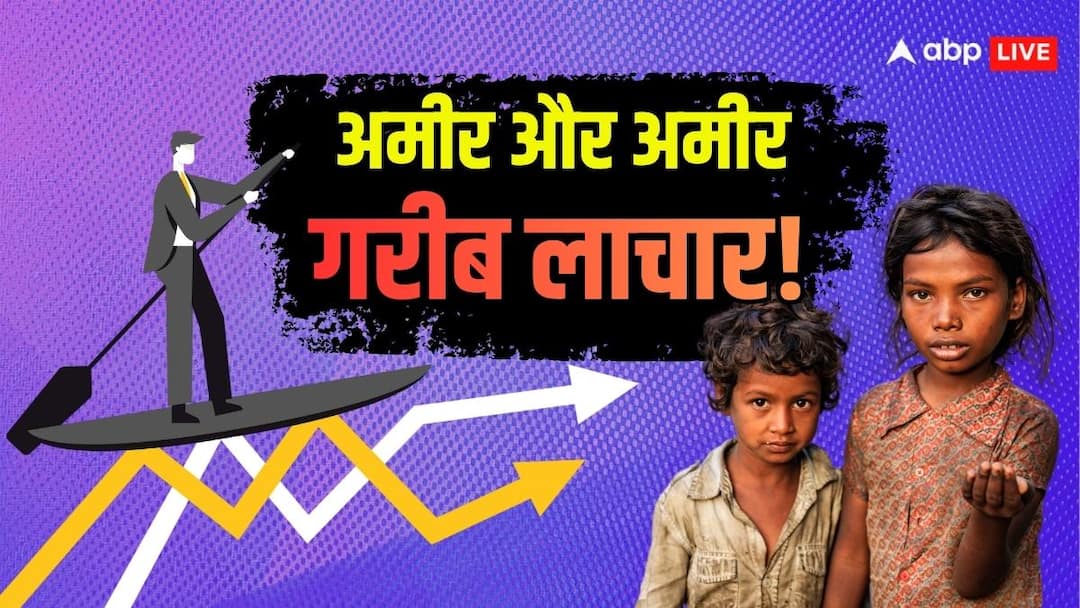

अमीर और अमीर, गरीब और गरीब! देश के 1688 रईसजादों के पास है 50% GDP के बराबर दौलत

अमीर और अमीर, गरीब और गरीब! देश के 1688 रईसजादों के पास है 50% GDP के बराबर दौलत


Show Quick Read

Key points generated by AI, verified by newsroom

India Wealth Inequality Report 2026: देश में संपत्ति के बंटवारे को लेकर एक नई रिपोर्ट ने गंभीर सवाल खड़े किए हैं. सेंटर फॉर फाइनेंशियल अकाउंटेबिलिटी के अनुसार, भारत में सिर्फ 1,688 अमीर लोगों के पास लगभग 166 लाख करोड़ रुपये की संपत्ति है, जो कुल जीडीपी का करीब 50 प्रतिशत हिस्सा बनती है. जानिए इस रिपोर्ट में क्या कहा गया है?

क्या कहती है रिपोर्ट?

देश में पैसों को लेकर इस असमानता पर बड़ी बात कही गई है. रिपोर्ट में इशारा किया गया है कि मौजूदा हालात किसी हद तक औपनिवेशिक समय वाली असमानता की याद दिला रहे हैं. रिपोर्ट में इस स्थिति को संतुलित करने के लिए सुझाव भी दिए गए है. 

देश में संपत्ति के बंटवारे को लेकर जारी ‘Wealth Tracker India 2026’ रिपोर्ट में बड़ा अंतर सामने आया है. जिसे सेंटर फॉर फाइनेंशियल अकाउंटेबिलिटी ने ‘Tax the Top’ अभियान के साथ 1 अप्रैल 2026 को जारी किया है.

रिपोर्ट बताती है कि 2019 से 2025 के बीच ऊपरी वर्ग की संपत्ति में तेजी से इजाफा हुआ. जबकि निचले तबके की हिस्सेदारी में कोई खास बदलाव देखने को नहीं मिला.

आंकड़ों से समझिए पूरा गणित

आंकड़ों की बात करें तो, देश के टॉप 1 प्रतिशत लोगों के पास 40 प्रतिशत से ज्यादा संपत्ति है. वहीं निचले 50 फीसदी लोग कुल आय के सिर्फ 15 प्रतिशत हिस्से पर निर्भर हैं.

इसी दौरान 1,000 करोड़ रुपये से ज्यादा संपत्ति रखने वालों की संख्या 77 प्रतिशत से बढ़ी है. जबकि उनकी कुल संपत्ति 31 लाख करोड़ रुपये से बढ़कर 88 लाख करोड़ रुपये तक पहुंच गई है. जो करीब 227 प्रतिशत की बढ़ोतरी को दिखाता है. 

अमीर हो रहे और अमीर

बीते कुछ सालों में देश के सबसे अमीर परिवारों की दौलत में तेज उछाल देखने को मिला है. मुकेश अंबानी, गौतम अडानी, सावित्री जिंदल, सुनील मित्तल और शिव नादर जैसे बड़े नामों की कुल संपत्ति 2019 से 2025 के बीच करीब 400 प्रतिशत तक बढ़ गई है.

आंकड़ों के अनुसार, इस दौरान मुकेश अंबानी की संपत्ति में लगभग 153 प्रतिशत का इजाफा हुआ. जबकि गौतम अडानी की दौलत 625 फीसदी तक बढ़ी. इन पांचों परिवारों की कुल संपत्ति 2019 में करीब 6.68 लाख करोड़ रुपये थी. जो 2025 तक बढ़कर लगभग 26.54 लाख करोड़ रुपये हो गई है. 

अमीरों पर टैक्स से बढ़ सकती है सरकार की कमाई

रिपोर्ट में जानकारी दी गई है कि बेहद अमीर लोगों पर progressive वेल्थ टैक्स लागू करने से सरकार की इनकम में बड़ा इजाफा हो सकता है. सेंटर फॉर फाइनेंशियल अकाउंटेबिलिटी के मुताबिक, 1,688 सबसे धनी परिवारों पर 2 से 6 प्रतिशत तक का टैक्स और साथ में एक-तिहाई इनहेरिटेंस टैक्स लगाया जाए, तो हर साल करीब 10.63 लाख करोड़ रुपये जुटाए जा सकते हैं.

इन पैसों का उपयोग सामाजिक योजनाओं पर किया जा सकता है. जिससे गरीब परिवारों तक पहले की तुलना में ज्यादा मदद पहुंचेगी. जिससे दोनों वर्गों के बीच असमानता को कम करने में मदद मिलेगी.  

यह भी पढ़ें:

Ujjwala Yojana Update: उज्ज्वला लाभार्थियों की मौज, अब गैस सिलेंडर पर मिलेगी ₹300 की सब्सिडी  


Source link

Markets in Red: Are crude, Iran fears pressuring Nifty?

Markets in Red: Are crude, Iran fears pressuring Nifty?


Markets remained under pressure in afternoon trade Monday, with both benchmark indices trading in negative territory as elevated crude oil prices and ongoing US-Iran tensions continued to weigh on investor sentiment.

At 12.45 pm, the Sensex was trading at 73,166.58, down 152.97 points or 0.21 per cent from its previous close of 73,319.55. The Nifty 50 was at 22,691.25, down 21.85 points or 0.10 per cent from its previous close of 22,713.10, after opening at 22,780.30. Both indices had opened marginally higher before slipping into the red.

On the BSE, 2,714 stocks advanced against 1,441 declines, with 202 unchanged. As many as 68 stocks hit 52-week highs while 79 touched 52-week lows. There were 274 stocks in the upper circuit and 164 in the lower circuit.

Reliance Industries was the biggest drag on the Nifty, falling 4.32 per cent to ₹1,292.10 against its previous close of ₹1,350.50 on heavy volumes of over 1.68 crore shares. ONGC dropped 1.98 per cent to ₹281.50, reflecting the market’s concern that rising crude prices do not automatically translate into gains for domestic energy producers amid regulatory uncertainty. IndiGo fell 1.94 per cent to ₹4,112, JSW Steel declined 1.91 per cent to ₹1,119.50, and Max Healthcare shed 1.27 per cent to ₹932.60.

On the gaining side, Trent surged 6.53 per cent to ₹3,782.40, touching an intraday high of ₹3,804, with over 33 lakh shares changing hands. Titan rose 3.12 per cent to ₹4,225, Coal India gained 2.36 per cent to ₹459.95, Axis Bank advanced 2.11 per cent to ₹1,223.20, and Bajaj Auto added 1.75 per cent to ₹8,911.50.

Crude oil remained the central market driver. MCX crude was holding above ₹10,350, while US oil hovered near $110–$112 per barrel, close to a critical resistance zone. “As long as crude prices stay elevated and geopolitical uncertainty persists, confidence is likely to remain constrained,” said Ponmudi R, CEO of Enrich Money. “In the near term, markets appear reactive rather than directional.”

On currencies, the rupee had cooled from highs near 94.80 to trade around 92.80–93, supported by RBI intervention. Gold on COMEX was trading in the $4,650–$4,700 range, while MCX Gold hovered around ₹1,48,000–₹1,49,000, with selling visible at higher levels.

“Each bounce is encountering resistance,” Ponmudi R noted, adding that the 22,800 zone was emerging as an immediate supply area on the Nifty, with 23,000 remaining a critical hurdle for any meaningful recovery.

With the RBI’s Monetary Policy Committee meeting this week — its first since the conflict broke out — and Trump’s Iran deadline set for Tuesday evening EST, traders were keeping positions light and hedged ahead of potentially market-moving developments in the hours ahead.

Published on April 6, 2026


Source link

SC refuses interim relief to Vedanta in Jaiprakash Associates resolution plan matter

SC refuses interim relief to Vedanta in Jaiprakash Associates resolution plan matter


The Supreme Court of India on Monday declined to stay proceedings in a plea filed by Vedanta Limited challenging the approval of Adani Group’s resolution plan for the takeover of insolvent Jaiprakash Associates Limited.

A Bench led by Chief Justice of India Surya Kant observed that since the appeal is likely to be decided shortly by the National Company Law Appellate Tribunal (NCLAT), and Vedanta’s interests have been adequately safeguarded through interim measures, there was no necessity to grant any interim relief.

“The appeal is likely to be addressed soon, and we see no legal necessity to issue any interim direction,” the Court noted, while requesting the NCLAT to hear the matter on an out-of-turn basis on the scheduled date or immediately thereafter if arguments remain incomplete.

The NCLAT is scheduled to hear Vedanta petition on Friday 10th April.Vedanta, in its petition, has challenged the decision of the Committee of Creditors (CoC) to accept Adani Group’s resolution plan. It contended that its revised addendum bid offers over Rs 3,400 crore higher gross value compared to Adani’s proposal.Senior Advocate Kapil Sibal appeared for Vedanta, while Senior Advocate Mukul Rohatgi represented Adani Group.

Tushar Mehta appeared on behalf of the lenders’ consortium (CoC) at the apex court.During the hearing, Vedanta submitted that it proposed to pay Rs 17,926 crore to creditors, as against Rs 14,535 crore under Adani’s plan. It argued that the CoC was effectively accepting a resolution plan that was around Rs 3,000 crore lower in value. However, the CoC countered that the practical difference between the two bids would amount to only about Rs 500 crore.

The Court recorded submissions that the matter is listed before the NCLAT this week, and implementation of the resolution plan would take approximately 50 days, with little likely to change in the interim period of a few days.

Observing that the NCLAT interim order had already addressed Vedanta’s concerns, the Supreme Court stated it would not halt the process at this stage. It added that any policy decision taken by the resolution professional or monitoring committee during this period must be in accordance with law and subject to NCLAT’s approval.

The apex court further noted that the resolution process remains subject to approval by the adjudicating authority, and emphasised that if any action outside the legal framework is undertaken, appropriate recourse would be available.Both sides agreed before the apex court for an expeditious hearing before the NCLAT.

Published on April 6, 2026


Source link

India banking sector outlook: Credit growth strong, margins to stay under pressure

India banking sector outlook: Credit growth strong, margins to stay under pressure


India’s banking sector is expected to maintain strong credit growth in the near term, supported by broad-based demand across segments.
| Photo Credit:
iStockphoto

India’s banking sector is expected to sustain credit growth momentum in the near term, though margin pressures are likely to persist, according to a research report by Systematic Institutional Equities. The report highlights that advances growth remains robust, supported by broad-based traction across segments. “The strong advances growth momentum that got built at the end of 3QFY26 has sustained in Q4FY26,” it noted, adding that system-level advances grew 13.8 per cent year-on-year as of mid-March 2026.

Moderation risks ahead

However, growth is likely to moderate going forward amid macro headwinds. The report cautioned, “Growth momentum in advances is expected to slightly moderate, arising from higher inflation and slowdown in economy.”

On profitability, the sector outlook remains constructive. The report said earnings are expected to improve year-on-year, driven by multiple levers, the profitability is expected to improve YoY led by sustained advances growth, higher fee income and lower credit costs.

Margins to stay range-bound

The report says that net interest margins (NIMs) are expected to remain largely stable with mild pressure. “We expect margins to remain range-bound in 4QFY26… Overall… NIMs [are] marginally lower to flat,” the report stated, citing the lagged impact of rate cuts and benefits from deposit repricing.

Further, it added: NIMs are expected to sequentially move in the range of -5bps to +2bps, indicating limited upside in spreads.

A key structural trend flagged is the divergence between credit and deposit growth. “Deposit growth continues to lag advances growth,” the report said, noting that this has pushed the credit-deposit ratio higher to around 83%.

Asset quality trends and risks

On asset quality, the report indicated improving trends in unsecured segments. “The stress in unsecured segment continues to moderate,” it said, with slippages expected to remain under control in the near term.

However, it also warned of emerging risks: “There is an upside risk to slippages in the coming quarters,” suggesting a potential increase in credit costs ahead.

Balanced outlook

Summing up, the report noted that the sector outlook remains steady with balanced risks. NIMs are expected to be stable to better, with some build-up of stress resulting in marginally higher credit cost. It maintains a positive stance on select banks, backed by sustained growth visibility and improving earnings trajectory.

Published on April 6, 2026


Source link

Hi-Tech Pipes posts record quarterly sales of 1.47 lakh mt, up 27% YoY

Hi-Tech Pipes posts record quarterly sales of 1.47 lakh mt, up 27% YoY


Hi-Tech Pipes Limited on Monday reported its highest-ever quarterly sales volume of 1,47,125 metric tonne (mt) in the fourth quarter of FY26, a jump of approximately 27 per cent from 1,16,032 mt recorded in the same quarter last year.

The New Delhi-based ERW steel pipes and tubes manufacturer also posted an 8 per cent sequential rise over Q3FY26, which had recorded volumes of 1,36,067 mt.

For the full financial year FY26, Hi-Tech Pipes clocked total sales volumes of 5,32,437 mt, up roughly 10 per cent from 4,85,447 mt in FY25 — also a record annual figure for the company.

Managing Director Ajay Kumar Bansal attributed the performance to improved operational efficiency and capacity utilisation. The company cited a strengthening market presence as a key factor behind the sustained volume growth.

Hi-Tech Pipes operates six integrated manufacturing facilities across Sikandrabad (Uttar Pradesh), Sanand (Gujarat), Hindupur (Andhra Pradesh), Khopoli (Maharashtra) and Jammu (J&K), with a combined installed capacity of 10,50,000 mtPA. Its product portfolio spans ERW pipes, hollow sections, cold rolled coils and strips, GP/GC sheets, colour coated coils, road crash barriers and solar mounting structures. The company has a direct marketing presence across more than 20 States through a network of over 550 dealers and distributors.

The company said it remains optimistic about demand trends and expects to sustain its growth trajectory going into FY27.

The shares of Hi-Tech Pipes Limited were trading at ₹78.30 up by ₹1.18 or 1.53 per cent on the NSE today at 10.15 am.

Published on April 6, 2026


Source link

Brent crude edges up as Trump issues ultimatum to Iran

Brent crude edges up as Trump issues ultimatum to Iran


Brent crude oil futures traded higher on Monday morning after US President Donald Trump threatened to intensify strikes on Iran if it fails to reopen the Strait of Hormuz.

At 9.59 am on Monday, June Brent oil futures were at $109.63, up by 0.55 per cent, and May crude oil futures on WTI (West Texas Intermediate) were at $111.17, down by 0.33 per cent. April crude oil futures were trading at ₹10378 on Multi Commodity Exchange (MCX) during the initial hour of trading on Monday against the previous close of ₹10408, down by 0.29 per cent, and May futures were trading at ₹9269 against the previous close of ₹9193, up by 0.83 per cent.

In a post on the social media platform Truth Social, Trump said: “Tuesday will be Power Plant Day, and Bridge Day, all wrapped up in one, in Iran. There will be nothing like it!!!” Urging Iran to open the Strait of Hormuz, he threatened to intensify strike on it if it fails to do so.

Meanwhile, Iran rejected his ultimatum to open the Strait of Hormuz. It said that a part of the revenue from the Strait should be allocated to Iran to compensate for war-related damages.

The Organization of the Petroleum Exporting Countries and allies (OPEC+), which met virtually on Sunday, expressed concern regarding attacks on energy infrastructure, noting that restoring damaged energy assets to full capacity is both costly and takes a long time, thereby affecting overall supply availability.

Accordingly, OPEC+ stressed that any actions undermining energy supply security, whether through attacks on infrastructure or disruption of international maritime routes, increase market volatility and weaken the collective efforts to support market stability for the benefit of producers, consumers, and the global economy.

In their collective commitment to support oil market stability, the eight participating countries decided to implement a production adjustment of 206,000 barrels per day from the 1.65 million barrels per day additional voluntary adjustments announced in April 2023. This adjustment will be implemented in May 2026.

April menthaoil futures were trading at ₹1053 on MCX during the initial hour of trading on Monday against the previous close of ₹1029, up by 2.29 per cent.

On the National Commodities and Derivatives Exchange (NCDEX), April kapas contracts were trading at ₹1733.5 in the initial hour of trading on Monday against the previous close of ₹1673.50, up by 3.59 per cent.

April dhaniya futures were trading at ₹13110 on NCDEX in the initial hour of trading on Monday against the previous close of ₹12870, up by 1.86 per cent.

Published on April 6, 2026


Source link

YouTube
Instagram
WhatsApp