Strait of Hormuz crisis: Trump sets 48-hour deadline for Iran

Strait of Hormuz crisis: Trump sets 48-hour deadline for Iran


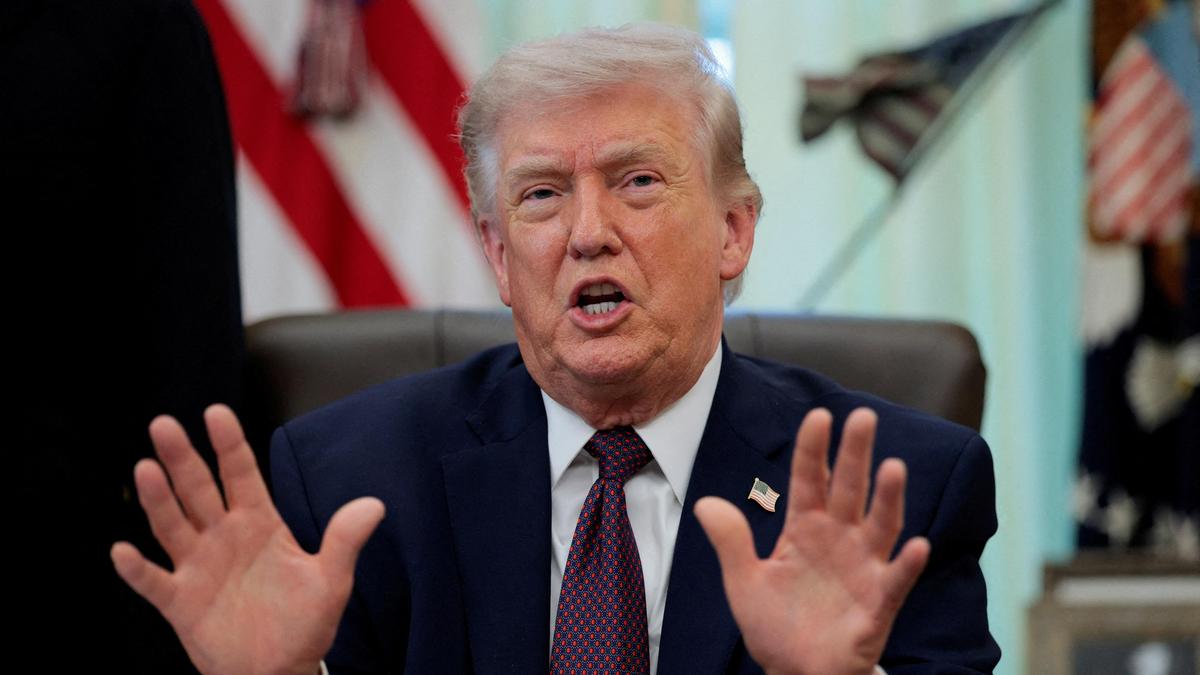
US President Donald Trump has issued a fresh 48-hour ultimatum to Iran, warning of severe consequences if it fails to strike a deal or reopen the strategically crucial Strait of Hormuz. (A file photo)
| Photo Credit:
Evan Vucci

US President Donald Trump on Saturday issued a stark ultimatum to Tehran, saying Iran has 48 hours to strike a deal or reopen the strategic Strait of Hormuz “before all hell will rain down on them”. Trump’s message, posted on his Truth Social platform, is a reminder of his 10-day ultimatum given to the Islamic Republic earlier to make progress toward a deal or reopen the vital shipping lane.

“Remember when I gave Iran ten days to MAKE A DEAL or OPEN UP THE HORMUZ STRAIT. Time is running out-48 hours before all Hell will rain down on them. Glory be to GOD! President DONALD J. TRUMP,” his post read.

Pause on strikes amid ongoing talks

Trump, on March 26, stated that he is extending the pause on strikes targeting Iran’s energy infrastructure for an additional 10 days, until Monday, April 6, 2026, as part of the ongoing diplomatic talks between the two sides.

In a post on Truth Social, the US President claimed that the announcement comes as per a “request” from the Iranian Government and further stated that the negotiations with Tehran were “going very well”.

“As per Iranian Government request, please let this statement serve to represent that I am pausing the period of Energy Plant destruction by 10 Days to Monday, April 6, 2026, at 8 P.M., Eastern Time. Talks are ongoing and, despite erroneous statements to the contrary by the Fake News Media, and others, they are going very well,” the post read.

Earlier warnings and escalating tensions

This was a continuation of Trump’s warning to Iran to open the Strait of Hormuz.

He earlier instructed the US Department of War to delay any military action against Iranian power plants and energy sites for five days, citing ongoing diplomatic engagements with Tehran amid escalating tensions in West Asia, prior to which he issued a warning to Tehran, giving it 48 hours to open the strategically significant Strait of Hormuz or face potential strikes on its energy facilities.

His latest 48-hour ultimatum is a reminder of his 10-day deadline given to Tehran last month.

Published on April 4, 2026


Source link

8वें वेतन आयोग पर अपडेट! कर्मचारियों के लिए आई राहत की खबर, जानिए पूरी डिटेल

8वें वेतन आयोग पर अपडेट! कर्मचारियों के लिए आई राहत की खबर, जानिए पूरी डिटेल


Show Quick Read

Key points generated by AI, verified by newsroom

8th Pay Commission Latest Update: केंद्रीय कर्मचारी और पेंशनर्स लंबे समय से आठवें वेतन आयोग का इंतजार कर रहे है. जिसको लेकर अब फिर से हलचल तेज हो गई है. आयोग ने अपनी प्रक्रिया को आगे बढ़ाते हुए विभिन्न संगठनों, यूनियनों और हितधारकों को चर्चा के लिए आमंत्रित किया है. 

आयोग के पास अपनी रिपोर्ट देने के लिए अब ज्यादा वक्त नहीं बचा है. 3 नवंबर 2025 को आयोग का गठन किया गया था. तय समय के अनुसार आयोग के पास करीब 13 महीने का वक्त शेष है.

हालिया नोटिस के मुताबिक वेतन, भत्तों और पेंशन सुधार से जुड़े सुझावों पर काम अब अहम मोड़ पर पहुंच चुका है. जिससे कर्मचारियों के बीच उम्मीद की लहर दौड़ गई है. आइए जानते हैं, नए अपडेट के विषय में…

सुझाव भेजने की समय सीमा

आठवां वेतन आयोग ने साफ किया है कि जो भी संगठन या यूनियन आयोग की विजिटिंग टीम से बातचीत करना चाहते हैं. उन्हें 10 अप्रैल 2026 तक ईमेल के जरिए अपॉइंटमेंट लेना होगा. इसके साथ ही, वेतन और पेंशन से जुड़े अपने सुझाव और फीडबैक भेजने के लिए 30 अप्रैल 2026 की डेडलाइन तय की गई है.

इसी फीडबैक के आधार पर आगे की सिफारिशें तैयार की जाएंगी. जो आने वाले समय में लाखों कर्मचारियों और पेंशनर्स का भविष्य तय करने वाली है.

राज्यों के दौरे से जुटाए जाएंगे सुझाव

आयोग अब सीधे जमीनी स्तर पर फीडबैक लेने की तैयारी में है. आयोग ने अपने दौरों की शुरुआत करने का फैसला लिया है. 30 मार्च की घोषणा के मुताबिक टीम की पहली विजिट उत्तराखंड से होगी. इस दौरान टीम वहां के संगठनों और संस्थानों से बातचीत कर उनकी राय लेगी. ताकि रिपोर्ट को और बेहतर बनाया जा सके.

बैठकों से जुड़ी जगह और समय की जानकारी संबंधित लोगों को ईमेल के जरिए दी जाएगी. साथ ही, ज्यादा से ज्यादा सुझाव मिल सकें, इसके लिए तारीखों में पहले ही बदलाव किया जा चुका है. जिससे आयोग को ज्यादा इनपुट मिल सके.

एरियर के साथ मिल सकता है फायदा

7वें वेतन आयोग का कार्यकाल 31 दिसंबर 2025 को खत्म हो चुका है. ऐसे में उम्मीद की जा रही है कि 8th Pay Commission की सिफारिशें 1 जनवरी 2026 से लागू मानी जा सकती हैं. अगर ऐसा होता है, तो कर्मचारियों और पेंशनर्स को एरियर के रूप में भी अच्छा खासा लाभ मिलने की उम्मीद है.
 
यह भी पढ़ें: जिंदगी भर की भागदौड़ के बाद अब चाहिए सुकून, छोटे शहरों में बस रहे लोग; ये शहर बने पहली पसंद


Source link

Crude Check: Strength Intact 

Crude Check: Strength Intact 


Crude oil prices firmed up last week. Brent crude oil futures on the Intercontinental Exchange (ICE) ($109/barrel) and crude oil futures in the domestic market (₹10,408/barrel) were up 3.5 per cent and 10.8 per cent respectively. Below is an analysis. 

Brent futures ($109)

Brent crude oil futures after opening with a gap-up last Monday, could not extend the rally and dropped. However, on Thursday, it rose 7.8 per cent, indicating the broader bullish bias is intact. 

The rebound happened on the back of the 21-day moving average at $100. The longer lower wicks on the recent weekly candles denote good buying interest, particularly between $96 and $104.

Going ahead, there is a good chance for Brent crude futures to rise, possibly to $120. A breakout of this can lift the contract to $130. Only a decisive breach of the support at $96 will turn the outlook bearish. Support below $96 is at $90.

MCX-Crude oil (₹10,408)

Crude oil futures on the MCX performed better than the Brent crude futures by posting a bigger gain of 10.8 per cent. It marked a new all-time high of ₹10,640 on Thursday before moderating to ₹10,408.

The chart shows a strong bullish momentum and so, we might see further upside in the coming days. The contract can rally to ₹11,200 soon if it can retain the existing momentum.

Nevertheless, there is a good chance for the contract to see a moderation to ₹9,800-10,000 price band. The corrective decline might extend to ₹9,300 before the crude oil futures makes fresh highs.

Trade strategy: Go long at ₹10,000 and ₹9,400. Stop-loss can be ₹8,700. Book profits at ₹11,200. The contract can experience high volatility and so, risk-averse traders can stay out.

Published on April 4, 2026


Source link

Bank credit, deposits grow across lenders; BoB crosses ₹30 lakh crore milestone

Bank credit, deposits grow across lenders; BoB crosses ₹30 lakh crore milestone


HDFC Bank, India’s largest private sector bank, reported a 14.4 per cent year-on-year (yoy) growth in deposits and a 12 per cent yoy growth in gross advances.

As at March-end 2026, the Bank’s deposits and gross advances stood at ₹31,05,500 crore and ₹29,60,000 crore, respectively, per provisional numbers shared by the Bank in its regulatory filing.

The Bank’s low-cost current account, savings account (CASA) deposits were a tad lower at 34.14 per cent of overall deposits as at March-end 2026 against 34.79 per cent as at March-end 2025.

Bank of Baroda

Bank of Baroda’s (BoB) global business (deposits plus advances) crossed the Rs 30 lakh crore milestone for the first time. Global business was up 13.93 per cent yoy in Q4FY26 and stood at ₹30,78,854 crore as at March-end 2026.

The public sector bank clocked a 12 per cent yoy growth in global deposits and a 16.23 per cent yoy growth in global advances in Q4FY26 ended March 31, 2026.

As at March-end 2026, BoB’s global deposits and global advances stood at ₹16,48,650 crore and ₹14,30,204 crore, respectively, per provisional numbers shared by the Bank in its regulatory filing.

Within global deposits and global advances, domestic deposits and domestic advances were up 12.83 per cent (to ₹14,01,497 crore as at March-end 2026) and 14.56 per cent (to ₹11,69,804 crore), respectively.

Domestic retail advances increased by 17.93 per cent yoy to stand at ₹3,02,657 crore as at March-end 2026.

PNB

Punjab National Bank’s (PNB) global business (deposits plus advances) rose 10.79 per cent yoy in the fourth quarter (Q4FY26) and stood at ₹29,72,896 crore as at March-end 2026.

The public sector bank clocked a 9.25 per cent yoy growth in global deposits and a 12.97 per cent yoy growth in global advances in Q4FY26 ended March 31, 2026.

As at March-end 2026, PNB’s global deposits and global advances stood at ₹17,11,476 crore and ₹12,61,420 crore, respectively, per provisional numbers shared by the Bank in its regulatory filing.

Within global deposits and global advances, domestic deposits and domestic advances were up 9.14 per cent (to ₹16,49,409 crore as at March-end 2026) and 12.17 per cent (to ₹11,95,811 crore), respectively.

UBoI

Union Bank of India’s global business (deposits plus advances) increased 5.79 per cent yoy in Q4FY26 and stood at ₹23,85,679 crore as at March-end 2026.

The public sector bank’s global deposits edged up 2.72 per cent, and global advances rose 9.76 per cent yoy in Q4FY26 ended March 31, 2026.

As at March-end 2026, UBoI’s global deposits and global advances stood at ₹13,06,900 crore and ₹R10,78,779 crore, respectively, per provisional numbers shared by the Bank in its regulatory filing.

Within global deposits and global advances, domestic deposits and domestic advances were up 2.72 per cent (to ₹13,06,297 crore as at March-end 2026) and 10.06 per cent (to ₹10,41,122 crore), respectively.

RAM (retail, agriculture and MSME) advances increased by 12.59 per cent yoy to stand at ₹5,98,620 crore as at March-end 2026.

Bandhan Bank

Bandhan Bank reported a 10 per cent yoy growth in total deposits and a 12.6 per cent yoy growth in loans & advances (on book + Pass-Through Certificates).

As of March-end 2026, the Bank’s total deposits and loans & advances stood at ₹1,66,344 crore and ₹1,54,235 crore, respectively, per provisional numbers shared by the Bank in its regulatory filing.

AU Small Finance Bank

AU SFB reported a robust 22.8 per cent yoy growth in total deposits and a 21.3 per cent yoy growth in gross loan portfolio (including securitised/ assigned portfolio).

As of March-end 2026, the Bank’s total deposits and gross loan portfolio stood at ₹1,24,269 crore and ₹1,15,704 crore, respectively, per provisional numbers shared by the Bank in its regulatory filing.

Published on April 4, 2026


Source link

India resumes energy trade with Iran after seven years

India resumes energy trade with Iran after seven years


India stopped buying crude oil from Iran after sanctions were re-imposed on the country by the US in November 2018 giving India six-months to wind down imports (May 2019).
| Photo Credit:
Dado Ruvic

The Ministry of Petroleum & Natural Gas (MoPNG) said on Saturday that Indian refiners have sourced crude oil from Iran, marking the first such purchase from the Persian Gulf nation after May 2019.

The development comes after the US un-sanctioned Iranian crude oil as the intensifying West Asian conflict prolonging the closure of the Strait of Hormuz (SoH) has choked out 20 per cent of the global consumption.

Besides, a very large gas carrier (VLGC) also delivered 44,000 tonnes of Iranian liquefied petroleum gas (LPG) to India on Thursday.

Refuting news reports and social media posts on an Iranian crude cargo diverted from Vadinar to China due to payment issues, the Ministry reiterated that India’s crude oil requirements remain fully secured for the coming months.

India imports crude oil from more than 40 countries, with companies having full flexibility to source oil from different sources and geographies based on commercial considerations, Oil Ministry emphasised.

“Amid Middle East supply disruptions, Indian refiners have secured their crude oil requirements, including from Iran; and there is no payment hurdle for Iranian crude imports, contrary to the rumours being circulated,” it added.

Claims on vessel diversion ignore how oil trade works. Bills of Lading often carry indicative discharge port destinations and on-sea cargoes can change destinations mid-voyage based on trade optimisation and operational flexibility, it explained.

“On LPG too, some claims being made are incorrect as LPG vessel Sea Bird carrying around 44,000 tonnes Iranian LPG berthed at Mangalore, India on April 2 and is currently discharging,” the Ministry added.

India utilises the Rupee payment mechanism between UCO Bank and Iran’s non-sanctioned banks having Vostro accounts with the former for payments. This was done after US and EU sanctions restricted dollar-based transactions.

India stopped buying crude oil from Iran after sanctions were re-imposed on the country by the US in November 2018 giving India six-months to wind down imports (May 2019). Iran was India’s third largest crude oil supplier in 2017, accounting for roughly 12-13 per cent of the total imports. At one point, Tehran was supplying more than 425,000 barrels per day (b/d) to New Delhi.

Iran sanctions

Sanctions imposed by the US and the European Union (EU) at the end of 2011 and during the summer of 2012, respectively, led to the displacement of more than 1 million barrels per day (mb/d) of Iranian crude oil on the global market, as per the US EIA.

In 2011, prior to sanctions, Iran exported 2.6 mb/d, most of which went to Asia, particularly China (550,000 b/d), India (320,000 b/d), Japan (315,000 b/d) and South Korea (250,000 b/d).

Although Iran supplied crude oil and condensates to a variety of countries in Europe and Asia in 2017, it sent all of its crude oil and condensate exports to China, Syria, the UAE and Venezuela in 2023. While most of these export volumes have export destinations listed as China, in many cases the destinations are listed as unknown, but US EIA assesses them to be destined for China.

For 2018 and 2019, these (barrels) specifically are listed as unknown, while in 2020 through 2023 these destinations also include Malaysia, Singapore, Vietnam, and destinations listed “unknown,” which US EIA has confirmed are all ultimately destined for China.

Published on April 4, 2026


Source link

Loan growth outpaces deposit for IDBI Bank, Kotak, AU SFB in Q4

Loan growth outpaces deposit for IDBI Bank, Kotak, AU SFB in Q4


The total business of IDBI Bank increased 14% to ₹6 lakh crore compared to ₹5.28 lakh crore at the end of March 31, 2025.
| Photo Credit:
ADNAN ABIDI

LIC-controlled IDBI Bank on Saturday reported a 16 per cent increase in loan growth to ₹2.53 lakh crore for the fourth quarter ended March 2026.

Its total advances were ₹2.18 lakh crore at the end of March 31, 2025, IDBI Bank said in a regulatory filing.

The lender reported a 12 per cent rise in total deposits to ₹3.46 lakh crore from ₹3.1 lakh crore at the end of the fourth quarter of the preceding financial year.

The total business of the bank increased 14 per cent to ₹6 lakh crore compared to ₹5.28 lakh crore at the end of March 31, 2025.

Meanwhile, Kotak Mahindra Bank also reported higher credit growth versus deposit expansion. The bank registered a 16.2 per cent rise in advances to ₹4.95 lakh crore from ₹4.26 lakh crore in the fourth quarter of the preceding fiscal.

It reported a 14.7 per cent increase in total deposits to ₹5.72 lakh crore from ₹4.99 lakh crore at the end of the fourth quarter of FY25, Kotak Mahindra Bank said in a regulatory filing.

AU Small Finance Bank also reported a higher credit growth vis-a-vis deposit expansion. The bank posted a 25.1 per cent rise in advances to ₹1.36 lakh crore against ₹1.08 lakh crore in the fourth quarter of FY25.

The lender reported a 22.8 per cent increase in total deposits to ₹1.52 lakh crore compared to ₹1.24 lakh crore at the end of the fourth quarter of FY25, AU Small Finance Bank (SFB) said in a regulatory filing.

However, the bank’s low-cost CASA (current account savings account) ratio declined to 28.4 per cent of the total deposits from 29.2 per cent at the end of March 2025.

Published on April 4, 2026


Source link

YouTube
Instagram
WhatsApp