Nifty extends losing streak to third day ahead of Fed policy decision

Nifty extends losing streak to third day ahead of Fed policy decision


Selling pressure emerged at higher levels, pulling the index down to close near the previous day’s low zone of 25,720-25,740

Markets closed lower for the third consecutive session on Wednesday, with benchmark indices slipping 0.32 per cent as investors adopted a cautious stance ahead of the US Federal Reserve’s policy outcome and amid persistent foreign institutional investor outflows and rupee weakness.

The Nifty 50 closed at 25,758.00, down 81.65 points or 0.32 per cent, after touching an intra-day high of 25,947.65 and a low of 25,734.55. Sensex ended at 84,391.27, declining 275.01 points or 0.32 per cent, having opened at 84,607.49 and oscillating between 85,020.34 and 84,313.62 during the session. Bank Nifty fell 261.95 points or 0.44 per cent to close at 58,960.40.

“The index opened steady and moved higher initially, hitting an intra-day high of 25,948. However, selling pressure emerged at higher levels, pulling the index down to close near the previous day’s low zone of 25,720-25,740,” said Sudeep Shah, Head – Technical and Derivatives Research at SBI Securities.

Gainers, losers

Broader markets witnessed sharper declines, with the Nifty Midcap 100 falling 668.45 points or 1.12 per cent to 59,007.75, while the Nifty Smallcap 100 dropped 155.65 points or 0.90 per cent to 17,090.15. Market breadth remained weak, with 2,332 stocks declining against 1,857 advances on the BSE, where a total of 4,337 stocks were traded. Notably, 136 stocks hit 52-week lows compared to just 74 touching 52-week highs.

Sectoral performance was mixed, with Nifty Media emerging as the top gainer, followed by Nifty Metal. However, Nifty IT and Nifty PSU Banks led the declines among sectoral indices. Nifty Financial Services fell 145.45 points or 0.53 per cent to 27,404.30.

Among Nifty 50 constituents, Eicher Motors emerged as the top gainer, surging 1.54 per cent to ₹7,233; followed by Hindalco, which rose 1.07 per cent to ₹821.60; HDFC Life gaining 1.06 per cent to ₹771; Tata Steel advancing 0.83 per cent to ₹162; and Sun Pharma climbing 0.70 per cent to ₹1,788.50. On the losing side, IndiGo plunged 3.17 per cent to ₹4,810; Eternal dropped 3.09 per cent to ₹282.70; Trent fell 1.77 per cent to ₹4,013; Adani Enterprises declined 1.39 per cent to ₹2,213.90; and JSW Steel slipped 1.31 per cent to ₹1,093.30.

“Global equity markets experienced continued volatility due to rising Japanese bond yields and indications of BoJ monetary tightening, which are fostering risk-off sentiments in emerging markets,” said Vinod Nair, Head of Research, Geojit Investments. “Focus now shifts to the upcoming US Fed meeting, where a 25-bps rate cut is widely expected.”

Technical indicators

Technical indicators continued to show weakness. “The RSI has slipped sharply from 60 to 44 over the last three sessions, indicating weakening momentum and a shift in favour of sellers,” Shah noted. “Additionally, the MACD red histogram bars have been rising, signalling strengthening bearish momentum and an expansion in downside pressure.”

Looking ahead, market participants await cues from US Federal Reserve Chair Jerome Powell’s commentary on the likely path of interest rates in 2026. “The key focus will be on the 2026 dot-plot guidance,” said Ajit Mishra, SVP – Research, Religare Broking. “Additionally, updates from the India-US trade discussions in New Delhi will remain in the spotlight.”

Published on December 10, 2025


Source link

MoCA officials visiting major airports for ground reality check

MoCA officials visiting major airports for ground reality check


Ambuj Sharma, Deputy Secretary, Ministry of Civil Aviation, addresses the press regarding IndiGo’s mass flight cancellations, in Chennai on Wednesday.
| Photo Credit:
Akhila Easwaran

The Ministry of Civil Aviation (MoCA) has deputed its top officials to various airports for a ground reality check to monitor operations and assure passengers that things are slowly returning to normal. This is after large-scale disruptions in air travel across the country in the last nine days due to IndiGo’s flight cancellations.

For instance, Ambuj Sharma, Deputy Secretary, MoCA, was at the Chennai Airport on Wednesday to meet with various stakeholders, including airlines. He inspected the airport during the day and spoke to passengers at the terminals to get their feedback on the operations.

Similarly, many senior officials from MoCA have been sent to other airports like Mumbai, Ahmedabad, Hyderabad, Bengaluru, Kolkata and Pune, he told newspersons after inspecting the terminals. Many passengers at the Chennai airport gave positive feedback on the operations while some had issues with the toilets and car parking. These are being looked at and action will be taken at the earliest, said Sharma, who also happens to be Public Grievances Officer in the Ministry.

“It was a crisis well handled from our side. Things are slowly returning to normal,” he said on the IndiGo flight cancellations.

Dip in revenue

Raja Kishore, Chennai Airport Director, said that there was a dip in revenue for the airport due to the cancellations but did not give a number. “We are still working on this,” he added.

In the last nine days, a total of 629 IndiGo flights were cancelled and 1,317 flights were delayed, he said.

On December 1, at the airport, there were a total of 209 arrivals and 208 departures. This number started to decline from the next day to a low of 132 arrivals and 123 departures on December 5. However, from the next day, it started to increase to 176 arrivals and 174 departures on December 9, he said.

On Wednesday, 37 arrivals and 33 departures of IndiGo flights were cancelled, the Chennai airport said.

Published on December 10, 2025



Source link

IFFCO scouting for JV partners to set up fertiliser plants abroad, secure supply for India

IFFCO scouting for JV partners to set up fertiliser plants abroad, secure supply for India


KJ Patel, Managing Director, IFFCO

Days after India and Russia announced an MoU to set up a 2 million tonnes capacity urea plant, Iffco — India’s largest fertiliser maker — unveiled plans to set up joint ventures in fertiliser supplying nations such as Sri Lanka and Senegal. The intent is to secure long-term sourcing of crop nutrients as access to raw materials like rock phosphate and gas at reasonable prices is becoming increasingly difficult.

Speaking with the media on December 9 in his first interaction after taking over as Iffco’s Managing Director in August, KJ Patel said: “Getting good quality raw material is increasingly becoming a challenge. For which one either has to pay more or incur higher financial burden. A better option is to set up manufacturing units in those parts of the world where these resources are available in abundance.”

Rock phosphate and phosphoric acid — critical inputs for producing DAP — are almost entirely imported as India’s rock phosphate quality is inadequate. Patel cited the example of Morocco’s OCP group, which has now stopped selling rock phosphate except to select partner companies abroad.

Morocco, which has 70 per cent of the world’s rock phosphate reserves, does not allow foreign investment in the fertilizer sector, industry officials said.

Tapping rock phosphate

In Sri Lanka, Iffco plans a joint venture for making phosphoric acid as the country has good quality rock phosphate, and ship it to India for manufacturing DAP, which contains 18 per cent nitrogen (N) and 46 per cent phosphorus (P). In Jordan, Iffco already has a joint venture – Jordan India Fertiliser Company — where it plans to double the phosphoric acid capacity from 0.5 million tonnes (mt) to 1 mt.

In Senegal, the co-operative has small stake at a urea plant, owned by Industries Chimiques du Senegal (ICS) of India’s Indo Rama group. As Iffco is looking to explore sourcing phosphate in Senegal, too, industry experts said it may need to either acquire a majority stake in ICS or find a new partner to set up another unit.

DAP is India’s second most-consumed fertiliser after urea, with annual demand of 10–-11 mt. Of this, about 5 mt are imported, while the rest is produced domestically using imported rock phosphate or phosphoric acid — both of which have seen sharp price rises over the past year.

Cost of imported phosphoric acid (CFR) has gone up to $1,153/tonne (up 22 per cent) in September 2025, while that of rock phosphate to $193/tonne from $167.

Russia’s Uralchem JSC last week signed an MoU with three Indian companies — Indian Potash (IPL), Rashtriya Chemicals and Fertilisers (RCF) and National Fertilisers (NFL) to set up a 2 mt per annum capacity urea plant in Russia with an estimated investment of about $1.2 billion (₹10,790 crore) and target to start operation in 2027-28.

The agreement was exchanged in New Delhi between Indian Ambassador in Moscow Vinay Kumar and Russian Ambassador in India Denis Alipov in the presence of prime minister Narendra Modi and President Vladimir Putin.

Published on December 10, 2025



Source link

भारत की अर्थव्यवस्था सुपरफास्ट! ADB ने बढ़ाया वृद्धि दर का अनुमान, जानें डिटेल

भारत की अर्थव्यवस्था सुपरफास्ट! ADB ने बढ़ाया वृद्धि दर का अनुमान, जानें डिटेल


Show Quick Read

Key points generated by AI, verified by newsroom

ADB Growth Forecast: एशियाई विकास बैंक (एडीबी) ने बुधवार को वित्त वर्ष 2025-26 के लिए भारत की वृद्धि दर का अनुमान 6.5 प्रतिशत से बढ़ाकर 7.2 प्रतिशत कर दिया. इसकी प्रमुख वजह हाल में जीएसटी दरों में कटौती से घरेलू खपत को मिली मजबूती है.

भारतीय अर्थव्यवस्था की यह तेज रफ्तार एशिया को भी तेजी से बढ़ने में मदद करेगी, जो इस साल 4.8 प्रतिशत के पिछले अनुमान के मुकाबले अब 5.1 प्रतिशत की दर से बढ़ सकती है.

एडीबी की रिपोर्ट

एडीबी की दिसंबर के लिए जारी एशिया विकास परिदृश्य रिपोर्ट कहती है, ”वर्ष 2025 के लिए भारत के वृद्धि अनुमान को 7.2 प्रतिशत कर दिया गया है, जो दूसरी तिमाही में अपेक्षा से अधिक मजबूत विस्तार को दर्शाता है. कर में कटौतियों ने खपत को मजबूती दी.” सितंबर में समाप्त दूसरी तिमाही के दौरान भारत की अर्थव्यवस्था 8.2 प्रतिशत की दर से बढ़ी, जो पिछली छह तिमाहियों में सबसे अधिक है. 

पहली तिमाही में यह 7.8 प्रतिशत थी. इस तरह चालू वित्त वर्ष की पहली छमाही में भारत आठ प्रतिशत की वृद्धि दर हासिल कर चुका है. एडीबी की रिपोर्ट के मुताबिक, यह मजबूत वृद्धि आपूर्ति पक्ष में विनिर्माण और सेवा क्षेत्रों के मजबूत विस्तार और मांग पक्ष में खपत एवं निवेश की वृद्धि के कारण हुई है. हालांकि मनीला स्थित इस बहुपक्षीय विकास बैंक ने वित्त वर्ष 2026-27 के लिए अपने अनुमान को 6.5 प्रतिशत पर बरकरार रखा है.

मुद्रास्फीति  पर ADB का अनुमान

रिपोर्ट के अनुसार फसलों के बेहतर उत्पादन, अच्छी मानसून और जीएसटी रिफॉर्म ने खाद्य कीमतों को नीचे रखने का काम किया है. ADB ने FY26 के लिए मुद्रास्फीति का अनुमान घटाकर 2.6 फीसदी कर दिया है, जो पहले 3.1 प्रतिशत था. रिपोर्ट में बताया गया कि, सब्जियों और दालों की कीमत कम होने से पिछले कुछ महीनों में मुद्रास्फीति में तेजी से गिरावट दर्ज की गई है.  

यह भी पढ़ें: लगातार तीसरे दिन भी गिरा शेयर बाजार! निवेशकों के डूबे 1.09 लाख करोड़, जानें गिरावट की वजह


Source link

‘An ounce of silver can now get you more energy than anytime since World War II’

‘An ounce of silver can now get you more energy than anytime since World War II’


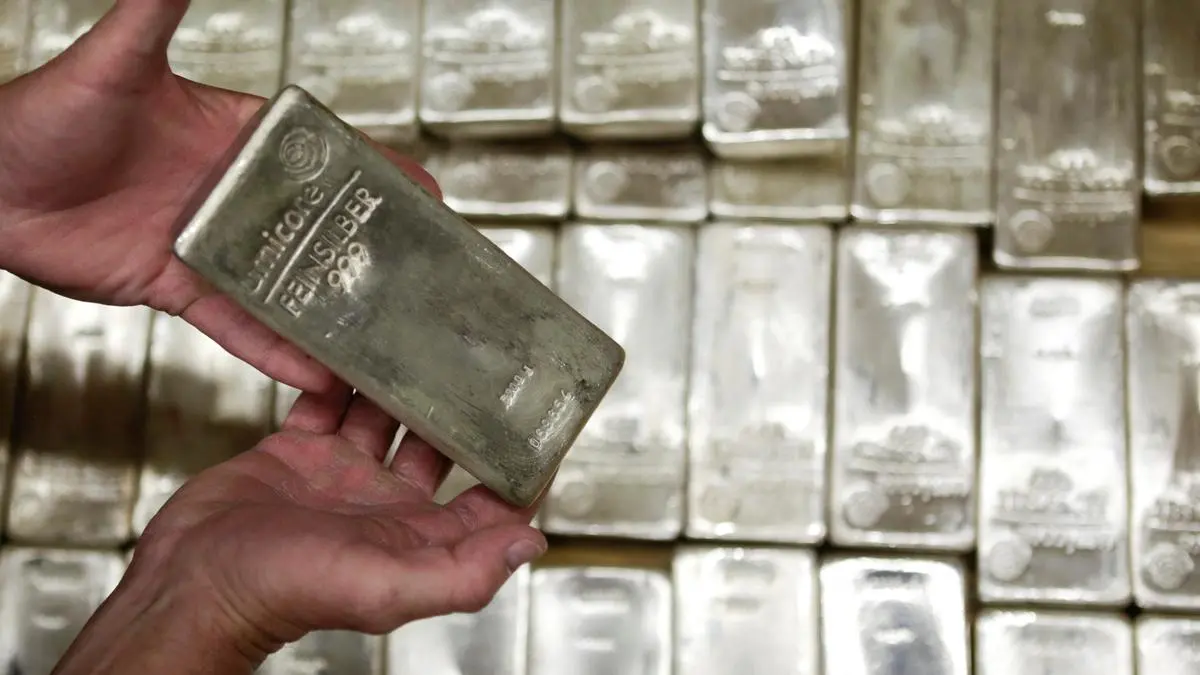
After touching $62 per ounce on Wednesday, silver could garner strength to soar even further in the global market. This is because the physical shortage of the precious metal is more serious than what it is perceived to be.

Experts and analysts pointed out the real issue of supply shortage could be gauged from how the silver-crude oil ratio zoomed to its second-highest level ever. 

The Silver Academy, which raises awareness about the white precious metal, said when the silver‑to‑oil ratio spikes to levels seen only around historic system breaks, the signal is simple: the world has too little real silver relative to the energy and industrial machine it has to power.​

“One ounce of silver now buys more energy than almost anytime since World War II,” said Czech silver tracker Hoza Cerny on X (formerly Twitter).

$100/oz by March?

On Wednesday, spot silver was quoted at $61.05 an ounce at 1745 hours IST. Silver futures, for delivery in March, ruled at $61.90 an ounce on CME. Crude oil (West Texas Intermediate) was $58.32 per barrel.

Silver has increased over 110 per cent since the beginning of this year. New York-based The Silver Institute attributed the precious metal’s dazzle to tightening supply, shrinking global inventories and robust long-term industrial demand from the solar, electric vehicles and artificial intelligence-related sectors. 

The Silver Academy said the precious metal “is the irreplaceable industrial backbone of solar, EVs, semiconductors, and defence.”

Just Dario, co-founder and COO of Synnax, said silver could top $100/ounce by March 2026. 

Capex at its worst

Cerny said silver was not rising due to any hype. “Mining is declining. Industrial demand is surging. And delivery requests are draining the vaults,” he wrote on X.

The Academy said silver mining capital expenditure is at its worst levels in over a decade. “Roughly three‑quarters of silver output is by‑product, inventories are thinning, and Eastern buyers are vacuuming up physical ounces outside Western vaults,” it said.

“$60 is not a bubble. It is a warming shot,” warned an analyst. 

Bulls bets rising

According to Dario and other experts, bets on silver prices rising are higher, while those on falling are lower in the options market. “These are clear indications of the trade expecting prices to rise further,” said an analyst. 

Renisha Chainani, head of research at Augmont, said investors would be wise to book profit and stay on the sidelines ahead of the US Fed meeting. Another expert said the options market moves first and it was showing that someone has been trapped and is scrambling for protection at higher prices. 

“This is what the early stages of a squeeze ignition look like,” said the expert.

A trader said those who had bet on silver prices declining panicked and covered “like mad” to escape losing heavily when the March futures are due to delivery. 

Analysts believe that there could be supply shortage in silver as it has been in structural deficit since 2021. Cumulative shortfall is now estimated at 820 million ounces by the end of this year.  

Published on December 10, 2025


Source link

IndiGo Flight Crisis: 5000 Flights Cancel! क्या आपका Refund भी फंसा है? |Paisa Live

IndiGo Flight Crisis: 5000 Flights Cancel! क्या आपका Refund भी फंसा है? |Paisa Live


IndiGo Airlines पिछले 7 दिनों से एक बड़े Operational Crisis का सामना कर रही है। अब तक लगभग 5,000 Flights Cancel की जा चुकी थीं। Government और Court के हस्तक्षेप के बाद Operations सामान्य होने लगे हैं और Company अब 1800 Flights रोज़ Operate कर रही है। Cancellation की वजह से IndiGo ने यात्रियों को ₹827 करोड़ का Refund भी जारी किया है। लेकिन कई यात्रियों का Refund अटका, कम आया या Reject कर दिया गया — ऐसे में Travel Insurance और Credit Card Insurance बहुत उपयोगी साबित हो सकते हैं। Travel Insurance Non-Refundable Tickets, Hotel Bookings, Pre-Booked Activities का नुकसान कवर करता है। Flights देरी पर बिना Bill दिखाए ₹1,000 से ₹5,000 तक Allowance मिलता है। हालाँकि, कुछ exclusions होते हैं—जैसे airline की गलती, crew shortage या documentation issues, जिन पर Claim Rejected हो सकता है। कई premium और Mid-tier credit cards में पहले से ही Travel Insurance शामिल होता है, लेकिन लोग इसका फायदा नहीं उठाते। India में सिर्फ 3-4% लोग Travel Insurance खरीदते हैं, जबकि US में 50% और Germany में 60%। Aviation और Geopolitics की अनिश्चित स्थिति में Travel Insurance लेना अब पहले से ज्यादा जरूरी हो गया है।


Source link

YouTube
Instagram
WhatsApp