BoB, Bank of India cut repo-linked interest rate after RBI’s policy rate cut, others to follow suit

BoB, Bank of India cut repo-linked interest rate after RBI’s policy rate cut, others to follow suit


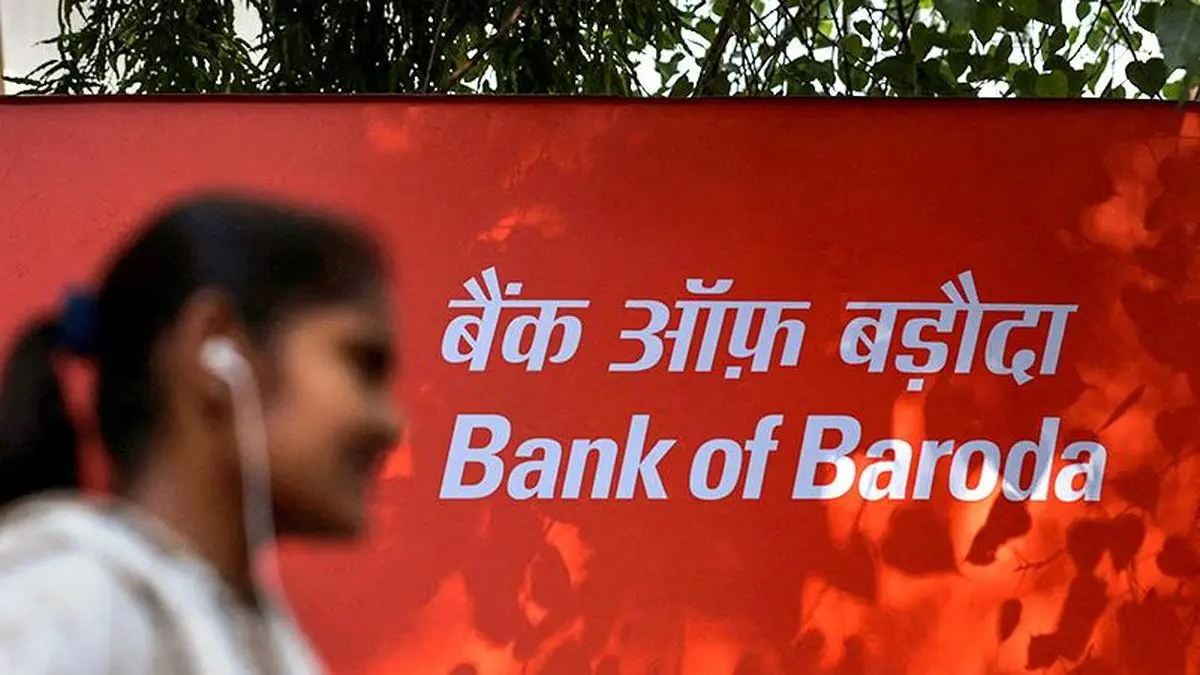
Bank of Baroda (BoB) says Baroda Repo Based Lending Rate (BRLLR) to come down to 7.90% as against the existing 8.15%.
| Photo Credit:
ANUSHREE FADNAVIS

Hours after the RBI slashed key policy rate, state-owned lenders, Bank of Baroda (BoB) and Bank of India, on Friday announced an interest rate cut on loans linked to repo rate by 25 basis points, a move expected to be followed by other lenders too.

Bank of India reduced Repo Based Lending Rate (RBLR) to 8.10 per cent from 8.35 per cent effective Friday, Bank of India said in a regulatory filing.

Baroda Repo Based Lending Rate (BRLLR) to come down to 7.90 per cent as against the existing 8.15 per cent, BoB said in a separate filing.

The new rate would be effective from December 6, it added.

Another state-owned lender Indian Bank, earlier this week, trimmed the Marginal Cost of funds based Lending Rate (MCLR) by 5 basis points to 8.80 per cent for a tenure of 1 year, effective from December 3.

The Reserve Bank of India (RBI) cut key benchmark interest rate for the first time in six months and vowed to provide ₹1 lakh crore liquidity boost to the banking sector to support a “goldilocks” economy in the face of high US tariffs.

The six-member monetary policy committee, led by RBI Governor Sanjay Malhotra, voted unanimously to lower the repurchase or repo rate by 25 basis points to 5.25 per cent and retained a neutral stance, which gave room for further rate cuts.

The step is being seen as lending support to the economy that has been hit hard by the steep 50 per cent tariff US President Donald Trump slapped on Indian goods.

RBI’s move will supplement government efforts in lending support to the economy in the form of the biggest GST reforms, relaxing labour rules and easing financial sector regulations.

A cut in the repo rate will lead to lower borrowing costs for individuals as well as corporations because it reduces the interest banks pay to borrow from the RBI. With cheaper funding, banks can lower lending rates such as MCLR and base rates, making home, auto, and business loans more affordable.

This reduces EMIs, encourages consumers and businesses to borrow more, and supports economic activity.

Published on December 6, 2025


Source link

Russia’s vital oil trade with India is down, but not out

Russia’s vital oil trade with India is down, but not out


India’s imports of Russian crude are expected to plunge to a near four-year low early next year, after months of US pressure. As workarounds emerge and the Kremlin cranks up its own charm offensive, however, the question is how long that drop will last.

India has until now been one of the great beneficiaries of restrictions on Russia’s crude industry, becoming the biggest buyer of seaborne Russian crude as curbs resulted in deep price discounts. It took a near-record 2.1 million barrels a day in June, or roughly 45 per cent of its total imports. 

By contrast, oil cargoes arriving in India from Russia next month could fall as far as 600,000 barrels a day, according to people involved in the purchases — the weakest level since early 2022, when the Kremlin launched its invasion of Ukraine.

That’s down to Trump administration’s aggressive campaign against purchases it has said are funding the Kremlin’s war machine, and sanctions against top producers Rosneft PJSC and Lukoil PJSC. (The people could not be named as they are not authorized to speak to the media.)

Still, even January’s low is well above pre-war levels. More importantly, according to traders and refiners, volumes could rebound as unsanctioned suppliers squeeze in and a vast number of new trading intermediaries appear.

Russian President Vladimir Putin has also been in Delhi this week to press his case on trade, promising to continue “uninterrupted shipments of fuel.” 

A trade deal with the US, meanwhile, has been slow to materialize, making it less imperative for India to toe Washington’s line. President Donald Trump said last month he would lower punitive tariffs on India “at some point.”

US sanctions add hurdles, but are not enough to completely stop the trade, said Elisabeth Braw, senior fellow at the Atlantic Council. “If your position on Russian oil is that you buy it not out of ideological affinity with Russia, but because it’s a product that suits you at a price that suits you, then you will keep doing it,” she said.

Since July, curbs on India’s Russian oil flows have steadily increased, beginning with European sanctions on Rosneft-backed refiner Nayara Energy Ltd., the bloc’s first such penalties.

The Trump administration, eager to boost its exports and to pressure Putin, then raised the temperature with its public criticism — an abrupt departure from a previous policy that had tolerated purchases under a Group of Seven-imposed price cap — and imposed a 50 per cent tariff.

Neither the levy nor the later sanctioning of Rosneft and Lukoil — a body blow to the trade — have cut off flows completely, though concerns over future disruption helped push November imports to 1.8 million barrels a day, as deals were brought forward.

December levels are likely to come in around 1 to 1.2 million barrels a day, according to Sumit Ritolia, lead analyst for refining and modeling at Kpler, still reflecting the flurry of shipments booked by refiners before sanctions took effect.

While Modi’s government hasn’t issued any formal guidance on Russian crude, even state refiners are conservative when it comes to sanctions and have largely pulled back.

Mangalore Refinery and Petrochemicals Ltd, and HPCL-Mittal Energy have halted purchases altogether, while Indian Oil Corp and Bharat Petroleum Corp are taking only limited, non-sanctioned volumes. 

The bigger question, though, is what comes next.

Putin received a warm welcome in Delhi, but despite the scale of the trade, his brief visit included few specific comments on oil — underscoring India’s delicate balancing act, as it tries to shore up longstanding defense and political ties with Russia while also avoiding incurring Washington’s wrath and sabotaging an imminent trade deal.

But the longer it takes for Trump to agree to that deal, the more time there is to question the financial and political cost of cutting back on cheap crude.

“If the deal drags on, then more and more people will find ways or more pathways will be made to enable such non-sanctioned barrels to still be bought legitimately by the Indian purchasers,” said June Goh, senior oil market analyst at Sparta Commodities.

To replace Russian oil, Indian refiners have had to turn to pricier Middle Eastern grades. They have stepped up US purchases in an effort to stay on the right side of Trump, even exploring areas such as Guyana and Brazil to make up for lost barrels.

They were also forced to scramble for vessels as freight rates spiked. On the other side of the trade, Russia too is feeling the squeeze — after discounts, its crude is fetching just $40–$45 a barrel, according to the people.

January will almost certainly mark a drop, and one that leaves open the question of whether the only other major buyer, China, can pick up the slack.

The extent of the fall and the outlook for the coming months, however, will depend on moving parts including Washington’s willingness to compromise on tariffs — but also the rapid emergence of new workarounds, as supply chains are rebuilt and discounts widen.

In recent weeks, new names including Eastimplex Stream FZE, Grewale Hub FZE and Tyndale Solutions FZE have appeared on port reports as traders shipping Russian crude into Vadinar.

“Indian refiners may also gradually find ways to shift towards non-sanctioned Russian entities, use of shadow carriers, adopt ship to ship transfers, etc in the future to balance geopolitical and economic considerations,” analyst Bineet Banka at Nomura wrote in a note this week.

The ultimate figure will hinge on Reliance Industries, until recently the single-largest buyer of Russia’s crude exports and a particular target for criticism from the Trump administration. It has stopped buying Russian oil for its export-focused plant and has said it will comply with applicable sanctions, but it also has a term deal with Rosneft that could add as much as 350,000 barrels a day in January.

A Reliance spokesman did not respond to emailed queries.

More stories like this are available on bloomberg.com

Published on December 6, 2025


Source link

RBI did its part, now time for markets to show maturity: SBI report

RBI did its part, now time for markets to show maturity: SBI report


The Reserve Bank of India (RBI) has done its best to ensure monetary policy continues to support India’s economic growth and it is now time for the markets to show maturity and remain non exuberant, SBI Research said in a report, as the central bank in an unprecedented move reduced repo rate when both GDP and inflation are congenial.

The RBI monetary policy committee unanimously voted to cut the repo rate by 25 bps amid uncertainties in a tumultuous global order. The RBI panel also maintained its neutral stance.

With GDP growth above 8.2 per cent in the July-September 2025 quarter and ultra-low inflation of 0.25 per cent in October, the rate cut is “exceptional”, the SBI Research said in the report.

Historical data of other countries reveal that there have been minimal instances across the UK, China and Indonesia, where central banks have reduced their rates even when GDP growth was high, the report noted.

However, all such cases of rate cuts were from very high interest rate levels, even as inflation was also much higher.

For example, it cited that the UK’s chancellor of the exchequer in the early 1970’s Anthony Barber, made a “dash for growth” by cutting rates when inflation was running at 11 per cent and growth at 12.5 per cent.

Similarly, the Bank of Indonesia had cut successively during 1995-1997 prior to the Asian crisis when growth was running at 8.6 per cent and inflation at 7.4 per cent.

“Its only China that had cut in 2012 and 2015 when inflation was averaging 1.8 per cent and growth at 7.4 per cent,” the report read.

On the inflation front, with continued lower food inflation, higher kharif production, healthy rabi sowing, adequate reservoir levels and conducive soil moisture, RBI has reduced inflation projection for 2025-26 to 2.0 per cent from the October estimate of 2.6 per cent and February estimate of 4.2 per cent.

“We forecast inflation for FY26 at 1.8 per cent and for FY27 at 3.4 per cent. With such unprecedented level of downward revisions and further prospects of downward revision looming large, the RBI has kept the door ajar for future rate decisions. However, for now, repo rate at 5.25 per cent will be lower for longer,” the SBI Research report read.

RBI has also revised real GDP growth for 2025-26 and is projected at 7.3 per cent now. Real GDP growth for Q1:2026-27 is projected at 6.7 per cent and Q2 at 6.8 per cent.

“However, ongoing tariff and trade policy uncertainties will impact external demand for goods and services,” it noted.

“Prolonged geopolitical tensions and volatility in international financial markets caused by risk-off sentiments of investors also pose downside risks to the growth outlook.

“SBI Research expects more than 7 per cent GDP growth in both Q3 and Q4, with 2025-26 growth at 7.6 per cent.

RBI Governor Sanjay Malhotra on Friday characterised India’s current macroeconomic moment as a “rare goldilocks period”, which currently marks high economic growth and exceptionally low inflation.

“The economy witnessed robust growth and benign inflation…We approach the new year with hope, vigour and determination to further support the economy and accelerate progress,” the central bank governor said.

Published on December 6, 2025



Source link

Revanth seeks no flight disruptions for Global Summit

Revanth seeks no flight disruptions for Global Summit


Telangana Chief Minister A. Revanth Reddy addressing the media along with cabinet ministers, during unveils the “Telangana Rising – Vision 2047” policy document outlining new development strategies for the State, as part of preparations for the upcoming Global Summit scheduled for December 8 and 9, in Hyderabad on Sunday, November 30, 2025.
| Photo Credit:
RAMAKRISHNA G

Hyderabad

Widespread flight cancellations across the country have raised concerns for the Telangana Government, which is preparing to organise a two-day Global Summit.

Chief Minister A Revanth Reddy, while reviewing the conference arrangements, has directed officials to contact the Civil Aviation Ministry to ensure that flight services to Hyderabad from different cities are not impacted. “Talk to them and try to resolve any issues with respect to flights to and from Hyderabad,” he said.

The Congress Government will launch the Telangana Rising 2047 vision document during the Global Summit, with a plan to achieve $3 trillion economy by 2047.

Published on December 5, 2025


Source link

Eastern states driving clean energy transition

Eastern states driving clean energy transition


With rising industrial demand, evolving state policies and growing interest in competitive green power, the Eastern states are set to play a pivotal role in India’s clean-energy trajectory.

Eastern India has been witnessing rapid expansion of renewable infrastructure, supported by state initiatives such as grid strengthening, rooftop solar promotion and storage-ready planning.

Arun Goyal, former Secretary to Government and former member of Central Electricity Regulatory Commission said if India’s Eastern Region has to transform its renewables potential into reliable industrial power, the Government must not only build capacity, but also build connectivity.

Unless intrastate network bottlenecks are resolved and transmission infrastructure modernised with private participation, even the best-capacitated solar or wind projects cannot deliver for commercial and industrial consumers, he said at the event organised by FICCI and CRISIL on Renewable Energy Transition in the Eastern Region.

Pinaki Bhattacharyya, Co-Chair, FICCI Renewable Energy CEOs Committee and Founder, CEO & Managing Director, AMPIN Energy Transition said the eastern region hosts some of India’s biggest load centres and renewables are now among the most cost-effective energy sources for customers.

“With penetration still at 1–18 per cent, the growth opportunity is massive. Our ₹5,000 crore investment outlay across the eastern states of Odisha, Chhattisgarh, Jharkhand, West Bengal, Assam and Bihar underscores our commitment to powering this transition and strengthening the region’s clean energy future,” said Bhattacharyya.

Arpan Gupta, Director, FICCI said the Eastern region is driving India’s clean energy transition, where technological innovation and industrial ambition are aligning with government vision.

With rising energy demand, expanding open access pathways, the emergence of gigafactories and a growing push for sustainability-led competitiveness, the Eastern region is poised to become one of India’s most dynamic renewable energy markets in the coming decade, he added.

Published on December 5, 2025


Source link

YouTube
Instagram
WhatsApp