SBI, HDFC Bank, ICICI Bank continue to be identified as Domestic Systemically Important Banks: RBI

SBI, HDFC Bank, ICICI Bank continue to be identified as Domestic Systemically Important Banks: RBI


 The indicators used for identifying a bank as D-SIB are: size, interconnectedness, substitutability (including total value and volume of payments made in Rupees) and complexity
| Photo Credit:

The Reserve Bank of India (RBI) said on Tuesday that State Bank of India (SBI), HDFC Bank and ICICI Bank will continue to be identified as Domestic Systemically Important Banks (D-SIBs).

The D-SIB designated banks have to maintain additional common equity tier 1 (CET1), in addition to the capital conservation buffer.

The additional CET 1 requirement for the aforementioned bank continues at last year’s level. SBI has been prescribed an additional CET 1 requirement of 0.80 per cent as a percentage of its risk weighted assets (RWAs); HDFC Bank (0.40 per cent) and ICICI Bank (0.20 per cent) .

Within the CRAR (capital to risk-weighted assets ratio) of 11.5 per cent for banks, the CET-1 is at 5.5 per cent. So, if SBI wants to make a loan, it will have to back it up with 12.3 per cent of the loan amount as capital, going by the D-SIB prescription.

If HDFC Bank and ICICI Bank want to make a loan, they will have to back it up with 11.9 per cent and 11.7 per cent, respectively, of the loan amount as capital.

The indicators used for identifying a bank as D-SIB are: size, interconnectedness, substitutability (including total value and volume of payments made in Rupees) and complexity.

In its December 2023 Framework for Dealing with D-SIBs, the RBI underscored that D-SIBs are perceived as banks that are too big to fail (TBTF). This perception of TBTF creates an expectation of government support for these banks at the time of distress. Due to this perception, these banks enjoy certain advantages in the funding markets.

However, the perceived expectation of government support amplifies risk-taking, reduces market discipline, creates competitive distortions, and increases the probability of distress in the future.

“These considerations require that SIBs should be subjected to additional policy measures to deal with the systemic risks and moral hazard issues posed by them,” said the RBI.

Published on December 2, 2025


Source link

Russia, Middle East account for over 80% of India’s crude oil imports in November

Russia, Middle East account for over 80% of India’s crude oil imports in November


However, analysts, refiners and traders indicate that November 2025 was perhaps the last month when Russia accounted for 35 per cent or more of India’s cumulative imports of crude oil.  

India’s crude oil imports during November 2025 reflected the trend from the last few years with the Middle East and Russia accounting for more than 80 per cent of the cargoes which spilled to a little over 5 million barrels per day (mb/d).

A notable development during last month was India importing larger quantities of crude oil from the US and Africa with both regions witnessing their share rising to record levels.

However, analysts, refiners and traders indicate that November 2025 was perhaps the last month when Russia accounted for 35 per cent or more of India’s cumulative imports of crude oil.

The US sanctions, which kicked in on November 21, will drag down Russian cargoes by roughly one-third during December this year. The sanctions by the European Union, which will come into effect in January 2026, also threatens to upend supplies from Moscow.

Global real time data and analytics provider Kpler said that “as expected”, Russian arrivals remained strong so far this month, averaging around 1.8 mb/d (provisionally) and accounting for more than 35 per cent of India’s total crude import mix.

Before November 21, imports were closer to 1.9–2 mb/d as buyers moved cargoes ahead of the deadline, after which volumes slowed. It looks like refiners stocked up on crude ahead of the sanctions, planning to process it once the rules were in force, it added.

Source diversification

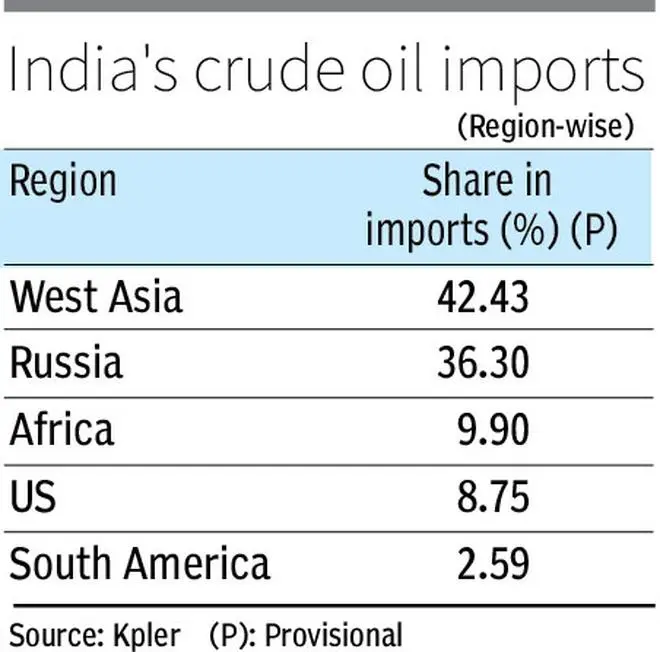
India imported around 1.83 mb/d of crude oil from Russia during November 2025, growing by 13 per cent M-o-M and more than 4 per cent Y-o-Y. Russia accounted for around 36.30 per cent of India’s cumulative crude oil imports (around 5.05 mb/d).

Urals grade accounting for more than 77 per cent of the total Russian cargoes. India imported 1.41 mb/d of Urals, higher by 13.5 per cent M-o-M. The cargoes, however, fell by 4.5 per cent Y-o-Y.

Middle East remained India’s largest crude oil supplier, cornering 42.43 per cent share of the imports. Cumulatively, Iraq, Saudi Arabia, The UAE, Kuwait and Oman shipped 2.14 mb/d to India.

The outlier regions were North America and Africa. India imported roughly 500,000 b/d crude oil from Africa (Nigeria, Angola, Congo, Libya, Ghana and Gabon) accounting for 9.90 per cent of India’s total imports.

The US accounted for 8.75 per cent of India’s total crude oil imports. Washington shipped 442,000 b/d to India during November 2025, declining by over 22 per cent M-o-M from the record cargoes in September (568,000 b/d). However, shipments rose by 100 per cent on an annual basis.

Going ahead

Sumit Ritolia, Kpler’s Lead Research Analyst for Refining & Modeling, told businessline “Looking ahead, we’ve started to see a clear dip in Russia’s exports to India since the OFAC sanctions announced on October 23. Based on current loadings and voyage activity, we expect December (2025) arrivals to be in the range of 1 mb/d. This aligns with our earlier view that, in the short term, Russian flows could ease toward around 800,000 b/d before stabilising.”

While India’s oil imports from Russia are likely to decrease after November 21st, the decline is most likely to be temporary, allowing the supply chain to reorganise itself. Unless more expansive secondary sanctions are introduced, he emphasised.

To compensate for softer near-term Russian arrivals, Indian refiners are expected to increase intake from a broader mix of suppliers, including Middle East (Saudi Arabia, Iraq, UAE and Kuwait), Brazil and broader Latin America (Argentina, Colombia and Guyana), West Africa and North America (the US and Canada).

Published on December 2, 2025



Source link

Russia, Middle East account for over 80% of India’s crude oil imports in November

Russia, Middle East account for over 80% of India’s crude oil imports in November


However, analysts, refiners and traders indicate that November 2025 was perhaps the last month when Russia accounted for 35 per cent or more of India’s cumulative imports of crude oil.  

India’s crude oil imports during November 2025 reflected the trend from the last few years with the Middle East and Russia accounting for more than 80 per cent of the cargoes which spilled to a little over 5 million barrels per day (mb/d).

A notable development during last month was India importing larger quantities of crude oil from the US and Africa with both regions witnessing their share rising to record levels.

However, analysts, refiners and traders indicate that November 2025 was perhaps the last month when Russia accounted for 35 per cent or more of India’s cumulative imports of crude oil.

The US sanctions, which kicked in on November 21, will drag down Russian cargoes by roughly one-third during December this year. The sanctions by the European Union, which will come into effect in January 2026, also threatens to upend supplies from Moscow.

Global real time data and analytics provider Kpler said that “as expected”, Russian arrivals remained strong so far this month, averaging around 1.8 mb/d (provisionally) and accounting for more than 35 per cent of India’s total crude import mix.

Before November 21, imports were closer to 1.9–2 mb/d as buyers moved cargoes ahead of the deadline, after which volumes slowed. It looks like refiners stocked up on crude ahead of the sanctions, planning to process it once the rules were in force, it added.

Source diversification

India imported around 1.83 mb/d of crude oil from Russia during November 2025, growing by 13 per cent M-o-M and more than 4 per cent Y-o-Y. Russia accounted for around 36.30 per cent of India’s cumulative crude oil imports (around 5.05 mb/d).

Urals grade accounting for more than 77 per cent of the total Russian cargoes. India imported 1.41 mb/d of Urals, higher by 13.5 per cent M-o-M. The cargoes, however, fell by 4.5 per cent Y-o-Y.

Middle East remained India’s largest crude oil supplier, cornering 42.43 per cent share of the imports. Cumulatively, Iraq, Saudi Arabia, The UAE, Kuwait and Oman shipped 2.14 mb/d to India.

The outlier regions were North America and Africa. India imported roughly 500,000 b/d crude oil from Africa (Nigeria, Angola, Congo, Libya, Ghana and Gabon) accounting for 9.90 per cent of India’s total imports.

The US accounted for 8.75 per cent of India’s total crude oil imports. Washington shipped 442,000 b/d to India during November 2025, declining by over 22 per cent M-o-M from the record cargoes in September (568,000 b/d). However, shipments rose by 100 per cent on an annual basis.

Going ahead

Sumit Ritolia, Kpler’s Lead Research Analyst for Refining & Modeling, told businessline “Looking ahead, we’ve started to see a clear dip in Russia’s exports to India since the OFAC sanctions announced on October 23. Based on current loadings and voyage activity, we expect December (2025) arrivals to be in the range of 1 mb/d. This aligns with our earlier view that, in the short term, Russian flows could ease toward around 800,000 b/d before stabilising.”

While India’s oil imports from Russia are likely to decrease after November 21st, the decline is most likely to be temporary, allowing the supply chain to reorganise itself. Unless more expansive secondary sanctions are introduced, he emphasised.

To compensate for softer near-term Russian arrivals, Indian refiners are expected to increase intake from a broader mix of suppliers, including Middle East (Saudi Arabia, Iraq, UAE and Kuwait), Brazil and broader Latin America (Argentina, Colombia and Guyana), West Africa and North America (the US and Canada).

Published on December 2, 2025



Source link

Census 2027 in two phases between April 2026 and Feb 2027

Census 2027 in two phases between April 2026 and Feb 2027


Union Minister of State for Home Affairs Nityanand Rai
| Photo Credit:

The government on Tuesday announced that Census 2027 will be conducted in two phases, the first one between April and September 2026 and the second phase in February 2027. However, in the first phase, it will be conducted in a period of 30 days as per the convenience of States and Union Territories.

Replying to a question by Leader of Opposition Rahul Gandhi, Minister of State for Home Affairs Nityanand Rai said during Phase I, it will be house listing and housing census followed by population enumeration (PE) in Phase II. In a separate question, Rai also informed Parliament that caste enumeration will be done in the census as earlier decided by the Cabinet Committee on Political Affairs.

“Population Enumeration will be done in February 2027 with reference date 00:00 hours of 1st March, 2027 except for the Union territory of Ladakh and snow-bound non-synchronous areas of the Union territory of Jammu and Kashmir and the States of Himachal Pradesh and Uttarakhand, where it will be done in September, 2026 with reference date 00.00 hours of 1st October, 2026,” Rai said.

He said that India’s census has a history of more than 150 years and learnings from previous exercises are taken into consideration for conducting the next census. Questionnaires have been finalised on the basis of inputs and suggestions from different ministries, departments, organisations and census data users, he added.

He further said that Census 2027 will be conducted through digital means in which data will be collected through mobile Apps along with online provision for self-enumeration.

Published on December 2, 2025


Source link

Rupee comes within a whisker of 90 to dollar mark

Rupee comes within a whisker of 90 to dollar mark


In the calendar year so far, the rupee has depreciated about 5 per cent (or about 425 paise) against the US dollar 
| Photo Credit:

The rupee on Tuesday came within a whisker of the psychologically crucial 90 to a dollar mark, with the currency testing an all-time intraday low of 89.95 and closing at a record low of 89.87.

The Indian currency (INR) is being buffeted by FPI selling in the equity market, importer demand, short-covering by speculators, delay in clinching the tariff deal with the US, possibility of a repo rate cut and reduced RBI intervention, among others.

In the calendar year so far, the rupee has depreciated about 5 per cent (or about 425 paise) against the US dollar (USD).

The Indian unit on Tuesday closed down about 32 paise against the previous close of 89.5475 per dollar. Amit Pabar, MD, CR Forex Advisors, observed that with the RBI not actively defending levels, every round of dollar demand is pushing the rupee lower.

“The RBI had protected the 88.80 level for many days, but allowed it to break on 21 November. Since then, the central bank has stepped in only briefly to control sharp moves, and again today it allowed another 15-20 paise fall. This shows the RBI is allowing a slow and gradual depreciation while preventing excessive volatility. With 90 being a key psychological and technical level, the focus now shifts to how firmly the RBI manages this zone,” he said.

Pabari noted that the coming sessions will reveal whether the slow-depreciation trend continues, or whether a more active defence emerges around 90.

Anindya Banerjee, Head Commodity and Currency, Kotak Securities, said USD-INR extended its rise towards the 90 mark, driven by continued short-covering from speculators and sustained importer demand.

He opined that the 90 level is a major psychological barrier — and a cluster of buy-stop orders likely sits above it. “This is precisely why the RBI must remain active below 90; if the pair starts sustaining above this zone, the market could quickly shift into a higher trending phase towards 91.00 or even higher. At this stage, it is essential for the central bank to prevent speculators from becoming too comfortable with a one-way trend, as that can trigger an unnecessary spike in USD-INR volatility,” said Banerjee.

According to Pabari’s assessment, “the market now seems to be settling into a broader 88.90–90.20 band. Historically, whenever the rupee breaks a key level, it tends to stabilise in a new range — earlier shifts from 81–83 to 83–85 and later 86–88 followed the same pattern.”

The break above 89 has likely pushed USD-INR into a fresh consolidation zone between 88.90 and 90.20, he added.

Published on December 2, 2025


Source link

Fintechs secure PA-CB licences to drive cross-border payments

Fintechs secure PA-CB licences to drive cross-border payments


India’s fintech ecosystem is rapidly deepening its presence in cross-border payments, with several start-ups and large payment gateways securing the Reserve Bank of India’s (RBI) payment aggregator–cross border (PA-CB) licence and forming strategic partnerships to expand global money-movement capabilities. 

Recently, fintech major Razorpay received the Reserve Bank of India’s Payment Aggregator-Cross Border (PA-CB) licence, enabling it to facilitate both inward and outward cross-border transactions.

The new authorisation expands its ability to offer compliance-aligned payment infrastructure for businesses operating across markets, the firm said in a statement. 

“A growing number of Indian businesses today are being built for global customers from day one, just as a rising wave of global companies are choosing India as one of their most important growth markets. What these businesses need are financial rails that make it just as easy to serve a customer in New York or Singapore as it is in Mumbai,” said Shashank Kumar, MD & co-founder, Razorpay. 

The licence allows the company to support international collections in over 130 currencies and onboard global platforms looking to offer UPI, RuPay, EMIs, netbanking and other India-specific payment methods without requiring a local entity. 

Cashfree Payments announced a strategic collaboration with JP Morgan Payments, which will act as its authorised dealer category-I (AD-I) bank. The partnership will allow Cashfree to process import transactions under RBI regulations, strengthening its compliance and settlement infrastructure. 

“As India sets global benchmarks in digital payments, the next era will be defined by enabling international businesses to enter India compliantly while allowing Indian consumers to shop from global brands effortlessly,” said Akash Sinha, CEO and co-founder of Cashfree Payments. Combining JP Morgan’s global rails with Cashfree’s local stack creates “the foundation for international businesses to expand into India with confidence and speed”, he said. 

With fintechs scaling compliant infrastructure and forming bank partnerships, India’s cross-border payments landscape is poised for accelerated expansion, mirroring the broader surge in global digital commerce. 

Published on December 2, 2025


Source link

YouTube
Instagram
WhatsApp