एटीएम से नकद निकासी घटी; लेकिन लोग एक बार में निकाल रहे ज्यादा पैसा, जानें गांव और शहरों का ट्र

एटीएम से नकद निकासी घटी; लेकिन लोग एक बार में निकाल रहे ज्यादा पैसा, जानें गांव और शहरों का ट्र


Show Quick Read

Key points generated by AI, verified by newsroom

ATM Cash Withdrawal Decline: आज के डिजिटल दौर में ज्यादातर लोग मोबाइल ऐप और ऑनलाइन पेमेंट को प्राथमिकता देने लगे हैं. जिससे नकद लेन-देन धीरे-धीरे कम होता जा रहा है. पहले जहां छोटी-छोटी जरूरतों के लिए भी लोग एटीएम की ओर दौड़ लगाते थे, वहीं अब कई काम डिजिटल पेमेंट से पूरे हो जाते हैं. सब्जी- फलों से लेकर बड़ी-बड़ी दुकानों तक ऑनलाइन पेमेंट स्वीकार किया जा रहा है. इसका असर एटीएम से पैसे निकालने की आदत पर भी साफ नजर आने लगा है. 

सीएमएस इन्फो सिस्टम्स की रिपोर्ट के मुताबिक, साल 2025 में देशभर में एटीएम से कैश निकालने की संख्या में कमी देखने को मिली हैं. हालांकि, जो लोग एटीएम से पैसे निकाल रहे हैं, वे पहले के मुकाबले ज्यादा रकम की निकासी कर रहे हैं….

क्या कहते हैं आंकड़े?

सीएमएस इन्फो सिस्टम्स की रिपोर्ट में सामने आया है कि साल 2025 में देशभर के एटीएम से हर महीने औसतन 1.21 करोड़ रुपये की नकद निकासी हुई, जबकि वित्त वर्ष 2024-25 में यह आंकड़ा 1.30 करोड़ रुपये रहा था.

इससे साफ है कि निकासी में कमी देखने को मिली है. वहीं दूसरी ओर, एक बार में निकाले जाने वाले पैसों की रकम बढ़ी है. 2025 में प्रति ट्रांजैक्शन औसत राशि 4.5 प्रतिशत की बढ़ोतरी के साथ 5,835 रुपये पहुंच गई है. वहीं, साल 2024 में यह 5,586 रुपये थी.

ग्रामीण क्षेत्रों में ज्यादा निकासी

छोटे कस्बों और ग्रामीण इलाकों में एटीएम से नकद निकालने का चलन ज्यादा देखा गया है. इन क्षेत्रों में प्रति एटीएम हर महीने औसतन 1.30 करोड़ रुपये की निकासी दर्ज की गई है. वहीं, मेट्रो सिटी में यह आंकड़ा औसतन कम है.

मेट्रो सिटी में करीब 1.18 करोड़ रुपये की निकासी की गई. जबकि अन्य शहरी इलाकों में औसतन 1.11 करोड़ रुपये की मासिक निकासी देखने को मिली. इससे साफ होता है कि ग्रामीण क्षेत्रों में लोग अभी भी नकद लेनदेन में ज्यादा भरोसा दिखा रहे हैं. 

मौसम और त्योहारों का भी दिखता है असर

एटीएम से हर महीने होने वाली नकद निकासी पर मौसम, त्योहारों का समय और लोगों की आवाजाही जैसी सुविधाओं का भी सीधा प्रभाव पड़ता है. रिपोर्ट के अनुसार, सितंबर महीने में जीएसटी सुधारों के बाद लोगों के खर्च करने के तरीके में बदलाव देखने को मिला, जिससे नकद लेनदेन के पैटर्न पर भी असर पड़ा है.

यह भी पढ़ें: रॉकेट से भी तेज चांदी की रफ्तार! 10 दिन में एक 1 लाख उछली कीमत, जानें कैसे 1 लाख से पहुंची 4 लाख पार


Source link

Ajit Pawar’s last rites held with state honours in Baramati

Ajit Pawar’s last rites held with state honours in Baramati


Police officials perform state honours during the funeral of Ajit Pawar at the Vidya Prathisthan Ground in Baramati, Pune, on Thursday, January 29, 2025.
| Photo Credit:
EMMANUAL YOGINI

The last rites of Maharashtra Deputy Chief Minister Ajit Pawar, who was killed in a plane crash, were held with full state honours on Thursday at Baramati in Pune district.

Several senior leaders attended the funeral held at the Vidya Pratishthan ground, including Union Ministers Amit Shah and Nitin Gadkari, former Union Minister Sharad Pawar, BJP national president Nitin Nabin, Maharashtra Chief Minister Devendra Fadnavis and Deputy Chief Minister Eknath Shinde, Goa Chief Minister Pramod Sawant, and other political leaders and elected representatives.

Earlier in the day, Pawar’s mortal remains were taken from Punyashlok Ahilyadevi Hospital in Baramati, where they had been kept overnight, to his native village Katewadi.

Pawar and four others were killed when the aircraft crashed about 200 metres from the edge of a tabletop airstrip at Baramati on Wednesday morning. Those who lost their lives included pilot Captain Sumit Kapoor, co-pilot Captain Shambhavi Pathak, personal security officer Vidip Jadhav, and flight attendant Pinky Mali.

Union Home Minister Amit Shah met Pawar’s wife Sunetra Pawar and sons Jay and Parth to express his condolences. He also met Sharad Pawar and other family members.

Published on January 29, 2026


Source link

Digit Insurance disburses moisture index-based parametric insurance to Rajasthan farmers

Digit Insurance disburses moisture index-based parametric insurance to Rajasthan farmers


Farmers engaged in harvesting and sorting of onions in a farm at Bub Ka Hera Village in Alwar District of Rajasthan
| Photo Credit:
SHIV KUMAR PUSHPAKAR

Go Digit General Insurance Ltd (Digit Insurance) has said that it has disbursed a moisture index-based parametric insurance claim to farmers in Tonk district of Rajasthan as excess moisture breached pre-defined threshold limits.

A media statement said that the claim has been paid to farmers in over 30 villages in Tonk as the moisture-based parametric cover based on Water Balance Index (WBI) breached the pre-defined water balance threshold for excess moisture. Excess moisture waterlogs the soil, increasing the risk of crop rot, affecting overall yield and farmers’ income in rabi season. The claim will benefit nearly 500 farmers, providing support to vulnerable farming households and helping them manage losses during climate disruptions, it said.

Digit Insurance had partnered with Howden Insurance India to offer WBI-based parametric solution for excess moisture and drought to over 6,000 farmers across Rajasthan (Tonk) and Uttar Pradesh (Varanasi, Gorakhpur and Jaunpur), covering close to 2,200 acres of farmland.

‘Tools of confidence’

Quoting Adarsh Agarwal, Appointed Actuary, Digit Insurance, the statement said: “At Digit Insurance, our goal is to design data‑led insurance solutions that directly address the real‑world risks and expectations of our customers. India is prone to various climate-related risks and parametric insurance is a unique concept that has the potential to safeguard various vulnerable segments. Water Balance Index-based parametric insurance is one such solution to help farmers provide quick financial support in time of need. Our aim will always be to stay ahead of the curve and work with all stakeholders to develop scientifically driven and innovative parametric triggers to raise the standard of protection across the country.”

Mohammad Faizan Huq, Head – Climate Risk and Agriculture, Howden India, said as climate volatility accelerates, India’s agricultural sector deserves tools that deliver speed, transparency, and confidence.

“We are proud to support programmes that use robust indices to provide fast liquidity when adverse weather strikes. Parametric insurance is still evolving in India but has immense potential to transform how insurance is delivered to vulnerable segments. Collaborative partnerships with innovative insurance companies like Digit will ensure that these solutions benefit wider communities in the future,” Mohammad Faizan Huq said.

WBI‑driven moisture parametric insurance

The WBI, developed by Global Parametrics, a specialist in climate risk analytics and parametric insurance solution, is used as a proxy to measure excess moisture or drought conditions in a given location. The index measures the difference between rainfall and potential evapotranspiration levels, and the product is triggered using ERA5-Land climate data from European Centre for Medium-Range Weather Forecasts (ECMWF), an independent European Intergovernmental Organisation.

The WBI has been tailored to capture soil‑moisture stress conditions that directly affect rural smallholder farmers and their families. The use of parametric insurance means that the product triggers on objective, verifiable climate data, delivering transparent and timely payouts to policyholders.

A payout is triggered if the pre-defined water balance threshold is met or exceeded, leading to payouts in the range of 10-100 per cent of the total limit, depending on the severity of the excess moisture.

Published on January 29, 2026



Source link

Why Gold explodes past ,600, silver nears 0?

Why Gold explodes past $5,600, silver nears $120?


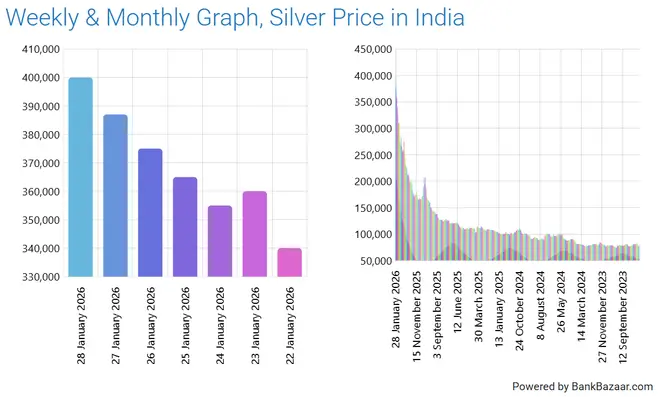
The precious metals rocket ship keeps accelerating into uncharted territory. Gold exploded past $5,600 to touch $5,626 on Thursday, smashing through ₹1.80 lakh in India, while silver broke the psychological ₹4 lakh barrier, marking a staggering 30 per cent year-to-date gain for gold and an eye-popping 66 per cent surge for silver. But as silver “screams” past historical norms, some experts are raising yellow flags about what comes next.

“Gold’s surge beyond $5,600 (₹1,80,000) and silver’s breakout above ₹4,00,000/kg reflect a deepening macro and geopolitical risk premium rather than short-term speculation,” explains Renisha Chainani, head of research at Augmont. The trigger? A combustible mix of Middle East tensions, dollar weakness, and Federal Reserve policy that’s essentially locked rates into accommodative mode.

Geopolitical tensions escalated sharply after President Trump urged Iran to return to nuclear negotiations, warning that “any future U.S. military action would be far more severe.” Iran fired back with threats of retaliation against the U.S., Israel, and their allies, sending shockwaves through global markets and turbocharging safe-haven demand. “This exchange has heightened fears of a broader regional escalation in the Middle East, reinforcing risk-off sentiment,” notes Chainani.

The Fed held rates steady on Wednesday, but Chair Jerome Powell’s acknowledgement of “elevated inflation and an uncertain outlook” while declaring that “rate hikes are not anyone’s base case” has effectively given precious metals a green light. Powell also warned that “the US budget deficit is unsustainable,” adding another layer of fiscal anxiety driving investors into hard assets.

MCX gold has now crossed ₹1,77,000. Ponmudi R, CEO of Enrich Money, sees more upside ahead: “A clear and sustained breakout above the ₹1,80,000 band could quickly open the path toward ₹1,85,000–₹1,90,000, with a psychological extension toward ₹2,00,000 increasingly likely if global momentum sustains.” For silver, he projects targets at “₹4,08,000–₹4,15,000, with scope to extend toward ₹4,17,000–₹4,25,000.”

But here’s where it gets interesting. WhiteOak Capital Mutual Fund just released a report titled “Gold is Talking, Silver is Screaming: A Case for Prudent Repositioning,” warning that silver’s parabolic move “often signals the final, speculative stage of a run.” The Gold-to-Silver ratio has collapsed to approximately 46:1, far below the 10-year average of 80:1. “When it drops below 50:1, silver is no longer cheap,” the report cautions, noting that “in previous cycles, a ratio this low has preceded a mean reversion where silver prices corrected significantly faster relative to gold.”

Ross Maxwell from VT Markets explains the broader dynamic: “Policy uncertainty around growth, trade, and fiscal sustainability tends to pressure the USD increasing volatility expectations. If this environment continues, gold and silver benefit as a softer or range-bound USD would support precious metals.”

The industrial demand story for silver remains robust. “Robust industrial demand, fuelled by rapid expansion in AI infrastructure, data centres, solar energy, electric vehicles, and advanced electronics—has emerged as a key support,” says Ponmudi. He adds that “momentum-driven participation, including FOMO (Fear of Missing Out)-led buying during technical breakouts, has amplified upside moves.”

Rahul Kalantri of Mehta Equities notes that “gold prices have surged more than 10 per cent over the last four sessions” with “investors increasingly shifting away from paper currencies and moving toward tangible assets.” Additional support has come from central bank buying and crypto major Tether’s plans to invest 10-15 per cent in physical gold.

Chainani’s technical view shows “gold sustaining above $5600 (₹1,87,000) opens the door to $5800–6000” while silver’s “decisive move above $118 (₹4,05,000) targets $125–130 (₹4,30,000–4,50,000).”

WhiteOak’s contrarian take suggests investors should “harvest the scream” by taking profits on silver first and rotating gains into diversified Indian equities, which offer better long-term returns and tax advantages. But for now, the precious metals party rages on, fueled by geopolitical chaos, fiscal fears, and a weakening dollar that shows no signs of stabilizing.

Published on January 29, 2026



Source link

SBI Life Insurance shares swing after Q3 results

SBI Life Insurance shares swing after Q3 results


Shares of SBI Life Insurance Company saw sharp swings on Thursday following the Q3 results, even as most brokerages struck an optimistic tone on the insurer’s growth and margin outlook.

At 10.56 am, the stock was trading 2 per cent lower at ₹2,003.50 on the NSE, after moving between the day’s low of ₹1,984.20 and a high of ₹2,065. The stock had closed the previous session at ₹2,053.20.

SBI Life reported a 4.7 per cent year-on-year rise in consolidated net profit to ₹576.74 crore for Q3 FY26, aided by more than 20 per cent growth in net premium income.

Morgan Stanley maintained an outperform rating on the stock at a target price of ₹2,550. It raised its VNB forecasts, flagged upside risks to annualised premium equivalent growth and margins, and said continued valuation re-rating is likely.

Citi reiterated its buy and lifted the target price to ₹2,700 from ₹2,550, citing sustained improvement in product-level margins and further headroom for expansion. The brokerage highlighted SBI Life’s ongoing agency expansion and said productivity gains should support growth going ahead.

Jefferies maintained buy at a target price of ₹2,510, noting that the quarter saw an encouraging rebound in performance. While strong premium growth was partly offset by GST-related margin pressure, the brokerage said full-year guidance remains intact and expects margins to normalise in the coming periods.

Domestic brokerage Motilal Oswal pointed out that VNB margins in Q3 were impacted by GST, though this was cushioned by rising traction in protection products, higher rider attachment rates and a favourable shift toward traditional policies. The brokerage expects sustained momentum in non-linked products and continued investments in agency and digital channels to drive growth, while reiterating its buy rating with a revised target price of ₹2,570.

HDFC Securities said SBI Life delivered healthy APE and VNB growth of 15 per cent and 18 per cent year-on-year, respectively, beating its estimates, aided by a rebound in new operating profit and a sharp surge in the participating segment. Although VNB margins were slightly lower due to the one-time impact of new labour laws, the brokerage highlighted diversification away from ULIPs, cost leadership and the company’s access to SBI’s vast distribution network as key strengths. It maintained buy recommendation with a revised target price of ₹2,400.

Published on January 29, 2026


Source link

सोने की कीमतों में तूफानी तेजी; चांदी 4 लाख के पार, जानें आपके शहर में आज कितना बढ़ गया रेट

सोने की कीमतों में तूफानी तेजी; चांदी 4 लाख के पार, जानें आपके शहर में आज कितना बढ़ गया रेट


Show Quick Read

Key points generated by AI, verified by newsroom

Gold Price Today: घरेलू फ्यूचर मार्केट में सोने की कीमतों में गुरुवार, 29 जनवरी को तूफानी तेजी देखने को मिल रही है. मल्टी कमोडिटी एक्सचेंज (MCX) पर 5 फरवरी, 2026 का एक्सपायरी वाला गोल्ड फ्यूचर वायदा गुरुवार को 1,69,882 रुपये (प्रति 10 ग्राम) पर ओपन हुआ. इसके आखिरी कारोबारी दिन एमसीएक्स पर सोना 1,65,915 रुपये पर ट्रेड करते हुए बंद हुआ था.

29 जनवरी की सुबह 10:00 बजे, एमसीएक्स पर 5 फरवरी का एक्सपायरी वाला गोल्ड 1,80,300 रुपए पर ट्रेड कर रहा था. जो कि पिछले दिन की बंद कीमत से लगभग 14,300 रुपये की तेजी दिखाता है. एमसीएक्स गोल्ड शुरुआती कारोबार में 1,80,501 रुपए के हाई लेवल पर पहुंचा था.

एमसीएक्स पर 5 मार्च 2026 का एक्सपायरी वाला सिल्वर 4,04,879 रुपये (प्रति किलो) पर ट्रेड कर रहा था. जो कि पिछले दिन की बंद कीमत से लगभग 19,500 रुपये की तेजी दिखाता है. एमसीएक्स सिल्वर शुरुआती कारोबार में 4,07,456 रुपये के हाई लेवल पर पहुंचा था. आइए जानते हैं कि आज आपके शहर में सोना और चांदी का ताजा भाव क्या है?

आपके शहर में सोने का भाव (गुड रिटर्न के अनुसार)

दिल्ली में सोने के दाम  (प्रति 10 ग्राम)

24 कैरेट – 1,79,000 रुपए
22 कैरेट – 1,64,100 रुपए
18 कैरेट – 1,34,290 रुपए

मुंबई में सोने के दाम  (प्रति 10 ग्राम)

24 कैरेट – 1,78,850 रुपए
22 कैरेट – 1,63,950 रुपए
18 कैरेट – 1,34,140 रुपए

चेन्नई में सोने के दाम (प्रति 10 ग्राम)

24 कैरेट – 1,83,280 रुपए
22 कैरेट – 1,68,000 रुपए
18 कैरेट – 1,39,000 रुपए

कोलकाता में सोने के दाम  (प्रति 10 ग्राम)

24 कैरेट – 1,78,850 रुपए
22 कैरेट – 1,63,950 रुपए
18 कैरेट – 1,34,140 रुपए

अहमदाबाद में सोने के दाम  (प्रति 10 ग्राम)

24 कैरेट – 1,78,900 रुपए
22 कैरेट – 1,64,000 रुपए
18 कैरेट – 1,34,190 रुपए

लखनऊ में सोने के दाम  (प्रति 10 ग्राम)

24 कैरेट – 1,79,000 रुपए
22 कैरेट – 1,64,100 रुपए
18 कैरेट – 1,34,290 रुपए

पटना में सोने के दाम  (प्रति 10 ग्राम)

24 कैरेट – 1,78,900 रुपए
22 कैरेट – 1,64,000 रुपए
18 कैरेट – 1,34,190 रुपए

हैदराबाद में सोने के दाम  (प्रति 10 ग्राम)

24 कैरेट – 1,78,850 रुपए
22 कैरेट – 1,63,950 रुपए
18 कैरेट – 1,34,140 रुपए

गुरुवार के कारोबारी दिन सोने-चांदी की कीमतों में जोरदार तेजी देखने को मिल रही है. अगर आज आप इन बहुमूल्य धातुओं की खरीदारी का प्लान बना रहे हैं, तो अपने शहर के ताजा भाव जरूर जान लेना चाहिए. 

यह भी पढ़ें: Stock Market 29 January: फ्लैट शुरुआत के बाद फिसला शेयर बाजार, सेंसेक्स 319 अंक टूटा, निफ्टी भी लाल  


Source link

YouTube
Instagram
WhatsApp