Shadowfax raises Rs 856 crore from anchor investors ahead of IPO

Shadowfax raises Rs 856 crore from anchor investors ahead of IPO


The anchor book saw strong participation from domestic and global institutional investors, including mutual funds, insurance firms and foreign institutions.
| Photo Credit:
iStockphoto

Logistics services provider Shadowfax on Monday said it has collected Rs 856 crore from anchor investors, a day before the opening of its initial share sale for public subscription.

The anchor book attracted participation from a wide range of domestic and global investors, including mutual funds, insurance companies, pension funds and foreign institutions.

Key anchor investors

The top investors in the anchor round include Nippon India Mutual Fund (MF), ICICI Prudential MF, JM Financial MF, Motilal Oswal MF, Government Pension Fund Global, ICICI Prudential Life Insurance Company, Societe Generale, HSBC Global Investment Funds, Eastspring Investments and Jupiter India Fund, according to a circular uploaded on BSE’s website.

Shares allocated to anchor investors

The company allocated 6.90 crore equity shares to anchor investors at a price of Rs 124 per share, which is also the upper end of the IPO price band. This takes the total fundraising to Rs 856 crore, the circular noted.

Domestic MFs’ share

Of the total shares allotted to anchor investors, around 3.68 crore shares, or 53.24 per cent, were allocated to nine domestic mutual funds through 20 schemes, reflecting strong institutional interest ahead of the public issue.

Shadowfax’s Rs 1,907-crore maiden public offering will be available for subscription from January 20 to 22. The price band has been fixed at Rs 118-124 apiece for its upcoming IPO, valuing the company at over Rs 7,100 crore at the higher end.

The IPO will comprise a fresh issue of shares worth Rs 1,000 crore and an offer for sale (OFS) of Rs 907.27 crore by existing shareholders. This takes the total issue size to Rs 1,907.27 crore.

Selling shareholders in OFS

As a part of the OFS, Flipkart Internet, Eight Roads Investments Mauritius II Ltd, NewQuest Asia Fund IV (Singapore) Pte Ltd, Nokia Growth Partners IV, LP, International Finance Corporation, Mirae Asset, Qualcomm Asia Pacific Pte Ltd, and Snapdeal founders — Kunal Bahl and Rohit Kumar Bansal — would offload shares.

Valuation reset

Market experts said Shadowfax has reduced its post-market valuation to over Rs 7,100 crore, lower than previous estimates of Rs 8,500 crore, in what is being positioned as a more conservative pricing approach aimed at attracting long-term institutional investors.

The company proposes to utilise proceeds from the fresh issue towards enhancing capacity in terms of network infrastructure, funding of lease payments for new first-mile and last-mile, and sort centres, as well as towards branding, marketing, and communication initiatives, unidentified inorganic acquisitions, and general corporate purposes.

Shadowfax is backed by marquee investors such as Flipkart, TPG, Eight Roads Ventures, Mirae Asset Ventures and Nokia Growth Funds. It is India’s leading logistics service provider for e-commerce express parcel and value-added services. It has a service network encompassing 14,758 Indian pin codes as of September 2025.

Client base and services

The company serves a wide range of enterprise clients, including horizontal and non-horizontal e-commerce, quick commerce, food marketplaces, and on-demand mobility companies. It offers express forward parcel deliveries, reverse pickups, and on-demand hyperlocal and critical logistics solutions.

Shares of Shadowfax are expected to list on January 28 on the bourses.

The company said that 75 per cent of the issue size has been reserved for qualified institutional buyers, 15 per cent for non-institutional investors and the remaining 10 per cent for retail investors.

Financial performance

For the first half of FY26, Shadowfax reported a revenue of about Rs 1,800 crore, marking a 68 per cent year-on-year increase. Its total revenue stood at Rs 2,485 crore in FY25.

Revenue mix

The e-commerce express parcel segment is the major revenue contributor, accounting for around 70 per cent of the company’s business and around 20 per cent of revenue comes from hyperlocal and quick commerce logistics.

Shadowfax’s express parcel market share rose to about 21 per cent in Q1 FY26, up sharply from around 8 per cent in FY22, according to data from Redseer.

The firm filed draft papers in late June with the markets regulator Sebi for an IPO through a confidential pre-filing route and had received Sebi’s approval in October.

The company opted for the confidential pre-filing route, which allows it to withhold public disclosure of IPO details under the DRHP until later stages. This route is gaining traction among Indian firms aiming for flexibility in their IPO plans.

Published on January 19, 2026


Source link

Nitin Nabin elected BJP national president, becomes youngest party chief

Nitin Nabin elected BJP national president, becomes youngest party chief


Nabin, 45, emerged as the sole candidate for the post with Prime Minister Narendra Modi and other senior BJP leaders filing nomination papers in his support.

Nabin will be formally declared as BJP president on Tuesday signalling a generational shift in its top organizational leadership and a new era in the party, which was founded in 1980, the same year he was born.

Succession from J P Nadda

The low profile and unassuming Nabin, who resigned as the minister for law and justice, urban development and housing in the Bihar government after he was appointed working president of the BJP on December 14, will succeed J P Nadda. Nadda, who is the union health minister, has been at the helm of the party’s affairs for an extended period since 2020.

“I hereby announce that only one name, that of Shri Nitin Nabin, has been proposed for the post of National President of Bharatiya Janata Party,” K Laxman, the Returning Officer for presidential election, said in a statement.

Valid nomination papers

Laxman said 37 sets of nomination papers were filed in favour of Nabin as the BJP national president and all nomination papers were found to be valid.

Prime Minister Modi was among the proposers of Nabin’s candidature for the party post Several senior BJP leaders including Nadda, and other union ministers Amit Shah, Rajnath Singh and Nitin Gadkari were among the proposers.

Of the 37 sets of nomination papers, 36 were filed by state units of the party and one set was submitted by the BJP Parliamentary Party.

Sangathan Parv process

In a post on X, Laxman said, “Under the BJP’s Sangathan Parv, the election process for the post of national president was conducted successfully in my capacity as national returning officer.”

This “transparent and democratic process” once again reflects the party’s strong organisational values and its deep commitment to internal democracy, the BJP Rajya Sabha MP further said.

Laxman said the nomination process was completed in a “fully constitutional and transparent manner”.

Nationwide consensus

“With nationwide consensus, Nitin Nabin was the sole nominee. Heartiest congratulations and best wishes,” he said in another post on X.

Nadda, senior ministers Amit Shah, Rajnath Singh, Nitin Gadkari, Nirmala Sitharaman, Kiren Rijiju, Chief Ministers Yogi Adityanath, Nayab Saini, Pramod Sawant, Pema Khandu, Pushkar Singh Dhami were among those present on the occasion.

Key electoral tests ahead

As the BJP seeks to further expand its influence in uncharted territories, the upcoming Assembly elections in the opposition-ruled states of West Bengal, Tamil Nadu and Kerala as well as BJP-ruled Assam will come as a major test for Nabin, who was preferred to more seasoned leaders.

Rise through youth wing

The elections will be an opportunity for Nabin, who rose through the ranks in the Bhartiya Janata Yuva Morcha, the youth wing of the BJP, to prove his mettle as organisational head of the BJP pyramid.

Laxman said according to the schedule, the nomination process was completed between 2 pm and 4 pm on Monday.

“In all, 37 sets of nomination papers were received in favour of Shri Nitin Nabin for the post of national president. On scrutiny, all sets of nomination papers were found to be duly filled out in the required format and were valid.”

He said the election process was initiated after the election of 30 state presidents out of 36 states, well above the required number for completing a minimum of 50 per cent of the states.

He said the notification of the schedule of events was announced and the electoral roll was published on January 16, 2026.

Political entry

Nabin took the political plunge in 2006 after the death of his father Nabin Kishore Prasad Sinha, who was a BJP MLA.

According to a party leader, Nabin, a Kayasth by caste, may be young but has a lot of experience in governance and working for the people and the organisation.

Chhattisgarh success

He impressed the BJP central leadership as the party co-in charge of the November 2023 Chhattisgarh Assembly elections, where BJP pulled off a surprise win by beating chief minister Bhupesh Baghel of the Congress.

In the Lok Sabha elections, he repeated the success formula. The BJP won 10 of the 11 seats in Chhattisgarh.

Born in Ranchi, now in Jharkhand, Nabin is married to Deepmala Shrivastava and the couple has a son and a daughter.

Electoral track record

He has been known to win elections with huge margins, starting with the first bypoll he contested in 2006 which he won by nearly 60,000 votes. He won the latest one, earlier this year, by more than 51,000 votes.

Legacy of BJP Presidents

Nabin is the latest link in the chain of BJP presidents — Atal Behari Vajpayee became the first BJP president in 1980 and was succeeded by Lal Krishna Advani in 1986 who held the post for three terms.

Others who have held the position include Murli Manohar Joshi, Kushabhau Thakre, Bangaru Laxman, Jana Krishnamurthi, Venkaiah Naidu, Rajnath Singh (twice), Nitin Gadkari and Amit Shah.

Published on January 19, 2026



Source link

चांदी ने तोड़ा रिकॉर्ड; ढाई महीने में दोगुना हुआ भाव, ईंट और सिक्कों में बढ़ी निवेशकों की दिलचस

चांदी ने तोड़ा रिकॉर्ड; ढाई महीने में दोगुना हुआ भाव, ईंट और सिक्कों में बढ़ी निवेशकों की दिलचस


Show Quick Read

Key points generated by AI, verified by newsroom

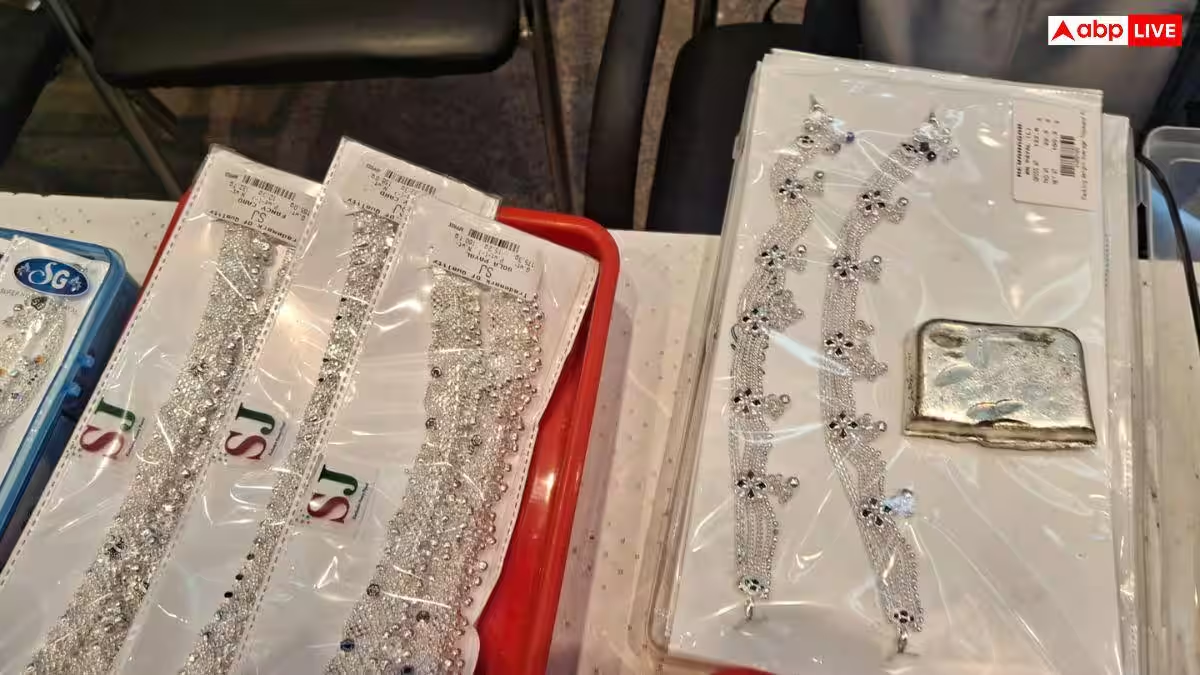
Silver Price Surge India: पिछले दो से ढाई महीनों में चांदी के भाव और सोने के भाव में लगातार वृद्धि हो रही है. अभी बाजार भाव में 24 कैरेट सोने का भाव प्रति 10 ग्राम 145000 हो चुके हैं. तो वहीं चांदी के भाव में बेतहासा वृद्धि हो रही है.

दीपावली के दिन 31 अक्टूबर 2025 को चांदी के भाव 1 लाख 49000 पर प्रति किलो दर्ज किए गए थे. आज 19 जनवरी सोमवार को 2,096,000 प्रति किलो चांदी के भाव दर्ज किया गया हैं. यानी ढाई महीने में दोगुना की वृद्धि हो चुकी है. चांदी के भाव में वृद्धि के साथ-साथ अब इसकी मांग भी बढ़ने लगी है.

सराफा व्यापारी ने दी जानकारी

चांदी के सिक्के और चांदी के ईंट की बिक्री जोरों पर होने लगी है. बिहार सराफा व्यावसायिक संघ के अध्यक्ष और पटना के सोने-चांदी के थोक विक्रेता अशोक कुमार वर्मा ने एबीपी न्यूज से खास बातचीत में कहा कि पिछले करीब एक सप्ताह से प्रतिदिन सिर्फ पटना में 100 करोड़ से अधिक की चांदी की बिक्री हो रही है.

इसमें बड़ी वजह यह है कि अब चांदी के भाव घटने के उम्मीद नहीं दिख रही है और लोग निवेश के तौर पर चांदी के सामान खरीद रहे हैं.

चांदी की कीमतों में बनी रहेगी तेजी

बड़े-बड़े पूंजीपति चांदी के ईंट की खरीदारी कर रहे हैं. इसकी बिक्री ज्यादा हो रही है. क्योंकि चांदी का एक ईंट करीब 500 ग्राम का होता है. जिसकी कीमत करीब 1.50 लाख रुपये होती है. वहीं मध्यम वर्ग के लोग चांदी के सिक्के और चांदी के बने सामान ज्यादा खरीद रहे हैं. आज चांदी के 10 ग्राम सिक्के का रेट 3200 रुपए है, जो ढाई महीना पहले 1500 से 1600 रुपए थे. 

अभी जिस तरह से चांदी के रेट में वृद्धि हो रही है, ऐसी संभावना है कि भाव फरवरी तक 5 लख रुपए प्रति किलो तक भी हो सकते हैं. क्योंकि प्रतिदिन चांदी के भाव बढ़ रहे हैं. कभी 5000 तो कभी 10000. कभी-कभी तो एक दिन में 20000 रुपये प्रति किलो की वृद्धि हो रही है. ऐसे में अब लोग निवेश के लिए चांदी की खरीदारी ज्यादा कर रहे हैं.

अशोक कुमार वर्मा ने बताया कि पहले निवेश के लिए सोने की खरीदारी लोग ज्यादा करते थे. सोने के भाव मे भी वृद्धि हुई है, परंतु पिछले 15 दिनों से इसकी कीमत स्थिर है. कीमतें एक से दो हजार ऊपर नीचे हो रहे हैं, लेकिन चांदी के भाव में अत्यधिक तेजी देखने को मिल रही है. यही वजह है कि लोग निवेश के लिए चांदी की खरीदारी करने लगे हैं.

उन्होंने बताया कि चांदी की मांग हर क्षेत्र में तेज है. सोलर लाइट बनाने में चांदी का उपयोग होता है तो इलेक्ट्रॉनिक कई सामान में चांदी का उपयोग हो रहा है. ऐसे में चांदी की मांग बढ़ी है और इन सब सामानों के दाम बढ़ने की भी संभावना है.

वैश्विक स्तर पर चांदी की हाल

अशोक कुमार वर्मा ने  बताया कि अमेरिका ने सिल्वर और कॉपर को रेयर मेटल घोषित कर दिया है. चीन ने चांदी को बटोरना शुरू कर दिया है, क्योंकि इलेक्ट्रॉनिक सामान में चांदी का उपयोग ज्यादा हो रहा है. अब चीन ने चांदी को एक्सपोर्ट करने पर भी बैन लगा दिया है.

साथ ही साथ ही अमेरिका ने जो 10 फीसदी टैरिफ बढ़ाई है वह भी चांदी के भाव बढ़ने का एक बड़ा कारण है. अभी चांदी का भाव में वृद्धि होगी, लेकिन अर्थशास्त्रियों के मुताबिक इसको निवेश के रूप में भी देखना उचित नहीं होगा. क्योंकि भविष्य में चांदी के भाव गिरने की भी संभावना है.

यह भी पढ़ें: अब दुनिया देखेगी भारत की ताकत, ड्रैगन को सीधी चुनौती! इस मामले में करने जा रहा बराबरी


Source link

Banks to step up scrutiny of priority sector loans purchased via ‘Securitisation Notes’

Banks to step up scrutiny of priority sector loans purchased via ‘Securitisation Notes’


In the case of eligible priority sector loans to self-help groups/joint liability groups, this limit will be applicable per member and not to the group as a whole  

To ascertain the priority sector status of the underlying portfolio purchased via ‘securitisation notes’, banks may rely on a combination of any external auditors’ certification provided by the originating entity such as a non-banking finance company and conduct of sample check by their own staff or by an auditor for the purpose.

The aforementioned norms may be specified in banks’ internal policy, per Reserve Bank of India (Priority Sector Lending – Targets and Classification) (Amendment) Directions, 2026.

These norms come in the wake of the asset quality of PSL originated banks on their own turning out to be much better than that purchased via the securitisation/direct assignment route.

Priority sector

Investments by banks in securitisation notes, representing loans to various priority sector categories, except ‘others’ category, are eligible for classification under the respective categories depending on the underlying assets, subject to certain conditions.

Investment by banks in securitisation notes with loans against gold jewellery originated by NBFCs as underlying, are not eligible for priority sector status.

Bank credit to National Co-operative Development Corporation (NCDC) for on-lending to co-operative societies for purposes and activities as laid down in this master direction will be eligible for classification as PSL under the respective categories.

RBI said no loan related charges (including guarantee fees of credit guarantee schemes), and ad hoc service charges/inspection charges can be levied on priority sector loans up to ₹50,000.

In the case of eligible priority sector loans to self-help groups/joint liability groups, this limit will be applicable per member and not to the group as a whole.

Bank credit to housing finance companies (HFCs), approved by the National Housing Bank for their refinance, for on-lending for the purpose of purchase/construction/reconstruction of individual dwelling units or for slum clearance and rehabilitation of slum dwellers, will be eligible for classification as PSL subject to an aggregate loan limit of ₹20 lakh per borrower, under ‘housing’ category.

Banks have to maintain necessary borrower-wise details of the underlying portfolio and obtain external auditors’ certificates from the HFCs, confirming that on-lending benefit in respect of such loans has not been claimed from any other bank.

Published on January 19, 2026



Source link

Mandatory digital sanction at pan India for below ₹10 lakh loan from Feb 1, says PNB MD Chandra

Mandatory digital sanction at pan India for below ₹10 lakh loan from Feb 1, says PNB MD Chandra


Ashok Chandra, Managing Director and CEO of Punjab National Bank believes that there will be no impact of the new labour codes on the PNB’s wage bill. In an interview, Chandra discussed a range of subjects including measures to reduce fresh slippage. Excerpts:

Given the government’s focus on capital expenditure, do you believe you can meet the rising credit demand across various sectors?

Absolutely. As of now also, credit to MSME is growing at 19 per cent. As we are reducing IBPC (Inter-Bank Participation Certificates), core retail has grown by more than 18.5 per cent. Agriculture credit has grown over 11 per cent. We remain fully aligned with our core strategic objectives for this financial year and are currently executing them as planned. Corporate loan book is now ₹3.12 lakh crore, which is the sanctioned amount till December 31, 2025. Of this, around ₹1 lakh crore is yet to be disbursed in Q4 of this fiscal and Q1 and Q2 of the next financial year.

With what we have been doing, corporate loan book would have grown more than 11 to 12 per cent, except the IBPC, which is at a very, very low rate. The reported 8–9 per cent growth rate reflects our strategic decision to reduce exposure to IBPC and other low-yielding advances. We intend to maintain this disciplined approach through Q4 as we phase out these low-margin assets entirely.

Which sector has the higher share in fresh slippage during the quarter under consideration and also during the 9-month period?

For the current quarter, agriculture accounted for approximately ₹800 crore, while MSME and Retail contributed ₹400 crore each. For the nine-month period, total slippages stood at ₹4,518 crore, down slightly from ₹4,557 crore year-over-year. The MSME sector represented the largest share during this nine-month period, totaling ₹2,500 crore.

What are the plans to further reduce reduce slippage?

Our analysis revealed that 80 per cent of slippages occurred in accounts below ₹10 lakh. To address this, we implemented a mandatory digital sanctioning process for loans in this category, effective November 1, 2025. By utilising stringent, unbiased Business Rule Engines (BRE), we have ensured that only viable proposals are approved in our pilot geographies. Based on these results, we will mandate this automated, zero-manual underwriting process nationwide, starting February 1.

Given that the recent rate cuts have pressured your Net Interest Income (NII) and led to a slight de-growth, when do you expect the full impact of lower deposit rates to materialise?

We anticipate the meaningful impact of deposit repricing to begin in Q1 of FY27. Currently, 70 per cent of our deposit book has already been repriced. An additional 21 per cent is slated for repricing in the current quarter (Q4 FY26), with the remaining 9 per cent following in the first two months of FY27. While repricing is ongoing, the full benefit to our interest expenses will be most visible starting in the latter half of Q1 and into Q2 of FY27.

And if there is another rate reduction in February, then Q4 and Q1 of FY27 will be affected?

Definitely. Then we need to look into our entire deposit interest rate as well because as of now, 125 basis point rate cut has happened. But the entire lot has not passed on the deposits. We have passed on hardly 60-70 basis points on deposits. We have enough cushion for adjustment in our deposit rate. We will see that if any further rate cut happens, then definitely we will have to pass it on to the depositors.

What has been the net increase in headcount over the last nine months, and what are your hiring projections for the remainder of the fiscal year or the next six months?

Our total headcount has remained stable over the past 18 months, as the volume of retirements has offset new recruitment. We have maintained a consistent workforce of approximately 1.03 lakh employees since the start of the financial year. Consequently, there has been no net increase in staff strength.

Any particular reason for this?

Our digital transformation strategy is significantly optimising our human resource requirements. By automating processes such as the digital sanctioning of loans up to ₹10 lakh, we have reduced the need for manual intervention at the branch level. Through centralisation and the integration of digital tools across all operations, we are able to manage natural attrition and retirements without the need for large-scale replacement hiring.

What will be impact of new labour code on your Wage Bill?

There will not be any impact because we don’t have any contractual worker which means all 1.03 lakh are on regular payroll.  


Source link

Clean Tamil Nadu Company invites implementation partners for Solid Waste Management projects

Clean Tamil Nadu Company invites implementation partners for Solid Waste Management projects


Clean Tamil Nadu Company Limited (CTCL), a state Government company functioning as the executive arm of the Thooimai Mission, Government of Tamil Nadu, has invited Expressions of Interest (EOI) for the selection of implementation partners for various Integrated Solid Waste Management (SWM) pilot projects across various local bodies of Tamil Nadu

Experienced firms, agencies, CSR entities, brands and organisations with expertise in SWM planning, infrastructure development, operations and maintenance, resource recovery, financial planning, PPP enablement and digital governance are to apply to the Managing Director, Clean Tamil Nadu Company Limited (CTCL), Chennai.

The empanelment of eligible partners will be periodically updated, and the validity of empanelment shall be up to 30th December 2028.

Published on January 19, 2026


Source link

YouTube
Instagram
WhatsApp