
What lawyers can learn about storytelling from Josh Johnson’s comedy

Careers
Law students who work as a summer intern in nonprofit, government or academic positions in 2026 will be paid a $25,000 stipend if they join Davis Polk & Wardwell as a summer associate in 2027. (Image from Shutterstock)
Law students who work as a summer intern in nonprofit, government or academic positions in 2026 will be paid a $25,000 stipend if they join Davis Polk & Wardwell as a summer associate in 2027.
Davis Polk is accepting applications now, according to a LinkedIn post.
Law.com has the story.
“We are pleased to share that those students who join our 2027 summer class full time and spend their 2026 1L summer giving back through a legal internship at a nonprofit, in government or in academia will qualify for a $25,000 payment upon their arrival at the firm in 2027,” the LinkedIn post said.
The Davis Polk program “is another example of competition ratcheting up for top associates earlier in their law school careers,” Law.com reports. “The so-called ‘talent wars’ are not getting any less intense, and firms are seeking to recruit top talent, at all levels, earlier.”
Kirkland & Ellis also offers a $25,000 stipend, the article reports. According to the Kirkland & Ellis website, the money is paid to eligible students who commit to certain unpaid public and nonprofit positions, such as working with a judge, after their first year of law school in 2026.
Write a letter to the editor, share a story tip or update, or report an error.
Judiciary
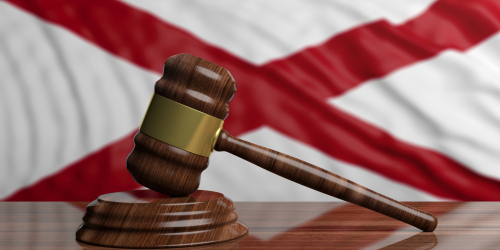
A former Alabama judge accused of using his office for personal gain and lying about it was convicted last week on 17 of 18 counts against him. (Image from Shutterstock)
A former Alabama judge accused of using his office for personal gain and lying about it was convicted last week on 17 of 18 counts against him.
The 17 counts that led to conviction alleged that Judge Gilbert P. Self Sr., the former presiding judge of the Eleventh Judicial Circuit in Lauderdale County, Alabama, used public money for personal purchases.
Prosecutors said Self used public funds to pay for a couch, alcoholic beverages, eyeglasses and vacations—including skiing, cycling and beach trips. He was also accused of using public money for tuition at conferences that he didn’t attend and trying to escape accountability by lying to a grand jury and public auditors.
Alabama Attorney General Steve Marshall announced the verdict Nov. 7.
Publications with coverage include WAFF, AL.com, WAAY and the Alabama Daily News.
Self was acquitted on one count based on an allegation that he hired his son as a law clerk and paid him without proper documentation. Self claimed that he had permission to pay his son through a law library fund, WAFF reports.
One of Self’s defense lawyers, Bryce Graham Jr., scored points during cross-examination of a government witness regarding the salary for Self’s son, Yellowhammer News reports. Graham asked whether Self had repaid the $140,000 in disputed funds and whether that included the salary paid to Self’s son. The witness said it was true.
Graham asked whether that meant that the government received 2½ years of free work from Self’s son. The witness answered in the affirmative.
Graham, 66, died of an apparent heart attack after the second week of trial.
The trial lasted three weeks, according to the state attorney general. Sentencing is scheduled for Dec. 17.
Sixteen of the 17 convictions are felonies. Intentional use of public office for personal gain has a potential sentence of two to 20 years in prison. Making false statements carries a potential sentence of one year and one day to 10 years in prison.
Self had previously blamed the problems on sloppy bookkeeping during the COVID-19 pandemic, according to the Alabama Daily News.
Another defense lawyer, Mark White, told WAFF that he and his client were “obviously disappointed” by the verdict.
White pointed out that the acquittal related to the employment of Self’s son involved the largest amount of disputed money.
White hinted that there would be an appeal.
“This is not the ending,” he told WAFF. “Frankly, on the legal side, it’s the second quarter. It’s not even halftime yet.”
Write a letter to the editor, share a story tip or update, or report an error.

The Karnataka government on Thursday informed the High Court that it has granted permission to Rashtriya Swayamsevak Sangh (RSS) to conduct a route march in Chittapur on November 16 subject to a cap of 300 on the maximum number of participants [ Ashok Patil V Deputy Commissioner and ors].

Bar Exam
Reality TV star Kim Kardashian speaks onstage during the 2020 Winter TCA Tour on Jan. 18, 2020, in Pasadena, California. (Photo by David Livingston/Getty Images)
Reality TV star Kim Kardashian has lost her faith in psychics after “maybe four of them” told her that she would pass the bar exam.
She actually failed the California bar exam, considered one of the most difficult in the country.
Kardashian revealed her anger with the psychics in a TikTok video posted Monday showing clips from her mother Kris Jenner’s 70th birthday bash, report TMZ, People, Page Six, E! News and the Independent.
In the clip beginning at about 16 seconds into the video, Kardashian expressed her disappointment during a phone call.
“I’m just letting you guys know that all of the f- – -ing psychics that we have met with and that we’re obsessed with are all f- – -ing full of s- – -,” Kardashian said. “They all collectively, maybe four of them, have told me I was gonna pass the bar. So they’re all full pathological liars. Don’t believe anything they say.”
Kardashian disclosed the bar exam failure in an Instagram story Saturday.
“I’m not a lawyer yet, I just play a very well-dressed one on TV,” Kardashian wrote, referring to her role in the new Hulu legal drama All’s Fair.
Kardashian skipped law school and studied law through an alternative apprenticeship and study program that is allowed in California. She revealed in December 2021 that she passed the “baby bar,” which is required in California for those who are in apprenticeship programs or attending unaccredited law schools. It was the fourth try.
TMZ spoke with psychic Matt Fraser, who’s featured in the reality television series Meet the Frasers. He said the spirit world operates on a different time frame, and the psychics could eventually be right.
“It could be that she’s going to pass this exam in the future, and this just was not the time,” Fraser said.
Kardashian said she’s not giving up.
“I’m still all in until I pass the bar,” she wrote in her Instagram story.
Write a letter to the editor, share a story tip or update, or report an error.

Benjamin Franklin said, “By failing to prepare, you’re preparing to fail.” Sounds wise, but I doubt Benjamin Franklin carried on a busy litigation practice.
During my 40-plus years in the trenches, I always prepared my clients prior to examinations for discovery, also known in the USA as depositions. But notwithstanding my adherence to Benjamin Franklin’s credo, some of my clients still dropped the ball no matter how well I prepared them.
I would send out a letter describing the process, and, of course, we would meet in advance to go over the case and make sure the clients understood what awaits them. Generally, after explaining the drill and admonishing the client to tell the truth, these instructions specifically boiled down to about five main points.
Easier said than followed. I had a case involving a young woman who suffered severe facial scarring in a motor vehicle car accident. We pleaded that as a result of the wreck, she became depressed. At the discovery, the opposing counsel asked when she started taking her antidepression medication. She replied, “About two years ago, before Christmas, just after I broke up with my fiance.”
This answer opened up a Pandora’s box. The opposing lawyer beamed, as if he just discovered Blackbeard’s treasure. He continued, “Why don’t we delve into this breakup.” His client investigated, interviewing the fiance, who was only too happy to spill some dirt on my client, compromising our case.
Not my fault. I warned her.
After this disaster, I used to reiterate the need to keep it short, even telling clients about my “fiance” case. Needless to say, one client’s pendulum swung the other way. Mike was a sports jock who enjoyed engaging in summer and winter sports, including skiing, hockey, martial arts, marathon running, tennis and pingpong, to name just a few. I was surprised he never participated in an Olympics triathalon.
Unfortunately, he suffered injuries in a car accident, which hit his enjoyment of life big time. At his examination, he took my advice about keeping it short—to an extreme. When asked what he can no longer do, he replied, “I can’t play pingpong.”
I felt like giving him a kick under the table. What flashed in front of me was that iconic James Bond scene in From Russia With Love where Col. Klebb (the Spectre agent) activates a poison switch spike in her shoe as she struggles with Bond. But actually, I felt like kicking myself. Where did I go wrong? At least the client listened to me about keeping his answers short.
A common question defense counsel would ask was, “On a scale of 1 to 10, how would you rate your backaches? One is mild, and 10 is a 911 call.” Although this one got through to most clients, one client here actually said emphatically, “Ten!”
Opposing counsel continued, “Do you want to take a break, so you can call an ambulance?” The client replied, “No, I just have to stand up; I can’t sit for more than 15 minutes straight.”
The problem at this point was that he already had been seated for over an hour.
I just knew my case hit an iceberg. But unlike the Titanic, we had no lifeboats.
I would suggest they leave some wiggle room, saying “about 50 feet” or “approximately three months” or “between 10 and 15 seconds.” Although this suggestion worked most of the time, there is a tendency for people not to want to sound ignorant, and they feel they must be specific.
I was once the beneficiary of an opposing party who, when I asked how fast his truck was traveling in a 30-miles-per-hour zone about 10 seconds before entering the intersection facing an amber light, replied, “I was crawling, 20 miles per hour, neither more nor less.” And yet he could not stop. I went on to another topic quickly, not trying for a home run. Yes!
This was not a common problem, but it once took me aback.
I warned the client that opposing counsel cold be a bit abrasive. To my surprise, my opponent showed up wearing a tie covered with Looney Tunes characters. My client breathed a sigh of relief. He expected an ogre, and he was getting Bugs Bunny.
Furthermore, on the contrary, the two became a bit cordial, and they started discussing favorite cartoon characters. The other lawyer just loved the Road Runner, while my client routed for Wile E. Coyote. They achieved instant rapport, agreeing that the No. 1 character was Yosemite Sam.
The atmosphere throughout was certainly light and jovial. The way the mood persisted, I thought maybe I could leave the room, that my client did not need my services at this stage. Fortunately, the case resolved favorably shortly thereafter. Maybe it helped that I also added my vote of approval of Yosemite Sam.
Benjamin Franklin was right on with his comment about the importance of preparation. But the best of us, no matter how well prepared, will somehow still have some of our cases blow up at the examination office, though maybe not from a device manufactured by Acme bombs.
Marcel Strigberger, after 40-plus years of practicing civil litigation in the Toronto area, closed his law office and decided to continue his humor writing and speaking passions. His latest book is First, Let’s Kill the Lawyer Jokes: An Attorney’s Irreverent Serious Look at the Legal Universe. Visit MarcelsHumour.com, and follow him at @MarcelsHumour on X, formerly known as Twitter.
ABAJournal.com is accepting queries for original, thoughtful, nonpromotional articles and commentary by unpaid contributors to run in the Your Voice section. Details and submission guidelines are posted at “Your Submissions, Your Voice.”







