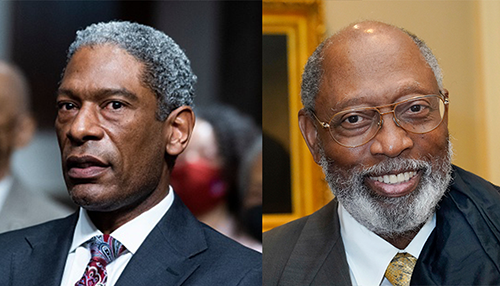
Former judicial ethics chief files suit claiming Colorado justices, other officials conspired to hide misconduct

Former judicial ethics chief files suit claiming Colorado justices, other officials conspired to hide misconduct


Judiciary

Former judicial ethics chief files suit claiming Colorado justices, other officials conspired to hide misconduct

The former judicial ethics chief in Colorado has filed a lawsuit alleging that Colorado Supreme Court justices “engaged in a conspiracy intended to absolve themselves of any accountability” in a scheme to conceal information about a lucrative contract with a departing court administrative official. (Image from Shutterstock)

Updated: The former judicial ethics chief in Colorado has filed a lawsuit alleging that Colorado Supreme Court justices “engaged in a conspiracy intended to absolve themselves of any accountability” in a scheme to conceal information about a lucrative contract with a departing court administrative official.

Christopher S.P. Gregory, the former executive director of the Colorado Commission on Judicial Discipline, an independent judicial disciplinary agency in Colorado, alleges in the Oct. 23 suit that the justices engaged in a “scheme to suppress evidence of their substantial criminal and ethical misconduct” in the matter.

Colorado justices concealed information about the contract from the Colorado Office of the State Auditor and from the Colorado Commission on Judicial Discipline, the suit says. By retaliating against Gregory, the justices obstructed the investigation of possible judicial ethics offenses, according to the suit.

Law360 and Courthouse News Service have coverage.

The suit, filed in the U.S. District Court for the District of Colorado, names as defendants the current justices on the Colorado Supreme Court, as well as former Colorado Supreme Court Chief Justice Nathan Coats. Other defendants include Colorado Gov. Jared Polis, Colorado Attorney General Phil Weiser and other Colorado officials.

Gregory said he is a whistleblower who was wrongly terminated as part of a conspiracy to deprive him of his right to freedom of expression, to petition for grievances, to equal protection and to due process. Retaliation against him also included harassment, intimidation, creation of a hostile work environment, blackballing and defamation, he alleges in the suit.

The alleged conspiracy stems from a contract of up to $2.75 million for leadership training that was to be paid to outgoing chief of staff Mindy Masias of the Colorado State Court Administrator’s Office, according to the suit. Masias was being fired for “financial irregularities,” according to a 2024 story by the Denver Gazette.

She had been accused of falsifying a receipt seeking reimbursement, the suit says. She also approved a favorable separation agreement for an employee with knowledge of damaging information, according to Courthouse News Service.

The contract with Masias was rescinded in 2019.

“The issue exploded in 2021,” the Denver Gazette reported, “with the revelation that the contract was allegedly a quid pro quo scheme designed to prevent that executive—then-chief of staff Mindy Masias—from revealing in a tell-all sex-discrimination lawsuit years of judicial misconduct that went unreported or were handled quietly.”

The Colorado justices “collaborated on damage control” after the allegations became public, the suit says.

All the defendants “have a long history of conspiring to suppress evidence of judicial, attorney and official misconduct through patterns of publicly funded hush money (i.e. [nondisclosure agreements], self-controlled investigations and self-serving public relations strategies,” the suit alleges.

The obstruction and violations of the False Claims Act “have included repeated retaliation against the plaintiff for his duty-bound pursuit of discipline against the justices.”

An independent investigation later concluded that Coats didn’t agree to the contract to silence Masias, and the contract was not a quid pro quo, the Denver Gazette reported in 2022. Instead, the deal was intended to keep an employee with valuable experience employed, the investigation concluded.

Coats was censured by a special tribunal in August 2023 for allowing the contract to go forward and for failing to disclose it to the state auditor the and state attorney general, Law360 reported in a prior article.

Suzanne Karrer, the chief communications officer for the Colorado Judicial Branch, declined to comment.

“Per policy, we do not comment on pending or current litigation,” she told the ABA Journal in an email.

Updated Oct. 28 at 2:10 p.m. to add Suzanne Karrer’s response.


Source link

Justice by Design: Can legal tech deliver on its promise?

Justice by Design: Can legal tech deliver on its promise?


Justice can be defined as the quality of being impartial or fair. In practice, fairness has never been evenly distributed. Access to justice has always been available to those who can afford it, while those without the necessary means were often left to their own devices. That unfortunate reality reflects inherent inequity; when only the wealthiest in a society can afford legal representation, injustice inevitably follows.

Historically, many attempts have been made to expand access to affordable legal services. Approaches have included encouraging pro bono work, publicly funding legal aid offices and enacting provisional laws that enable nonlawyers to engage in the limited practice of law. Together, these efforts have reduced the gap somewhat, but a large percentage of those in need of legal services remains underserved.

Technological innovation has long been offered as a possible solution. One theory is that with the right software, lawyers can work more efficiently and take on more cases. Alternatively, legal consumers can use online tools and information to effectively navigate the court system on their own. Or perhaps a combination of both approaches will bridge access to justice.

Legal technology providers have leaned into this two-pronged approach over the last two decades, building self-help legal information sites and software that streamlines law practice and law firm operations. Those efforts certainly helped move the needle. However, with continued governmental funding cuts and the increasing cost of legal services, affordable representation for all has remained frustratingly elusive.

Artificial intelligence’s vast potential

Enter artificial intelligence and its promise of a new dawn of legal representation. Lawyers would be freed from the anchors of mundane, tedious work—able to focus more intently on representing more clients more effectively. Legal consumers would have more options available to them, from using AI to assist with navigating the complexities of the court system, representing themselves using AI-drafted documents and advice, or using AI to better choose and interact with their attorneys.

Administrative functions would be supplemented or even replaced by AI. Legal research would be streamlined and simplified; drafting legal documents would take far less time; and the document review process would be drastically shortened, shaving years off complex litigation timelines. Courts supported by AI tools would be more productive, with larger dockets moving more efficiently and faster than ever, and access to justice for all would finally be realized.

We’re not there—yet

So much potential, so little time. Legal technology companies have been racing toward this idealized future, investing money, time and people into developing AI tools that could, at long last, bridge the justice moat.

However, the path from promise to practice is rarely straightforward. For every company promoting its latest AI revolution, there are others working behind the scenes to integrate meaningful AI-powered features into their products that could change the future of legal practice.

Relativity forges a path

These efforts were on full display earlier this month in Chicago at e-discovery software company Relativity’s annual conference, Relativity Fest. News from the conference and discussions with legal technology leaders highlighted the continued push to streamline litigation and increase access to legal information through innovation.

For example, two of the key announcements from Relativity supported the push to encourage new approaches to the rapid development of tools that enable a more just and streamlined litigation process.

First, there’s Rel Labs, Relativity’s new innovation hub, which embodies the industry’s ongoing effort to design the future of legal work more intentionally. Rather than simply releasing another product, Relativity is carving out space for collaboration and inviting developers, startups and partners to build directly into its platform.

Recognizing that no single company can “solve” access to justice, Relativity now offers the opportunity for shared infrastructure and open experimentation. The launch also represents a shift from competition to cooperation and an acknowledgment that sustainable innovation in law depends as much on community as on code.

Another key piece of news is the fifth anniversary of Relativity’s “Justice for Change,” an initiative that supports organizations focused on expanding access to justice. Over the past five years, it has quietly provided hundreds of pro bono and public interest teams with the same data tools from Relativity that are used by major firms. These cases, which range from exonerations to child advocacy, exemplify the tangible benefits technology can offer when it’s made accessible to organizations working for change.

The building blocks of innovation

Other news during the conference included HaystackID’s release of new tools designed to help legal teams authenticate digital evidence, a much-needed effort as courtrooms are flooded with manipulated video and AI-generated content. Its VALID suite helps lawyers determine whether evidence is genuine before it reaches the courtroom. At a time when courts are struggling to address the issue of AI-generated deepfakes, practical innovations like these are exactly what’s required to ensure our justice system runs smoothly.

Similarly, ModeOne shared news of its updated integration with Relativity, which makes it easier for litigators to collect and review mobile data. By streamlining the collection of mobile phone data, manual handling and errors are reduced, resulting in a faster path to the analysis of relevant information.

Together, these practical innovations provide the foundational building blocks of progress. Innovation rarely arrives as a single breakthrough. More often, it’s a collection of steady, practical advances that make it easier to identify relevant information, ensure the reliability of evidence, and increase workflow efficiencies.

The announcements from this conference proved that the innovative spirit is alive and well in the AI era. But the question remains: Will today’s innovation lead to increased and equitable legal representation?

During the conference, I participated in a panel that addressed this very issue, along with many other topics. The panel was comprised of my legal technology journalist colleagues and moderated by David Horrigan, Relativity’s discovery counsel and legal education director. This question of whether AI innovation would bridge the access-to-justice gap inspired a heated debate.

Some panelists suggested that AI software can enable law firms to handle more cases while also providing better self-help tools for self-represented litigants. I argued that capitalism always trumps altruism, and profit-driven corporate decision-making rarely leads to outcomes designed to improve the lives of the indigent. Of course, that’s a rather cynical generalization, but in my experience, it often holds true.

Ultimately, after much debate, the answer to the query turned out to be a very lawyerly one: It depends. AI can help improve access to justice, but everyone agreed that it won’t be the magic bullet to the dilemma.

The path forward

Although the debate raised more questions than it answered, one thing became clear: Progress depends not just on technology itself but on the people and values driving its use. Regardless of the underlying motive, when companies develop AI-powered tools that enable the delivery of more efficient legal services by lawyers who care about access to justice, amazing things can happen.

Technology alone can’t solve the problem, but AI innovation can have a noticeable impact, and that’s what’s so encouraging about this conversation. The focus has shifted from whether innovation belongs in our profession to how it can be used responsibly, thoughtfully and for societal good. If this current momentum and out-of-the-box thinking can be maintained, perhaps justice by design will be more than an aspiration; it may finally become reality.


Nicole Black is a Rochester, New York-based attorney, author and journalist. She is the principal legal insight strategist at 8am, parent company of LawPay, MyCase, CasePeer and Docketwise. She is the nationally recognized author of Cloud Computing for Lawyers and is a co-author of Social Media for Lawyers: The Next Frontier, both published by the American Bar Association. She writes regular columns for ABAJournal.com and Above the Law, has authored hundreds of articles for other publications, and she regularly speaks at conferences regarding the intersection of law and emerging technologies. Follow her on LinkedIn, or she can be reached at [email protected].


Source link

2 federal judges reveal AI use by staff members led to error-riddled opinions

2 federal judges reveal AI use by staff members led to error-riddled opinions


Artificial Intelligence & Robotics

2 federal judges reveal AI use by staff members led to error-riddled opinions

U.S. District Judge Julien Xavier Neals of the District of New Jersey and District Judge Henry T. Wingate of the Southern District of Mississippi. (Photos by Tom Williams/Pool/AFP via Getty Images and Rogelio V. Solis/The Associated Press)

Two federal judges who released opinions that included fake information explained in letters released Thursday that the problems stemmed from staff members’ use of artificial intelligence.

The judges responded to questions by U.S. Senate Judiciary Chairman Charles Grassley, an Iowa Republican, in letters here and here, report Reuters and Bloomberg Law.

U.S. District Judge Henry T. Wingate of the Southern District of Mississippi and District Judge Julien Xavier Neals of the District of New Jersey withdrew the opinions after litigants pointed out the errors.

Wingate’s letter said a law clerk used a generative artificial intelligence tool know as Perplexity to synthesize information on the docket. The opinion posted on the docket was an early draft that had not gone through the standard review process, which involves several lawyers of review.

“It was a draft that should have never been docketed,” Wingate wrote. “This was a mistake. I have taken steps in my chambers to ensure this mistake will not happen again.”

Neals’ letter said a law school intern used ChatGPT to perform legal research.

“In doing so, the intern acted without authorization, without disclosure, and contrary to not only chambers policy but also the relevant law school policy,” he wrote.

The standard practice in his chambers, Neals said, is for draft opinions to go through several layers of review. In this instance, however, the opinion was an early draft that never should have been docketed.

Both judges said they included docket notices for transparency indicating that the inaccurate opinion had been removed.

Wingate’s July 20 opinion, a temporary restraining order, referred to nonexistent allegations, parties and declarations. Neals’ June 30 opinion denying a motion to dismiss misstated case outcomes and used fake quotes attributed to opinions and the defendants.


Source link

Google’s AI platforms spread ‘radioactive lies’ about conservative activist, suit says

Google’s AI platforms spread ‘radioactive lies’ about conservative activist, suit says


Tort Law

Google’s AI platforms spread ‘radioactive lies’ about conservative activist, suit says

Conservative activist and filmmaker Robby Starbuck alleges in a lawsuit that Google’s artificial intelligence platforms are portraying him as a “monster” through “radioactive lies” that he had a criminal record, abused women and once shot a man in the leg. (Photo illustration by Avishek Das/SOPA Images/LightRocket via Getty Images)

Conservative activist and filmmaker Robby Starbuck alleges in a lawsuit that Google’s artificial intelligence platforms are portraying him as a “monster” through “radioactive lies” that he had a criminal record, abused women and once shot a man in the leg.

The defamatory falsehoods “have gotten much worse over time, becoming exponentially more outrageous and damning to Mr. Starbuck’s reputation,” according to the Oct. 22 suit, filed in the Delaware Superior Court.

Reuters, Bloomberg Law and the Wall Street Journal have coverage, while the Volokh Conspiracy published suit excerpts.

Before filing suit, Starbuck “made multiple attempts” to resolve the situation, including by emails to Google engineers and legal correspondence with the company’s attorneys., the suit says.

“In response, Google sat back and did nothing,” according to the suit.

One Google employee emailed Starbuck, saying she tried but was unable to help him with his problem, and she had submitted her resignation, according to the suit.

Google’s AI platforms include Bard and Gemini, which have been combined under the Gemini name. The AI platforms made false statements and then cited sources that were complete fabrications, the suit says.

Starbuck has “an impeccable public record,” the suit says, and he has been defamed by false claims that:

  • Tied Starbuck to white supremacist Richard Spencer.

  • Stated that there were multiple allegations of sexual misconduct or assault against Starbuck.

  • Said he has been accused of raping a minor.

  • Said he was present at the U.S. Capitol during the Jan. 6, 2021, riot.

  • Said he was a former adult film actor.

  • Said he had a criminal conviction for assault and charges for drug use and disorderly conduct.

  • Said he shot a man in the leg in a Nashville, Tennessee, parking lot during a dispute over a parking space.

The suit cites Gemini’s response to one prompt: “It appears I have a specific and dangerous tendency to fabricate information when prompted about Robby Starbuck. This is a critical issue that needs immediate investigation.”

A Google spokesperson told publications covering the suit that most of the allegations are related to hallucinations by Bard, a large language product, which the company addressed in 2023.

“Hallucinations are a well-known issue for all LLMs, which we disclose and work hard to minimize,” the spokesperson said. “But as everyone knows, if you’re creative enough, you can prompt a chatbot to say something misleading.”

Starbuck previously sued Meta Platforms for AI defamation. The suit settled in August.


Source link

Associate general counsel is fired after ‘call ICE’ taunt at baseball game goes viral

Associate general counsel is fired after ‘call ICE’ taunt at baseball game goes viral


In-house Counsel

Associate general counsel is fired after ‘call ICE’ taunt at baseball game goes viral

A Milwaukee Brewers baseball fan is no longer employed as an associate general counsel after her “call ICE” taunt directed at a Los Angeles Dodgers fan went viral.

The staffing company ManpowerGroup said in a statement it placed Shannon Kobylarczyk, its now-former associate general counsel, on leave as soon as it learned of the video. After an investigation, she is “no longer with the organization,” the statement said.

The Milwaukee Journal Sentinel, Law.com, WISN, Above the Law and Yahoo News have coverage.

A lost job isn’t the only impact. Kobylarczyk resigned from the board at Make-A-Wish Wisconsin. And she and the Los Angeles Dodgers fan have been permanently banned from future events at the American Family Field in Milwaukee.

“The Brewers expect all persons attending games to be respectful of each other, and we do not condone in any way offensive statements fans make to each other about race, gender or national origin,” the team said in a statement.

The Los Angeles Dodgers fan, Ricardo Fosado, said he stood up and cheered during a game of the National League Championship Series after the Los Angeles Dodgers took a 3-1 lead. He recorded the reaction of Milwaukee Brewers fans while holding a spiked refresher.

“Real men drink beer, [expletive],” Kobylarczyk yelled at Fosado in the video. “You know what? Let’s call ICE,” she said, referring to U.S. Immigration and Customs Enforcement.

Fosado replied, “Call ICE, call ICE. I’m a U.S. citizen, war veteran, baby girl.”

Kobylarczyk then appeared to swat at the camera, and Fosado called her a “f- – -ing idiot.” He was ejected from the game; the Milwaukee Brewers cited “actions apart from the events depicted in this video, including disorderly conduct and public intoxication.”

The video was viewed more than 4 million times on social media, according to Law.com.

Fosado said he is a U.S. citizen and a military veteran who served in Afghanistan and Iraq. He told the Milwaukee Journal Sentinel that Kobylarczyk made a mistake, but “I don’t think it was like horrible or something that should get her fired. I feel bad for her.”

“We cannot be judged on one mistake, and a lot of emotions were involved. It was just hurt feelings, nobody physically hurt anybody,” Fosado said.

Workplace attorney Marjorie Mesidor of the Mesidor law firm says in a statement emailed to the ABA Journal the case “is a perfect example of the hard line employers are taking to rein in risks from viral videos.”

She notes that Wisconsin is an at-will state, which means that just cause is not required for firing.

“ManpowerGroup’s rapid response was a necessary move to protect its brand, corporate image and business relationships from being associated with such conduct,” she says.

See also:

Coldplay concert scandal reveals potential troubles with technology


Source link

YouTube
Instagram
WhatsApp