Trump’s plan to penalize states using cashless bail is unconstitutional and unnecessary, critics say

Trump’s plan to penalize states using cashless bail is unconstitutional and unnecessary, critics say


Criminal Justice

Trump’s plan to penalize states using cashless bail is unconstitutional and unnecessary, critics say

Critics are raising questions about the constitutionality and wisdom of President Donald Trump’s executive order seeking to pressure states to require cash bail for defendants charged with a variety of crimes. (Image from Shutterstock)

Critics are raising questions about the constitutionality and wisdom of President Donald Trump’s executive order seeking to pressure states to require cash bail for defendants charged with a variety of crimes.

In his Aug. 25 executive order, Trump called for the federal government to withhold grants and contract funds to jurisdictions that have “substantially eliminated” cash bail for charged crimes “that pose a clear threat to public safety and order, including offenses involving violent, sexual, or indecent acts, or burglary, looting or vandalism.” In a second Aug. 25 order, Trump called for “appropriate actions,” including funding decisions, to press Washington, D.C., to change its policies on cashless bail.

Trump’s plan to withhold funds “is simultaneously an attack on federalism and an attempt to usurp Congress’ spending power,” wrote Ilya Somin, a professor at the George Mason University Antonin Scalia Law School, at the Volokh Conspiracy. “Supreme Court precedent—most of it authored by conservative justices—holds that only Congress can impose conditions on state and local governments receiving federal grants, and those conditions must be clearly stated in the statutes allocating the funds.”

U.S. Supreme Court precedent requires that grant conditions be clearly indicated by Congress, be related to the purpose of the grant, and not be coercive, Somin said.

“In addition,” he wrote, “this is an attempt to insert the federal government in a core traditional area of state and local authority. Few powers are more central to state and local autonomy than control over state criminal law enforcement.”

Washington, D.C., provided a roadmap for other states when it eliminated cash bail in 1992, Bloomberg Law reports. The Brennan Center for Justice at the New York University School of Law identified 19 states and one city that enacted reforms related to pretrial release over the decade ending in 2023. The report focused on five of those states. Three of them repealed some of the changes, and in two others, judges appeared reluctant to order pretrial release despite reforms.

Among the jurisdictions, details varied. Illinois eliminated cash bail entirely, while New Jersey eliminated it for most cases. Some eliminated cash bail for only certain lower-level crimes. Some required ability-to-pay determinations or the least restrictive means of release.

Judges in jurisdictions with cashless bail still consider whether to detain a defendant based on criteria that include criminal history and whether the charged crime involves violence, explain Bloomberg Law and CNN. Illinois, for example, created a default rule that all people charged with an offense are eligible for pretrial release on personal recognizance, subject to conditions of release set by a judge. Defendants who are considered a danger to the public or a flight risk will be held.

The ABA supports limits on the use cash bail and supports the elimination of bail schedules that consider only the nature of the charged offense, according to a 2017 ABA Journal article written by the ABA Governmental Affairs Office.

Supporters of cashless bail say it ensures fairness because defendants without money to pay bail will be treated the same as those who can afford it. They also say it prevents poor defendants from losing their jobs while they are in jail, which could lead them to commit crimes to support themselves or their families.

One 2013 study found a strong correlation between length of pretrial detention and likelihood of committing more crimes, according to a 2016 story by the Journal. Researchers suggested that as the time in detention increases, the detainees’ place in the community becomes more destabilized, increasing the risk of reoffending.

Supporters of cashless bail also point to findings showing that the practice does not endanger public safety.

The District of Columbia’s Pretrial Services Agency has reported that 87% of defendants in superior court were released before trial in fiscal year 2024, and 89% of them were not rearrested, the Washington Post reports. At the national level, 87% of people released before trial were not rearrested while on release, the agency said.

A study of dozens of jurisdictions by the Brennan Center for Justice found no statistically significant relationship between bail reform and crime rates. The findings hold true even when considering cashless bail states such as New Jersey and Illinois, the researchers found.

Those who oppose cashless bail say jurisdictions that prevent pretrial detention for lower-level crimes are impeding judges’ ability to detain people who cycle in and out of the justice system.

“You have ‘turnstile justice’ where recidivists have been arrested for the same crime hundreds of times … and you can’t impose bail,” said James Gagliano, a retired FBI supervisory special agent who spoke with CNN. “It’s wrong, and it doesn’t fix the system.”

One example cited by those who want to keep cash bail is the case of a teenager charged with the fatal October 2024 beating of DJ and hair stylist Bryan Smith. The accused teen had five pending charges for robbery and assault at the time of the crime, according to Bloomberg Law.

See also:

ABA weighs in on California Supreme Court case affecting state’s new bail reform law


Source link

Riding Camels in Mongolia With Justice Sandra Day O’Connor: A journey of friendship and the rule of law

Riding Camels in Mongolia With Justice Sandra Day O’Connor: A journey of friendship and the rule of law


When the conversation ended, I simply stared into space, stunned. I must have misheard the official from the U.S. Agency for International Development. This can’t be happening to me, I thought.

“We would like you to accompany Justice Sandra Day O’Connor on her trip to Mongolia this fall to support democratic reforms,” he said. It was summer 2000, and I had just returned from Mongolia, where I helped develop the country’s first justice system strategic plan.

I was astonished and elated by the opportunity—but not intimidated—as I had first met Justice O’Connor in Bulgaria in 1994, where I was serving as a pro bono rule of law liaison for the Central and East European Law Initiative, a project of the American Bar Association. Justice O’Connor, the first member of CEELI’s executive board, was in Bulgaria for its 1994 board meeting.

At the suggestion of Homer Moyer Jr. and Talbot “Sandy” D’Alemberte, CEELI was founded after the fall of the Berlin Wall to support democratic transitions abroad by providing U.S. legal expertise in judicial reform, strengthening of legal frameworks, and promoting accountability and transparency in governance. USAID was its principal funder with additional support from the Department of State.

Within its first decade, CEELI mobilized more than 5,000 American lawyers, judges and legal scholars, serving as unpaid volunteers, to work in former communist countries alongside their counterparts—local legal pioneers committed to advancing the rule of law. Together, they helped improve the lives of millions across more than two dozen nations.

Justice O’Connor was deeply committed to CEELI’s historic mission. Over more than a decade, she never missed a single board meeting.

Working with CEELI became my passion, leading me to volunteer for five years. Over that time, Justice O’Connor and I developed both a professional and personal friendship. We met often at the Supreme Court and shared meals together with her husband, John, in Washington, D.C., at their Arizona home and in my hometown, San Francisco.

I was thrilled to return to Mongolia. After the era of Genghis Khan, Mongolia had nearly become forgotten. That changed in the 1990s with the collapse of communism, which hurled Mongolia back onto the world stage. Mongolians were no longer the only ones who knew how stunningly beautiful their remote country was.

When Justice O’Connor and John arrived in Ulaanbaatar, the capital of Mongolia, their first request was to visit the countryside. That didn’t surprise me, since I knew Justice O’Connor would be more at home roaming the hills among wandering cattle than whirling around Ulaanbaatar in a Russian-built automobile.

It was during this trip to Mongolia that I got to know John well. He and Justice O’Connor were remarkably similar—exceptionally intelligent and lighthearted when off duty. Although a nationally prominent lawyer, John, like Justice O’Connor, never let titles interfere with friendships or professional relationships. His self-confidence was essential to their relationship. When others heaped praise on Justice O’Connor, he would remind her that she was once a cowgirl who rode horses and swam in a cattle tank. No matter how often he said it, she always laughed.


U.S. Supreme Court Justice Sandra Day O’Connor (center) and Mary Noel Pepys (right) pose with a local man and a camel in Mongolia in 2000. (Photo courtesy of Mary Noel Pepys)

On our first day, our driver took us on a countryside tour. As we drove through the open landscape, Justice O’Connor lit up at the sight of Mongolian cowboys with their lassos.

“The horses make me feel at home,” she said, pointing to one in the distance. “That reddish-brown one looks like Chico.” He was her favorite horse on her family’s ranch.

To learn how nomadic cowboys live, I suggested we visit a family living in a ger— a Mongolian yurt. Though uninvited, I reassured them that in nomadic cultures like Mongolia, strangers are always welcomed.

As we approached, a graceful woman emerged from her ger and introduced herself as Altansarnai. There was no need to identify us beyond being Americans—nomadic Mongolians measure status by livestock, not titles.

Altansarnai invited us into her ger and offered lunch. What looked stark from the outside dazzled us inside. The floors and walls were covered with vibrantly colored rugs and fabrics in stately jewel tones. Above the ger hung a side of raw mutton—stored there for lack of refrigeration. Altansarnai brought it inside and whacked it into small pieces. Beside the wooden stove sat a container of cow dung, which she used to heat both her ger and our meal.

With help from our driver, we asked her opinion of elections in Mongolia. She eagerly described the recent presidential race, concluding, “There is a sanctity in freely voting for the candidate of your choice.” Justice O’Connor and I sighed.

Americans often take for granted rights handed to them on a silver platter.

On our return to Ulaanbaatar, Justice O’Connor grew curious as we passed a village with a modest courthouse and three camels nearby. I described its interior from a prior visit: one courtroom, a shared office for three judges, a hallway with benches—and no restroom. “You mean the courthouse has its own outhouse?” John quipped. We all laughed, picturing robed judges trudging through snow to a shack midtrial.

Back at the hotel, Justice O’Connor reviewed her 10-page schedule promoting democratic reforms: numerous briefings with U.S. and Mongolian governmental officials, a keynote at a rule of law conference, a roundtable with Mongolia’s women trailblazers, a seminar with law students, press conferences and official dinners. Exhausting for John and me—but not for Justice O’Connor.

On our last day in Mongolia, she asked if we could take a camel ride. She had to be joking. “A camel ride,” she repeated calmly, as if asking for a cup of tea.

I had worked hard to accommodate not only the needs of Mongolians but also to anticipate Justice O’Connor’s interests. A camel ride was not among them, and arranging it at the last minute was impossible.

However, Justice O’Connor was like the E.F. Hutton ad from the 1980s—when she spoke, people listened.

Dressed as we were, we set off to ride the camels. As mine lurched forward to stand, I shrieked, certain I was about to be catapulted to the ground. Justice O’Connor, on the other hand, sat tall and steady, her hand resting casually on the saddle. Once a cowgirl, always a cowgirl.

Two decades later, during my last visit with Justice O’Connor at her retirement home in Phoenix—her dementia seeping into our limited conversation—I reminisced about our trip to Mongolia, her love for CEELI and her commitment to the universal importance of the rule of law.

She praised the 5,000 American lawyers and judges for their unwavering commitment to advancing the rule of law abroad, describing their volunteerism as a hallmark of American citizenship and an inspiring act of selflessness that made a meaningful difference in the lives of others.

One can only wonder what Justice O’Connor would make of the global backsliding of the rule of law, now compounded by USAID’s dismantling. Knowing her as I did, I’m confident she would urge us to press on—at home and abroad—to resist authoritarianism, defend human rights and uphold the rule of law. Let’s commit to doing just that.


Since 1993, Mary Noel Pepys has helped to advance the rule of law in more than 45 countries, specializing in international legal and judicial reform. More recently, she has focused on the rule of law and judicial independence in the United States through the Alliance for American Rule of Law, a network of international rule of law practitioners.


ABAJournal.com is accepting queries for original, thoughtful, nonpromotional articles and commentary by unpaid contributors to run in the Your Voice section. Details and submission guidelines are posted at “Your Submissions, Your Voice.”


Source link

Estranged son of Donna Adelson, charged with law prof’s murder, called as a government witness

Estranged son of Donna Adelson, charged with law prof’s murder, called as a government witness


Criminal Justice

Estranged son of Donna Adelson, charged with law prof’s murder, called as a government witness

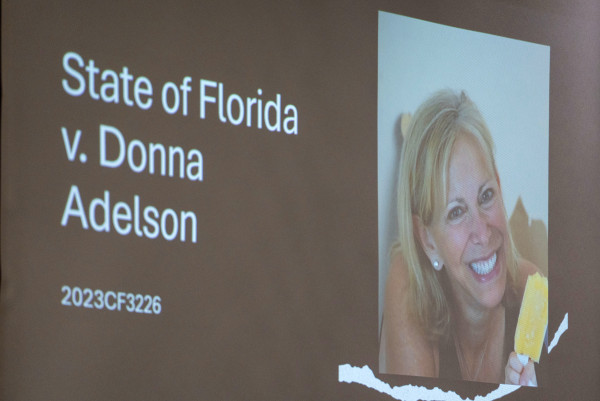
Government exhibit from the murder trial of Donna Adelson. (Photo by the Tallahassee Democrat via the Associated Press)

New York physician Robert Adelson, the estranged son of murder defendant Donna Adelson, testified about an unusual phone call during his mother’s trial this week in Tallahassee, Florida, for the murder of a law professor who was her former son-in-law.

It was the first time Robert Adelson testified in any prosecutions in the case, one of which led to the November 2023 conviction of another of Donna Adelson’s sons, dentist Charlie Adelson.

Donna Adelson is accused of seeking the murder of Florida State University College of Law professor Dan Markel to allow her daughter Wendi Adelson, a lawyer who was Markel’s ex-wife, to relocate with the couple’s two children from Tallahassee to be near the family in Miami.

Robert Adelson testified Monday that his mother called on his wedding anniversary, which was two days after the arrests of two alleged hit men, the first arrests in the case. Publications covering the testimony include the Tallahassee Democrat (here and here) and WCTV.

Robert Adelson said he considered the arrests “big news” but his mother did not bring it up during the phone call. He finally broached the topic, according to the Tallahassee Democrat’s coverage. “I said it at least two or three times—that they made an arrest, they got the guy who killed Danny,” Robert Adelson testified. “And her response was, ‘I’ve got to go.’ ”

“That was the last time I spoke with her,” he said.

Robert Adelson also testified about the family dynamic, according to a news analysis by the Tallahassee Democrat that labeled him “the most credible witness on the stand.”

“He testified Donna is controlling and rigid with fixed ideas regarding her children and their lives,” the newspaper reports. “He described his sister Wendi as acting like a ‘damsel in distress’ during the divorce.”

Donna Adelson approved of Markel until Wendi Adelson left him, Robert Adelson testified. Donna Adelson helped her daughter and the children leave while Markel was away for a speaking engagement and was gleeful when her daughter told Markel she had left just before he went on stage.

Wendi Adelson, who has not been charged, denied any involvement in the murder, the Tallahassee Democrat reports in a separate story. In testimony on Monday, she described the legal custody battle with Markel and her inability to get a judge to agree that she should be allowed to relocate with the children. She also said her brother Charlie Adelson had joked about hiring a hit man to kill Markel.

Earlier in the day, an investigator testified that Markel had filed a March 2014 motion to prevent Donna Adelson from having unsupervised visits with the children after they reportedly told Markel that “Grandma says she hates you.”

A hearing on the motion never occurred because Markel was killed beforehand.

Donna Adelson is the fifth person prosecuted in the case. The last person convicted was her son, Charlie Adelson. The alleged triggerman, Sigfredo Garcia, was convicted, and his alleged accomplice, Luis Rivera, pleaded guilty to second-degree murder. An alleged go-between accused of hiring the hit men for Charlie Adelson, Katherine Magbanua, was also convicted.

See also:

‘Can a killer look like a granny?’ Prosecutor poses questions as mother-in-law of slain law prof goes on trial


Source link

Equity partner profits jump 13.7% in first half of 2025 amid rising law firm revenue

Equity partner profits jump 13.7% in first half of 2025 amid rising law firm revenue


Law Firms

Equity partner profits jump 13.7% in first half of 2025 amid rising law firm revenue

Law firms held the line on equity partner ranks in the first half of 2025 as revenue increased, helping profits per equity partner increase 13.7% from the same period last year, according to a six-month survey of mostly larger firms by Wells Fargo’s Legal Specialty Group. (Image from Shutterstock)

Law firms held the line on equity partner ranks in the first half of 2025 as revenue increased, helping profits per equity partner increase 13.7% from the same period last year, according to a six-month survey of mostly larger firms by Wells Fargo’s Legal Specialty Group.

The number of equity partners increased by only 0.7% in the first half of the year, compared to the same time last year. At the same time, firm revenue increased 11.3% and net income increased 14.5%, Wells Fargo said Tuesday in a summary of the findings.

Nonequity partners are the fastest growing category of lawyers in firms, increasing more than 5% from the same period last year, according to the survey. Overall, lawyer head count was up 3.4%.

Increases in standard billing rates, up 9.2% from the first six months of 2024, are the primary reason for revenue growth.

On the downside, demand for legal services decreased 2.1% in the year’s first half, well below the 3.2% growth forecasted by firms in January.

The increase in nonequity partners contributed to lawyer compensation growth of 10.4%. Overhead costs, which include professional staff salaries and general expenses, were up 8.6%.

More than 130 firms took part in the survey, including 67 of the nation’s 100 top-grossing firms and 46 firms with gross revenues putting them in the Am Law Second Hundred.


Source link

Retired judge sexually assaulted assistant in courthouse stairwell, lied to investigators, federal indictment says

Retired judge sexually assaulted assistant in courthouse stairwell, lied to investigators, federal indictment says


Judiciary

Retired judge sexually assaulted assistant in courthouse stairwell, lied to investigators, federal indictment says

A retired superior court judge in Fresno County, California, has been charged in a federal indictment with an alleged sexual assault of a judicial assistant and then lying about that attack and about a second incident. (Photo by Matthew Field, CC-BY-SA-3.0, via Wikimedia Commons)

A retired superior court judge in Fresno County, California, has been charged in a federal indictment with an alleged sexual assault of a judicial assistant and then lying about that attack and about a second incident.

Retired Judge Adolfo Corona, 66, is charged in an Aug. 21 indictment, according to an Aug. 22 press release and reporting by Law.com, Bloomberg Law and the Fresno Bee.

He is charged with deprivation of the right to bodily integrity under color of law, false statements with the intent to hinder law enforcement, and attempted alteration of a document to impair its use in an official proceeding.

Both incidents allegedly happened at the Fresno County Courthouse in California.

The indictment alleges that Corona sexually assaulted a judicial assistant in a stairwell in March 2024 and made false statements about it during an administrative investigation and a criminal investigation by the FBI.

He is accused of falsely telling an investigator that the woman grabbed his phone while they were in the stairwell and added her cellphone number to it. He is also accused of falsely telling FBI agents that he led the woman into a stairwell because he was going to go back upstairs to work after giving the woman a gift.

Corona actually penetrated the woman with his fingers without her consent and then left the courthouse, the indictment alleges.

The indictment alleges that Corona also made false statements to the FBI during an investigation of a December 2023 incident involving another judicial assistant who was found alone in his chambers with her pants unbuttoned after passing out. Corona had been alone with the woman for about two hours, and she was found about 30 minutes after he left, the indictment says.

Corona had claimed that he left the woman alone in his chambers while he drove to a motorcycle dealership to pick up his motorcycle. Prior to his statements, he had called the dealership and asked an employee to falsify records for the date that he picked up his motorcycle to coincide with the date of the incident in his chambers, the indictment alleges.

Corona was formerly indicted for the alleged sexual assault by a grand jury in Fresno County, according to the news reports. He pleaded not guilty.

A lawyer for Corona, Margarita Martinez-Baly, told Law.com that Corona will “definitely” plead not guilty to the federal charges.

Corona retired in April 2024 after serving as a judge for more than 20 years.


Source link

DC Circuit cites ‘constitutional concerns’ even as it rejects challenge to suspension of federal appeals judge who’s 98

DC Circuit cites ‘constitutional concerns’ even as it rejects challenge to suspension of federal appeals judge who’s 98


Judiciary

DC Circuit cites ‘constitutional concerns’ even as it rejects challenge to suspension of federal appeals judge who’s 98

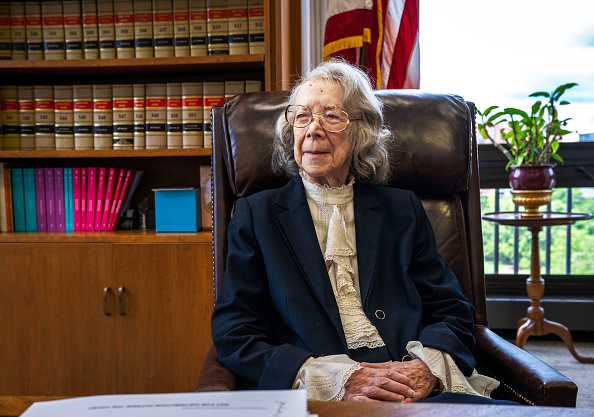
Judge Pauline Newman, now age 98, of the U.S. Court of Appeals for the Federal Circuit in May 2023. (Photo by Bill O’Leary/The Washington Post via Getty Images)

The U.S. Court of Appeals for the District of Columbia Circuit ruled Friday that it does not have jurisdiction to review the bulk of Judge Pauline Newman’s challenge to her suspension, saying it was bound by 2001 precedent that it cannot overrule.

The appeals court said the only argument that it could consider was that the statute on judicial suspensions for disability was unconstitutional on its face, and that argument failed because Newman of the U.S. Court of Appeals for the Federal Circuit agrees that the law is constitutional in some applications.

Other challenges by Newman are barred by a 2001 D.C. Circuit decision holding that the U.S. Judicial Conference is the exclusive body that can review statutory and as-applied constitutional challenges to judicial council orders, the D.C. Circuit said.

The D.C. Circuit questioned the 2001 precedent and appeared to invite further review, according to experts who spoke with Law360 and Paul Cassell, a professor at the University of Utah S.J. Quinney College of Law, who wrote about the case at the Volokh Conspiracy.

The decision “is about as clear an invitation by a panel to the losing side to file a petition for rehearing en banc as I’ve ever seen,” said Arthur Hellman, a professor at the University of Pittsburgh School of Law, in an interview with Law360.

Newman, 98, is a judge for the Federal Circuit. The Federal Circuit’s judicial council has suspended Newman from hearing new cases since 2023 because she refused to submit to medical evaluations to probe allegations that she suffered from memory loss and confusion.

Newman’s lawsuit challenged the Judicial Conduct and Disability Act, which authorizes judicial councils made up of fellow judges to investigate allegations of disability against federal judges. She argued that a statutory provision authorizing temporary suspensions is facially unconstitutional, that the same provision is unconstitutional as applied to her because she was effectively removed without impeachment, and that the judicial council exceeded its statutory authority because her suspension is not temporary. She also claimed that her due process rights were violated because her case was not transferred to another district.

The precedent binding the D.C. Circuit panel is McBryde v. Committee to Review Circuit Council Conduct & Disability Orders of the Judicial Conference of the United States.

“Judge Newman cannot show that McBryde has been eviscerated or that her specific claims escape its grasp,” the D.C. Circuit said. “We thus lack jurisdiction over her statutory and as-applied constitutional challenges.”

The D.C. Circuit said its decision against Newman is unrelated to the strength of her claims and does not reflect its views on the underlying dispute.

According to the D.C. Circuit, the McBryde decision may suggest that no forum is available to decide Newman’s claims if the Judicial Conference declines consideration. And giving the Judicial Conference the power to decide would mean that the conference, rather than the U.S. Supreme Court, would have “the last word on major questions of constitutional law.”

“The seeming absence of a judicial forum to address Newman’s as-applied constitutional claims itself raises constitutional concerns,” the appeals courts said. Newman presents “substantial arguments” that her suspension “threatens the principle of judicial independence and may violate the separation of powers. She further contends that the refusal to transfer her case to a different circuit deprived her of an impartial tribunal, which if correct would raise due process concerns. … Those doubts, however, would at most suggest that McBryde was wrong the day it was decided, not that it does not bind us now.”

Because Newman’s claims can’t be heard “in any Article III forum,” the appeals court said. it is “up to the judicial council and the Judicial Conference to genuinely engage with those arguments.”

Cassell, who signed an amicus brief urging review of Newman’s claims on the merits, said the opinion suggests “some possible new judicial avenues Judge Newman might consider,” including en banc review by the D.C. Circuit and the possibility of mandamus review by the Supreme Court.

A lawyer for Newman, John J. Vecchione of the New Civil Liberties Alliance, a nonprofit public interest law firm, told Law360 that he thinks that the D.C. Circuit provides “a road map.”

“I assure you we will be moving forward. I just can’t tell you with exactly what procedure yet,” he said.


Source link

YouTube
Instagram
WhatsApp