Meet May Mailman, the lawyer leading Trump administration’s pursuit of universities

Meet May Mailman, the lawyer leading Trump administration’s pursuit of universities


Careers

Meet May Mailman, the lawyer leading Trump administration’s pursuit of universities

May Mailman, the lead counsel and director of the Independent Women’s Law Center, speaks during a news conference in May 2024 in Denver. (Phot by David Zalubowski/The Associated Press)

A 37-year old lawyer known for her “ruthless efficiency and engaging personality” is leading the Trump administration’s effort to “root out perceived liberal bias from colleges and deter the use of race in admissions,” according to a profile in the New York Times.

A 2015 graduate of Harvard Law School, May Mailman “is the most important, least-known person behind the administration’s relentless pursuit of the nation’s premier universities,” the article reports. She helped create the policies being used against universities and is leading negotiations with targeted institutions.

Her influence began at the start of President Donald Trump’s second term when he signed two executive orders that she had written. One called for an end to race-and sex-based preferences intended to promote diversity. The other declared that it is U.S. policy to recognize only two sexes that are not changeable.

The transgender policy had an impact on the University of Pennsylvania, which agreed to adhere to the administration’s definition of sex in connection with transgender athletes in women’s sports. The statement helped resolve an investigation by the U.S. Department of Education’s Office for Civil Rights.

Mailman also “had a direct hand” in seeking to ban the enrollment of international students at Harvard University and “closed a $221 million deal” with Columbia University that settled allegations that it failed to stop the harassment of Jewish students, the New York Times says. The Columbia deal led to restoration of its research funding, according to past coverage by the New York Times.

The administration wants to change Harvard’s hiring practices, admissions policies and governance, the Boston Globe reports. The pressure campaign against the school also included canceling nearly $3 billion in federal grants and threatening its accreditation.

Harvard is challenging the administration’s actions.

Mailman told the Boston Globe that her goal is to make Harvard better.

“It doesn’t feel like I’m against Harvard,” Mailman said.

Mailman’s pursuit of universities began as a senior policy strategist. She plans to leave the White House because of a pregnancy and is currently a senior adviser for special projects, a role in which she will continue as lead negotiator with targeted universities.

Mailman became interested in Republican politics in college at the University of Kansas when she saw former President George W. Bush at a campaign event. She had “various roles” in the first Trump administration after she left her job at a law firm to work there.

Mailman grew up in Kansas in mostly white towns after her father, a physician, met her mother, a teacher, when he was in South Korea vaccinating children. She dealt with childhood taunts by using her wits, she told the New York Times.

After her first stint in the White House, Mailman became the deputy solicitor general of Ohio and married a former baseball player. They currently live in Texas with their two children.

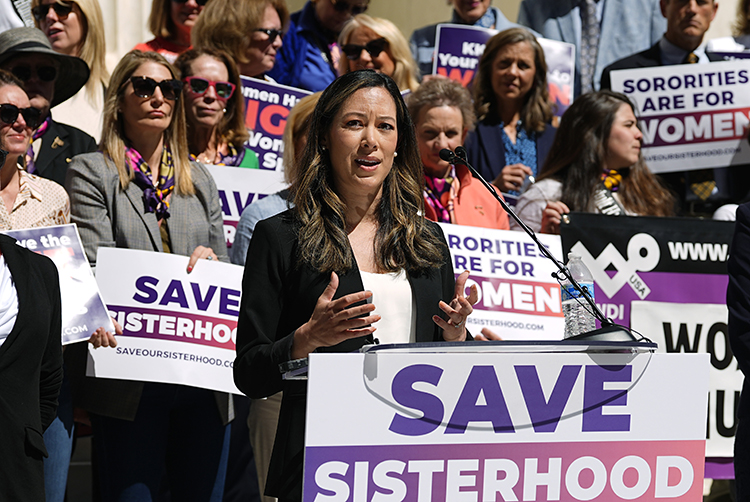
Last year, she became director of the conservative-leaning Independent Women’s Law Center, where she “quickly immersed herself in issues that animated Mr. Trump’s campaign,” the New York Times article says. In one case, she represented a woman who sued her sorority in 2023 over its admission of a transgender woman.

Mailman plans to return to the Independent Women’s Law Center.

“She is a visionary strategist and fearless advocate who delivers results,” said Heather R. Higgins, the CEO of the Independent Women’s Law Center, in an Aug. 7 press release. “We are thrilled to have her unmatched strategic and policy acumen back at Independent Women.”


Source link

EEOC data requests to law firms were not mandatory, agency says in court filing

EEOC data requests to law firms were not mandatory, agency says in court filing


Law Firms

EEOC data requests to law firms were not mandatory, agency says in court filing

Andrea Lucas is the acting chair of the Equal Employment Opportunity Commission. (Photo by Mariam Zuhaib/The Associated Press)

A letter to 20 BigLaw firms seeking detailed information about diversity-program applicants and other attorney job seekers constituted “informal information gathering” rather than a mandatory demand, according to a court filing by the Equal Employment Opportunity Commission.

Most of the 20 law firms did not provide any information requested by the EEOC, and those that did reply did not include identifying information about any specific individual, according to the July 31 EEOC filing seeking to dismiss a lawsuit challenging the information gathering. Three anonymous law students are the plaintiffs.

Any information provided to the EEOC did not include individual names, phone numbers, email addresses or other contact information, the motion says, and as a result, the law students who sued lack standing.

And if the plaintiffs were found to be injured, any harm would be caused by independent decisions of law firms receiving the letters, rather than the EEOC request, according to the motion.

Law.com has a report on the filing.

The March 17 letters by EEOC acting chair Andrea Lucas expressed concerns about the firms’ diversity hiring practices, saying they may amount to discrimination that violates Title VII of the Civil Rights Act of 1964.

The student plaintiffs had alleged the EEOC acted beyond its authority when it demanded sensitive personal information about the law firms’ applicants and employees dating back six to 10 years. The students applied to or worked at one or more of the law firms.

In their Aug. 14 reply to the EEOC’s motion, the student plaintiffs say the EEOC defendants “attempt to minimize their conduct—an implicit acknowledgment that they have overstepped.”

The agency’s position, the students say, is an attempt to bypass statutory requirements for a formal charge of discrimination before an investigation can begin “simply by calling an investigation something else.”

According to Law.com, Goodwin Procter “is the only law firm known to have submitted voluminous hiring data to the EEOC.” The firm did not provide applicant names, however.

Six of the targeted law firms resolved the EEOC requests for information when they reached pro bono deals with President Donald Trump, Law.com reports. Those firms are: Kirkland & Ellis; A&O Shearman; Latham & Watkins; Milbank; Simpson Thacher & Bartlett; and Skadden Arps Slate Meagher & Flom.


Source link

Fewer will qualify for student loan forgiveness under proposed new guidelines; will sanctuary jurisdictions be disqualified?

Fewer will qualify for student loan forgiveness under proposed new guidelines; will sanctuary jurisdictions be disqualified?


Education Law

Fewer will qualify for student loan forgiveness under proposed new guidelines; will sanctuary jurisdictions be disqualified?

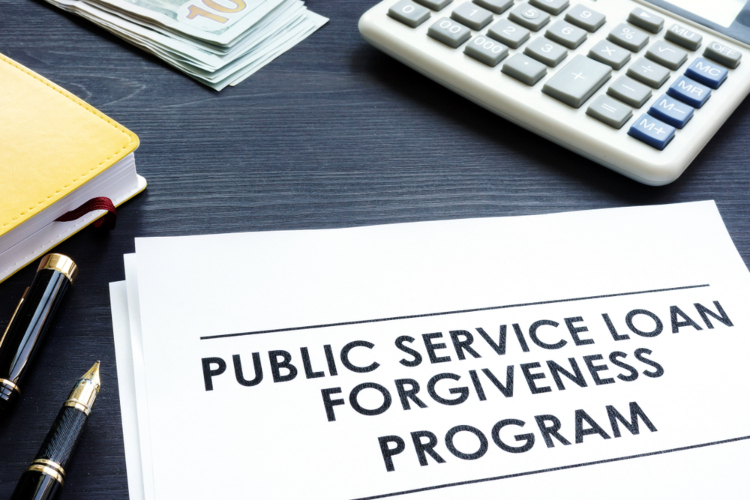
Proposed changes to the Public Service Loan Forgiveness program published Monday would revoke eligibility for borrowers working for nonprofit and government organizations deemed to have a “substantial illegal purpose,” a term with a broad definition. (Image from Shutterstock)

Proposed changes to the Public Service Loan Forgiveness program published Monday would revoke eligibility for borrowers working for nonprofit and government organizations deemed to have a “substantial illegal purpose,” a term with a broad definition.

The program offers loan forgiveness for those who make monthly payments on direct federal student loans for 10 years while working full time in qualified public service jobs. Among those participating in the program are lawyers working as prosecutors, public defenders and advocates for low-income communities.

Critics allege that the changes could kick some employers out of the program if their mission conflicts with the Trump administration’s agenda, Forbes reports.

A provision that cuts out employers that aid violations of federal immigration laws, for example, could be used to disqualify work for state and local governments that don’t cooperate in immigration enforcement, Forbes says, citing a blog post by the Institute for College Access & Success.

Other provisions will keep employers out of the program if they aid discrimination in violation of federal law or support terrorism. Prior news coverage points out that he Trump administration has previously described diversity and inclusion initiatives as illegal discrimination and has described anti-Israel protests as terrorism.

According to the guidelines, another activity with a “substantial illegal purpose” includes aiding castration or mutilation of transgender minors in violation of state and federal laws. An illegal purpose is also defined as violating state laws that prohibit, among other things, trespassing, disorderly conduct, vandalism and obstruction of highways.

The changes would apply to activities with a “substantial illegal purpose” that happen after July 1, 2026.

President Donald Trump had called for the changes in a March executive order that said the PSLF program should be focused on “on its original intent of encouraging Americans to enter essential public service roles, such as nursing, rather than activist groups.”

ABA employees are currently allowed to participate in the program as a result of a 2020 settlement.

The ABA objected to the proposed changes in a May letter to Linda McMahon, the secretary of the U.S. Department of Education.

Then-ABA President Bill Bay said changing the definition of qualified employers based on their activities “has no basis in the PSLF statute.” Nor does the law permit retroactive changes, he said. Bay also raised due process concerns about the process of determining which employers are now ineligible.

The Education Department says it would use a preponderance of the evidence standard in its eligibility determinations. Before any actions, employers would be notified and given a chance to respond.

“The overall design of the regulations—including advance notice, transparency around determinations, and employer recertification pathways—helps mitigate unexpected harm,” the Education Department said in a summary in the Federal Register.

The department also said the “substantial illegal purpose” standard would not be construed to revoke eligibility for employers based on their protected First Amendment rights.

The notice of changes published in the Federal Register followed public feedback, according to an Aug. 18 press release. The government is accepting further comments through Sept. 17.

See also:

These Public Service Loan Forgiveness applicants have seen their student debt erased


Source link

Professionalism: The ABA requires it, employers want it, students need it; so let’s teach it

Professionalism: The ABA requires it, employers want it, students need it; so let’s teach it


By graduation, law students should understand what it means to act professionally: to succeed as a professional in a professional field. This doesn’t seem like a radical or controversial notion. But when looking back at your own legal education, where exactly were you taught the soft skills, norms and insights that underlie professionalism in practice? Was it embedded in the required 1L curriculum? Offered as an upper-level course? Mandated as a graduation requirement?

No, probably not. Chances are you were simply thrown to the wolves and expected to figure out how to fit into the pack. No time for questions or for practice. Just put your head down, assimilate and survive. That is, in effect, how we “teach” law students professionalism: Put your head down, assimilate and survive. And we wonder why our profession suffers from astronomical rates of burnout, career dissatisfaction, depression and substance abuse.

Judgment casting vs. solution finding

The problem is that professional identity formation and soft skill development have long been treated by employers, career advisers and legal educators as an assumed skill set: Young people should “just know” how to act professionally.

Students shouldn’t need a class to teach them to show up to a meeting on time, use complete sentences in their emails, dress appropriately for court or respond to their clients.

I get it. But casting judgment from our wise, experienced high horses causes us to miss the real question. We can lament that students shouldn’t need a class to address such “basic” skills and competencies all we want, but it doesn’t change the fact that they do.

Fortunately, two separate forces with overlapping interests have nudged the topics of professionalism and professional identity to the top of law schools’ “to do” list. Both the ABA and the Institute for the Advancement of the American Legal System are forcing law schools to explore ways to incorporate (and perhaps even mandate) professionalism, soft skills and value exploration into the law school curriculum.

ABA Standard 303(b)

In response to the rising levels of burnout, substance abuse, mental health issues and ethical complaints that continue to plague the profession, the ABA now requires law schools to incorporate professional identity formation into their legal curriculum.

Revised ABA Standard 303(b) mandates law schools to “provide substantial opportunities to students for … the development of a professional identity.” ABA Interpretation 303-5 further explains that these opportunities should involve “an intentional exploration of the values, guiding principles and well-being practices considered foundational to successful legal practice … during each year of law school.”

IAALS Foundations for Practice study

Ten years ago, the Institute for the Advancement of the American Legal System set out to determine the skills and characteristics that law school graduates needed to be successful in the practice. The project surveyed over 20,000 practicing attorneys across the country, spanning different practice areas and disciplines.

Ultimately, the study distilled and organized the responses into 76 “foundations for practice” that respondents considered necessary immediately out of law school. Spoiler alert: Soft skills won the day. In fact, less than a quarter of the foundations involved substantive legal skills or specialized knowledge. The other 75% were all grounded in character-based soft skills.

The IAALS summarized its study’s findings as follows: “Most law students graduate thinking they have the knowledge, skills and abilities necessary for practice, but that opinion is not shared by the profession they hope to enter or their future clients. Indeed, this gap reflects that legal education does not sufficiently prepare students for practice.”

Yikes.

Stepping up

Both the ABA and IAALS (and the thousands of legal employers who responded to the study) seem to be sending law schools a unified directive: “Spend more time teaching people, not just the law.”

So what exactly does that mean, and what does it look like in the classroom? Where do professional identity, soft skills and value exploration fit within the often formal and rigid framework of legal education?

Personally, I designed my course with three constituents in mind: Students, legal employers and the ABA. The Foundations for Practice framework essentially allows me to kill three birds with one stone: comply with ABA 303(b), focus on relevant in-demand traits as identified by legal employers, and prepare students with the skills they need to succeed in the real world.

But in the end, I don’t think there’s any one “right” way to teach law students professional soft skills. The “right” way to discuss professionalism, soft skills and values will be your way.

With that being said, creating something from nothing can be daunting and a bit overwhelming. Here is my Foundations for Practice framework as a potential starting point for anyone else interested in teaching a people-first approach to the profession.

Structure

I divide my course into five “modules” based on the IAALS Foundations for Practice Wheel.

  • Module 1: Lawyer as Communicator (basic communication skills; emotional intelligence, self-awareness and self-control; compassion, humility and perceptiveness)

  • Module 2: Lawyer as Professional (focus and habit formation; time, stress and boundary management; civility, respect and integrity)

  • Module 3: Lawyer as Problem Solver (resourcefulness, patience, coachability and common sense; accountability, performance under pressure and self-regulation)

  • Module 4: Lawyer as Self-Starter (initiative, motivation and goal-setting; seeking and receiving feedback; grit, resilience and positivity)

  • Module 5: Professional Identity Formation (value exploration and self-worth; sustainability and well-being)

Assigned reading

Students are assigned articles, podcast episodes and other assessments that are related to the respective module’s foundations. Examples include: Emailing Professionally; Facial Expressions Emotional Intelligence Quiz; HBR Podcast: How to Be Less Distracted at Work and in Life; How Lawyers Can Optimize Performance Under Pressure; How (and When) to Motivate Yourself; and the National Task Force for Lawyer Wellbeing Report.

Examples of exercises and assignments

  • Email assignment: Students are given instructions from a hypothetical law firm partner to email a client with a status update. Students must send me an actual email that complies with the partner’s directive and accurately conveys all information in a succinct professional manner.

  • Time boxing: Students are tasked with scheduling their week in hour increments using a time boxing technique. During the following class, students shared their successes and struggles in sticking to their planned schedules.

  • Mindset challenge reflection: Students are given a difficult research prompt with minimal guidance and a finite amount of time to complete the assignment. Students then submit a written reflection that describes both their research processes and mindset shifts throughout the task.

  • Value statement: Students are asked to identify their values and incorporate them into a personal anchoring statement or “tagline.” Students then work in small groups to brainstorm additional ways to frame their values in a way that aligns with their desired professional identity.

I’m more than happy to share my full syllabus and class plan with anyone who is interested.

Soft skills are success skills. Professionalism is paramount. Both are necessary and teachable. Now is the time for law schools to examine whether they are truly equipping students with the essential skills—both soft and substantive—needed for practice. The ABA requires it, employers want it, students need it; and the future of the profession depends on it.


After a decade serving the judiciary in various capacities, Jillian Boone currently is a lecturer and assistant director of externships at the Ohio State University Moritz College of Law.


ABAJournal.com is accepting queries for original, thoughtful, nonpromotional articles and commentary by unpaid contributors to run in the Your Voice section. Details and submission guidelines are posted at “Your Submissions, Your Voice.”





Source link

After PACER hack, judiciary takes ‘special measures’ and ‘technical steps,’ DOJ official says

After PACER hack, judiciary takes ‘special measures’ and ‘technical steps,’ DOJ official says


Judiciary

After PACER hack, judiciary takes ‘special measures’ and ‘technical steps,’ DOJ official says

The federal judiciary is taking “special measures” in cases in which information may have been exposed in a hack of the case management system used to upload case documents. (Image from Shutterstock)

The federal judiciary is taking “special measures” in cases in which information may have been exposed in a hack of the case management system used to upload case documents, according to Acting Assistant Attorney General Matt Galeotti.

In a briefing with reporters, Galeotti said “technical steps” are being taken, and “different filing measures” are being put into place, Reuters reports.

The Administrative Office of the U.S. Courts announced in an Aug. 7 press release that the judiciary was strengthening protections “in response to recent escalated cyberattacks of a sophisticated and persistent nature on its case management system.”

Although most of the documents filed on the courts’ electronic filing system are open to the public through PACER, some sealed documents “can be targets of interest to a range of threat actors,” the press release said.

According to CNN, some federal courts were requiring sealed documents to be filed in paper form only. They include the Eastern District of Washington, the Southern District of Florida and the Eastern District of Virginia.

Taking another tack, the Eastern District of New York was creating an online submission process outside PACER’s Case Management/Electronic Case Files system, known as CM/ECF, for sealed documents, according to CNN and the New York Times.


Source link

YouTube
Instagram
WhatsApp



