Barrister’s new mystery novel offers glimpse inside the Inner Temple

Barrister’s new mystery novel offers glimpse inside the Inner Temple


The Modern Law Library

Barrister’s new mystery novel offers glimpse inside the Inner Temple

Like her Edwardian era hero, Sir Gabriel Ward KC, Sally Smith lives and works on the grounds of the Inner Temple in London. (Photo courtesy of Bloomsbury Publishing)

Since it was seized from the Knights Templar in the 14th century, the Inner Temple in London has housed acolytes of a different sort: men (and eventually women) who serve as advocates of the law. Sally Smith spent her legal career—and now is spending her retirement—inside the 15 acres that comprise the Inner Temple, now one of the four Inns of Court.

Smith has previously written nonfiction books about historical crimes and legal figures. When she decided to turn her hand to writing fiction, the familiar setting of the Inner Temple was the perfect setting for her new mystery novel, A Case of Mice and Murder: The Trials of Gabriel Ward.

Set in 1901, mere months after the death of Queen Victoria, A Case of Mice and Men introduces a new (and very reluctant) sleuth to the literary scene. Sir Gabriel Ward KC is happiest either when holed up in his Inner Temple lodgings with his books or when making a compelling case in front of the High Court judges. A solitary, particular and cerebral man, Ward is not looking for excitement beyond the intellectual. But he finds it early one morning when he trips over the body of the Lord Chief Justice of England, which has been left on the doorstep of his professional chambers.

book cover

The ancient privileges afforded to the Inner Temple mean that no policeman is allowed to enter without permission, and an aghast Ward is told that he will conduct the investigation or be at risk of being kicked out of his lodgings. Unused to the world outside the Temple walls or of conversing with women apart from his old nanny or his mother, Ward must stretch himself to discover who killed Lord Norman Dunning.

All the while, Ward is also wrestling with a knotty legal issue involving the rights to a bestselling children’s book and will have to exercise all his skills on behalf of his client, the publisher of Millie the Temple Church Mouse. Written by a mysterious author, the book has been a runaway success, bringing throngs of children to the Temple Church and spawning toys, games and an American publishing deal. Now that the author has reportedly surfaced and is demanding her share of the money and control of the intellectual property, what will happen to Millie the Temple Church Mouse?

In this episode of The Modern Law Library podcast, Smith and the ABA Journal’s Lee Rawles discuss the launch of this new series, which will contain at least three books following Ward’s adventures. Smith describes her career as a barrister and why she chose to set the series at the beginning of the Edwardian era. She also discusses the issues of class, gender and the complex world within the walls of the Inner Temple.

Want to listen on the go? The Modern Law Library is available on several podcast listening services. Subscribe and never miss an episode.
Apple | Spotify | Google Play

In This Podcast:

<p>Sally Smith. (Photo courtesy of Bloomsbury Publishing)</p>

Sally Smith. (Photo courtesy of Bloomsbury Publishing)

Sally Smith spent all her working life as a barrister and later king’s counsel in the Inner Temple. After writing a biography of the famous Edwardian barrister, Sir Edward Marshall Hall KC, she retired from the bar to write full time. A Case of Mice and Murder: The Trials of Gabriel Ward, her first novel, was inspired by the historic surroundings of the Inner Temple in which she still lives and works and by the rich history contained in the Inner Temple archives. A Case of Mice and Murder is the first in a series starring the reluctant sleuth Sir Gabriel Ward KC.


Source link

BigLaw’s manufactured ‘arms race’ for talent recruitment harms us all

BigLaw’s manufactured ‘arms race’ for talent recruitment harms us all


By Jamie R. Abrams

BigLaw has manufactured an “arms race” for talent that is hurting employers, students, recruiters, career counselors and legal educators alike. Like most arms races, the action of one law firm has triggered the reactions of others, all seeking to cultivate the impression of superior strength while instead imposing enormous (and often-absurd) costs on everyone.

This arms race pushed BigLaw hiring for 1L summer into October of the 1L year and leapfrogged BigLaw hiring for 2L summer into March to May of the 1L year while collapsing diversity-centered recruitment portals into this murky process, abandoning on-campus recruitment and blurrily suggesting that 1L summer applicants are simultaneously being “precruited” for summer 2L. If you found that prior sentence to be a dizzying time warp of poorly sequenced chaos, then you understand precisely.

This timeline fosters a fictitious scarcity mindset absent any evidence that the talent pool is smaller or harder to assess while undermining the exact educational processes and professor-student relationships seeking to cultivate robust future talent.

“Talent” is not preordained at 1L orientation, and to adopt this mindset is myopic and exclusionary. Rather, talent develops from inquisitive growth mindsets, thoughtful feedback and adaptation, resilience and persistence, problem solving, creativity and self-reflection. Premature hiring processes perpetuate deep biases that arise from rushed decision-making with incomplete information.

This manufactured arms race harms legal education pedagogy, creates a logistics nightmare for students and educators, imposes psychological harms on students, and frays what should be synergistic relationships between legal education and law practice. Educational pedagogy should allow all students time to grow, adapt and transform before employers assess job readiness. Students need time to cultivate skills and flourish in their educational institution.

Instead, this year’s fall 1Ls began working on preparing their summer job resumés before they had submitted a single piece of written legal analysis. 1Ls skipped afternoon/evening classes early in the fall (often in groups) to attend law firm mixers with no clear assessment of their employment viability at these firms while simultaneously (and understandably) seeking excused absences and professional references from the very professor whose class they were skipping.

Professors who give formative assessment, such as legal research and writing professors and 1L faculty with midterms, do this laborious task because it is an equitable educational best practice to give students low-stakes assignments to assess and strengthen competencies before a high-stakes outcome attaches.

In this frenzied hiring environment, formative assessment instead became the source of student panic and resentment because 1Ls sometimes perceived critical feedback as fatal to their BigLaw employment viability instead of an opportunity to learn. BigLaw hiring timing further reinforced this inversion of formative development by giving 2L summer job offers before students ever began their 1L summer job. This undermines educational pedagogy and professional formation.

This timeline bets against education itself and sends an exclusionary message that students land “prestigious” jobs based on their pedigree or preexisting network alone. Students need to complete their first graded assignment before their first exam, their first exams before applying for their first jobs, perform in their first job before seeking their second job to form as professionals. This also yields more fruitful interviews and reference calls. It allows students to be present and purposeful in the task before them—whether class participation, a first writing assignment or a first assignment in a summer job.

This manufactured arms race also creates a logistics nightmare. Students are pulled off campus for extensive programming that often conflicts with campus activities. They are compelled to choose between the possibility of a job lead vs. class attendance or between holiday family time vs. sending out applications or exam studying vs. attending interviews (sometimes out of the geography entirely).

Recruiting professionals and law school career counselors are servicing and processing more student candidates than is necessary or efficient with increasingly slim budgets. 1Ls are compelled to seek references from fall and spring faculty before faculty have assessed a single piece of work product or called on the student in class. 1L faculty are rushed to meet aggressive grading deadlines. These logistics are burdening some of the most overworked stakeholders in this ecosystem already.

The psychological harms are steep too. Students cannot yet assess their employability in this sector. Professors and career counselors can’t advise strategically either, absent grades. Students cannot consider BigLaw contemporaneously with other employment sectors, a vital comparator to secure and retain talent.

Students jammed their Thanksgiving, winter and spring breaks with BigLaw recruitment tasks, steepening an acute wellness crisis and creating inequities for those balancing travel, family caregiving, paid employment and health barriers. Grades became the goal for 1Ls over learning (explicitly so now while perhaps always implicitly so). Students with offers are left feeling entitled to—and frankly desperate for—the grades that match the contingent offers. This is a flawed psychological pivot to an already-tenuous wellness picture for 1Ls, lawyers and higher education.

Finally, this arms race reflects a fundamental breakdown between the private bar and legal education. It devalues the classroom and evaluative processes of legal education because it makes decisions before students have learned foundational skills, thus disproportionately privileging those with law experience and existing networks. Yet it simultaneously makes offers contingent on grades, which is frankly a worst-case scenario.

The solutions are simple. They cost us nothing. Let students finish their fall semester immersively and with a purpose. Let fall faculty assess fall work product wholly, allowing formative and summative assessment to do its job. (Or make offers without contingencies.)

Let career counselors transition into 1Ls’ lives after 1Ls have learned more about themselves, the profession and law school pedagogy. Don’t put students in a high-stakes gamble brewing with resentment hoping that their grades match their contingent offer. Let students complete their first summer job before recruiting them for their second summer. They will know more, understand themselves better and be more authentic and well-rounded. Faculty, in turn, will also know our students more holistically and concretely.

This arms race harms everyone in its process, pedagogy and logistics. It undermines the well-being of 1Ls, educators and career services and recruiting professionals. It causes tension in relationships that should be synergistic and reciprocal.

Most dissonant, institutions following this new timeline—a necessary complicity to position students successfully in this highly competitive market—simultaneously boast deep commitments to wellness, professional identity formation, formative feedback and equitable institutional practices. Those specific aspects of legal education pedagogy were the most striking and noteworthy reforms seeking to build inclusive institutions that prepared more practice-ready graduates.

Now, the searing tensions between stated institutional values relative to lived student experiences comes across as tone deaf to law students (at best) and gaslighting (at worst). Law faculty wholeheartedly want to help train practice-ready students, tell employers about our students’ strengths and abilities, and improve our own pedagogies in conversation with employers about their needs and expectations.

This is a reciprocal relationship that should deploy equitable practices that are fair, methodical, paced, thoughtful and grounded in skills and knowledge, not gambles and guesses. A reset to rein in runaway recruitment practices helps build a more equitable, sustainable and thriving profession at a time when we need this outcome more than ever.


Jamie R. Abrams is a professor and the director of legal rhetoric at the American University Washington College of Law. She is the author of numerous books and articles about legal education pedagogy and the recipient of multiple teaching awards for innovative and inclusive teaching practices.



Source link

Disbarment recommended for ex-Trump lawyer Eastman by State Bar Court of California panel

Disbarment recommended for ex-Trump lawyer Eastman by State Bar Court of California panel


Ethics

Disbarment recommended for ex-Trump lawyer Eastman by State Bar Court of California panel

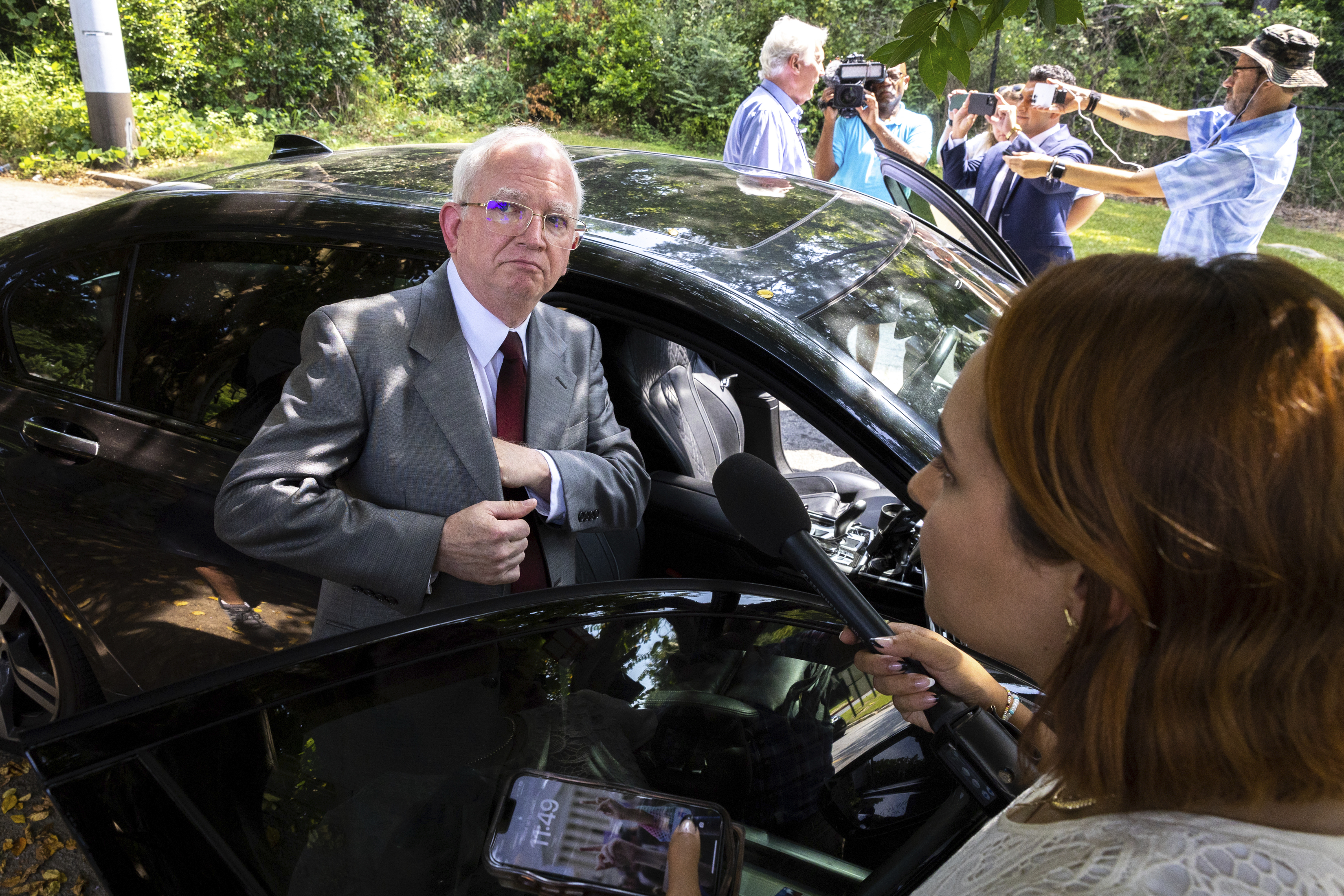
Attorney John Eastman leaves after speaking to the media outside the Fulton County Jail in Atlanta, where he was booked Aug. 22, 2023. His attorney David Wolfe speaks to press in the background. (Photo by Arvin Temkar/The Atlanta Journal-Constitution via the Associated Press)

Ex-Trump lawyer John Eastman has moved another step closer to disbarment, as a unanimous three-judge panel of the State Bar Court of California’s review department affirmed earlier findings that he was culpable of 10 counts of misconduct relating to his representation of President Donald Trump during and after the 2020 election.

“In a democracy nothing can be more fundamental than the orderly transfer of power that occurs after a fair and unimpeded electoral process as established by law,” the review department said in its June 13 opinion. “In this disciplinary matter, we consider the appropriate discipline to recommend to the California Supreme Court when an attorney, who has sworn to uphold the laws and constitutions of the state of California and the United States, attempts to actively undermine the results of an election to the most powerful office in the United States.”

Reuters and Law.com have coverage.

In March 2024, Judge Yvette Roland of the State Bar Court of California—the administrative arm of the California Supreme Court—recommended that Eastman be disbarred. According to previous reporting by Law.com, Roland wrote that “Eastman’s actions transgressed … ethical limits by advocating, participating in and pursuing a strategy to challenge the results of the 2020 presidential election that lacked evidentiary or legal support.” As a result, his law license also was suspended.

The State Bar of California’s chief trial counsel charged Eastman with multiple disciplinary counts in January 2023.

Eastman spoke at Trump’s “Stop the Steal” rally Jan. 6, 2021, and wrote two memos to support the bogus theory that former Vice President Mike Pence had the power to reject certified state electors and reverse Trump’s 2020 election loss. He also represented Trump in a lawsuit at the U.S. Supreme Court that aimed to invalidate votes in four states where Trump falsely claimed that there was evidence of voter fraud, according to Reuters.

Eastman initially faced 11 disciplinary charges under the state’s business and professions code, with the California bar accusing him of acts of “moral turpitude, dishonesty or corruption.”

On Friday, the State Bar Court of California’s review department agreed that Eastman “consistently failed to be honest” in his dealings with the courts, the public, and Pence and his staff.

It rejected Eastman’s claims that adverse pretrial rulings and the judge’s bias and conduct in his trial violated his due process rights.

“Eastman states his case is unique, calling it ‘the most politicized disbarment proceeding in California’s history,’ but his belief is not evidence, nor does it create an appearance of impropriety regarding the hearing judge,” the opinion said. “Because he identifies no evidence other than his subjective belief, we reject his claims of bias as speculative and conclusory.”

The review department also rejected Eastman’s assertions that the First Amendment provided him free speech protections.

“While attorneys have a First Amendment right to make statements in public in the course of their professional duties, this right does not extend to making knowing or reckless false statements of fact or law,” the opinion said.

The State Bar Court of California’s review department said it recommended that Eastman be disbarred because of “the serious nature and extent of Eastman’s misconduct and the weight of aggravating circumstances in relation to mitigation.”

It also said “disbarment is necessary to protect the public, the courts and the legal profession.”

Eastman’s lawyer Randall Miller of Miller Waxler told Law.com that they would appeal the decision.

“The decision is an unconstitutional abuse of power against lawyers and the legal system, diminishes the profession’s revered independence, and will chill attorneys from representing clients in unpopular or controversial matters, especially those that are inimical to the government,” Miller said.

George Cardona, the State Bar of California’s chief trial counsel, also provided a statement to Law.com. He called the ruling “a powerful and timely reminder that whoever they are and whoever they represent, attorneys must remain true to the ethical rules that govern their conduct and respect the rule of law.”

The California Supreme Court, which has the final say on recommended attorney discipline, will now review Eastman’s case.

See also:

Criminal charges add twist to Trump lawyers’ disciplinary cases

Former Chapman law prof says ex-dean knew of his work for Trump; 2 students were ‘thrilled’ to help


Source link

Retired California justice faces disciplinary charges for allegedly taking too long to decide cases

Retired California justice faces disciplinary charges for allegedly taking too long to decide cases


Ethics

Retired California justice faces disciplinary charges for allegedly taking too long to decide cases

Former Justice William J. Murray Jr. of the Third District Court of Appeal in California has been accused of delaying hundreds of case decisions for years. (Photo from the Judicial Branch of California)

A retired state appellate justice in California has been accused of delaying hundreds of case decisions for years.

The California Commission on Judicial Performance said Monday it launched formal proceedings against former Justice William J. Murray Jr. of the Third District Court of Appeal in California, who retired in 2022 after serving for 12 years.

Among the commission’s charges, filed June 10, Murray “engaged in a neglect of duty and a pattern of chronic delay” by failing to promptly decide or dismiss 355 cases within a year after he was assigned a case or after a case was fully briefed. The commission said two of his cases, one of which was a juvenile matter, weren’t decided for more than eight years. It said more than 100 others were delayed between three and seven years.

The commission also noted that while “all protracted decisional delay damages the public’s esteem for the judiciary,” Murray’s decisional delays “resulted in actual prejudice” to parties in at least 16 cases. This allegedly includes an elderly victim of criminal securities fraud who died before Murray issued an opinion in the case, which he had been assigned four years earlier.

“You did not minimize the impact of delay by prioritizing the delayed matters and taking into account the effect of delay on the parties in some cases,” according to the commission. “Your neglect of duty and pattern of persistent decisional delay, as described above, … prejudiced civil litigants and criminal defendants. It also, at minimum, created the appearance that appropriate appellate review was impeded or denied.”

The commission alleged that Murray was aware of and often discussed his case backlog with other members of the court. It said “corrective measures,” which included reducing the number of cases and complex assignments, did not resolve his backlog. It also said cases were reassigned to other justices, and in several cases, another justice asked to be reassigned from a panel that included Murray because of concern about his decisional delays.

“Your neglect of duty and decisional delay … imposed a greater workload on research attorneys and other panel justices who were required to conduct additional research and analysis, some of which was necessary as the result of your delay in deciding the cases,” the commission said.

Murray is represented by Miller Waxler, according to Law.com, which has coverage of the commission’s charges against the retired justice. The law firm told the publication that Murray had worked toward a possible settlement with the Commission on Judicial Performance for more than a year after he retired. The firm also said Murray was disappointed by the charges but looked forward to presenting his case.

Law.com said Gregory Dresser, the commission’s executive director and chief counsel, declined to answer why disciplinary charges were not filed against Murray until three years after he retired.

“We believe we can prove, by clear and convincing evidence, the misconduct alleged in the notice of formal proceedings,” Dresser said in an email to Law.com. “We also believe that the misconduct in which Justice Murray engaged is serious.”

Law.com noted that the charges against Murray stem from an investigation into several justices on the appellate court who allegedly allowed cases to sit unattended for years before acting on them.


Source link

New York man pleads guilty to posing as lawyer, stealing over 0K from more than 100 clients

New York man pleads guilty to posing as lawyer, stealing over $290K from more than 100 clients


Prosecutors

New York man pleads guilty to posing as lawyer, stealing over $290K from more than 100 clients

A New York man who posed as a lawyer has admitted to stealing more than $290,000 from more than 100 clients who came to him for legal services. (Image from Shutterstock)

A New York man who posed as a lawyer has admitted to stealing more than $290,000 from more than 100 clients who came to him for legal services.

Manhattan District Attorney Alvin L. Bragg Jr. announced on Monday that Sean Mescall, 46, of Newburgh, New York, who stole the funds between April 2022 and January, pleaded guilty in the New York State Supreme Court to one count of grand larceny in the third degree and one count of scheme to defraud in the first degree. He is expected to serve between two and six years in prison.

“Sean Mescall went to extreme lengths to steal from over 100 New Yorkers, falsely posing as an attorney providing legal assistance, while he was actually exploiting them,” Bragg said in a news release.

According to the Manhattan district attorney’s office in New York, Mescall created a fake law firm that went by several different names, including “Prospection Legal,” “Prospection Legal Group” and “Mescall Law P.C.” He advertised his fraudulent legal services on online legal search platforms and social media. He also provided false information, including that he graduated from “Texas Tech University School of Law.”

In April 2024, Mescall hired an attorney who was licensed in New York and New Jersey to work at his fake firm, the Manhattan district attorney’s office said. She began representing clients in his cases, which included class action, discrimination and business lawsuits.

“Mescall told this attorney that he had graduated from law school, that he was licensed to practice law in New York, New Jersey and other places, and that he had been practicing law since ‘before she was born,’” the district attorney’s office said.

The New York State Supreme Court also ordered a confession of judgment in the amount of $294,275.63 in the case.

Law360 has additional coverage.


Source link

Americans share declining views of Supreme Court in new poll

Americans share declining views of Supreme Court in new poll


U.S. Supreme Court

Americans share declining views of Supreme Court in new poll

Most Americans don’t see the U.S. Supreme Court as politically neutral, according to a new Reuters/Ipsos poll. (Photo from Shutterstock)

Most Americans don’t see the U.S. Supreme Court as politically neutral, according to a new Reuters/Ipsos poll.

According to the poll’s results, which Reuters published Monday, only 20% of respondents agreed that the nation’s highest court is neutral. Fifty-eight percent disagreed, and the rest did not respond or said they were uncertain.

When separated by political party, 74% of respondents who described themselves as Democrats and 54% of respondents who described themselves as Republicans disagreed that the Supreme Court is politically neutral.

The Reuters/Ipsos poll, which collected responses from 1,136 U.S. adults over two days last week, also asked respondents how they perceive the Supreme Court.

Reuters reports that 44% expressed a favorable view of the Supreme Court, which includes 67% of Republicans and 26% of Democrats. In a similar poll conducted in March, 49% of respondents had a favorable view of the high court.

The Reuters/Ipsos poll additionally sought respondents’ views on major cases that are before the Supreme Court this term. Justices are expected to rule in these cases, including the challenge to President Donald Trump’s birthright citizenship directive, in the coming weeks.

The poll’s results showed that only 24% of respondents supported ending birthright citizenship, while 52% opposed ending it. Only 5% of Democrats and 43% of Republicans supported ending birthright citizenship.

See also:

Third federal appeals court rejects Trump administration bid on birthright citizenship


Source link

YouTube
Instagram
WhatsApp