A New York lawyer has been arrested after allegedly threatening the judge in his custody case through a series of text messages, including one that said, “I wish you die tonight in a car fire.” (Image from Shutterstock)
A New York lawyer has been arrested after allegedly threatening the judge in his custody case through a series of text messages, including one that said, “I wish you die tonight in a car fire.”
Lawyer Nicholas Leo, 57, of Yonkers, New York, was arraigned Friday on a felony charge of aggravated harassment of a judge and ordered held without bail until his next court appearance. The judge he allegedly targeted is Acting New York Supreme Court Justice Susan Capeci, who presides over Westchester County’s Integrated Domestic Violence Court.
Leo had been a defendant in criminal and matrimonial proceedings before Capeci, who he allegedly began sending threatening communications in late May.
In one of Leo’s text messages to Capeci, he allegedly told her, “I’m going to beat you,” according to the Mid-Hudson News, which cited the felony complaint. In another message, Leo allegedly said, “I warned you month after month after month. If you take my kids from me for no reason, which you did, it’s not gonna go well,” and “I hope you die.”
“At a time of increasing threats to members of the judiciary, the defendant’s alleged conduct is especially alarming,” Westchester County District Attorney Susan Cacace said in a statement published by the Mid-Hudson News. “We must never allow this type of conduct to become normalized. The sanctity of our legal process demands nothing less.”
Capeci received a temporary order of protection against Leo, the Mid-Hudson News reports.
A New York jury has awarded $6.2 million to an attorney who sued her law firm for allegedly firing her after she complained that she was paid less than male attorneys who ranked lower than her. (Image from Shutterstock)
A New York jury has awarded $6.2 million to an attorney who sued her law firm for allegedly firing her after she complained that she was paid less than male attorneys who ranked lower than her.
Denise A. Rubin, a former general counsel at Napoli Bern Ripka Shkolnik, received $5.8 million in punitive damages and $350,000 in compensatory damages after a decade of litigation, Law.com reports.
The jury in Rubin’s case found that she had good faith to file her discrimination claim, in which she said she was paid less than male colleagues with less experience, even though she handled managerial duties for the firm, according to Law.com. She alleged that firm founding partner Paul Napoli failed to promote her to partner despite his promise to do so.
Jurors also found that Rubin was the target of retaliation by Napoli, who she said personally and professionally denigrated her to colleagues and filed “meritless, lewd and professionally damaging” counterclaims against her, Law.com reports.
“The jury’s verdict recognized the extent and severity of Napoli’s unlawful retaliation as well as the effect on Ms. Rubin,” said Jason Solotaroff of Giskan Solotaroff & Anderson in an email to Law.com. “This verdict sends a message that employers will not be permitted to punish and intimidate discrimination plaintiffs from seeking justice by dragging them through the mud.”
Jack Baughman of Baughman Kroup Bosse, who represents Napoli, said in a statement also published by Law.com “Mr. Napoli believes the verdict is legally baseless and factually unsupported.” He also noted that the court had dismissed the discrimination claims against the defendants.
“The retaliation finding—tied to a dismissed claim and based on incomplete facts—will not withstand appeal,” Baughman said.
Baughman also contended that Rubin was found liable for breaching her professional duties.
The jury ordered her to pay the defendants $15,000 for disseminating confidential firm documents, which she allegedly posted to defend herself from the firm’s accusations after she was dismissed, Law.com reports.
Napoli Bern’s principals, Napoli and Marc Bern, split up and formed separate firms in 2015, according to Law.com. The firms named as defendants in Rubin’s lawsuit are largely defunct.
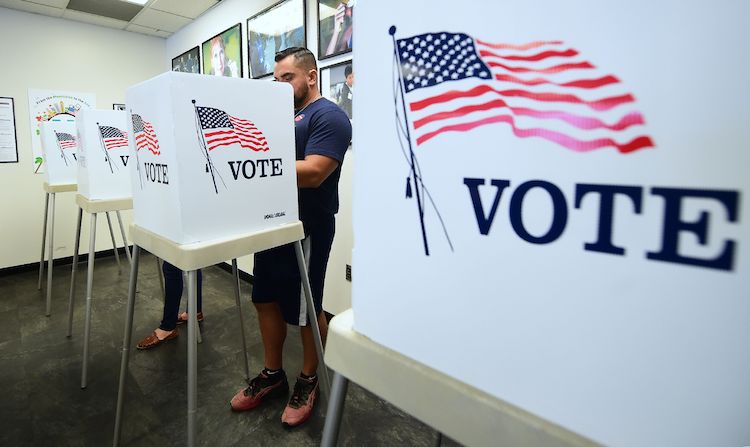
Voters cast their ballots for early voting at the Los Angeles County Registrar’s Office in Norwalk, California, on Nov. 5, 2018. (Photo by Frederic J. Brown/AFP via Getty Images)
A federal judge in Boston has blocked the Trump administration from significantly overhauling federal elections.
On Friday, U.S. District Judge Denise J. Casper of the District of Massachusetts granted a preliminary injunction sought by attorneys general from 19 states who argued that President Donald Trump lacked the authority to require proof of U.S. citizenship to register to vote and to bar states from counting ballots mailed on or before Election Day but not received until afterward.
Trump announced these changes to the federal elections process as part of an executive order titled “Preserving and Protecting the Integrity of American Elections” on March 25.
“The Constitution does not grant the president any specific powers over elections,” Casper wrote in her memorandum and order. “Rather, the Constitution vests the president with ‘executive power’ and commands him to ‘take care that the laws be faithfully executed.’”
According to Reuters, there are several pending challenges to Trump’s March 25 executive order. District Judge Colleen Kollar-Kotelly of the District of Columbia also blocked parts of the order in April, according to Reuters.
Casper, whose order goes further, noted that the states’ challenge to certain provisions of Trump’s executive order are “ripe for review.” She also said the states are likely to be successful in their case and blocked the executive order from taking effect until the case is resolved.
While Casper said there is no dispute that U.S. citizenship is required to vote in federal elections, the issue in this case is whether a president can require documentary proof when only Congress has the power to alter election requirements. She said Congress, through several statutes, does not require proof of citizenship.
As for mail-in ballots, Casper said “the text of the Election Day statutes require only that all votes are cast by Election Day, not that they are received by that date.” She also said the statutes do not authorize the Department of Justice to pursue criminal or civil enforcement actions against states that count ballots in accordance with their ballot-receipt deadlines.
PBS News, citing data from the National Conference of State Legislatures, reports that 18 states and Puerto Rico accept ballots received after Election Day if they are postmarked on or before that date.
Casper’s decision blocks the Trump administration from implementing additional provisions of the executive order, including a directive to the secretary of the Department of Defense to impose voter ID requirements on military members and U.S. citizens who live abroad.
Casper said the challenged mandates in Trump’s executive order “pose the risk of irreparable harm to the states.” She noted that it will take significant time, cost and effort to comply with new requirements, which she also said could “chill voter registration and participation.”
Casper also said states could possibly lose federal funding if they fail to comply with the Trump administration’s executive order.
“The states … have shown a ‘substantial risk’ that, absent an injunction, citizens will be disenfranchised,” Casper said. She added that the states “also credibly attested that the challenged requirements could create chaos and confusion that could result in voters losing trust in the election process.”
Trump “will keep fighting for election integrity, despite Democrat objections that reveal their disdain for commonsense safeguards like verifying citizenship,” said Harrison Fields, a White House spokesperson, in a statement published by Reuters.
“Free and fair elections are the bedrock of our constitutional republic, and we’re confident in securing an ultimate victory in the courtroom,” Fields also said.
Lori Zeno, center, then the executive director of the Queens Defenders, addresses the media outside the Queens courthouse following with the arraignment of a police officer on June 25, 2020, in New York. (Photo by Kevin Hagen/The Associated Press)
The founder of one of New York City’s public defender offices is facing fraud charges for allegedly taking money from the organization for luxury vacations, a penthouse apartment and designer clothes.
Lori Zeno, who helped start the Queens Defenders in 1996, and her husband, Rashad Ruhani, stole at least $60,000 from the organization between June 2024 and January 2025, according to an indictment unsealed by the U.S. attorney’s office for the Eastern District of New York on Wednesday. They were charged with wire fraud conspiracy, wire fraud, money laundering conspiracy and theft of funds.
Zeno became the executive director of the Queens Defenders in 2018 but was forced to step down in January following allegations of mismanagement and misappropriation of funds, federal prosecutors say.
Zeno became romantically involved with Ruhani after he joined the Queens Defenders as a client advocate in 2023, according to federal prosecutors. Zeno promoted him to a position managing the organization’s youth program in June 2024.
Also in June 2024, Zeno and Ruhani allegedly used the organization’s credit cards to buy clothing from Neiman Marcus, Ralph Lauren and Louis Vuitton, federal prosecutors say. After getting married a few months later, they used corporate credit cards to pay for hotels, food and jewelry during their honeymoon in Bali. They also used the credit cards to pay for expenses at a luxury resort in Santa Monica, California.
The pair additionally asked to be reimbursed $39,000 after they said they rented a penthouse apartment to house a homeless child for two months, according to federal prosecutors.
Among other allegations, federal prosecutors say Zeno gave Ruhani’s daughter and a woman he had been married to “no-show jobs” and paid them salaries of $80,000 and $60,000, the New York Times reports. Prosecutors have alleged that the woman was hired to lead a fake health and wellness program and did not reside in the United States.
The New York Times says Zeno could not be reached for comment. As of Friday, Law.com reports that she was not in custody.
Law.com also says lawyers for Ruhani, who was in custody, declined to comment.
In a statement provided to Law.com, Doneath Powell, chair of the Queens Defenders’ board of directors, said the organization was “deeply saddened by the nature of these allegations against two former employees.”
Brooklyn Defender Services announced in March that it would take over the Queens Defenders’ $32 million contract with the city, Law.com reports.
Massachusetts is experiencing a “full-blown constitutional breakdown” as bar advocates refuse to take on more court-appointed cases, according to the leader of the state’s association of criminal defense attorneys. (Image from Shutterstock)
Massachusetts is experiencing a “full-blown constitutional breakdown” as bar advocates refuse to take on more court-appointed cases, according to the leader of the state’s association of criminal defense attorneys.
“The right to counsel is not a luxury,” said Shira Diner, the president of the Massachusetts Association of Criminal Defense Lawyers, last week. “It is a bedrock principle of our justice system, guaranteed by the Sixth Amendment and by Article 12 of the Massachusetts Declaration of Rights. When people are jailed without lawyers, the system ceases to be just—or constitutional.”
Bar advocates, independent attorneys who are appointed by the state to represent low-income defendants, handle about 80% of indigent defense, according to the Massachusetts Association of Criminal Defense Lawyers.
But those attorneys began declining additional cases in May because of pay rates that the association characterizes as lagging “far behind those in neighboring states.” Many experienced attorneys have left, and new attorneys have accepted jobs elsewhere because of the low compensation, the association also says.
MassLive.com reported in May that bar advocates who handle district court cases are paid $65 per hour. They argue that they actually earn about $20 per hour after accounting for health and malpractice insurance and other expenses.
As of last week, more than 150 people in Boston were waiting for the court to appoint their attorney, according to the Massachusetts Association of Criminal Defense Lawyers. Nearly 40 people who were in custody didn’t yet have a lawyer.
The association notes that defendants who remain in custody without representation for more than a week can be released under Massachusetts law. It also contends that courts that fail to assign counsel are either violating defendants’ constitutional rights or releasing them without due process.
“People accused of crimes are sitting in jail cells without a lawyer,” Diner said. “Others are missing crucial opportunities to gather necessary evidence and are left with nothing but uncertainty. Neither outcome is acceptable.”
Anthony Benedetti, the chief counsel of the Committee for Public Counsel Services, the state’s public defender agency, told MassLive.com that bar advocates “should be paid more for the essential work they do in providing legal services to indigent clients across the commonwealth.”
The Massachusetts trial courts are working with the Committee for Public Counsel Services to reduce disruptions that arise because of work stoppages, a spokesperson also told MassLive.com.
The Massachusetts Association of Criminal Defense Lawyers is urging the state legislature to increase funding for bar advocates in the state budget.
Dr Anjali Vinocha (Through Her … vs Delhi State Cancer Institute And Anr on 13 June, 2025
Delhi High Court
Dr Anjali Vinocha (Through Her … vs Delhi State Cancer Institute And Anr on 13 June, 2025
                          $~17
                          *      IN THE HIGH COURT OF DELHI AT NEW DELHI
                          %                                                  Date of Decision: 13.06.2025
                          +      W.P.(C) 8435/2025, CM APPL. 36712/2025 & & CM APPL.
                                 36713/2025

                                 DR ANJALI VINOCHA (THROUGH HER AUTHORIZED
                                 REPRESENTATIVE DR ARUN WADHAWAN)            .....Petitioner
                                               Through: Counsel for petitioner (appearance
                                                        not given).

                                                       versus

                                 DELHI STATE CANCER INSTITUTE AND ANR .....Respondents
                                               Through: Mrs. Avnish Ahlawat, Advocate
                                                        (through videoconferencing)

                                 CORAM:             JUSTICE GIRISH KATHPALIA

                          JUDGMENT                (ORAL)
1. The prayer clause of petition is extracted below:
“a. For a Writ, Order or Direction to the Respondents to handover to the
Petitioner Dr. Anjali Vinocha immediately the Experience Certificate of
her work at the Respondent hospital.
b. For an Order directing the Respondents to pay the Petitioner Dr. Anjali
Vinocha all her legal dues forthwith.
c. For any other Writ, Order or Direction this Hon’ble Court deems
necessary in the interest of justice.”
2. At the outset, learned counsel for respondents submits that as regards
the experience certificate, the same has been delivered to the petitioner. This
is affirmed by learned senior counsel for petitioner on instructions of
briefing counsel.
W.P.(C) 8435/2025 Page 1 of 2 pages
GIRISH Digitally signed by GIRISH
KATHPALIA Signature Not Verified
KATHPALIA Date: 2025.06.13 18:06:56
+05’30’
Digitally Signed
By:NEETU N NAIR
Signing Date:13.06.2025
18:20:53
3. As regards prayer clause ‘b’, learned counsel for respondents submits
that it is the petitioner who has to pay certain amount but within a span of
four weeks from today, the respondents shall reconcile the accounts and take
appropriate steps. This satisfies the petitioner.
4. Under these circumstances, as requested the petition is disposed of as
satisfied. Pending applications also stand disposed of.
Digitally signed by
GIRISH GIRISH KATHPALIA
KATHPALIA Date: 2025.06.13
18:07:12 +05'30'
GIRISH KATHPALIA
JUDGE
JUNE 13, 2025/DR
W.P.(C) 8435/2025 Page 2 of 2 pages
Signature Not VerifiedDigitally SignedBy:NEETU N NAIRSigning Date:13.06.202518:20:53