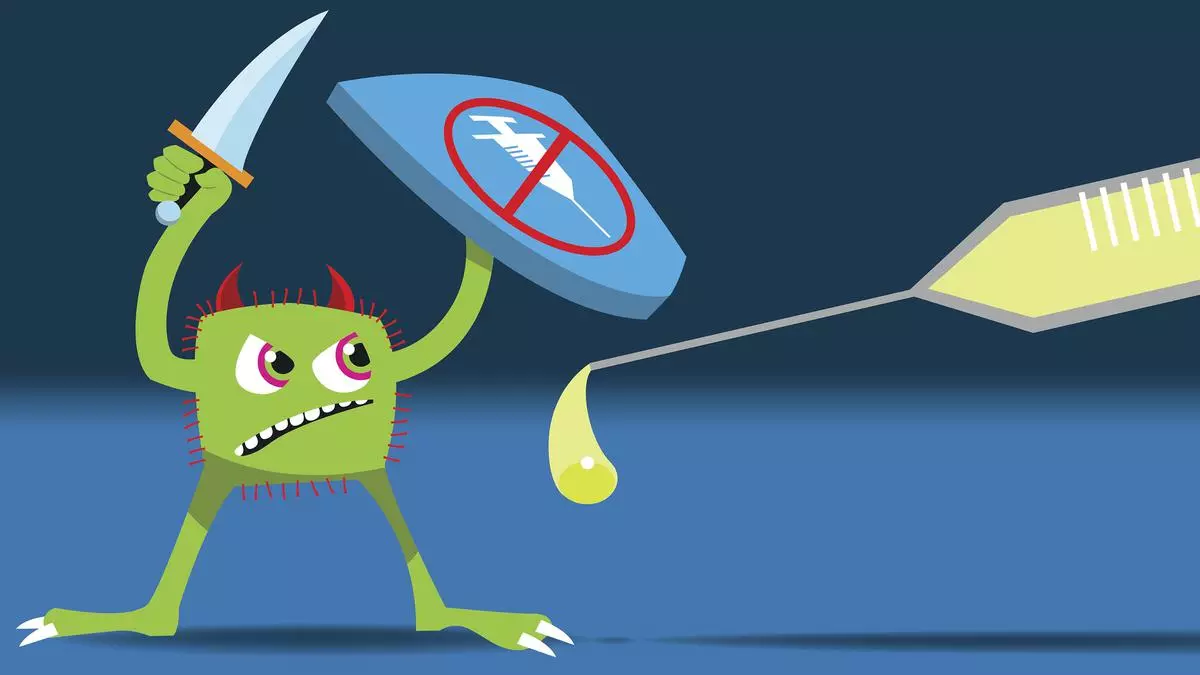
AMP up the fight against hardy pathogens

AMP up the fight against hardy pathogens


We know that our bodies have their own defence mechanism against invading microbes (pathogens such as bacteria and viruses). This defence mechanism is in the form of antibodies, which are proteins (long chains of amino acids) — the antibodies destroy the pathogens, or, at least, most of the time. This defence mechanism is strengthened by man-made drugs — antibiotics — which kill bacteria (not viruses).

However, the pathogens are smart. Over time, they have developed resistance to drugs. This antimicrobial drug resistance (ADR) is now so serious that it has come to be recognised as a major killer. Take, for example, the tuberculosis-causing  Mycobacterium tuberculosis, which is proving to be too slippery for the TB vaccine Bacillus Calmette Guérin, or BCG. Some research papers say that about 700,000 people die annually because of ADR; this number is estimated to swell to 10 million by 2050.

What’s the solution?

Scientists are now turning to a less-recognised line of defence known as ‘antimicrobial peptides’, or AMPs. Peptides are small chains of amino acids. AMPs are produced by human bodies, as also other living beings. Today, about 5,000 AMPs are known, catalogued. AMPs are proving to be smarter than invading pathogens (at least for now). The pathogens enter healthy cells and use the chemicals to multiply, destroying the cells in the process. AMPs attach themselves to cell membranes of bacteria or virus and prevent them from entering healthy cells. This happens because the cell walls of pathogens are negatively charged, whereas AMPs are positively charged — the attraction between unlike charges enables AMPs to cling to the membranes.

“The use of antimicrobial peptides (AMPs) provides an attractive solution to combat the problem of antimicrobial resistance,” says a December 2022 research paper authored by scientists from Guru Granth Sahib World University, Punjab, and Amity Institute of Biotechnology, Rajasthan, and published in the magazine  Microbiological Research. “These peptides are effective, broad-spectrum antimicrobials that establish themselves as new therapeutic agents, and hold potential to kill gram-negative and gram-positive bacteria, fungi, enclosed viruses, and even mutated or malignant cells,” the authors say.

The point to note is, unlike antibiotics, AMPs are effective against viruses too. There is recent evidence that several AMPs of human, insect and plant origin work against a broad range of viruses, says the paper, which indeed was about the potential of AMPs to fight Covid-19.

Amir Pandi et al of multiple German research institutions note in a paper awaiting peer review that, despite the looming threat of ADR pathogens, there is not enough research on developing antimicrobial drugs. “While more than 4,000 immuno-oncology compounds were in clinical trials in 2021, only 40 antimicrobials (of which none is active against multi-drug resistant gram-negative bacteria) were subjected to clinical studies, highlighting the urgent need to increase the development of novel antimicrobial compounds,” the paper says.

Well, the world will turn to AMPs, which are described as “next-generation antimicrobials”. But the problem is, how to produce AMPs. It is possible to chemically synthesise AMPs. Another option is to take the DNA in organisms and coax it to produce the peptides. But both are time-consuming, costly and with no guaranteed output.

Designer AMPs

The German researchers have reported a novel method, called ‘cell-free protein synthesis’ (CFPS), which involves in-vitro transcription (making RNA from DNA) and translation (making peptides from RNA). In other words, the peptides are made outside living cells.

This method, the scientists say in the paper, “can help overcome potential cellular toxicity effects, and open up the way for rapid, small-scale production of several hundreds of peptides from linear DNA in parallel.”

Describing the research, the paper says, “We combined deep learning and CFPS for de novo-design, rapid production and screening of AMPs at small scale within 24 hours, and less than $10 per individual AMP production assay (excluding cost for the DNA fragment).”

Having explored around 500,000 theoretical sequences, the researchers screened 500 AMP candidates to identify 30 functional AMPs, which are completely unrelated to natural sequences. Six of these AMPs “exhibited high antimicrobial activity against multidrug-resistant pathogens, showed no emergence of resistance and only minimal toxicity on human cells.”

AMPs are still in the realm of R&D, but show promise. Dr Subramanian Swaminathan, Director–Infectious Diseases, Gleneagles Global Health City, Chennai, feels Indian industry should undertake more research into this “exciting area”. Swaminathan told  Quantum that with the sole exception of enfuvirtide, for HIV infections, there is no AMP drug in the market yet. He observed that good work is on at public research labs, but not much in pharma industry. In 2019, Indian Institute of Science, Bengaluru, and MS Ramaiah Medical College came up with a peptide, named Omega76, against the ESKAPE family of bacteria, but there has not been much progress since.

Swaminathan observed that industry tended to ignore the anti-microbial segment because it is return-negative. As a result, the problem is growing bigger. AMPs can be a solution. However, there is need for proper clinical trials, he cautions. After all, these are biological products and there will be long-term consequences, both intended and unintended.



Source link

Materials programmed to change shape

Materials programmed to change shape


Can there be materials that change shape according to one’s desire? If yes, then you could, for instance, make comfortable chairs and mattresses that never cause bedsores.

Indeed, there are ‘programmable materials’ that adjust themselves to pressure, says the Fraunhofer Cluster of Excellence Programmable Materials, (CPM), Germany. The CPM comprises six core institutes that aim to design and produce programmable materials.

How to programme materials?

“Essentially, there are two key areas where adjustments can be made: the base material — thermoplastic polymers in the case of mattresses and metallic alloys for other applications, including shape memory alloys — and, more specifically, the microstructure,” explains Dr Heiko Andrä, in a press release. “The microstructure of these metamaterials is made up of unit cells that consist of structural elements such as small beams and thin shells.” While the size of each unit cell and its structural elements in conventional cellular materials, like foams, vary randomly, the cells in the programmable materials are also variable — but can be precisely defined or programmed. This programming, for example, can be such that pressure on a particular position will result in specific changes in other regions of the mattress — that is, increase the size of the contact surface and provide optimal support to certain areas of the body.

Materials can also react to temperature or humidity.

The desired change in shape of the material and the stimuli to which it reacts — mechanical stress, heat, moisture or even an electric or magnetic field — can be determined by the choice of material and its microstructure. “The programmable materials allow adapting products to the specific application or person, so that they are more multifunctional than before. As such, they do not need to be swapped as often. It is particularly interesting in the context of material saving and sustainability,” says Franziska Wenz, deputy spokesperson on the topic at the Fraunhofer Institute for Mechanics of Materials IWM, another core institute of Fraunhofer CPM. This can also create added value, whereby products are adapted to individual needs.

A single piece of material can take the place of entire systems of sensors, regulators and actuators. The goal of Fraunhofer CPM is to reduce the complexity of systems by integrating their functionalities into the material and reducing material diversity. “We always have industrial products in mind when developing the programmable materials. As such, we take mass production processes and material fatigue into account, among other things,” says Wenz.

The research team expects that, initially, programmable materials will act as replacements for components in existing systems or find use in special applications such as medical mattresses, comfortable chairs, variable damping shoe soles and protective clothing. “Gradually, the proportion of programmable materials used will increase,” says Andrä. Ultimately, they can be used everywhere — from medicine and sporting goods to soft robotics and even space research.


Source link

Aqueous electrolyte for ammonia synthesis

Aqueous electrolyte for ammonia synthesis


A new aqueous electrolyte has been discovered that can help in the electrochemical synthesis of ammonia.

Electrochemical ammonia synthesis is largely limited by the poor solubility of nitrogen in an aqueous electrolyte environment as well as the competitive hydrogen evolution reaction. The obstacle faced was the reduction of nitrogen in the aqueous medium. In an attempt to solve these issues, the “ambient” conditions are mostly overseen. Researchers mostly work on catalyst development, while electrolyte improvisation is still in infancy, says a press release.

Scientists from the Institute of Nano Science and Technology (INST), Mohali, an autonomous institute of the Department of Science and Technology (DST), have introduced a new electrolyte that not only acts as a nitrogen carrier but also full-fledged “co-catalyst”, along with active material transition metal-doped nanocarbon, to deliver a high yield of ammonia at ambient experimental conditions. The ammonia production rate approached industrial scale and exceeded almost all standard catalysts.

Low-cost milk inspection

Adulteration of milk is a big problem; scientists at IIT-Madras have developed a novel low-cost method to detect it. Food Safety and Standards Authority of India (FSSAI) has stated that more than 70 per cent of tested milk samples do not conform to standards.

A team led by Prof Pallab Sinha Mahapatra of the Micro Nano Bio-Fluids Group, Department of Mechanical Engineering, used a three-dimensional paper-based portable device to detect different adulterants in milk samples, based on the colorimetric technique.

The adulterants chosen for this study included urea, detergents, soap, starch, hydrogen peroxide, sodium hydrogen carbonate, and salt.

Just 1-2 ml of sample is required for each test; the result is known in less than 30 seconds. This lightweight, low-cost, simple-to-use, environment friendly method can also be used to inspect water and other liquid foods such as protein shakes and fruit juices, says a note published on the IIT-Madras website.

Graphene nanoribbons

A group of researchers from the University of Punjab, Chandigarh and the Institute of Nano Science and Technology, Mohali, have developed graphene nanoribbons from carbon nanotubes, which are good for making supercapacitors. They took acid-processed carbon nanotubes and reduced them with microwaves to get graphene nanoribbons (GNRs). It showed 97.3 per cent of initial capacitance retention after 10,000 cycles, which proves good cycle stability and retention capability of the multi-walled GNRs based electrode with gel electrolyte. MWGNRs have more reactive edges and high specific surface area as compared to pristine carbon nanotubes and therefore exhibit high specific capacitance. They fabricated a super capacitive device with MWGNRs based electrodes and 1M H 2SO 4–PVA gel electrolyte. It has showen high super capacitive performance during tests.

This method of production “is highly scalable and can pave a way to develop high performance low cost supercapacitors,” the scientists say in a research paper published in Materials Chemistry and Physics.


Source link

Why are some snowy peaks pink-tinted?

Why are some snowy peaks pink-tinted?


In some high mountain peaks in the US, in the shimmering snow powders an odd spectacle can startle an unsuspecting beholder — patches of pink. What is this? Perhaps the blood of some animal? Not really.

This is a phenomenon caused by the blooming of a green algae known as  Chlamydomonas nivalis, according to an article in the Smithsonian magazine. And it is a cause for concern, because the algae’s presence increases snowmelt.

Bright white snow has a high albedo — it reflects back sunlight. But when the algae bloom and turn red, they absorb more light, and heat up. This causes the snow to melt. The algae, which love water, then eat more nutrients and multiply, adding to the problem.

The higher algal growth these days has been attributed to climate change.

The western US is facing its worst drought in more than 1,200 years, which has been exacerbated by climate change, says the article.

Researchers are still unsure why the algal blooms are occurring, how exactly they’re impacting the snowmelt, and how climate change is contributing to the algae’s spread.

But for now, if you are up there in the mountains and chance upon the pink patches in white snow, leave the worrying to scientists and just enjoy the beauty of the sight.


Source link

Biodiesel from used cooking oil that burns better

Biodiesel from used cooking oil that burns better


Biodiesel is seen as a non-fossil replacement for carbon dioxide-spewing diesel. On the flip side, biodiesel emits more nitrous oxide, is unstable when stored for long, does not always burn well, and is costly to make.

Scientists are searching for solutions to these problems.  Quantum dated December 26, 2022, highlighted the discovery, by Prof Anand Krishnaswamy of IIT-Madras, of a surfactant that can emulsify karanja oil-based biodiesel.

Now, Dr J Jayaprabhakar et al find a way to process used cooking oil to derive biodiesel that burns better.

Jayaprabhakar, who teaches at Sathyabama Institute of Science and Technology, Chennai, and seven other researchers came up with a catalyst made of nanoparticles of zinc oxide and tungsto phosphoric acid (TPA) to convert used cooking oil into biodiesel. Usually hydroxides of potassium or sodium are used as catalysts.

Jayaprabhakar’s goal was “to synthesise biodiesel using solid acid catalysts at a low cost… without compromising yield.”

The catalysts were designed to improve their effectiveness, making production cost-effective. They mixed TPA and zinc oxide in the ratio 9:1 by weight.

They discovered an optimal set of parameters, through which 94 per cent of waste cooking oil could be converted to biodiesel.

Their conclusion: Biodiesel fuel technology laden with zinc oxide nanoparticles can cut compression injection’s reliance on fossil fuel.

You can cut nitrous oxide emissions, Jayaprabhakar says, but that will reduce efficiency. Instead, use catalytic converters to deal with nitrous oxide outside the combustion chamber, he says.


Source link

Golden edge to the battle against tuberculosis

Golden edge to the battle against tuberculosis


Each year, more than a million people die of tuberculosis, a disease caused by the pathogen  Mycobacterium tuberculosis. The only available defence against it today is a vaccine named Bacillus Calmette-Guérin, commonly known as BCG, which is an attenuated (weakened) form of the pathogen. But BCG is not evenly effective and poses safety issues for patients with weakened immune systems. Scientists, therefore, have been trying to develop a better vaccine against TB.

In this quest, a group of scientists at the Indian Institute of Science (IISc), Bengaluru, has achieved significant success. Instead of attenuated mycobacterium, they decided to try the pathogen’s secretion, known as outer membrane vesicles (OMV). Vesicles are membrane bubbles that hold several proteins and lipids.

OMVs are good antigens — substances that prod our immune system to produce antibodies to kill invading pathogens. Attenuated pathogens are still pathogens — therefore, instead of teaching our bodies to produce antibodies to fight the invaders they might, like a good vaccine, end up producing a severe disease that could even kill. But OMVs, which also trigger an immuno-response, cannot cause disease — hence they are safe. Further, OMVs contain a variety of antigens and can, therefore, elicit a better immuno-response.

However, the disadvantage is that OMVs come in many sizes and shapes, and are not stable.

The scientists, led by Edna George, of the IISc’s Centre for BioSystems Science and Engineering, have overcome this problem by bringing into the picture gold nanoparticles. OMVs that swallowed gold nanoparticle became uniform in size and lived longer (more stable).

An article on the IISc website quotes George as saying that to synthesise OMV coated on gold nanoparticles, “the OMVs and gold nanoparticles are forced through a 100 nm filter”. The OMVs break up in the process and encapsulate the gold nanoparticles.

For the research, the scientists used OMVs derived from another bacterium,  Mycobacterium smegmatis, which is related to the deadly  Mycobacterium tuberculosis but is not disease-causing.

In the next phase, the team intends to use OMVs derived from  Mycobacterium tuberculosis and test the vaccine on animals. When this work is taken to its logical end, after clinical trials, the world would have a brand new weapon to fight TB.


Source link

YouTube
Instagram
WhatsApp



