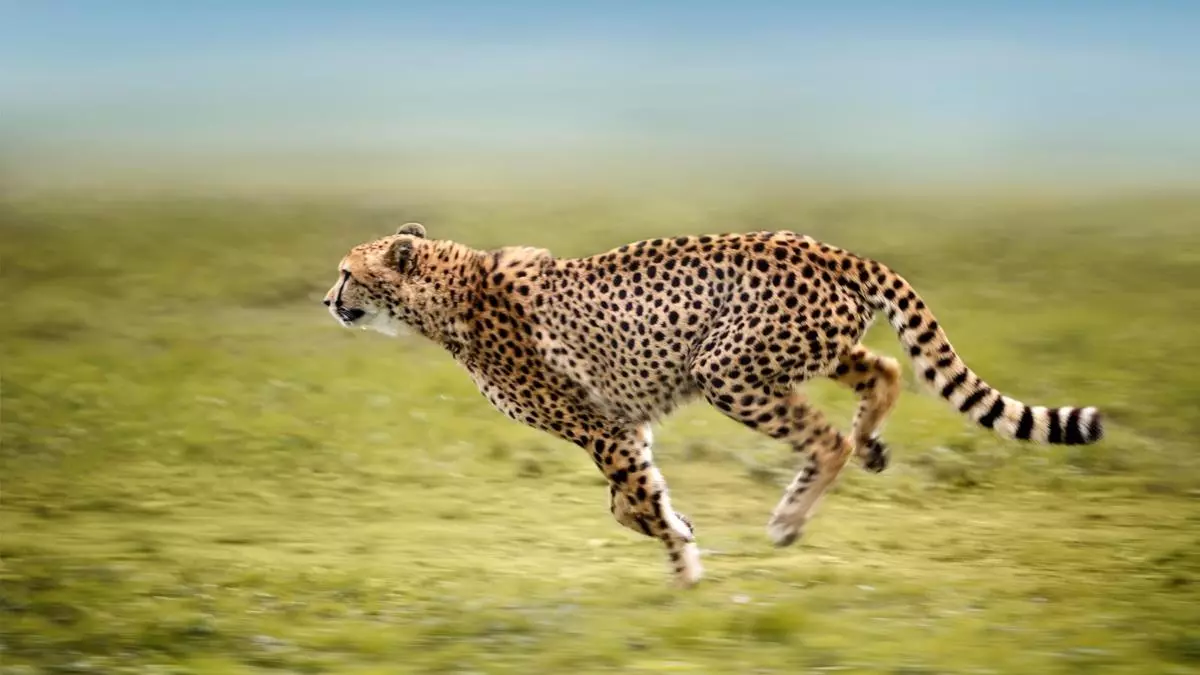
We have seen videos of a cheetah sprinting across the savannah, effortlessly manoeuvring around obstacles at high speed and marvelled at the combination of grace and speed. Now, picture a robot attempting the same feat. While advances in robotics have been significant, the robot’s performance is clunky and slow in comparison.
In a study published in Science Robotics, researchers Samuel A Burden, Thomas Libby, Kaushik Jayaram, Simon Sponberg, and J Maxwell Donelan, explore why animals still outpace the most advanced robots in terms of running speed, agility, and robustness.
The study digs deeper into the mechanics of movement, comparing the locomotive systems of animals and robots across five key areas: power, frame, actuation, sensing, and control.
Power: The fuel of movement
In the race between animals and robots, one of the critical areas where the gap is most evident is in the subsystem of power — how energy is stored and used to fuel movement. This is not just about the total amount of energy available but how efficiently it can be converted into action.
Animals have a highly efficient system for storing and using energy. They rely on fats and carbohydrates, which provide a dense and efficient fuel source. The energy density of biological fuels is remarkably high, allowing animals to operate over long distances without needing to refuel. For instance, the fat stores in an animal can provide more than twice the energy per unit mass compared to the best lithium-ion batteries.
Moreover, animals metabolise these fuels with an efficiency that engineers can only envy. The oxidative metabolism in mitochondria converts fats to usable energy (ATP) with efficiencies around 70 per cent. In contrast, the internal combustion engines used in some robots convert fuel to movement at about 25 per cent efficiency, and even the best batteries and electric motors do not match the energy density and conversion efficiencies of biological systems.
The frame: Skeleton vs structure
Animals have evolved skeletal structures that are highly optimised for their specific modes of movement. Vertebrates have bones made of collagen and hydroxyapatite, creating frames that are both strong and lightweight, allowing them to withstand stresses while being agile. Invertebrates have exoskeletons made of chitin and protein, providing a high strength-to-weight ratio and supporting flexible movement.
Additionally, animal frames can grow and adapt to stress, and their limbs often function as natural springs, storing and releasing energy efficiently during movement.
Robotic frames, constructed from materials like carbon fibre, aluminium, or steel, are designed with principles from mechanical and aerospace engineering. These materials are chosen for their strength and lightness, but they don’t match the adaptive nature of biological frames. For example, carbon fibre offers high stiffness and can be tailored for directional strength, but it lacks the multifunctional capabilities of biological tissues. Aluminium and steel provide durability but add significant weight.
Unlike biological frames, robotic frames are static and do not adapt or heal; they require manual repair, and their rigidity often leads to less efficient energy transfer and more mechanical loss.
Actuation: Muscles vs motors
Animals use muscles for actuation, which are remarkably efficient and versatile in generating force and movement. Muscles can adjust their stiffness and rapidly change their length, allowing animals to move with a fluidity and precision that robots struggle to match. These biological actuators have a high torque density, and can generate more force relative to their weight compared to most robotic actuators.
Muscles can achieve impressive power densities due to their ability to contract and expand quickly, storing and releasing energy in the process. This dynamic ability contributes significantly to the agility and speed of animals, as they can propel themselves forward with bursts of power that robotic systems find hard to replicate.
Robotic actuation primarily relies on electric motors and piezoelectric actuators, each with unique characteristics suited to different tasks. Electric motors are favoured in many robots for their good balance between power density and efficiency. They can be precisely controlled and can produce a consistent output for a wide range of tasks. However, while high-end electric motors can match or exceed the power density of muscle, they often fall short in terms of torque density without the use of gearboxes or other transmission mechanisms, which can introduce inefficiencies and reduce response times.
Piezoelectric actuators, on the other hand, offer very fine control at small scales and can operate quickly, but they do not scale well to the larger forces and movements needed for faster, larger-scale locomotion. These actuators also typically provide less torque than muscles, making it difficult for robots to achieve the same level of dynamic movement as animals.
Sensory supremacy
Animals excel in this domain due to their sophisticated sensory systems, which provide comprehensive and nuanced feedback about their surroundings. These systems are highly developed, with a wide array of sensors distributed across the body, allowing for an exceptional level of situational awareness and body control. For instance, animals use photoreceptors in their eyes to detect light, enabling vision that guides movement and obstacle avoidance. These photoreceptors can detect minimal light changes, allowing some animals to see in near-darkness.
Moreover, animals have mechanoreceptors distributed throughout their bodies, particularly in their skin, joints, and muscles. These sensors detect pressure, stretch, and touch, providing critical feedback on the environment and the body’s position within it. This feedback is vital for adjusting gait, speed, and posture to maximise efficiency and stability.
Robots, by contrast, typically rely on a more limited set of sensors, often centralised rather than distributed, which can reduce their ability to adapt to new or complex environments. Common robotic sensors include cameras and LIDAR (Light Detection and Ranging), which serve as the robot’s eyes by mapping out the environment in high resolution. While these tools are powerful for navigation and object recognition, they do not fully replicate the depth and breadth of sensory input available to animals.
For example, robots often use inertial measurement units (IMUs) to get a sense of movement and orientation. However, these units cannot provide the same level of detailed, localised feedback that animals get from their proprioceptive systems. Robots also employ force sensors in their limbs to detect interaction with the ground or other objects, but these are typically less sensitive and less numerous than the mechanoreceptors found in animals. This gap in sensory capabilities can lead to less fluid and adaptive movement, as robots cannot adjust their actions as precisely in real time.
Control: Brain vs computer
Animals demonstrate an extraordinary level of control, facilitated by their complex nervous systems. The neural architecture in animals, particularly in their spinal cord and brain, allows for rapid processing of a vast array of sensory data and the generation of dynamic, context-specific responses. This neural control is highly distributed; for instance, much of the basic motor control in animals occurs via spinal reflexes and central pattern generators (CPGs), which automate repetitive motion patterns like walking or running without constant brain intervention. This setup allows animals to react almost instantaneously to changes in their environment, adjusting their gait, speed, and direction to optimise movement.
The control systems in animals are inherently adaptable, learning and improving from repeated experiences. This neuroplasticity enables animals to master complex locomotor tasks through practice, from the intricate footwork of a cat stalking its prey to the powerful galloping of a horse.
Robots, on the other hand, traditionally use more centralised and less adaptive control systems. These systems often rely on pre-programmed responses and have limited ability to learn from experience or adapt in real-time. Robot controllers typically process input from sensors like cameras and IMUs and then compute outputs to actuators based on algorithms or control models.
While advancements in computational power and algorithms, especially in the realm of machine learning and artificial intelligence, have significantly improved robotic control, these systems still generally lack the fluidity and adaptability of biological control systems. For example, most robots use a form of model-based control, where the movements are planned based on predictive models of how the robot should react to certain inputs.
While effective in stable and predictable environments, this approach can struggle with the unexpected variations and complexities found in natural terrains. Furthermore, robotic control often suffers from delays due to the time needed to process sensory information and compute the appropriate responses, whereas animals benefit from the parallel processing capabilities of their neural networks.
Bridging the performance gap
Animals excel in locomotion due to their integrated systems that combine sensory inputs, neural processing, and adaptive actuation in a seamless manner. Their ability to dynamically adjust their behaviour based on environmental feedback and internal states allows for efficient, agile, and
robust movement. In contrast, robots often have disjointed systems where sensing, control, and actuation are not as well integrated, leading to slower, less adaptable, and more rigid movements.
One promising approach to bridge the gap is the development of bio-inspired designs and algorithms that replicate the natural integration seen in animal locomotion. These bio-inspired approaches, combined with advancements in materials science and computational modelling, hold the potential to significantly narrow the performance gap, leading to robots that can move with the grace, efficiency, and resilience of their biological counterparts.
SHARE
- Copy link
- Email
- Facebook
- Telegram
- LinkedIn
- WhatsApp
- Reddit
Published on May 12, 2024