Why Thorium is key to our net zero goals

Why Thorium is key to our net zero goals


Apart from coal, thorium is the only abundant energy source in India. Recent developments at the Bhabha Atomic Research Centre (BARC) give hope that this mineral can be India’s answer to green energy.

BARC is working on several technologies for using thorium, of which two are noteworthy.

One is the ‘Indian high-temperature reactor’ (IHTR), which is designed to produce heat and, in turn, produce hydrogen through the ‘sulphur-iodine’ method. In this process, sulphuric acid decomposes into oxygen, sulphur dioxide and water under high temperature. When iodine is added to sulphur dioxide and water, you get hydrogen iodide, which again splits into hydrogen and iodine at high temperatures. The fuel for this reactor is a mixture of uranium-233 dioxide and thorium dioxide. Uranium-233 does not occur naturally and is obtained by the mutation of thorium in reactors.

The other important thorium technology at BARC is the ‘ Indian molten salt breeder reactor’ (IMSBR). This 5-MW pilot project in Visakhapatnam is cloaked in secrecy, with BARC declining to share information about it.

Its design has two interesting features. First, it pulls more uranium-233 from thorium and is, therefore, considered better than the fast-breeder reactors like the one under construction (for decades) in Kalpakkam, near Chennai. The IMSBR is also a ‘breeder reactor’, which means it produces more that it consumes.

This happens when you place uranium-233 inside the reactor core and a blanket of thorium around the core. When neutrons bombard the fissile nuclei of uranium-233, energy is produced, but some of the neutrons hit the thorium nuclei and convert it into uranium-233. Thus, even as uranium-233 is burnt inside the reactor, more of it is produced (from thorium) outside the reactor.

However, there is a problem. Thorium does not mutate into uranium-233 straightaway; it first turns into an isotope of an element known as protactinium. The isotope, protactinium-233, turns into uranium-233. Meanwhile, during its brief life, protactinium-233 is also bombarded by neutrons and it partly absorbs the neutrons to become uranium-234, which is not fissile and therefore useless. The longer protactinium tarries in the reactor, the lower the output of uranium-233 from thorium.

BARC’s design, on the other hand, features a fluid fuel instead of the solid fuels used in conventional reactors. Liquid fuels can be pumped in and out unlike solid fuels, which stay in place until they burn out completely. In the IMSBR, the fuel is a liquid thorium-based salt. It can be pumped out to ensure that the decay of protactinium-233 into uranium-233 happens outside the reactor, leading to a higher output than in conventional reactors. There are a few more advantages, too. These, as BARC scientist IV Dulera notes in a paper, include continuous removal of xenon and krypton, resulting in improved neutron economy, negative fuel salt reactivity coefficient and other technical benefits.

BARC has developed an appropriate salt for this purpose (LiF-CaF -ThF –UF) which is circulated by pump through the reactor core. (Elsewhere in the world, researchers are coming up with better salts, which are chloride-based rather than fluoride-based (such as NaCl-ThCl4-PlCl3).

BARC has also developed other things such as pumps, valves, flow meters and heat exchangers. It has also concocted an alloy for the pipes conducting the molten salt.

The second interesting feature of the IMSBR is how it produces electricity. It does away with the conventional, inefficient Rankine cycle, where water boils to steam and turns the turbine. Instead, the IMSBR is to be married to the highly efficient Brayton cycle, where supercritical carbon dioxide (namely, carbon dioxide that is in a state between liquid and gas at a certain temperature and pressure) is used to drive the turbines, thereby cutting water use and producing a lot more electricity.

In response to an emailed query from  Quantum, Dr Soumyakanti Adhikari, Head, Scientific Information Resource Division, BARC, said: “The MSBR and HTR are promising technologies among other available options and constitute a part of our continuing developmental endeavour. Both these systems and the associated fuel cycle aspects are in exploratory evaluation and initial assessment stages.” The aim is to gain a sound understanding of the challenges inherent in these reactors and fuel systems, and the likely solutions to them, he said.

When the IMSBR demonstration plant comes up at Visakhapatnam, it would mark a significant step in India’s green energy journey with the entry of the thorium cycle. It appears as if the electricity generating IMSBR and the hydrogen producing IHTR could be the vehicles taking India closer to its net-zero target. Both use thorium — which is abundant in India and, yet, intriguingly absent in its green transition narrative.




Source link

OS with ‘no apps attached’

OS with ‘no apps attached’


When you are watching a video online, an ad related to a recent online purchase pops up. This recurs for weeks on end. How do you stop this? And what about the site at which you used your credit card to pay? How can you be sure that the site has not stored those details or that it is secure enough to prevent fraudulent access to your card details?

BharOS promises an alternative. Yet to see commercial release, the mobile operating system developed by JanK Operations, a Chennai-based start-up incubated by IIT-Madras, can be set up on off-the-shelf smartphones without needing to install any other apps that exchange information on your browsing or purchase history.

The firm’s director, Karthik Ayyar, says this is the first step to a secure mobile environment. “We develop the operating system. We then allow the user to decide which apps to install.”

Operating systems are software applications that allow computer software and hardware to interact and communicate. They control all complex processes and are the basis for any computing device in existence. The leading mobile OS are Android (48 per cent market share), Windows (29 per cent), and iOS (18 per cent). Now BharOS joins their ranks.

Choose your apps

Until India’s competition watchdog fined Google for its alleged anti-competitive practices, every Android phone in the market came with the company’s search tool as the default, and the entire suite of Google’s apps. “With BharOS, nothing is pre-installed, or ‘no default apps’ (NDA),” says Ayyar.

But wouldn’t that leave the user with the task of reviewing and selecting safe apps? He says ‘private applications store services’ (PASS) providers can help. “You don’t have to depend on the OS provider’s store of apps. Anyone can build a platform for apps and users can choose the PASS providers they are comfortable with. It could be your WhatsApp group that gets together and builds a platform. You could choose a PASS that your telecom provider builds. Or even one built by your own organisation. Indian Railways or the Government of India, too, can run PASS services.”

You may recall how the Joker Trojan malware insidiously entered apps in online stores. As many as 1.2 million users were reported to be affected by the malware, which started showing up advertisements, helping an unknown entity earn revenue at the cost of user privacy. A trusted PASS provider may help avert similar mishaps.

Ayyar likens BharOS to UPI (unified payments interface) as the underlying technology platform. “PASS service providers will be to BharOS what payment apps like Google Pay or PhonePe are to UPI.” BharOS is currently used by select entities, which give users restricted access to apps.

Marketing BharOS

The global market for OS was an estimated $45.04 billion in 2022, expected to rise to $48.27 billion in 2026. How would BharOS be marketed? “By appealing to the hearts of a billion Indians,” says Ayyar. The more people demand BharOS, the more the ODMs (original device manufacturers) would be compelled to use the operating system. He agreed it would be an uphill task against competition from Google, Microsoft and Apple.

What makes BharOS secure? “The bootloader is the first program that runs when you power up your device. The bootloader then checks if the kernel loaded in step two has been signed by an authenticated entity. This is done via cryptography,” he says.

In cryptography, a public key-private key pair helps maintain security. For example, when someone wants to send you a confidential file, they will use your public key, which is publicly available. Any document encrypted using your public key can only be decrypted with your private key, which only you hold.

In BharOS the kernel will, in turn, order other services such as the touchscreen, Wi-Fi, and display systems. Each of these must be cryptographically verified. If any malware has been introduced with any of these programs, the process will fail. Up to this point, the OS provides what is called a ‘chain of trust’ environment. That is, each system is signed off via a digital certificate that gives a stamp of approval. If the system has been tampered with, the digital validation process would fail. Beyond this point, the user has the liberty to choose PASS providers or even select apps that are deemed secure.

Ayyar concedes that other mobile OS in the market offer varying levels of security. “The analogy is: when a stranger from a foreign land wants to enter my house, the builder decides that is safe enough for me. But the same builder decides that my great-aunt who has raised me may not have security clearances to visit me three days in a year. Who decides on what is secure for you?”


Source link

They are coming back

They are coming back


When a tiny droplet of blood in the belly of a prehistoric mosquito trapped and preserved in amber gave enough DNA to bring back the dinosaurs to life, in Steven Spielberg’s 1993 superhit, Jurassic Park, it was the triumph of a fiction-writer’s imagination. It was fascinating to think of such a scenario.

But now, an American company has set out to welcome back the woolly mammoth, dodo, Tasmanian tiger…. and all the goodfellas lost to history.

Every hour, 6 species go extinct, most, if not all, due to human activities. Colossal Biosciences believes it is the moral responsibility of humankind to correct this historical wrong. “We accept the responsibility,” declares the company’s website.

Colossal Biosciences, which calls itself ‘de-extinction company’, intends to use the CRISPR technology to “jumpstart nature’s ancestral heartbeat”. CRISPR, a gene-editing technology, can cut a gene and insert another one in its place. Colossal Biosciences, founded by a Harvard geneticist, intends to “insert cold-resistant characteristics into the elephant DNA”. This, it says, would lead to “de-extinction of the Woolly Mammoth”.

Will it succeed? Investors seem to think so since they have put over $150 million into the company. But the scientific community is somewhat skeptical. To bring back an extinct species, Colossal would need to get hold of the entire DNA of the species, which is not easy.


Source link

Cost-effective electrochromic smart window

Cost-effective electrochromic smart window


Researchers at the Centre for Nano and Soft Matter Sciences (CeNS), Bengaluru, have developed a cost-effective polymeric electrochromic smart window that can store energy using hybrid transparent electrodes, as well as carry out transparency switching. “It has the potential of replacing the costly traditional smart windows in modern structures,” says a press release.

Electrochromic smart windows can aid in efficient power management. However, the high cost of such smart windows, especially the traditional ones made of tin-doped indium oxide (ITO), have resulted in limited market uptake.

CeNS has found a cost-effective solution by utilising a chemically synthesised conducting polymer, poly(o-methoxyaniline) or PMOANI, as an electrochromic layer over a low-cost transparent conducting electrode (ITO 60 nm/ aluminium mesh) to form a smart window. The scientists have set up a semi-automated production plant for the production of the hybrid transparent conducting electrodes (TCE).

“We are making a few more electrochromic smart window prototypes using our hybrid TCE to prove their capability with other materials. These transparent conducting electrodes can be made available to interested industries and R&D labs on a request basis,” says Dr Indrajit Mondal, one of the scientists involved in the project.

Micro-algal bio-refinery

Prof Kaustubha Mohanty of IIT-Guwahati’s Department of Chemical Engineering has developed an advanced micro-algal bio-refinery model that integrates wastewater treatment and high-value biofuel production via hydrothermal liquefaction (HTL), with domestic sewage sludge and micro-algal biomass as feedstock. This has resulted in 40 per cent bio-crude yield and properties comparable to petroleum crude

The research team has collaborated with organisations including IIT-Kharagpur, CSIR-IICT Hyderabad, and Technical University Denmark, to develop an advanced bio-refinery process. The industry partners for technology transfer include Purabi Dairy in Assam, Symbiosis Center Denmark, and HPCL, says a press release.

Compact air plasma torch

The Bhabha Atomic Research Centre (BARC) has developed “a compact hafnium electrode air plasma torch” operating in the range of 30 kW and is readying for technology transfer to industry.

The device converts atmospheric air into a controlled jet of air plasma with a maximum core temperature around 9,000 K and electro-thermal efficiency of 60-plus per cent.

A thermal plasma jet is a high-temperature beam of concentrated thermal energy consisting of electrons, ions and neutrals. Such plasmas are naturally formed in the atmosphere during thunderbolts and observed as a bright flash in the sky. The key features of BARC’s compact device include low operational cost, simple design, use of cheapest gas (atmospheric air), high efficiency, high peak temperature, and ease of control, says the research centre.


Source link

More bio-inspired functional materials pouring out of labs 

More bio-inspired functional materials pouring out of labs 


Euplectella aspergillum is a beauty. It is a greyish-white sponge that is found in the deep waters of the Pacific. Loosely-woven and bottle shaped, they grow in clumps and keep dancing with motion of the waters. The locals know them as ‘venus flower basket’ and are a spectacle to behold. 

Deepak Sharma put a sample of Euplectella aspergillum on his worktable and began regarding it keenly, with folded hands. But its aesthetics appealed little to him. He was more concerned about the ying-yang of the lattice structure. There were vertical and horizontal struts, making several little squares. But while some squares had diagonal struts (closed cells), others didn’t (open cells).  

To most of us, this may not mean anything—we wouldn’t even have noticed these features — but for Sharma, who is doing his doctorate in mechanical engineering, and his guide, Prof Somasekhar Hiremath, of IIT-Madras, saw this peculiar cellular architecture of the Venus flower basket as nature’s way of giving the sponge properties of buckling resistance and impact and vibration absorption. 

Deepak Sharma holding a ‘Venus flower basket’ and a functional material

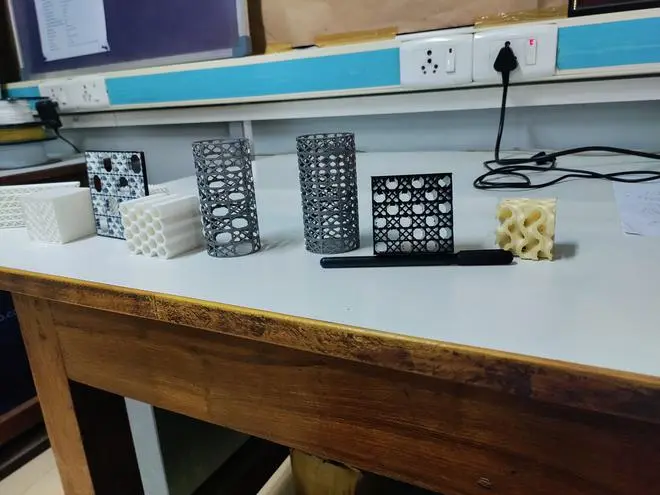
Sharma pulled out a sheaf of papers and made some drawings and scribbled some points. These became the feed material for 3D printers. Presently came an assortment of weird objects, some cylindrical, some cuboid, made of weirdly named polymers. He and Prof Hiremath tinkered with the cellular architecture, making some struts soft (with thermoplastic polyurethane) and others hard (with poly lactic acid). These are meant to impart the engineered material different properties such as energy absorption. These engineered materials are the basic building blocks that can eventually be adopted into automobiles, space, armoured vehicles, bio implants, and so on. “Our bio-inspired structures showed better energy absorption performance than the most commonly used foams and honeycombs for industrial applications,” says Sharma.  

“These structures can be incorporated in the aero-engine components to significantly reduce the weight, increase vibration absorption and for improved heat dissipation control,” Prof Hiremath told Quantum. 

Nature’s wonders

Well, this is an over-simplified description of Deepak Sharma’s work, which actually took years from start to finish, but the underlying theme is an evolving branch of engineering, called bio-inspired materials. (B L Zhou notes in his paper on bio-inspired study of structured materials, that the term “bio-inspired” may be better than the terms “bionic” or “biomimetic”, since the former is relatively easy to be accepted.)

Deepak Sharma holding a ‘Venus flower basket’ and a functional material

Deepak Sharma holding a ‘Venus flower basket’ and a functional material

The hard back of a beetle, the wings of a butterfly, the hairs of sea skaters, the natural spider silk—the list could be endless—all have messages for engineers to make new materials. The beautiful colours of butterflies come from their microstructure interacting with light. Spider silk, for example, has ultra-high tensile strength. In an article in Chemical Engineering Journal, a group of Chinese scientists says how they copied the “nanoconfinement effect of hydrogen-bonded crystalline β-sheets on the soft amorphous protein matrix” and used the same nature’s trick to create similar material with soy proteins and tannic acid, an inexpensive plant-derived polyphenol. 

Another student-researcher in Prof Hiremath’s lab, Priya Ranjan, has drawn inspiration from the rather peculiar, crescent-shaped structures on the insides of a pitcher plant — a plant with pitchers into which insects fall and are duly digested — to give a better surface texture to the cutting edges of machine tools. Ranjan has been able to arrive at the exact dimensions of the ‘crescents’ etched on the machine tools that would give the best results. Surface texturing is altering the topography of the cutting tool’s surface by micro-etching different geometrical patterns on it — the geometrical texture generation enhances the tribological characteristics (friction, lubrication and wear) of the interfaces between the tools and the workpiece.  

Copying nature

‘Bio-inspired materials’, as a science, is not really new, but is gathering momentum, as researchers are seeing that there is so much to learn from nature, to partake of the knowledge accumulated by nature, by its own trial and error, over billions of years. But what happened to accelerate research now? One reason, scientists say, 3D printing. Earlier scientists didn’t know how to copy nature, but with 3D printing, you can make anything, no matter how complex the structure. 

It is not clear as to how much the bio-inspired materials have made their way to the industry, because the distinction between bio-inspired materials and others is not sharp. Some cellular structural materials, such as those of honeycomb structures, are well in use in the industry. But it is safe to say that what has seeped into the portals of the industry is practically nothing compared with what is available. 


Source link

YouTube
Instagram
WhatsApp



