US SEC appeals decision that restricted its ability to regulate crypto mkts

US SEC appeals decision that restricted its ability to regulate crypto mkts


If the appeals court agreed, or defined securities narrowly, it could impede the SEC’s ability to police the cryptocurrency exchange. Photo: Bloomberg


The US Securities and Exchange Commission said on Wednesday it is appealing a court ruling that restricted its ability to regulate cryptocurrency markets.


Wall Street’s main securities regulator will ask the 2nd US Circuit Court of Appeals in Manhattan to review a July 2023 decision that the XRP token sold by Ripple Labs on public exchanges did not meet the legal definition of a security.


Click here to connect with us on WhatsApp


The decision by US District Judge Analisa Torres meant the sales of the token, totaling about $757 million, were not subject to investor protection laws that the SEC enforces.


If the appeals court agreed, or defined securities narrowly, it could impede the SEC’s ability to police the cryptocurrency exchange Coinbase and other defendants selling or making markets for newer, non-traditional financial products.


Torres also gave the SEC a partial victory, saying another $728 million of XRP sales to institutional investors should have complied with securities laws.


She fined Ripple $125 million in August, but put the fine on hold pending an appeal. The SEC had sought $2 billion. Torres’ stay would last until the 2nd Circuit ruled, court records show.


Ripple can also appeal parts of Torres’ rulings that it dislikes.


Ripple CEO Brad Garlinghouse said the SEC decision to appeal was “misguided” and “infuriating,” but not a surprise.


“While we’ll fight in court for as long as we need, let’s be clear: XRP’s status as a non-security is the law of the land today,” Garlinghouse said in a post on X.

(Only the headline and picture of this report may have been reworked by the Business Standard staff; the rest of the content is auto-generated from a syndicated feed.)

First Published: Oct 03 2024 | 8:40 AM IST


Source link

Dividend, Bonus, Split: KPI Green Energy, 5 others to go ex-date tomorrow: Ex-dividend stocks

Dividend, Bonus, Split: KPI Green Energy, 5 others to go ex-date tomorrow: Ex-dividend stocks


Ex-date dividend stocks: Shares of six companies, including KPI Green Energy, Godawari Power and Ispat, and Real Eco-Energy, will be in focus today as they trade ex-date tomorrow, October 4, for key corporate actions such as dividends, bonus issues, and stock splits. 


Accelya Solutions India and KPI Green Energy will trade ex-dividend on Thursday, October 4, having announced final dividends of Rs 40 and Rs 0.20 per share, respectively, according to BSE data.

Click here to connect with us on WhatsApp


Meanwhile, Classic Electricals and Shikhar Leasing and Trading will trade ex-date for their bonus issue announcements, with bonus shares being issued in the ratios of 5:1 and 3:1, respectively.


Classic Electricals has announced it will issue 4,20,375 equity shares of Rs 10 each as fully paid bonus shares to non-promoter shareholders in the ratio of 5 new shares for every 1 existing share held as of the record date.


Shikhar Leasing and Trading has announced it will issue 2,77,260 equity shares of Rs 10 each as fully paid bonus shares to non-promoter shareholders in the ratio of 3 new shares for every 1 existing share. 


Additionally, shares of Real Eco-Energy and Godawari Power and Ispat will trade ex-date on Thursday for stock subdivisions. Real Eco-Energy has announced a stock split, converting 1 equity share of Rs 10 face value into 5 equity shares of Rs 2 each.


Godawari Power and Ispat will also split its stock, subdividing 1 equity share of Rs 5 face value into 5 equity shares of Re 1 each.


The ex-date marks the cutoff point when buying a stock no longer includes entitlement to upcoming dividends, bonuses, or stock splits. To qualify, investors must own the stock prior to the ex-date. Those purchasing on or after this date are ineligible. 


Companies then determine beneficiaries based on the record date, identifying eligible investors from the list of shareholders at that time, typically a few days after the ex-date. Essentially, the ex-date is the last day to buy a stock and still receive upcoming corporate benefits.

First Published: Oct 03 2024 | 7:54 AM IST


Source link

Bitcoin falls 4.7% as West Asia tension spurs caution across markets

Bitcoin falls 4.7% as West Asia tension spurs caution across markets


A 50-day correlation coefficient for a gauge of the top 100 digital tokens and MSCI Inc.’s global equity index is at 0.65. | Photo: Shutterstock

By Suvashree Ghosh


Bitcoin speculators banking on a seasonal October melt-up faced an early reality check as deepening tension in the Middle East spurred a bout of caution across global markets.


The digital asset fell 4.7 per cent on Tuesday, the most in nearly a month, after Iran fired about 200 ballistic missiles at Israel in a sharp but brief escalation of hostilities between the two adversaries. The token pared some of the drop on Wednesday, changing hands at around $61,260 as of 7:43 a.m. in New York.

Click here to connect with us on WhatsApp

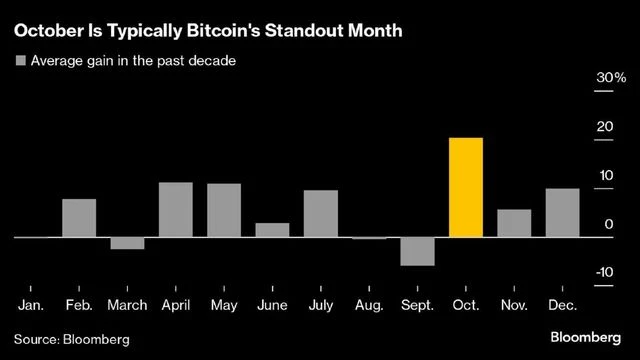
Bitcoin has shed about 4 per cent in the first two days of October, a contrast with its average 20 per cent climb over the month as a whole in the past decade, according to data compiled by Bloomberg. That historical pattern sparked hopes of a lift past March’s record high of $73,798, until arguably the biggest geopolitical fault-line in global markets poured some cold water over the optimists.

Chart


Sean McNulty, director of trading at liquidity provider Arbelos Markets, argued that the selloff is a “momentary setback” given that the Federal Reserve has begun cutting interest rates. The government that emerges after November’s US presidential election is also likely to be friendlier toward crypto, he said.


“The seasonal trend of October being the best month for Bitcoin is alive and well,” McNulty added.

For now, markets are on alert for intensifying conflict as they parse Israeli Prime Minister Benjamin Netanyahu’s vow to retaliate against Iran’s strikes. US equity futures dipped Wednesday, while oil prices rose on supply fears.

Chart


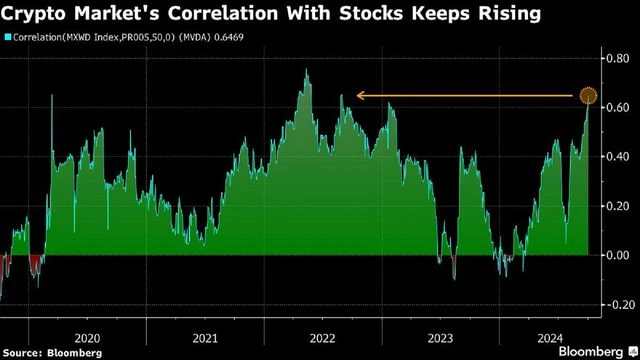
Digital assets have moved more in tandem with stocks lately, indicating macroeconomic drivers like monetary policy are key for Bitcoin at the moment. 


A 50-day correlation coefficient for a gauge of the top 100 digital tokens and MSCI Inc.’s global equity index is at 0.65, the highest since 2022, according to data compiled by Bloomberg. A reading of 1 indicates assets are moving in lockstep, while minus 1 signals an inverse tie. 


“The geopolitical environment doesn’t look conducive to risk assets,” said Caroline Mauron, co-founder of Orbit Markets, a provider of liquidity for trading in digital-asset derivatives.

First Published: Oct 02 2024 | 11:43 PM IST


Source link

Japanese investors'  trillion 'carry trade' begins to slowly unwind

Japanese investors' $4 trillion 'carry trade' begins to slowly unwind


By Ruth Carson, Masaki Kondo and Winnie Hsu


Japan’s investors are starting to lose their decades-long infatuation with overseas assets.


Click here to connect with us on WhatsApp


In the first eight months of the year, Japanese investors snapped up a net ¥28 trillion ($192 billion) of the nation’s government bonds, the largest amount for the time frame in at least 14 years. They also cut purchases of foreign bonds by almost half to just ¥7.7 trillion and their buying of overseas equities was less than ¥1 trillion. 


“It’s going to be one of the mega trends and it is a super cycle for the next five to 10 years,” said Arif Husain, head of fixed-income at T. Rowe Price, who has nearly three decades of investing experience. “There will be a sustained, gradual but massive flow of capital back into Japan from abroad.”


With $4.4 trillion invested abroad, an amount larger than India’s economy, the speed and size of any pullback has the power to disrupt global markets. Even as the gap in rates between Japan and other countries has narrowed, the inflows have been a trickle rather than the flood some investors have feared. 


The overseas investments of the Japanese have been compared to a giant carry trade, where investors benefited from ultra-low interest rates available at home to fund purchases abroad.


The scope of the flows will depend on the pace and trajectory of rates in Japan. While Bank of Japan Governor Kazuo Ueda indicated policymakers would be more measured on plans to hike, strategists are almost unanimously forecasting a stronger Japanese currency into next year on views policy will inevitably normalize. 


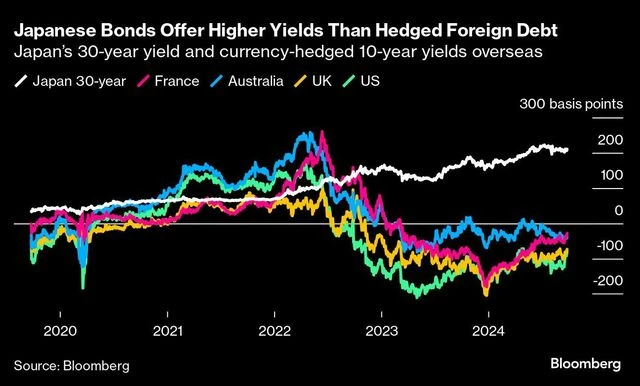
Yields on the benchmark 30-year Japanese government bonds have risen about 40 basis points to above 2% as the BOJ has raised rates this year. That’s getting closer to the point where some of the country’s biggest insurers intend to amp up their holdings of local debt. 


T&D Asset Management Co. has said a 30-year JGB yield above 2.5% can be a level where money flows back home. Dai-ichi Life Insurance Co. said in April that yields above 2% on these bonds would be relatively attractive. The yen weakened 0.4% to 144.16 to the dollar on Wednesday. 


Japan Post Insurance Co. is still investing offshore, but “it has become easier to invest in yen-denominated assets,” said Masahide Komatsu, senior general manager at the firm’s global credit investment department. “We want to diversify our investments.” 

chart


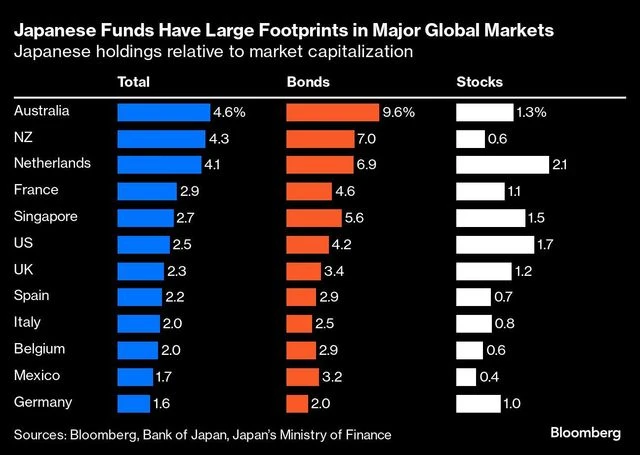
The stakes are massive: Japan’s investors are the largest foreign holders of US government bonds and own almost 10% of Australia’s debt. They also control hundreds of billions of dollars worth of stocks from Singapore to the Netherlands and the US, owning anywhere between 1% and 2% of the markets. Their reach extends to high risk investments such as cryptocurrencies and risky debt that blew up in Europe.


They built up holdings during the years of sub-zero rates at home and snapped up everything from Brazilian bonds that yield over 10% to Alphabet Inc. shares and bundles of risky loans in the US. 


One prominent example of the drive to go overseas is Norinchukin, Japan’s largest agricultural bank, which invested a significant chunk of its ¥60 trillion securities portfolio in US and European government debt. It is now in the process of unwinding about ¥10 trillion in foreign holdings after an unexpected spike in rates increased its funding costs and saddled the bank with losses. San-in Godo Bank Ltd., a regional bank based in western Japan, also plans to bulk up its holdings of JGBs while selling off Treasuries. 


A nightmare scenario for markets would be an even more extreme version of the chaos of Aug. 5, when fears of higher Japanese rates and a slowing US economy led to a rapid unwinding of carry trade bets by global hedge funds and other overseas speculators. The Nikkei 225 suffered its biggest rout since 1987, Wall Street’s stock volatility gauge spiked, and the yen advanced. Even gold, a haven in time of stress, fell. 


Japanese investors — including some of the world’s biggest pension funds and insurers — largely laid dormant, underscoring the potential for more tectonic shifts. 


The turmoil also prompted the BOJ to say it would take market conditions into account before raising rates again and would hold off if markets were unstable. Additionally, the Federal Reserve cut rates by half a percentage point in September, in an effort to preserve the strength of the US economy. 


“August gave us a glimpse into the repatriation trend,” said Charu Chanana, a global markets strategist at Saxo Markets. “The Fed’s commitment to achieving a soft landing has reduced the odds of a recession. This means future repatriation may not be as abrupt.”

chart


While policy is normalizing, Japan’s rates remain hundreds of basis points below counterparts like the US and Europe, meaning offshore assets still appeal to yield-hungry investors willing to tolerate currency risk. Japan’s Government Pension Investment Fund, one of the world’s largest pension funds, targets about half of its holdings in foreign bonds and equities. Those positions helped it offset losses in domestic debt during its last reporting period. 


Japanese investors are “realizing that the US markets are still incredibly liquid, very large, offer the most diversification,” said Anders Persson, global head of fixed income at Nuveen LLC. “They’re looking for a little bit more yieldy-type opportunities.” 


After the market chaos in August, JPMorgan Chase & Co. estimated that as much as three quarters of the carry trade had been unwound. That analysis looked at global trades funded by borrowing in currencies with low rates. With a BOJ benchmark rate of 0.25%, the yen still fits that criteria. As that changes, the incentives for the Japanese to bring their money home will grow. 


“Investors everywhere are underestimating the risk of big repatriation flows in the long run,” said Shoki Omori, chief desk strategist at Mizuho Securities Co. in Tokyo. “The Japanese are big carry traders themselves. The trend is already underway — watch this space.”


(Updates with yen in 8th paragraph)

First Published: Oct 02 2024 | 11:20 PM IST


Source link

F&O volumes hit record high of Rs 537 trn in Sept, but headwinds loom

F&O volumes hit record high of Rs 537 trn in Sept, but headwinds loom


The average daily trading volume (ADTV) for the futures and options segment climbed to a new record high of Rs 537 trillion in September, rising 7.2 per cent on a month-on-month basis. The ADTV for the cash segment, however, fell nearly 4 per cent to Rs 1.3 trillion. The rise in F&O volumes came even as the markets clocked stable performance last month. The benchmark Nifty 50 index rose nearly 4 per cent, while the Nifty Midcap 100 and the Nifty Smallcap 100 indices ended the month little changed in September. Going ahead, however, F&O volumes could fall off the cliff with a slew of regulatory headwinds.

Market regulator Sebi on Wednesday announced measures that raise entry barriers for traders, reduce the number of weekly expiries and require upfront collection of margins. Three out of six measures will come into effect from November 20, two from February 1 and one intraday monitoring of position limits from April 1. In addition, Sebi has revised the stock selection criteria for stocks that qualify for the derivatives segment. The new rules— aimed at ensuring more liquid stocks qualify for the derivatives segment— too are expected to lead to a churn in the 182 stocks that are currently available for F&O trading.


Click here to connect with us on WhatsApp

First Published: Oct 02 2024 | 10:41 PM IST


Source link

Sebi's six-step measures seen making a dent in F&O volumes by up to 40%

Sebi's six-step measures seen making a dent in F&O volumes by up to 40%


The Securities and Exchange Board of India’s (Sebi) six-step plan to curb retail participation in speculative index derivatives may lead to a significant drop in volumes—potentially by 30 to 40 per cent.


These measures aim to reduce excessive speculation in the futures and options (F&O) segment, where daily turnover often exceeds Rs 500 trillion, and retail investors frequently end up on the losing side of the trade.

Click here to connect with us on WhatsApp


Sebi has decided to increase the contract size from Rs 5 lakh to Rs 15 lakh, raise margin requirements, and mandate the upfront collection of option premiums from buyers. Additionally, the new rules will limit weekly expiries to one benchmark per exchange, bring intraday monitoring of position limits, and remove the calendar spread treatment on expiry days.


The steps are intended to raise the entry barrier for retail investors, whose losses have been mounting, as per a recent study by the watchdog.


Analysts have estimated that the curbs may bring down the volumes on the National Stock Exchange (NSE) by nearly one-third. In September, the average daily turnover (ADTV) for NSE’s cash market segment stood at Rs 394 trillion, while that of BSE was around Rs 144 trillion.


Besides the fresh derivatives curbs, futures trading volumes are also expected to be impacted due to the increase in securities transaction tax (STT), which came into effect from Tuesday.


Further, many expect the volumes to shift to the Gift City in Gujarat, where Gift Nifty contracts are traded on the NSE’s International Exchange.


“Limiting weekly expiries to a single index on NSE and BSE could encourage a shift in trading volumes towards GIFT City, which still offers a wider range of weekly options. From an FPI (foreign portfolio investor) perspective, this creates an attractive opportunity for those seeking flexibility in trading strategies,” said Rohit Agarwal, chief executive officer of the funds business, Dovetail Capital.


“While NSE remains the dominant player, averaging 10.8 billion equity derivatives contracts monthly in FY24, GIFT City, although growing, represents less than 1 per cent of NSE’s volume with around 2 million contracts traded monthly. However, the transition will largely depend on how well GIFT City can build its liquidity and market depth to support this shift,” added Agarwal.


As far as onshore trading is concerned, the impact of the new measures on BSE may be lower than NSE, given its relatively lower dependence on the number of index options expiring through the week—which now will be limited to one.


Index derivatives trading accounts for a large portion of the revenues for both brokers and stock exchanges.


Zerodha, the largest broker in terms of profitability, has estimated a decline of 30 to 50 per cent in revenue owing to the changes.


Stock brokers are planning to diversify their revenue streams to offset the hit on revenues.


NSE’s income from transaction charges stood at Rs 3,623 crore in the first quarter of FY25. The same for BSE was Rs 366 crore. A majority of this is contributed by the F&O segment and has surged on the back of heightened activity.


Three of the key measures by the market regulator will take effect from November 20, while others will be effective from February and April next year.


As per an earlier report by IIFL Securities on NSE published in late August, Sebi’s decisions could dent the exchange’s revenues by 20 to 25 per cent.


Global trade body Futures Industry Association (FIA) believes that while the intent of Sebi’s action is justified, the new measures could end up inflating the cost of trading.


“Liquidity providers could also face increased margin costs, leading to wider bid/ask spreads and creating market distortion. These higher spreads will ultimately be absorbed by retail traders, creating unintended additional costs for both retail and institutional investors,” the FIA said in its submissions to Sebi’s consultation paper floated in July on derivatives curbs.


Higher entry barriers, some believe, may lead to some retail participants taking disproportionately higher risks.


A Sebi expert group is expected to monitor the impact of the proposed changes and return to the drawing board if further follow-up action is warranted.

First Published: Oct 02 2024 | 7:43 PM IST


Source link

YouTube
Instagram
WhatsApp