Hazoor Multi Projects bags contract for user fee collection from NHAI
Powered by Capital Market – Live News
Disclaimer: No Business Standard Journalist was involved in creation of this content
First Published: Mar 13 2026 | 9:16 AM IST
Powered by Capital Market – Live News
Disclaimer: No Business Standard Journalist was involved in creation of this content
First Published: Mar 13 2026 | 9:16 AM IST
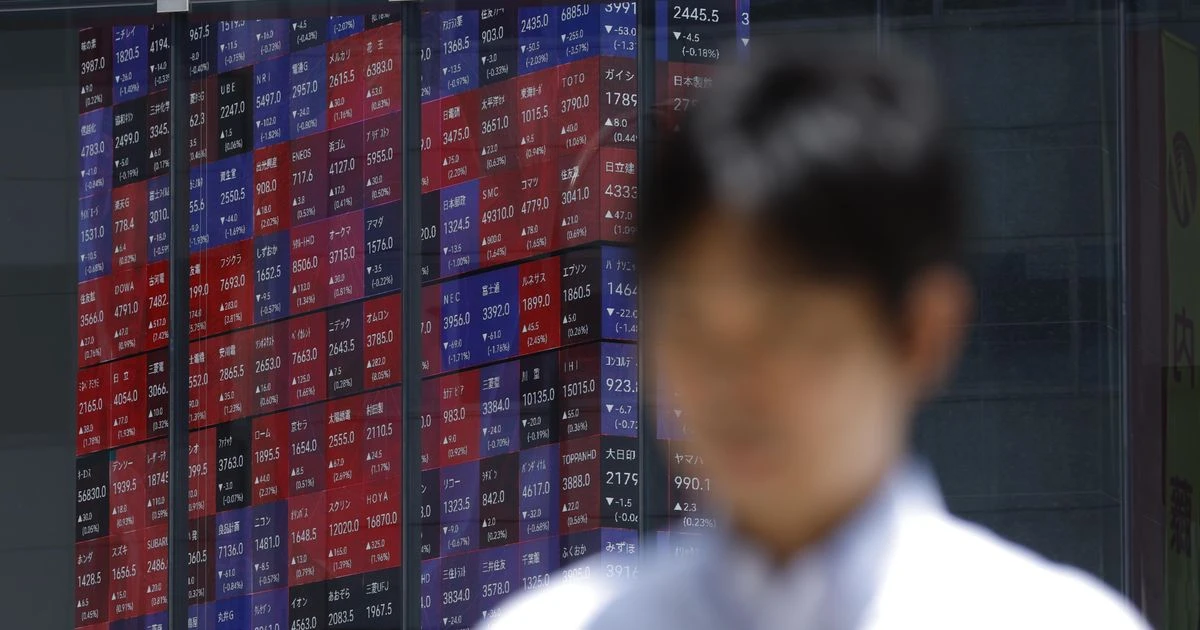
Asian stocks slumped on Friday, poised for a second straight weekly decline as fast-dwindling hopes of a resolution to the US and Israel’s war with Iran kept oil prices aloft, casting a shadow over global markets and spurring inflation fears.
The US dollar has become the safe-haven of choice during the tumult, putting most other currencies under pressure. The dollar was set for a second consecutive week of gains and is up 2 per cent since the war broke out at the end of February.
Oil prices remained close to the closely watched $100 per barrel level, although they eased a bit in early trading on Friday after US issued a 30-day license for countries to buy Russian oil and petroleum products currently stranded at sea.
Brent futures were last at $99.85 a barrel, while West Texas Intermediate crude was at $95.05 a barrel.
In Asia, MSCI’s broadest index of Asia-Pacific shares eased 0.5 per cent, on course for a 1.5 per cent decline for the week. Japan’s Nikkei fell 1.3 per cent, while tech-heavy South Korean stocks slid nearly 2 per cent and Taiwan equities fell 1 per cent.
With Iran stepping up attacks across the West Asia as its new Supreme Leader Mojtaba Khamenei vowed to keep the Strait of Hormuz shipping lane closed, investors are bracing for a prolonged conflict and higher oil prices.
The spectre of rising inflation has led markets to rapidly reprice what they expect from central banks this year, with traders now anticipating just 20 basis points of easing from the Federal Reserve compared to 50 bps of cuts priced in last month.
“Markets were positioned for Fed cuts this year but the runway to justify Fed cuts is no longer there with the US excursion into Iran,” said Prashant Newnaha, senior rates strategist at TD Securities. “The markets are recalibrating for a higher terminal rate.”
The selloff in global stocks and bonds shows no signs of easing. US stocks fell sharply overnight and the two-year Treasury yields, which typically move in step with Fed interest rate expectations, scaled a six-month high on Thursday.
“With the possibility of higher oil prices still elevated, investors should be prepared for continued volatility and potentially further downside in the near term,” said Vasu Menon, managing director of investment strategy at OCBC in Singapore.
Jose Torres, senior economist at Interactive Brokers, said the negative impact of rising oil prices on corporate margins, inflation expectations, rate-cut prospects and yields is sparking market volatility, leaving participants with few places to hide.
“Indeed, sinking optimism about Fed rate reductions amid strengthening cost pressures is weighing on traditional safe havens such as silver, gold, and government debt.”
The two-year note yield eased 3 bps to 3.730 per cent after hitting its highest level since August 22 on Thursday. The yield has gained 35 bps in the two weeks since the war started.
The yield on the longer-dated 30-year bond has risen 24 bps this month.
Investor focus will switch to a slate of policy meetings next week with the Fed, the Bank of Japan, the European Central Bank and the Bank of England all due to meet, with most expected to keep rates unchanged. The Reserve Bank of Australia is broadly expected to hike rates next week.
In currencies, the euro last fetched $1.1527, inching higher on the day but still on course for a weekly decline of nearly 1 per cent. The dollar index was at 99.599, set for an 0.8 per cent rise for the week.
The yen firmed a bit to 159.13 per dollar, hovering around the 160 mark but the noise around possible intervention has been fairly muted. Analysts said the bar for intervention from Tokyo is higher due to the oil price shock.
“What was once a ‘line in the sand’ at 160 has evolved into more of a moving goalpost,” said Tony Sycamore, market analyst at IG.
“Against such a hostile macro backdrop, it makes little sense for authorities to waste precious intervention ammunition-whether verbal or physical, trying to defend the 160ish level this time around.”
Gold was 0.7 per cent higher at $5,114 per ounce on Friday but set for a 1 per cent drop for the week.
Stocks to Watch today, Friday, March 13, 2026: The Indian equity markets are likely to start the week’s last trading session in the negative territory, weighed down by weak global cues. GIFT Nifty futures also indicate a weak start for the benchmark indices. The futures were quoted at 23,565, trading 163 points lower than the previous close at 06:58 AM on Friday.
Overnight in the US, Wall Street’s major indices also ended lower after Iranian strikes on two oil tankers pushed crude prices toward $100 per barrel, intensifying inflation concerns and prompting investors to pull back from equities. The S&P 500 fell 1.52 per cent, the Nasdaq Composite dropped 1.78 per cent, and the Dow Jones Industrial Average declined 1.56 per cent.
ACME Solar Holdings: The company, through its wholly owned subsidiary ACME Sun Power, has commissioned the second phase of 33.335 MW / 160.51 MWh from the total 300 MW / 1,409.34 MWh capacity of its battery energy storage system (BESS) project in Phalodi and Jodhpur, Rajasthan. The commercial operation date (COD) for Phase II is scheduled for March 14. With this development, ACME Sun Power’s commissioned capacity stands at 66.67 MW / 320.99 MWh out of the total 300 MW / 1,409.34 MWh capacity.
Godrej Properties: The company has announced the acquisition of an approximately 44-acre land parcel in Coimbatore through an outright purchase. It plans to develop a premium plotted residential project with a developable potential of about 1.1 million sq. ft. and an estimated revenue potential of ₹450 crore.
KPI Green Energy: The company has energised an additional 35 MWp of solar capacity, taking its total operational independent power producer (IPP) capacity to 589 MWp. With projects currently in hand, the company expects to commission an additional 1,582 MWp in the near term, which would expand its total IPP portfolio to 2.17 GWp.
JK Lakshmi Cement: The company has been declared the preferred bidder for the mining lease of the Juipahar New Umrangso Limestone Block (A and B) in Assam. The limestone blocks cover an area of 405 hectares. Separately, the board has approved the acquisition of a 77.96 percent equity stake in NECEM Cements.
Manorama Industries: The company has announced that its board has approved raising up to ₹500 crore through the issuance of equity shares, non-convertible debt instruments along with warrants or other convertible securities, via a qualified institutional placement (QIP) or any other method.
Max Financial Services: The company informed the exchanges that its board has approved raising up to ₹2,000 crore through a qualified institutional placement (QIP) or other methods. The funds will primarily be used to meet the funding requirements of its material subsidiary, Axis Max Life Insurance, to support business growth and expansion, with the balance allocated for general corporate purposes.
Gravita India: The company has announced the signing of definitive agreements to acquire a 98.95 percent stake in Rashtriya Metal Industries for ₹559.08 crore. The transaction is expected to close by March 31, 2026.
Kalpataru: The company has announced the signing of a redevelopment project for Shree Mahalakshmi CHS located off Veera Desai Road, Andheri West. The project spans approximately 3 acres and has a total potential carpet area of about 0.4 million sq. ft., with an estimated gross development value (GDV) of around ₹1,400 crore.
Nectar Lifesciences: The company informed the exchanges that it has entered into an inter-corporate loan agreement worth up to ₹100 crore with Avensis Exports, a subsidiary of the company.
Indian Overseas Bank: The lender has reduced its one-month marginal cost of funds-based lending rate (MCLR) by 10 basis points, effective March 15, while the MCLR for other tenures remains unchanged.
Oil prices rose about 9 per cent on Thursday as Iran stepped up attacks on oil and transport facilities across the Middle East, and the country’s supreme leader said the closure of the vital Strait of Hormuz should continue.
Brent futures extended gains to climb up $8.05, or 8.8 per cent to $100.03 at 10:25 a.m. ET or 1425 GMT, while US West Texas Intermediate crude climbed $8, or 9.2 per cent to $95.25.
Prices of both contracts were trending higher after US Energy Secretary Chris Wright told CNBC that the Navy cannot escort ships through the Strait of Hormuz now but it was “quite likely” that could happen by the end of the month. However, global oil prices are unlikely to hit $200 a barrel, he said, even Iran if continued to strike merchant ships.
Two fuel tankers in Iraqi waters were struck by explosive-laden Iranian boats, Iraqi security officials said early on Thursday, while an Iraqi official told state media that its oil ports “have completely stopped operations.” Oman shifted all vessels out of its main oil export terminal at Mina Al Fahal outside the Strait of Hormuz in a precautionary move, a Bloomberg News report said.
Brent hit $119.50 a barrel on Monday, its highest since mid-2022, then dropped after US President Donald Trump said the Iran war could be over soon.
The war in the Middle East is causing the biggest oil-supply disruption in the history of global markets, the International Energy Agency said on Thursday, a day after approving the release of a record volume of 400 million barrels of oil from strategic stockpiles.
Middle East Gulf countries have cut total oil production by at least 10 million barrels per day – a volume equalling almost 10 per cent of world demand, the agency said in its latest monthly oil market report.
A detailed breakdown has not been provided yet, so there is some scepticism in the market that the full volume will actually be released, Energy Aspects analysts said, adding that a total of 400 million barrels of mostly crude and some products inventories is only equivalent to 25 days of the current disruption to flows.
Goldman Sachs forecast Brent crude prices would average $98 per barrel in March and April before declining to $71 by the fourth quarter, but warned that in an upside-risk scenario, where flows through the strait are disrupted for a month, the March and April average could surge to $110.
“The only way to see oil prices trade lower on a sustained basis is by getting oil flowing through the Strait of Hormuz,” ING analysts said. “Failing to do so means that the market highs are still ahead of us.”
The Strait of Hormuz runs past Iran’s coast and supplies a fifth of the world’s oil and liquefied natural gas.
LEBANON, CHINA, UKRAINE
Lebanon’s Hezbollah launched its biggest rocket salvo of the current war on Wednesday night, prompting Israeli strikes that shook Beirut. Hezbollah’s attack also raised fears about Yemen’s Houthis joining the war alongside Iran, in a potential development that could further disrupt Red Sea shipping. Saudi Arabia has ramped up crude exports from its Red Sea port of Yanbu in recent days.
Also on the supply side, China has ordered an immediate ban on refined fuel exports in March, a further step to preempt a potential domestic fuel shortage caused by the Middle East conflict, sources said on Thursday.
Ukraine struck the Tikhoretsk hub, an oil pumping station in Russia’s Krasnodar region, an official from Ukraine’s SBU security service said on Thursday, targeting one of the largest oil points in southern Russia and the only supply route for petroleum products to the key Black Sea port of Novorossiysk.
Brookfield India Real Estate Trust (REIT) will raise Rs 4,000 crore through a qualified institutional placement (QIP), which will be utilised for paring debt and funding future growth opportunities, the entity said in a statement to the exchanges on Thursday.
“To create readiness for its next phase of growth, the REIT is proposing to raise an enabling resolution for a qualified institutional placement (QIP) of up to Rs 4,000 crore in one or more tranches,” the trust said in a regulatory filing on the exchanges.
It added that the QIP is aimed at creating dry powder which could be used for future growth opportunities, capital commitments and/or interim debt reduction.
The REIT’s wholly owned subsidiary Ecoworld SPV will raise Rs 1,125 crore from funds managed by multinational wealth and asset management company 360 ONE WAM, with an additional Rs 25 crore commitment, the entity added.
The raise will be done through the issuance of equity shares worth Rs 1,089.82 crore and non-convertible debentures (NCDs) worth Rs 60.18 crore on a preferential basis, resulting in the investor holding approximately 13.07 per cent of the equity share capital of Ecoworld SPV.
“During FY25 and FY26, the REIT successfully issued more than Rs 9,000 crore of equity and acquired interests in 11 million square feet (msf) of assets between North Commercial Portfolio and Ecoworld,” the trust said.
India’s only 100 per cent institutionally managed office REIT, Brookfield India owns a total leasable office area of 37 msf, with 92 per cent committed occupancy as of December 31, 2025. The Trust’s board will meet unitholders of Brookfield India REIT to seek approval for the fund-raising measures on April 7, 2026.
The fund raise comes at a time when other REITs are also actively raising funds to manage their finances. This month, Embassy Office Parks REIT approved a Rs 500 crore commercial paper issuance for debt management and raised Rs 1,400 crore via 10-year NCDs. Similarly, Mindspace Business Parks REIT recently redeemed Rs 560 crore of commercial paper.
In December 2025, Brookfield REIT had finalised a Rs 13,125 crore acquisition of Ecoworld, a 7.7 msf office campus located in Bengaluru. To fund this, it had previously raised Rs 3,500 crore via a QIP in the month, alongside Rs 2,000 crore from sustainability-linked bonds with International Finance Corporation (IFC) as an anchor investor.
The trust added that the Ecoworld fund raise aims to lower its consolidated Loan-to-Value (LTV) ratio by at least 2 per cent, potentially making the investment accretive to Net Distributable Cash Flow (NDCF).
The trust added that all cash generated until the period ending Q4FY26 will be 100 per cent distributed to the REIT, and it will continue to have complete control of the board and management of Ecoworld SPV.
The rupee depreciated to a new intraday low of 92.37 per dollar tracking the rise in crude oil prices and selling in domestic equities, dealers said. However, the local currency trimmed some losses by the end of the trade as the Reserve Bank of India (RBI) intervened in the foreign exchange market via dollar sales.
The rupee settled at 92.20 per dollar, against the previous close of 92.04. The domestic unit has depreciated by 7.30 per cent in 2025-26 (FY26) so far, and has weakened by 2.52 per cent in the current calendar year (CY26) so far.
“After stumbling to a historic low, the rupee recouped some ground, anchored by central bank supports and a pullback in oil benchmarks. Though the rupee stabilised, the overarching momentum stays skewed to the downside. The spot rupee has resistance near 92.50, with downside protection hovering at 91.60,” said Dilip Parmar, senior research analyst at HDFC Securities.
Firm crude oil prices have raised concerns over India’s current account deficit and inflation trajectory, further weighing on sentiment toward the domestic currency.
Brent crude oil prices rose up to $101.5 per barrel during the day following attacks on oil and transport facilities, against previous day’s $92.06 per barrel.
Intensifying geopolitical tensions in West Asia over the past two weeks have heightened risk aversion in global markets and pushed crude prices higher, putting sustained pressure on the rupee and its Asian peers. The rupee has depreciated by 1.32 per cent since the beginning of the conflict in West Asia, in line with other Asian currencies; however, even before the beginning of the conflict, it was the worst performing unit in CY25. The rupee was the worst-performing Asian currency in 2025 as well.
“The rupee trimmed some losses later in the session, supported by easing crude prices and likely intervention by the RBI through dollar sales to curb excessive volatility. Despite the partial recovery, the near-term outlook for the rupee remains sensitive to geopolitical developments and oil price movements, with markets expecting continued volatility,” said Abhishek Goenka, founder & CEO of IFA Global.
The dollar index remained steady at 99.29 on Thursday. It measures the strength of the greenback against a basket of six major currencies.
Meanwhile, government bond yields rose by 2 basis points to settle at 6.66 per cent against the previous close of 6.64 per cent.
Market participants said bond yields remained capped as the cutoff in the recent open market operation (OMO) purchase auction came in better than expected, raising expectations of a similar outcome in the upcoming auction on Friday. The RBI purchased securities at prices higher than prevailing market levels, which helped stabilise market sentiment.
Additionally, the central bank has been active in the secondary market purchases.
“The bond market tracked crude oil prices movement today (Thursday). The cut-off at the OMO auction will determine further movement,” said a dealer at a state-owned bank.
The central bank plans to purchase ₹50,000 crore worth of government bonds via OMO auction on Friday.