Razer unveils Nintendo Switch-style, world’s 1st 5G gaming device

Razer unveils Nintendo Switch-style, world’s 1st 5G gaming device


Consumer electronics company Razor has unveiled a Nintendo Switch-style handheld device for $399.99 that is touted as the world’s first 5G gaming device.


Called the Razer Edge and a Verizon exclusive, the premium gaming handheld comes with exclusive Snapdragon G3x Gen 1 chip, the 144Hz AMOLED display offers and a detachable controller called Kishi V2 Pro for and Xbox games.


The Snapdragon G3x Gen 1 chip is capable of “2-3x speeds” for consistent performance and a high frame rate.


The users can use the Razer Kishi V2 Pro with microswitch buttons, analog triggers, programmable macros, and Razer HyperSense haptics for competitive AAA gaming, said the company during its annual RazerCon event.


Like Nintendo’s Switch, the Edge comes in two parts: a main unit with a display and internal hardware, and a set of modular, detachable controls.


The main unit includes a 6.8-inch AMOLED touchscreen display running at a 2,400×1080 resolution, with a refresh rate of 144Hz.


Razer said this results in “87 per cent more pixels than competitive offerings.”


It also features a 5,000-mAh battery, which Razer says should keep you gaming for “hours.”


The Razer Edge will be available in the market in January 2023.


Razer has been preparing a dedicated Android gaming device for months, complete with Verizon’s 5G connectivity to enable cloud gaming on the go.


According to the company, the handheld is perfect both for cloud gaming services and for high-end mobile games like Apex Legends.


–IANS


na/

(Only the headline and picture of this report may have been reworked by the Business Standard staff; the rest of the content is auto-generated from a syndicated feed.)

Source link

Meta’s social VR platform Horizon Worlds struggling to woo users

Meta’s social VR platform Horizon Worlds struggling to woo users


Meta (formerly Facebook) is reportedly struggling to gain and keep users on its social virtual reality (VR) platform called Horizon Worlds – its biggest bet to fulfil its $10 billion dream.


According to a report in the Wall Street Journal, nearly a year after Meta Founder and CEO Mark Zuckerberg announced his project, internal documents reveal that the company is grappling with “glitchy technology, uninterested users and a lack of clarity about what it will take to succeed.”


Horizon Worlds currently has less than 200,000 monthly active users, down from the 300,000-user mark milestone Meta confirmed in February.


Meta initially set a goal of reaching 500,000 monthly active users for Horizon Worlds by the end of this year.


The company has now revised its goal to reach around 280,000 monthly active Horizon Worlds users by 2022 end.


While Meta said that it had around 10,000 separate virtual worlds (as of February), the report claimed only about nine per cent of these virtual worlds are visited by more than 50 users, and most users don’t even return after one month of using the platform.


While Zuckerberg said that the transition to a more immersive online experience will take years, “the company’s flagship offering for consumers, Horizon Worlds, is falling short of internal performance expectations”.


Meta’s other products, including Facebook, Instagram and WhatsApp, together attract more than 3.5 billion average monthly users.


Earlier this month, Vishal Shah, Meta’s VP of Metaverse, reportedly admitted that Horizon Worlds is inundated with several quality issues and even those building the VR social network at the company are barely using it.


“Simply put, for an experience to become delightful and retentive, it must first be usable and well crafted,” he told employees in an internal memo seen by The Verge.


Horizon Worlds is a social VR experience where you can discover new places with friends, build unique worlds of your own, and form teams to compete in action-packed games.


Mark Zuckerberg last week unveiled a new VR headset Meta Quest Pro that is packed with features like full-colour mixed reality and is priced at $1,500.–IANS


na/kvd

(Only the headline and picture of this report may have been reworked by the Business Standard staff; the rest of the content is auto-generated from a syndicated feed.)


Source link

Apple working on new dock to turn iPad into smart display and speaker

Apple working on new dock to turn iPad into smart display and speaker


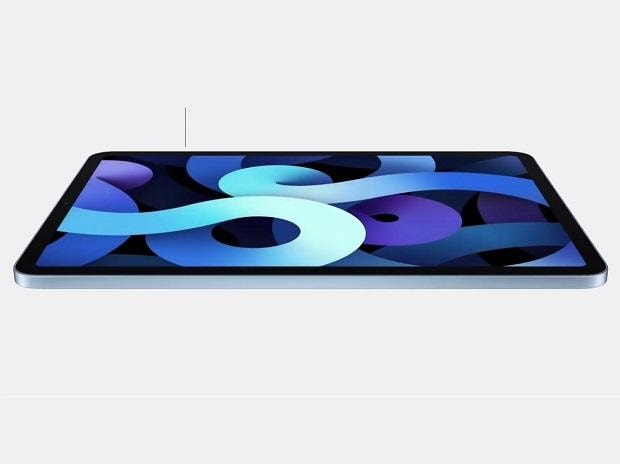
American Tech giant is working on a dock for the that would allow the device to function as a smart display and speaker, reported The Verge.


As per the outlet the update was shared by Bloomberg’s Mark Gurman who stated that the company plans on introducing the capability as soon as next year, converting the into an Amazon Echo Show-like device that you can set atop a counter or nightstand.


Amazon already does something similar with its Fire tablets, as the company lets users place the devices into a charging dock to prop them up like a smart display.


Even Google announced a docking accessory for its upcoming Pixel Tablet last week, which is supposed to serve as both a magnetic charging station and speaker.


Once the tablet’s in place, it’ll function like a Nest Hub Max, letting you control your smart home through the Home app, as well as interact with Google Assistant, reported The Verge.


Gurman noted that an docking station could work similarly, potentially letting users make calls through FaceTime and gain hands-free control of smart home devices.


The company is also working on other devices in the smart home space, including an updated version of the HomePod that Gurman says could have an updated display, an S8 chip, and multitouch functionality.


Last year, Gurman reported that is also planning a combined TV and smart speaker device equipped with a camera, which he believes is still in the works.


Meanwhile, Apple’s poised to launch the iPad Pro before the end of this month, which is rumoured to come with 11-inch and 12.9-inch variations, as well as with Apple’s in-house M2 chip, according to The Verge.

(Only the headline and picture of this report may have been reworked by the Business Standard staff; the rest of the content is auto-generated from a syndicated feed.)



Source link

Google’s Pixel Fold’s internal display to have 120Hz, 1200 nits brightness

Google’s Pixel Fold’s internal display to have 120Hz, 1200 nits brightness


An exclusive report has uncovered a new set of specifications for American tech giant Google’s upcoming foldable Pixel device.


According to GSM Arena, the specs uncovered by developer Kuba Wojciechowsck were shared by 91Mobiles.


It tells that the Pixel Fold (codenamed ‘Felix’) will feature dual displays (internal and external) and both will be manufactured by Samsung.


The internal display will support a resolution of 1840 x 2208 (5:6 aspect ratio) and the dimensions listed are 123mm x 148mm.


GSM Arena calculated the hypotenuse diagonal dimension of the display (192.44 mm), it measures 7.58 inches diagonally.


As per Wojciechowski, the internal display will output a peak brightness of 1200 nits with an average brightness output of 800 nits. Although there’s no certainty from the source, they say the display may support a 120Hz refresh rate.


The same developer previously uncovered Felix’s triple camera hardware, comprising a 64MP IMX787 main camera, a 12MP IMX386 ultrawide, and a 10.8MP S5K3J1 telephoto shooter, reported GSM Arena.


There’s also an 8MP IMX355 selfie camera on the internal screen and another S5K3J1 for the external selfie camera.


The ‘Felix’ refers to a second foldable device. The company was initially rumoured to release a foldable in late-2021, but then scrapped the plans and must have begun work on what would have been its successor.


That first Pixel foldable was rumoured to have a more modest array of cameras, the same ones from the Pixel 5, and a 7.6-inch internal display, as per GSM Arena.

(Only the headline and picture of this report may have been reworked by the Business Standard staff; the rest of the content is auto-generated from a syndicated feed.)



Source link

Google Meet to automatically zoom in on your face for more visibility

Google Meet to automatically zoom in on your face for more visibility


Tech giant has announced a new feature for Meet users to improve visibility by automatically framing the video.


Before a user attends a meeting, Meet will automatically frame the video to ensure that everyone is equally visible, the company said in a blogpost.


There are no motion disturbances that could draw attention away from the meeting’s subject because the automatic framing only happens once. But the video can be reframed manually at any time.


This feature does not have an admin control. By default, this function will be disabled, however, it can be turned on by the user.


The new feature is scheduled to roll out on November 2, the company said.


The feature was first announced during the Cloud Next 2022.


Earlier, the company had announced a Meet feature that enable users to unmute themselves by holding down the spacebar and to mute themselves again by releasing it.


The company said it will make it easier for users to participate in their meetings by quickly unmuting to say something.


‘This feature helps in situations where you forget to mute again after unmuting yourself. This feature is OFF by default and can be enabled in the Meet settings,’ the company said.


The company said it changed how the ‘Hey Google’ voice control works for hardware devices.


With this update, the Google Assistant will only be active when a device is not in a meeting and within 10 minutes of an upcoming meeting.


–IANS


aj/na

(Only the headline and picture of this report may have been reworked by the Business Standard staff; the rest of the content is auto-generated from a syndicated feed.)



Source link

Apple Watch Series 8 review: Iterative upgrade with temperature sensor

Apple Watch Series 8 review: Iterative upgrade with temperature sensor


Successor to the Watch Series 7 (review), the Watch Series 8 is an incremental upgrade with temperature sensor among the notable additions. There are actually two temperature sensors; one placed under the screen and another on the bottom alongside other sensors. These sensors are not available on-demand, but work in the background while you sleep to calculate the baseline (first five nights) and thereafter measure the variations in body temperature.


A temperature-sensing wearable tied onto your wrist is a novel idea, but its utility is limited to women’s health in the Watch Series 8. That said, the Watch Series 8 enables users to receive retrospective ovulation estimates in the Health app available on iPhones. For the uninitiated, knowing when ovulation has occurred can be helpful for family planning. Besides, the temperature sensing enables improved period predictions. Aside to women’s health related metrics, there is barely anything from and third-party app makers that take advantage of temperature data.


‘Crash Detection’ is another feature that I could not test and pray to never be in a situation for it to trigger. However, I did set it up and the process was straightforward – Open Watch app, tap on ‘Emergency SOS’, enable ‘Call after serious crash’, and add emergency contacts.


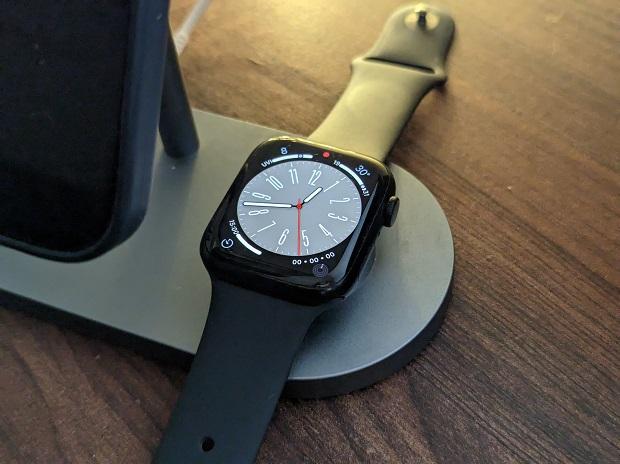
Lifting the experience is the WatchOS 9, which brings several new features and adds fineness to the existing ones that arrived with the last version of Watch operating system. There are four new faces — Lunar, Playtime, Metropolitan, and Astronomy – and each of them are designed to utilise the Watch Series 8’s screen with contoured bezels to the fullest. My personal favourite is the new ‘Low Power Mode’, which extends the battery life by limiting the use of power-intensive sensors and features such as activity tracking, fall detection, background heart rate monitor, and always-on display.


Verdict


Priced at Rs 45,900 (review unit – midnight aluminium case with sport band), the Series 8 is an iterative upgrade. Apple has made significant changes in the sensors to enable features like crash detection. Besides, it added a temperature sensor for holistic insights into women’s health. The WatchOS 9 brings dollops of newness, but it is not exclusive to Watch Series 8. That said, the Series 8 is more of a seasonal refresh than a proper upgrade from the last gen model. Yet, it makes a good buy for existing Watch Series 4, Series 5, Series 6, and SE users looking to upgrade.


Source link

YouTube
Instagram
WhatsApp

