iPhones boost Apple's India operations surge to Rs 2 trillion in FY24

iPhones boost Apple's India operations surge to Rs 2 trillion in FY24


Apple’s operations in India saw a significant increase in value to over Rs 2 trillion in FY24, a notable rise from Rs 1.15 trillion in the previous year. This growth was driven by a surge in iPhone production and the domestic sales of MacBooks, iMacs, iPads, Watches, and AirPods, according to a report by The Economic Times.


According to officials, Apple has demonstrated the most rapid growth in production and exports among all companies in India over the past five decades. This has positioned the Cupertino-based tech giant as the largest global value chain (GVC) within the country. Apple is also the first GVC in India to swiftly transfer parts of its supply chain away from China, the report said.


The recent Economic Survey highlights that India accounts for around 14 per cent of Apple’s total production, solidifying its role as a pivotal hub for the company’s global exports. This marks a significant increase from the 7 per cent contribution in FY23. Calculations based on official data reveal that iPhones dominated the export figures, with devices valued at around Rs 1.35 trillion being shipped abroad in the last financial year.


Regarding domestic sales, Apple products generated around Rs 68,000 crore in FY24, according to the calculations. In contrast, the value of exported iPhones stood at Rs 66,000 crore in FY23, the report said.


Rise in market share in India


While Apple’s market share in India is currently under 6 per cent, it has been on an upward trajectory from just 2 per cent in FY18, despite the market being primarily dominated by Android devices from Chinese brands such as Vivo and Xiaomi. Additionally, India’s revenue contribution to Apple’s global earnings was less than 2 per cent of the $383 billion generated in FY23. Apple’s financial year runs from October to September, with the financial year 2024 results to be disclosed in October.


Since 2020, Apple has experienced significant growth in India following the government’s introduction of the smartphone production-linked incentive (PLI) scheme. Apple began manufacturing iPhones in India in 2021, marking its first production effort outside of China.


iPhone production in India has consistently increased through its partnerships with Foxconn, Wistron, and Pegatron, amounting to a value of Rs 1.20 trillion in FY24.


iPhone’s FY24 production growth


Considering the market value, Apple’s iPhone production in FY24 was valued at Rs 1.80 trillion. Approximately 75 per cent of this production, equating to Rs 1.35 trillion, was exported to markets in Europe, the US, West Asia, and other regions. The remaining Rs 45,000 crore was sold domestically, the report said.


Industry experts suggest that local iPhone manufacturing has bolstered Apple’s sales in India, not only for iPhones but also across its range of products. In FY24, Apple’s revenue in India surged to Rs 68,000 crore, a fivefold increase from Rs 13,756 crore in FY20, including MacBooks, iMacs, iPads, Apple Watches, AirPods, and other accessories.

First Published: Aug 14 2024 | 11:13 AM IST


Source link

Nvidia's rebound adds 0 bn market value, shares surge 17% in 4 sessions

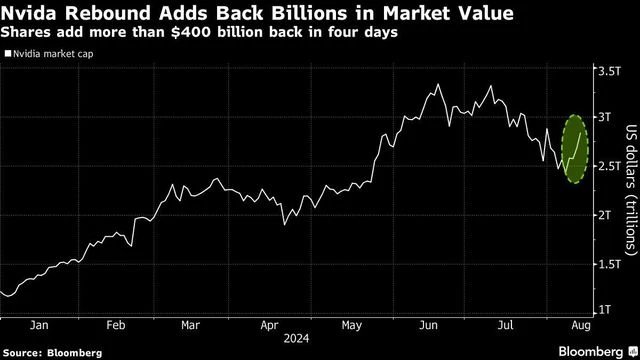
Nvidia's rebound adds $420 bn market value, shares surge 17% in 4 sessions


The gauge has since notched its best stretch since early July, a welcome reprieve to investors who on Aug. 5 were hit by the worst one-day rout in almost two years | Photo: Bloomberg


By Jeran Wittenstein and Carmen Reinicke


It’s been a rough six weeks for Nvidia Corp. shareholders. A historic dip that erased record market value from the company was followed by a four-day stretch of stomach-churning volatility. Now, though, signs are emerging the worst might be over.


The chipmaker’s shares have surged 17 per cent in the past four sessions, adding nearly $424 billion in market value to one of the biggest companies in the world. The rebound has propelled the broader market higher as well, with Nvidia accounting for roughly 22 per cent of the S&P 500’s gain over that span, double the contribution of any other single stock. The gauge has since notched its best stretch since early July, a welcome reprieve to investors who on Aug. 5 were hit by the worst one-day rout in almost two years.

“There was a lot of positive news for Nvidia out of the hyperscalers this earning season, but the carry trade impact was so massive it didn’t matter,” said Ivana Delevska, founder and chief investment officer of Spear Invest. “Now that that technical pressure has abated, there’s been a return to the fundamental story, and that’s why we’re seeing this spike.” 

Chart


.The rally in Nvidia took options traders who have been betting on more losses in the chipmaker off guard. The cost of protection against a 10 per cent decline in the stock over the next 60 days is near the highest since May 2023 relative to contracts profiting from a 10 per cent rally, data compiled by Bloomberg show.


Of course, a 17 per cent advance in a stock that rallied more than 1,000 per cent in 15 months before quickly giving back a quarter of the gains isn’t going to allay all the worries that caused the most recent selloff. Investors remain on edge about the health of the American economy and the wisdom of tech companies plowing hundreds of billions into artificial intelligence over the next several years with little profit to show for it.


But for now, the selloff has attracted legions of dip buyers. Hedge funds to retail investors are bullish on the long-term trajectory of artificial intelligence and may be positioning ahead of what’s expected to be a solid quarterly earnings report from Nvidia, due at the end of the month. Results from megacap technology companies so far show that some of Nvidia’s largest clients — Microsoft Corp., Amazon.com Inc., Alphabet Inc. and Meta Platforms Inc. — all said they plan to continue investing billions into AI infrastructure. 


The selloff also brought down Nvidia’s valuation to a level that might look more enticing to investors. Shares currently trade at about 36 times forward earnings, down from about 44 times in June. Overall, the Nasdaq 100 Index trades at about 25 times future earnings. 


“Even if you expect competition going forward, the valuation doesn’t look expensive,” Delevska said, adding that her preferred valuation metric, which measures equity value over earnings, is near a seven-year floor. 


Other beaten-down semiconductor names are also seeing investor interest Tuesday. Shares of Broadcom Inc. climbed 5.1 per cent and have contributed the most to the Nasdaq 100’s daily gains, save for Nvidia. Applied Materials Inc., Advanced Micro Devices Inc. and Qualcomm Inc. all traded higher Tuesday. 


Still, Nvidia shares remain down about 14 per cent from the June 18 record, the day it overtook Microsoft to briefly become the world’s most valuable company.  

First Published: Aug 14 2024 | 8:46 AM IST


Source link

US Justice Dept considers rare antitrust move: Breaking up Google

US Justice Dept considers rare antitrust move: Breaking up Google


A forced breakup of Google would be the biggest of a US company since AT&T was dismantled in the 1980s | Photo: Bloomberg


By Leah Nylen and Anna Edgerton


A rare bid to break up Alphabet Inc.’s Google is one of the options being considered by the Justice Department after a landmark court ruling found that the company monopolised the online search market, according to people with knowledge of the deliberations.


The move would be Washington’s first push to dismantle a company for illegal monopolisation since unsuccessful efforts to break up Microsoft Corp. two decades ago. Less severe options include forcing Google to share more data with competitors and measures to prevent it from gaining an unfair advantage in AI products, said the people, who asked not to be identified discussing private conversations.


Regardless, the government will likely seek a ban on the type of exclusive contracts that were at the center of its case against Google. If the Justice Department pushes ahead with a breakup plan, the most likely units for divestment are the Android operating system and Google’s web browser Chrome, said the people. Officials are also looking at trying to force a possible sale of AdWords, the platform the company uses to sell text advertising, one of the people said.


The Justice Department discussions have intensified in the wake of Judge Amit Mehta’s Aug. 5 ruling that Google illegally monopolised the markets of online search and search text ads. Google has said it will appeal that decision, but Mehta has ordered both sides to begin plans for the second phase of the case, which will involve the government’s proposals for restoring competition, including a possible breakup request.


Alphabet shares fell as much as 2.5 per cent to $160.11 in after-hours trading before erasing some losses. 


A Google spokesman declined to comment on the possible remedy. A Justice Department spokeswoman also declined to comment.


The US plan will need to be accepted by Mehta, who would direct the company to comply. A forced breakup of Google would be the biggest of a US company since AT&T was dismantled in the 1980s.


Justice Department attorneys, who have been consulting with companies affected by Google’s practices, have raised concerns in their discussions that the company’s search dominance gives it advantages in developing artificial intelligence technology, the people said. As part of a remedy, the government might seek to stop the company from forcing websites to allow their content to be used for some of Google’s AI products in order to appear in search results.


Breakup


Divesting the Android operating system, used on about 2.5 billion devices worldwide, is one of the remedies that’s been most frequently discussed by Justice Department attorneys, according to the people. In his decision, Mehta found that Google requires device makers to sign agreements to gain access to its apps like Gmail and the Google Play Store.


Those agreements also require that Google’s search widget and Chrome browser be installed on devices in such a way they can’t be deleted, effectively preventing other search engines from competing, he found.


Mehta’s decision follows a verdict by a California jury in December that found the company monopolised Android app distribution. A judge in that case hasn’t yet decided on relief. The Federal Trade Commission, which also enforces antitrust laws, filed a brief in that case this week and said in a statement that Google shouldn’t be allowed “to reap the rewards of illegal monopolisation.”


Google paid as much as $26 billion to companies to make its search engine the default on devices and in web browsers, with $20 billion of that going to Apple Inc.


Mehta’s ruling also found Google monopolised the advertisements that appear at the top of a search results page to draw users to websites, known as search text ads. Those are sold via Google Ads, which was rebranded from AdWords in 2018 and offers marketers a way to run ads against certain search keywords related to their business. About two-thirds of Google’s total revenue comes from search ads, amounting to more than $100 billion in 2020, according to testimony from last year’s trial. 


If the Justice Department doesn’t call for Google to sell off AdWords, it could ask for interoperability requirements that would make it work seamlessly on other search engines, the people said.


Data access


Another option would require Google to divest or license its data to rivals, such as Microsoft’s Bing or DuckDuckGo. Mehta’s ruling found that Google’s contracts ensure not only that its search engine gets the most user data – 16 times as much as its next closest competitor — but that data stream also keeps its rivals from improving their search results and competing effectively.


Europe’s recently enacted digital gatekeeper rules imposed a similar requirement that Google make available some of its data to third-party search engines. The company has said publicly that sharing data can pose user privacy concerns, so it only makes available information on searches that meet certain thresholds. 


Requiring monopolists to allow rivals to have some access to technology has been a remedy in previous cases. In the Justice Department’s first case against AT&T in 1956, the company was required to provide royalty-free licenses to its patents.


In the antitrust case against Microsoft, the settlement required the Redmond, Washington, tech giant to make some of its so-called application programming interfaces, or APIs, available to third-parties for free. APIs are used to ensure that software programmes can effectively communicate and exchange data with each other.


AI products


For years, websites have allowed Google’s web crawler access to ensure they appear in the company’s search results. But more recently some of that data has been used to help Google develop its AI.


Last fall, Google created a tool to allow websites to block scraping for AI, after companies complained. But that opt-out doesn’t apply to everything. In May, Google announced that some searches will now come with “AI Overviews,” narrative responses that spare people the task of clicking through various links. The AI-powered panel appears underneath queries, presenting summarised information drawn from Google search results from across the web.


Google doesn’t allow website publishers to opt-out of appearing in AI Overviews, since those are a “feature” of search, not a separate product. Websites can block Google from using snippets, but that applies to both search and the AI Overviews. 


While AI Overviews only appear on a fraction of searches, the feature’s roll-out has been rocky after some excerpts offered embarrassing suggestions, like advising people to eat rocks or to put glue on pizza.

First Published: Aug 14 2024 | 7:18 AM IST


Source link

Huawei Tech readies new AI chip to challenge Nvidia in China: Report

Huawei Tech readies new AI chip to challenge Nvidia in China: Report


China’s Huawei Technologies is close to introducing a new chip for artificial intelligence use to challenge Nvidia in China amid US sanctions, the Wall Street Journal reported on Tuesday, citing sources.


Huawei’s latest processor, Ascend 910C, is being tested by Chinese internet and telecom companies in recent weeks, the report said, adding that Huawei has told potential clients that the chip is comparable to Nvidia’s H100.


Huawei did not immediately respond to a Reuters request for comment.


US regulators last year put in place rules that stopped Nvidia from selling its advanced chips, including the H100, to Chinese customers, citing national security concerns.


Nvidia then introduced three chips tailored for China, including the most-closely watched H20 chips. However, in line with US sanctions, H20’s computing power had been significantly capped compared to the H100 chips.


The Journal report said Huawei aims to start shipping its newest chip as soon as October.


Companies such as TikTok parent ByteDance, Baidu and China Mobile are looking to obtain the 910C chips.


Initial negotiations between Huawei and potential customers indicate that orders are likely to surpass 70,000 chips, with a total value of around $2 billion, according to the report.

First Published: Aug 14 2024 | 12:01 AM IST


Source link

Google Pixel Buds Pro 2, powered by Tensor A1, launched: Price, features

Google Pixel Buds Pro 2, powered by Tensor A1, launched: Price, features


In addition to the Pixel 9 series smartphones and the Pixel Watch 3, Google also launched the second-generation Pixel Buds Pro wireless earphones at its Made By Google event on August 13. The Google Pixel Buds Pro 2 is powered by the Tensor A1 chip, which Google stated is built for advanced audio processing and Google AI. Utilising this technology, the new wireless earphones feature several new artificial intelligence capabilities.


Google Pixel Buds Pro 2: Details


Priced at Rs 22,900, the Google Pixel Buds Pro 2 is powered by the Tensor A1 chip, which the company developed for advanced audio processing and handling Google AI workloads. Google claimed that it processes audio 90 times faster than the speed of sound to adapt to the user’s environment. The Tensor A1 chip also powers Silent Seal 2.0 technology for Active Noise Cancelling (ANC), which, according to the company, allows the Buds Pro 2 to cancel twice the noise compared to its predecessor. Google also stated that the Pixel Buds Pro 2 cancels a wider range of noises, including higher frequencies.


The Google Pixel Buds Pro 2 features 11mm drivers and a new high-frequency chamber that, according to the company, smooths out the treble. This is further enhanced by the Tensor A1 chip’s multi-path processing capability, which Google said adds an additional signal path for music to reach the speaker drivers.


Among the highlight features of the Pixel Buds Pro 2 is a new Conversation Detection feature. This feature uses artificial intelligence to detect when the wearer is speaking and automatically switches to Transparency mode. Once the conversation ends, the Buds Pro 2 switches back to ANC mode hands-free. Another notable inclusion is the Clear Calling feature, which reduces background noise from the person on the other side of the call, thereby improving voice clarity. The Pixel Buds Pro 2 is also compatible with the new Google Find My Device network, enabling users to locate the precise position of the device if lost.

First Published: Aug 13 2024 | 11:23 PM IST


Source link

Google Pixel Watch 3 arrives in two sizes and Wi-Fi connectivity in India

Google Pixel Watch 3 arrives in two sizes and Wi-Fi connectivity in India


Google launched the new Pixel Watch 3 series at its Made by Google event on August 13. Unlike its predecessor, which was available in a single dial size, the Pixel Watch 3 comes in 41mm and 45mm size options. Although it features a design similar to the previous generation, the Pixel Watch 3 offers a significantly brighter display with thinner bezels, increased battery life, and new fitness tracking features. Here are the details:


Pixel Watch 3: India pricing


  • Pixel Watch 3 Wi-Fi (41mm): Rs 39,900

  • Pixel Watch 3 Wi-Fi (45mm): Rs 43,900


Pixel Watch 3: Design and colour options


The Pixel Watch 3 continues with the circular dial design that Google introduced in the previous models. Available in two sizes, the Pixel Watch 3 devices are made from 100 per cent recycled aluminium.


Both sizes of the Pixel Watch 3 come with a Matte Black Aluminium Case with an Obsidian Active Band and a Polished Silver Aluminium Case with a Porcelain Active Band. However, the larger 45mm Pixel Watch 3 also offers a Matte Hazel Aluminium Case with a Hazel Active Band. The 41mm variant exclusively features a Champagne Gold Aluminium Case with a Hazel Active Band, as well as a Polished Silver Aluminium Case with a Rose Quartz Active Band.


Pixel Watch 3: Display


Google stated that the new Pixel Watch 3 has over 16 per cent smaller bezels compared to the Pixel Watch 2. This makes the display on the 41mm Pixel Watch 3 10 per cent larger than its predecessor, and the display on the 45mm variant 40 per cent larger.


With the new Actua Displays, the Pixel Watch 3 models can be twice as bright as last year’s model. While it can reach up to 2000 nits in brightness, in the always-on display mode, it can go as low as 1 nit. The display also dynamically adjusts between a 1 to 60Hz refresh rate based on usage.


Pixel Watch 3: Battery


The company stated that the new Google Pixel Watch 3 offers a 24-hour battery life with the always-on display, which can be extended up to 36 hours with Battery Saver mode. Additionally, the smartwatch automatically enters Battery Saver mode at 15 per cent battery and activates Bedtime mode when it detects sleep. These features help to extend battery life.


Regarding charging speed, Google said that the 41mm model charges 20 per cent faster than the Pixel Watch 2 of the same size.


Pixel Watch 3: Health and fitness tracking


The Google Pixel Watch 3 introduces several new features to track fitness data. Google said that the watch offers a “comprehensive running experience.” Users can now create a variety of running routines with timed warm-ups and cooldowns. It is also possible to set target pace, heart rate, time, and distance, with the Pixel Watch 3 alerting users when they miss the target. The smartwatch also introduces a new running dashboard in the Fitbit app, displaying running data collectively.


Other new features include Cardio Load tracking and an improved Readiness Score. Google stated that Cardio Load shows how hard your heart is working, allowing you to see exertion levels throughout the day and how they relate to your workout routine. Meanwhile, the Readiness Score now analyses sleep data, resting heart rate, and heart rate variability. Combining these data points will indicate whether you are under or over-training.


There is also a new Morning Brief feature that offers a summary of health and fitness metrics, including how well you slept, progress towards weekly goals, and more. It also shares other information such as weather predictions.

First Published: Aug 13 2024 | 11:21 PM IST


Source link

YouTube
Instagram
WhatsApp