AI agents go mainstream, but most firms lack proper oversight: Report

AI agents go mainstream, but most firms lack proper oversight: Report


Microsoft has released its Cyber Pulse Report, outlining how the security landscape is changing as enterprises adopt generative AI tools and AI agents across their operations. The report shows that these systems are no longer limited to pilot projects or experimental use, but are now being deployed widely inside large organisations.


According to the report, 80 per cent of Fortune 500 companies now have active AI agents built using low-code or no-code tools. At the same time, the findings point to gaps in oversight, with many of these agents described as unsanctioned, unobserved, or over-privileged, and only 47 per cent of organisations saying they have GenAI-specific security controls in place.


AI agents move into mainstream operations


According to the report, the rapid spread of low-code and no-code platforms has made it easier for teams outside central IT to build and deploy AI agents for specific tasks. This has pushed AI agents into day-to-day use across large organisations, often without the same review processes that apply to traditional software deployments.


The report notes that this ease of deployment also reduces organisational visibility into where agents are being used, what systems they connect to, and what data they can access. As a result, many agents are running without being fully tracked or reviewed by security teams.


Unsanctioned and over-privileged use


One of the main risks highlighted in the Cyber Pulse Report is the scale of unsanctioned usage. According to the findings, 29 per cent of employees admit to using unsanctioned AI agents at work.


The report also states that many agents currently in use are unsanctioned, unobserved, or over-privileged, meaning they may have broader access to systems or data than required for their intended role. This increases the risk of unintended data exposure or misuse inside enterprise environments. 


Security controls lag behind adoption


While AI agents are becoming more common, the report suggests that security frameworks have not kept pace. Only 47 per cent of organisations surveyed said they have GenAI-specific security controls in place.


This indicates that more than half of organisations are deploying or allowing the use of AI agents without dedicated policies or technical safeguards designed for the risks associated with generative AI systems. The report frames this as a widening gap between how widely AI agents are being used and how consistently they are being governed.


The Cyber Pulse Report also provides a sector-level view of adoption. Financial services account for around 11 per cent of all active AI agents globally, making it one of the largest contributors to enterprise AI agent usage.


India context: high AI usage, rising exposure


The governance gaps highlighted by Microsoft’s report align with trends already visible in enterprise AI usage in India. In a separate study, the Zscaler ThreatLabz 2026 AI Security Report found that Indian enterprises are among the heaviest users of AI and machine-learning tools globally, with India emerging as the second-largest source of enterprise AI/ML traffic after the US.


That report, which analysed nearly one trillion AI/ML transactions, showed that enterprises worldwide sent 18,033 terabytes of data to AI/ML applications in a year, while India recorded 82.3 billion transactions and over 300 per cent year-on-year growth. It also found that India accounted for 46.2 per cent of all AI/ML traffic in the Asia-Pacific and Japan region.


The same study flagged a sharp rise in data leakage incidents linked to mainstream AI tools, including hundreds of millions of data loss prevention violations tied to services such as ChatGPT and a year-on-year increase in leakage linked to coding assistants. Together, these findings point to a pattern in which AI adoption is expanding faster than oversight and controls.




Source link

Over 30,000 tech jobs cut globally in first two months of 2026: Report

Over 30,000 tech jobs cut globally in first two months of 2026: Report


Barely two months into 2026, the tech industry is once again grappling with layoffs. Globally, more than 30,000 employees have already lost their jobs.


According to the latest report from RationalFx, tech companies have announced 30,700 job cuts worldwide, with 24,600, just over 80 per cent, occurring in the United States.


Interestingly, in Asia, India tops the list with 920 job cuts.


The report highlighted that the first month of 2026 has already seen a surge in layoffs, “and based on current trends, if job cuts continue at the same intensity, total reductions could reach 273,305 by year-end, surpassing 2025’s 245,000 layoffs.”


While last year the reasons for layoffs were automation, AI-driven job displacement and cost-cutting strategies, RationalFx said that in 2026 employers are increasingly emphasising AI expertise.


Layoff.fyi also states that in 2026 so far, 25,694 people have been laid off across 30 tech companies.


This is reflected in a recent report by LinkedIn, which stated that rapidly shifting skill requirements for today’s jobs, and an increasingly competitive but selective job market, are leaving professionals unprepared to find a new job. In India, 84 per cent of professionals feel unprepared to find a new job, even as 72 per cent say they are actively seeking a new role in 2026.


LinkedIn data show that applicants per open role in India have more than doubled since early 2022, intensifying competition and leaving many feeling unprepared. It is not just job seekers feeling the pressure. Nearly 74 per cent of Indian recruiters say it has become harder over the last year to find qualified talent.


In India, hiring by the large IT services players has been in the slow lane for a few quarters now. Traditionally known to hire in bulk from campuses, the top five IT services players, due to the uncertain macro environment, have kept their hiring targets much lower. For FY26, Infosys, the second-largest IT services firm, has continued to maintain its target of 20,000 freshers.


Tata Consultancy Services (TCS), the largest player in terms of revenue, has been subdued in its campus hiring, which has remained in the range of 40,000 freshers for the last two years. The firm last year also announced that it would lay off 2 per cent, or 12,000, of its employee base as it prepares to be an AI-first services player.


Meanwhile, a recent report by UnearthIQ said that global capability centres (GCCs), which have been expanding in India, laid off 5,500–6,000 employees in 2025. In 2026, UnearthIQ estimates layoffs would be around 4,000–5,000. The layoffs may happen due to parent-specific issues or product revamps.


The silver lining, of course, is that GCCs will continue to hire. “Looking ahead to calendar year 2026, around 1.2–1.4 lakh net new roles will be added in GCCs. Overall, growth is set to outpace layoffs across 1,900 GCCs, with India gaining more AI CoEs and AI-linked roles,” said a note from UnearthIQ.


Source link

OpenAI to discontinue GPT-5, GPT-4o and other models today: What changes

OpenAI to discontinue GPT-5, GPT-4o and other models today: What changes


OpenAI is set to retire several ChatGPT models today, February 13, at 11:30 pm IST. According to the company, the models being phased out include GPT-5, GPT-4o, GPT-4.1, GPT-4.1 mini, and OpenAI o4-mini. The company had already shared the deprecation timeline earlier this month, confirming that these models will no longer be available in ChatGPT after the deadline.


OpenAI said the decision was driven by low adoption, as the majority of users have already shifted to newer models. GPT-4o, which briefly returned after being removed during the GPT-5 rollout, will also be discontinued again as part of this plan.


OpenAI retires older GPT models today


In a blog post, the company clarified that the update applies only to ChatGPT and does not impact the API for now. It noted that the majority of users have shifted to GPT-5.2, with only about 0.1 per cent of daily users still using GPT-4o. OpenAI said phasing out older models will help it concentrate resources on improving the versions that are more widely used.


OpenAI has said that feedback from users has been important in guiding the development of its newer models. By studying how people interact with ChatGPT, the company said it has enhanced conversation quality, creative assistance, and personalisation features, including controls for tone and writing style. It has also worked on reducing responses that feel overly cautious or preachy.


Additionally, OpenAI is working on a version of ChatGPT designed specifically for adult users. At the same time, it is using age-estimation tools in most markets to better regulate how younger users access and use the platform.


Among these models, GPT-4o has had a comparatively complex history. It was initially withdrawn during the early GPT-5 rollout but was reinstated following feedback. The model also attracted criticism over what OpenAI described as “sycophantic” behaviour. In April 2025, the company reversed an update to GPT-4o after users highlighted the issue, restoring a previous version that provided more balanced responses. Following its return during the GPT-5 rollout, the GPT-4o model is going to be discontinued once again.


ChatGPT-5.3-Codex-Spark


OpenAI has also introduced GPT-5.3-Codex-Spark, a lighter version of GPT-5.3-Codex built for real-time coding. According to OpenAI, Codex-Spark is its first model created specifically for real-time coding in Codex. It allows developers to make focused edits, adjust logic, or refine interfaces and see the results immediately. OpenAI has recently launched a new macOS app for its Codex platform, adding a desktop interface designed to help users manage multiple AI agents at once.


The company said the emphasis is on speed and responsiveness, making it suitable for live coding workflows. The model runs on Cerebras’ Wafer Scale Engine 3, a specialised AI accelerator built for high-speed inference. 


Codex-Spark is rolling out as a research preview starting February 13. It will be available to ChatGPT Pro users through the latest versions of the Codex app, command-line interface (CLI), and the VS Code extension.


Source link

New AI panel to give insights on opportunities, risks and impacts: UN chief

New AI panel to give insights on opportunities, risks and impacts: UN chief


UN Secretary-General Antonio Guterres expressed his views after the appointment of the members of the Independent International Scientific Panel on Artificial Intelligence (AI) by the General Assembly.


In an official statement, he called it a foundational step towards global scientific understanding of AI and said, “The 40 members of the new Independent International Scientific Panel on Artificial Intelligence, established within the United Nations, have been appointed by the General Assembly of the United Nations for a three-year term. They will serve in their personal capacity.”


He further shared that the members were selected from more than 2,600 candidates, after independent review by the International Telecommunication Union (ITU), the UN Office for Digital and Emerging Technologies, and the United Nations Educational, Scientific and Cultural Organisation (Unesco).


According to the UN Chief, a multidisciplinary group of leading AI experts from across the globe –geographically diverse and gender-balanced –would provide independent and impartial assessments of AI’s opportunities, risks, and impacts, including for the new Global Dialogue on AI Governance.


“In a world where AI is racing ahead, this Panel will provide what’s been missing — rigorous, independent scientific insight that enables all Member States, regardless of their technological capacity, to engage on an equal footing”, he said.


In his concluding remarks, he expressed confidence that their work would inform collective dialogue on AI and support evidence-based decisions grounded in solidarity.


According to the United Nations official website, the General Assembly on Thursday appointed 40 members recommended by the Secretary-General to the Independent International Scientific Panel on Artificial Intelligence (AI), following a request from the United States that the vote be on the record.


Established by General Assembly resolution in 2025, the Panel is the first global scientific body of its kind, and it aims to bring experts together to assess how the technology is transforming the world and its people.


It will issue an annual report containing evidence-based scientific assessments that synthesise and analyse existing research related to the technology’s opportunities, risks and impacts.


Source link

Sony WF-1000XM6 earbuds with enhanced noise cancellation unveiled: Details

Sony WF-1000XM6 earbuds with enhanced noise cancellation unveiled: Details


Sony has unveiled the WF-1000XM6 flagship wireless noise-cancelling earbuds. The company says the new model delivers a 25 per cent reduction in noise compared to its predecessor, alongside improvements in call quality, connectivity, and overall fit. The Sony WF-1000XM6 will be available in Black and Platinum Silver from February 2026 in select regions. Sony has not announced details regarding availability or pricing in India at this time. 


Additionally, the company has introduced a new Sand Pink colour option for the WH-1000XM6 over-ear noise-cancelling headphones. Sony has not announced whether this new colour variant will be made available in India. 


Sony WF-1000XM6 earbuds: Details


Sony says the WF-1000XM6 achieves a 25 per cent improvement in noise cancellation over the previous generation using the HD Noise Cancelling Processor QN3e, Integrated Processor V2, an Adaptive Noise Cancelling Optimiser, and four microphones on each earbud. The company notes that performance in the mid-to-high frequency range has been enhanced, targeting common everyday noises. The earbuds also ship with Noise Isolation Earbud Tips available in four sizes. 


For audio, Sony has equipped the earbuds with dual processors. The Integrated Processor V2 supports 32-bit processing, compared to 24-bit on the previous model, while the QN3e processor enhances DAC amplifier performance. A newly developed driver unit uses different materials for the dome and edge of the diaphragm, which Sony says helps deliver deep bass and extended high frequencies while reducing distortion. Features include Hi-Res Audio Wireless, DSEE Extreme, 360 Reality Audio compatibility, head tracking, Background Music Effect, and a 10-band EQ adjustable via the Sony Sound Connect app. 


Sony claims that call quality is improved using two microphones and a bone-conduction sensor on each side, combined with an AI beamforming noise reduction algorithm to isolate the user’s voice. Connectivity is supported by enhanced antennas that are said to be 1.5 times larger than those on the previous model, and the earbuds are ready for LE Audio for low-latency audio. Battery life is rated at up to 8 hours on a single charge and up to 24 hours with the charging case, with Qi wireless charging supported. 


In terms of design, Sony says the WF-1000XM6 is approximately 11 per cent slimmer than its predecessor and shaped to better follow the contours of the inner ear. A newly adopted ventilation structure, according to the company, is intended to increase airflow and reduce internal noises such as footsteps and chewing sounds.


Source link

Now you can listen to Gemini-powered summaries in Google Docs: How it works

Now you can listen to Gemini-powered summaries in Google Docs: How it works


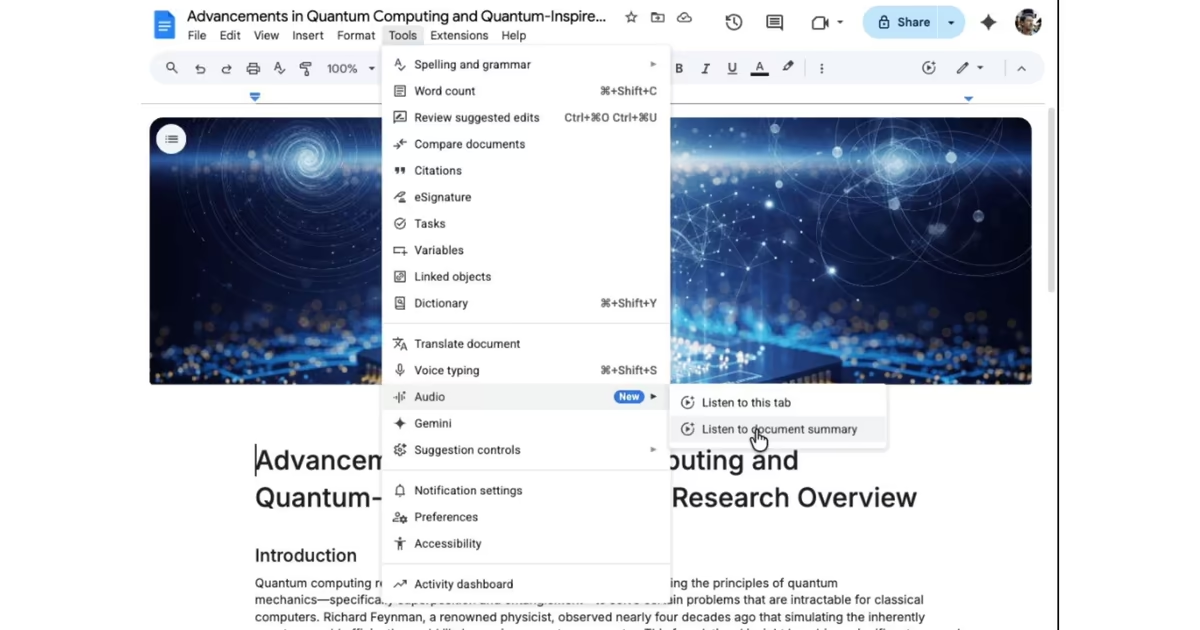
Google adds Gemini-powered audio summaries in Docs (Image: Google)


Google has started rolling out a new AI-powered feature in Google Docs that lets users listen to short audio summaries of their documents. According to Google, audio summaries in Docs provide a brief verbal synopsis of the contents of users’ documents, including multiple tabs. The update builds on the Text-to-Speech feature in Docs, introduced in August 2025, which uses Gemini to turn written content into spoken audio.


Google Docs Gemini-powered audio summary: How it works


According to Google’s blog, the new feature is designed to give a brief overview of a document. Instead of going through long reports or detailed notes, users can listen to a short audio summary that highlights the most important parts. The company said the summaries are usually under a few minutes long and use natural-sounding voices to enhance the listening experience.


Additionally, users can personalise their listening experience. The feature offers different voice styles such as narrator, persuader, and coach. Playback speed can also be adjusted, from 0.5x to 2x, depending on how fast or slow someone prefers to listen. 


Google explained that someone can quickly catch up on meeting notes before a discussion or listen to the highlights of a long report while doing other tasks. The company added that the tool can also help users follow along with their writing to improve understanding or even spot errors more easily.


On the web version of Google Docs, the feature can be found under the Tools menu. Along with the existing “Listen to this tab” option, users will now see “Listen to document summary.” When selected, it opens an audio player with playback controls, a timeline scrubber, and options to change the voice style. 


Google said the feature will roll out over the coming weeks for specific subscribers, including:


  • Business Standard and Plus

  • Enterprise Standard and Plus

  • Google AI Ultra for Business add-on

  • Google AI Pro for Education add-on

  • Google AI Pro and Ultra


First Published: Feb 13 2026 | 12:30 PM IST


Source link

YouTube
Instagram
WhatsApp