The Lenovo Yoga Pro 7i presents itself as a sophisticated fusion of design and functionality, aimed at those who seek a laptop that does more than just the basics. Priced at Rs 150,000 onwards, the laptop features a durable aluminium chassis, a high-resolution OLED display, and a powerful NVIDIA RTX 4050 GPU. While the Yoga Pro 7i promises to handle everything from multi-tasking to gaming, how well does it manage to balance these aspects effectively when put to test in real life. Let us find out:
Design
The Lenovo Yoga Pro 7i resembles the Yoga 7i 2-in-1, but features a slightly larger 14.5-inch display and a robust, nearly full-width hinge that allows up to 180-degree rotation. Like the convertible, the Pro model in the Yoga 7i series sports a sleek, all-aluminium design that exudes a premium feel. The matte finish on the surface combines style with practicality. Despite being marginally larger and heavier than its 2-in-1 counterpart, the Yoga Pro 7i remains competitive in portability, weighing in at 1.59 kg.
Opening the lid—a process that requires minimal effort thanks to its substantial hinge—the laptop unveils an edge-to-edge 14.5-inch OLED panel. Lenovo has modified the lid’s design slightly by extending the enclosure at the top-centre to include the front camera and infrared sensor. Notably, the front camera lacks a physical shutter, replaced instead by a slider switch on the edge of the lower half that controls the camera’s operation. Below the display, a full-sized keyboard is nestled between speakers on either side, with a generously sized trackpad that maintains the laptop’s matte finish.
While it does not offer 360-degree rotation, the Yoga Pro 7i retains the rounded edges from the Yoga 7i 2-in-1, making it equally comfortable to carry by hand. However, the side placement of the power button can be slightly inconvenient when in a rush. Additionally, the lack of adequate grips on the bottom might lead to minor slippage when used on smooth surfaces.
Lenovo Yoga Pro 7i: Ports and buttons
Display and audio
The Lenovo Yoga Pro 7i laptop features a 14.5-inch OLED display with a 2.8K resolution and a 120Hz refresh rate. Thanks to its 16:10 aspect ratio, the screen offers extended vertical content, enhancing the device’s display-to-body ratio.
OLED technology is known for rich colours and exceptional contrast, and the Yoga Pro 7i’s display is no different. It covers 100 per cent of the DCI-P3 colour space, providing a broader range of more vibrant and saturated colours. Lenovo enhances this with Dolby Vision HDR support, elevating the content viewing experience on the Yoga Pro 7i. The Lenovo Vantage app further improves video quality, offering Super Resolution features that enhance video resolution for non-HDR content on browsers like Chrome, Microsoft Edge, and Opera.
The 120Hz refresh rate significantly smooths visual experience, particularly noticeable when scrolling. Although the display is glossy, it manages reflections effectively in bright environments. The peak brightness of 400 nits, while not groundbreaking, ensures the screen remains sufficiently bright indoors. However, the glossy finish, while lending a more premium look, also attracts fingerprints and smudges.
In terms of audio, the laptop boasts a stereo speaker system with Dolby Atmos support. It includes two 2W tweeters for clear vocals and two 2W woofers that add depth to the sound. The audio output is clear, adequately loud, and well-balanced, with the woofers providing a slight thump to enhance audio tracks. While the speakers perform well for movie and video playback, for music enthusiasts, connecting to an external speaker might be preferable for the best audio experience.
Camera and microphone
The Lenovo Yoga Pro 7i laptop is equipped with a 1080p resolution camera that features an electronic shutter for enhanced privacy. The camera delivers decent video quality during calls in well-lit environments, but its performance dips in low-light situations, resulting in somewhat unclear images. While this may suffice for occasional use, those who frequently engage in video calls or wish to live stream might consider using an external webcam for improved clarity.
The laptop’s facial recognition technology, while generally accurate, can experience occasional delays in detection speed.
Audio-wise, the built-in microphone provides adequate clarity during calls, though recordings can come across as slightly muffled. Nonetheless, it excels in voice detection and effectively filters out background noise, ensuring clear communication.
In terms of software, Lenovo includes an option within the camera settings to experiment with new features. However, as of now, enabling this option does not introduce any significant changes. Future updates from Lenovo may expand these functionalities.
Keyboard and trackpad
The Lenovo Yoga Pro 7i features a full-sized backlit keyboard, notably without a dedicated numeric pad—a common feature omitted in compact laptops. The typing experience on this keyboard is outstanding, with users typically requiring minimal time to adjust. Despite its slim profile, the keys provide sufficient downward travel, ensuring tactile feedback with each keystroke. Functionality-wise, apart from the new Copilot button adjacent to the left arrow key, the keyboard gets dedicated buttons that doubles up as function keys. These include a button for launching settings menu, Snipping tool, calculator, clipboard and more.
The laptop’s touchpad is generously sized, conveniently accessible with both thumbs while typing. By default, the touchpad sensitivity is set quite high, which may lead to occasional accidental clicks. Adjustments can be made in the settings to reduce sensitivity, although this may result in slower scrolling speeds.
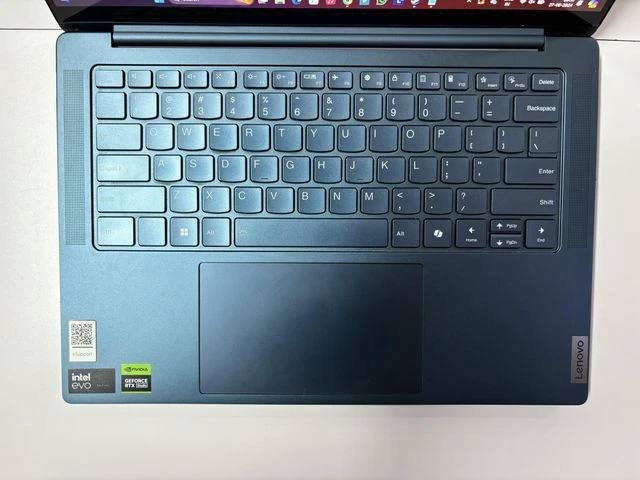 "Lenovo Yoga Pro 7i: Keyboard and trackpad")
Lenovo Yoga Pro 7i: Keyboard and trackpad
Software
Lenovo equips the Yoga Pro 7i with an array of customization options and settings through its Vantage software. This includes features like “Super Resolution” that we discussed earlier, and preset Dolby Atmos sound profiles tailored for different activities such as movies or gaming.
The Lenovo Vantage app also introduces various modes tailored to specific tasks, such as Media, Meeting, Learning, and Gaming. An “Automatic” mode, powered by Lenovo’s AI engine, adjusts settings based on the user’s current activity and behaviour. Additionally, users can select from three power modes: Performance, Battery Saver, and Adaptive, with the latter dynamically adjusting according to usage patterns. The software also includes an X-Power setting that enables GPU overclocking to boost performance during intensive tasks like running graphics-heavy games.
Apart from the Lenovo Vantage features, the Yoga Pro 7i offers a “Flip to Boot” function that instantly powers up the laptop when opened. Windows Studio Effects enhance video calls with background blur for privacy and auto framing to keep the user in focus regardless of movement. During tests, the background blur worked effectively, although the auto framing was less impressive.
The laptop also features presence detection for facial unlocking, which senses the user’s presence to initiate unlocking. The feature works well and definitely comes handy when returning from breaks between work. Apart from the hands-free unlocking experience, the Yoga Pro 7i offers “Zero touch video playback” that pauses and resumes video playback using presence detection. While effective with offline videos, this feature did not perform as well with YouTube and other streaming platforms.
Performance
The Lenovo Yoga Pro 7i laptop meets the expectations of a portable workstation, equipped with the Intel Core Ultra 7 155H processor and 16GB of LPDDR5X soldered RAM. The laptop handles multitasking effortlessly, maintaining efficient thermal management. Despite numerous tabs, windows, and background apps running, it remains responsive and cool to the touch, operating silently throughout.
This model includes a dedicated 6GB NVIDIA GeForce RTX 4050 GDDR6 GPU, suitable for graphic-intensive tasks. Although the laptop is labelled as a GeForce RTX Studio laptop, this badge simply indicates that it meets NVIDIA’s standards for a creator-friendly device, ensuring optimal display quality and performance. The laptop comes pre-installed with Creator Ready Drivers, and by installing NVIDIA’s Game Ready drivers, the GPU can be optimised for gaming.
While I didn’t extensively test the laptop with creative applications, I did run some demanding video games, such as Need For Speed Payback. On Ultra Graphic settings, the laptop achieved 45-to-55 frames per second (FPS) in Auto performance mode. Switching to Performance mode increased the FPS to around 65, without noticeable lag or glitches. Additionally, I experimented with the GPU overclocking feature, currently in the experimental stage. With some manual adjustments, I was able to achieve up to 80 FPS at the highest in-game graphic settings. It’s worth noting that the thermal management system is not on par with those found in gaming-specific laptops, which means the laptop may become uncomfortably warm during extended gaming sessions.
Regarding battery life, the dedicated GPU impacts longevity. Unlike the Lenovo Yoga 7i 2-in-1, which can multitask continuously for over nine hours, the Yoga Pro 7i lasts about six hours in Auto power mode, with potential reductions under heavier loads like graphic-intensive gaming. The laptop includes a 140W charger that uses a USB-C port and can recharge the battery fully in approximately one hour.
Verdict
Priced at Rs 150,000 onwards, the Lenovo Yoga Pro 7i boasts an impressive display and robust performance, all housed within a premium, durable aluminium chassis. The inclusion of a powerful dedicated GPU facilitates casual gaming and handling some graphic-intensive video game titles.
Overall, the Lenovo Yoga Pro 7i is an excellent choice for those seeking a professional, work-oriented laptop that doubles up as an entertainment device, while also allowing users to explore their creative pursuits. However, while it includes an NVIDIA RTX 4050 GPU, this alone does not position it as a primary gaming device. For those specifically seeking a high-performance gaming machine, other options in the same price bracket might be more suitable.









