JBL launches SoundBar2.1, Bar500, Bar800 and Bar1000 in India: Price, specs

JBL launches SoundBar2.1, Bar500, Bar800 and Bar1000 in India: Price, specs


HARMAN’s audio equipment arm on Tuesday launched in India its new BAR series of soundbars. There are four soundbars starting at Rs 34,999 and going all the way up to Rs 129,999. The soundbars are available for purchase starting today, January 17. “We are all set to elevate our customers’ experience to a whole new level with world-class surround sound home theatre experience,” said Vikram Kher, Vice-President, Lifestyle, India. Below are the product details:

Bar2.1 Deep Bass

The Bar2.1 Deep Bass has a compact build with the capacity to deliver 300W of sound. The Bar can be connected to the TV with a single optical or HDMI cable for wired connection, and with built-in Bluetooth for wireless connection. It is supported by Dolby Digital and JBL Surround Sound technologies for an immersive audio experience. The sound bar features a wireless down-firing sub-woofer, along with Enhanced Audio Return Channel (eARC) HDMI to boost sound bandwidth and speed.


JBL Bar500

Equipped with a 590W sound output, the Bar500 features PureVoice technology that optimises voice clarity. It works on the MultiBeam technology, supported by Dolby Atmos 3D surround sound designed for a cinematic experience. The soundbar has voice assistant-enabled and a wireless 10-inch down-firing sub-woofer for bass-rich audio. Besides, there is built-in Wi-Fi with support for Apple AirPlay2, Alexa Multi-Room Music and Google Chromecast.


JBL Bar800

Powered by a 720W sound output capacity, the JBL Bar800 is supported by Dolby Atmos sound systems. It boasts two up-firing speakers, detachable battery-powered rear surround speakers, and a 10-inch wireless down-firing sub-woofer. Similar to Bar500, it features PureVoice technology for dialogue enhancement and supports voice assistant-enabled . The soundbar allows access to over 300 online music streaming services through the built-in Apple Airplay2, Alexa, MRM and Google Chromecast.


JBL Bar1000

Packed with 880W audio output power, this soundbar boasts Dolby Atmos, DTS:X 3D, and a MultiBeam surround sound system. It comes with a 10-inch wireless down-firing sub-woofer and four up-firing . The JBL Bar1000 also features Enhanced Audio Return Channel (eARC) HDMI, voice assistant-enabled speakers, and built-in Wi-Fi with Apple AirPlay2, Alexa Multi-Room Music and Google Chromecast.


JBL Bar500, JBL Bar800 and JBL Bar1000 are by default connected with the JBLONE App, which offers features such as sound customisation and audio equalisation, among others.


Source link

In Galaxy S23 series run-up, Samsung unveils 200MP ISOCELL HP2 image sensor

In Galaxy S23 series run-up, Samsung unveils 200MP ISOCELL HP2 image sensor


South Korean electronics maker on Tuesday introduced a new 200-megapixel image sensor, the ISOCELL HP2. The ISOCELL HP2 image sensor has entered mass production and it is likely to debut in the Galaxy S23 series, which is slated for launch on February 1.


“The ISOCELL HP2 harnesses Samsung’s high-resolution image sensor technologies and know-how at the cutting edge for epic details. Our leadership comes from innovative pixel technologies that allow our sensors to go beyond the number and size of pixels. We will continue to open new horizons and solidify our presence in the expanding ultra-high-resolution sensor market,” said JoonSeo Yim, Executive Vice President, Sensor Business Team, Electronics.


The ISOCELL HP2 image sensor has 200-million 0.6-micrometer pixels in a 1/1.3-inch optical format, a sensor size similar to 108MP main smartphone . It essentially means the sensor has the same footprint of a 108MP image sensors but higher megapixel counts. It would allow smartphone makers to add higher resolution camera sensors in their premium smartphones without larger camera bumps.


Samsung said the sensor uses its tetra pixel binning to improve performance in low light conditions. According to the company, the sensor modifies either in to a 1.2-micrometer 50MP by binding four adjacent pixels or 2.4-micrometer 12.5MP image sensor by binding four to 16 neighbouring pixels in low-light conditions.


For recording 8K video, approximately at 33MP, the HP2 switches to 1.2-micrometer 50MP mode to minimize cropping and capture more of the scene. While filming 8K at 30 frames-per-second (fps), a wide field-of-view along with bigger pixel size can produce sharp cinematic videos, said the company in a statement.


“For superb HDR performance, Samsung is introducing the DSG feature for the first time in 50MP mode which applies two separate conversion values to the analog signal received at the pixel level,” said the company. In addition, there is Smart-ISO Pro, an HDR solution that merges different levels of ISO readouts from a single exposure – allows the camera to take 12.5MP images and 4K at 60fps video in HDR.


Source link

Google to come up with 381,000 sq ft data centre in Navi Mumbai by 2025

Google to come up with 381,000 sq ft data centre in Navi Mumbai by 2025


In a bid to expand the cloud infrastructure to cater to the growing demand in India, tech giant has signed a deal with Raiden Infotech India to pick up a spread over 381,000 sq ft in Navi through a lease of 28 years, a report by The Economic Times said.


Alphabet Inc’s company will pay Rs 1,144 crore over first 10 years with a rental escalataion of 1.75 per cent every 12 years. Earlier, it had acquired a 464,000 sq ft facility at Adani Centre in Noida on a 10-year lease.


The in will be an eight-storey building with a basement and a roof and is expected to be developed in next 24 months, the ET report added. The stamp duty on the property is over Rs 7.26 crore.


Big tech firms are making huge investments in expanding their data centres. Recently, an IANS report stated that has acquired Fungible, a provider of composable infrastructure. The deal was done to “enable high-performance, scalable, disaggregated, scaled-out infrastructure with reliability and security”.


“The announcement further signals Microsoft’s commitment to long-term differentiated investments in our data centre infrastructure, which enhances our broad range of technologies and offerings including offloading, improving latency, increasing data centre server density, optimising energy efficiency and reducing costs,” said in a blogpost.


Another tech firm, CtrlS Datacenters Ltd, is also aiming to triple its number of data centres from the existing eight to about 25 by 2024-25 in India.


It was in the process of expanding its footprint by an additional five million sq ft from the current 1.2 million sq ft space. As part of its expansion, the company’s two million sq ft Hyperscale Datacenter Park in Navi is under construction, while another similar size one in Hyderabad is ready for construction.


Source link

Apple likely to launch new M2-series MacBook Pro on Jan 17: Report

Apple likely to launch new M2-series MacBook Pro on Jan 17: Report


Tech giant is set to make an announcement on Tuesday, according to leaker Jon Prosser, and a new MacBook Pro is likely to debut at the event.


While Prosser said that the tech giant will share something in its PR newsroom, his collaborator Ian Zelbo mentioned that it will be hardware related and is expected to be the long-awaited M2-series MacBook Pro updates, reports AppleInsider.

However, if it is hardware, previous rumours point to two possibilities– Apple’s upcoming virtual reality (VR) headset or another M2-series chip update in Macs.


Analyst Ming-Chi Kuo had mentioned last year that the new VR headset is likely to be announced this month, but earlier this month he claimed that the mass shipment of the headsets would be delayed to the end of quarter 2 (Q2) or quarter 3 (Q3) this year.


According to Kuo, the reason for the delay is that the development of the headsets was behind schedule “due to issues with mechanical component drop testing and the availability of software development tools.”


Moreover, the M2 Pro and M2 Max versions of the MacBook Pro were expected for sometime in 2022, but Bloomberg’s Mark Gurman recently pushed those predictions late into 2023, the report said.


–IANS


aj/shb/

(Only the headline and picture of this report may have been reworked by the Business Standard staff; the rest of the content is auto-generated from a syndicated feed.)


Source link

Samsung Galaxy Z Fold 5 may feature 108MP camera, in-built S Pen slot

Samsung Galaxy Z Fold 5 may feature 108MP camera, in-built S Pen slot


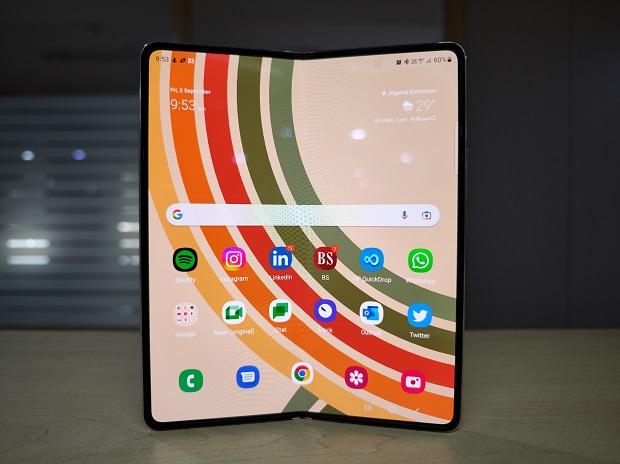
Tech giant Samsung’s upcoming flagship foldable smartphone, Galaxy Z Fold 5, will reportedly feature a 108MP primary rear camera and in-built stylus pen (S Pen) slot.


The upcoming Z Fold 5 is expected to launch in the second half of this year, reports SamMobile.

The 108MP main camera is likely to make the device a bit heavier which will make it weigh around 275 grams, for comparison, the Galaxy Z Fold 4 weighs 263 grams.


The main camera will be accompanied by a 64MP camera with 2x optical zoom and a 12MP ultrawide shooter.


Moreover, the new phone is expected to come with a dedicated slot for the S-Pen, the report said.


Meanwhile, it was reported that the Galaxy Z Fold 5 is likely to feature a “droplet” style hinge that would likely lessen its display crease.


According to tipster Ice Universe, the tech giant internally refers to the design as a “dumbbell” hinge.


–IANS


aj/dpb

(Only the headline and picture of this report may have been reworked by the Business Standard staff; the rest of the content is auto-generated from a syndicated feed.)


Source link

Microsoft to add OpenAI’s bot ChatGPT in Azure cloud services soon

Microsoft to add OpenAI’s bot ChatGPT in Azure cloud services soon


Corp. said it will add OpenAI’s viral bot ChatGPT to its cloud-based Azure service “soon,” building on an existing relationship between the two companies as mulls taking a far larger stake in OpenAI.


The software giant announced the broad availability of its Azure OpenAI Service, which has been available to a limited set of customers since it was unveiled in 2021. The service gives Microsoft’s cloud customers access to various OpenAI tools like the GPT-3.5 language system that ChatGPT is based on, as well as the Dall-E model for generating images from text prompts, the company said in a blog post. That enables Azure customers to use the OpenAI products in their own applications running in the cloud.


is in discussions to invest as much as $10 billion in OpenAI, people familiar with its plans said last week. That proposal calls for the Redmond, Washington-based software maker to put money in over multiple years, though the final terms may change, the people said, asking not to be named discussing a private matter. Semafor last week reported that the potential investment could value OpenAI at about $29 billion, citing people familiar with the negotiations. Microsoft and OpenAI representatives have declined to comment on the talks.


Microsoft, already an OpenAI partner thanks to a $1 billion investment in 2019, is looking to get an inside edge on the most popular and advanced AI systems in order to boost its own products in competition with Alphabet Inc.’s Google, Amazon.com Inc. and Meta Platforms Inc.


ChatGPT has lit up the internet since launching at the end of November, gathering its first million users in less than a week. Its imitation of human conversation sparked speculation about its potential to supplant professional writers and even threaten Google’s core search business. The organization behind it, co-founded by Elon Musk and Silicon Valley investor Sam Altman, makes money by charging developers to license its technology.


The new technology comes at the end of a year of headline-grabbing advances in AI. The company’s Dall-E — which accepts written prompts to synthesize art and other images — also gave rise to a broad debate about the infusion of AI into creative industries. OpenAI is already working on a successor GPT-4 model for its natural language processing.


Still, concern about its accuracy — which Altman himself has said is not good enough for the bot to be relied on — has prompted caution about its premature use, and New York City schools have banned its students from accessing ChatGPT.


Microsoft is currently using OpenAI’s Codex to add automation to its GitHub unit’s Copilot programming tool, and it’s adding that feature to Azure along with the other OpenAI tools. The company wants to adopt even more OpenAI technology in its Bing search engine, Office productivity applications, Teams chat program and security software.


Source link

YouTube
Instagram
WhatsApp




