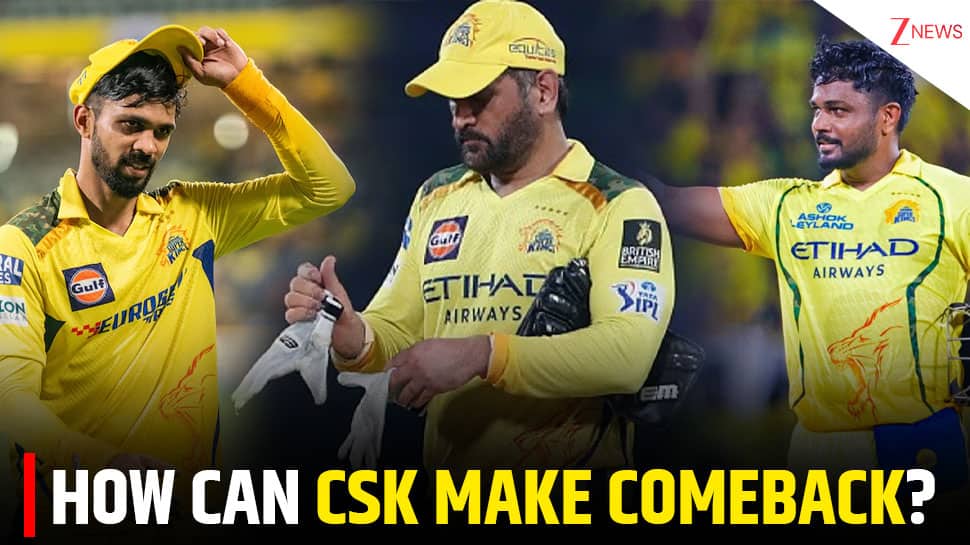
Chennai Super Kings’ faltering start to IPL 2026 is not merely a sequence of defeats; it is the manifestation of a deeper structural transition. With one win in four matches and a net run rate of -1.532, CSK find themselves in unfamiliar territory. Yet, the early signs of recovery, particularly the emphatic win over Delhi Capitals, suggest this is not a terminal decline but a recalibration phase. The central question is no longer why CSK are struggling, but whether their current composition can engineer a mid-season correction in a league that punishes inertia.
The Dhoni vacuum: Tactical absence beyond numbers
The absence of MS Dhoni due to a calf strain has had consequences that extend far beyond finishing ability.
For over a decade, Dhoni functioned as CSK’s on-field strategist-in-chief, dictating bowling changes, field placements, and tempo control under pressure. His absence has exposed a tactical fragility, particularly in the death overs, where CSK have lacked clarity in execution.
While Ruturaj Gaikwad continues to grow into leadership, the contrast in situational awareness has been evident. CSK’s identity has historically been anchored in calm, methodical decision-making. Without Dhoni, that identity appears diluted.
Injury crisis: Disrupting continuity and balance
Few teams have been as severely affected by injuries this season.
- Nathan Ellis — ruled out (hamstring)
- Spencer Johnson — unavailable for multiple games
- Dewald Brevis — missed early fixtures
This has forced CSK into reactive team selection, preventing the establishment of a settled XI. For a franchise that historically thrives on continuity, this disruption has been particularly damaging.
The bowling unit, in particular, has lacked cohesion, with combinations shifting frequently and roles remaining undefined.
Bowling without bite: The missing “X-factor”
Perhaps the most glaring issue has been the absence of a genuine wicket-taking threat.
CSK conceded 250 runs against Royal Challengers Bengaluru, a performance that underscored their inability to control high-scoring games. Captain Gaikwad’s admission of lacking an “X-factor” in bowling reflects a broader concern.
Key issues include:
- Lack of death-over specialists
- Inconsistent lengths under pressure
- Absence of a strike bowler capable of breaking partnerships
Even Noor Ahmad, expected to control middle overs, went wicketless in the initial matches, allowing opposition batters to dictate tempo.
Top-order inconsistency: A fragile starting point
CSK’s batting struggles have largely stemmed from an unstable top order.
The pairing of Gaikwad and Sanju Samson was expected to provide both stability and aggression. Instead, early failures placed undue pressure on the middle order.
However, Samson’s unbeaten 115 against Delhi Capitals offers a potential inflection point. It demonstrated that CSK possess the batting ceiling required to compete, provided the top order fires collectively rather than sporadically.
A franchise in transition: From legacy core to evolving identity
To fully understand CSK’s struggles, one must examine the structural shift since their 2023 title.
Key departures include:
- Ravindra Jadeja
- Sam Curran
- Deepak Chahar
- Devon Conway
These exits have dismantled the core spine of a championship-winning side.
In their place, CSK have invested in youth and dynamic profiles. While this aligns with long-term planning, it has introduced short-term volatility. The transition from a veteran-heavy unit to a hybrid squad is rarely seamless.
The paradox of stability: Strength turning into constraint
CSK’s management, led by Stephen Fleming and a long-standing support structure, has been synonymous with stability.
Historically, this continuity has been a competitive advantage. However, in an IPL ecosystem increasingly driven by data analytics, match-up strategies, and aggressive innovation, stability can risk becoming rigidity.
While other franchises have evolved rapidly, CSK’s slower adaptation curve is beginning to show.
The comeback blueprint: What must change immediately
For CSK to revive their IPL 2026 campaign, incremental improvement will not suffice. A multi-dimensional reset is required.
1. Re-establish top-order clarity
The Gaikwad-Samson partnership must be defined with clear roles. One anchors, the other attacks. Ambiguity in intent has been a recurring issue.
2. Prioritise wicket-taking over containment
Defensive bowling strategies have failed in high-scoring conditions. CSK must prioritise aggression, even at the cost of conceding boundaries.
3. Reinforce death-over strategy
Whether through personnel changes or tactical adjustments, the death overs require immediate correction. This has been CSK’s most vulnerable phase.
4. Leverage the Dhoni effect
Dhoni’s anticipated return could recalibrate both morale and decision-making. His presence remains a strategic asset, even in a reduced playing role.
5. Stabilise the playing XI
Frequent changes have disrupted rhythm. CSK must identify their best combination and persist with it to build cohesion.
The qualification equation: Margin for error is minimal
Historically, 16 points has been the benchmark for playoff qualification. With one win in four matches, CSK now require at least seven victories from their remaining fixtures.
Equally critical is net run rate recovery. Their current -1.532 NRR necessitates at least two or three dominant wins to remain competitive in tie-break scenarios.
This is no longer a campaign of gradual build-up. It is a results-driven sprint.
Signs of resurgence: Why the season is not lost yet
Despite the challenges, CSK’s victory over Delhi Capitals offered tangible positives:
- Samson’s return to form
- Improved wicket-taking from Jamie Overton and emerging bowlers
- Better intent in middle overs
These are not isolated indicators. They suggest that CSK’s issues are correctable rather than systemic failures.
Final assessment: Decline or delayed adaptation?
CSK’s IPL 2026 campaign sits at a critical juncture. The early losses reflect a team adjusting to new realities: leadership transition, squad overhaul, and evolving T20 dynamics.
However, writing off CSK would ignore their historical resilience. This is a franchise that has repeatedly demonstrated the ability to reconstruct mid-season narratives.
The difference this time lies in the margin for error. The IPL has become less forgiving, more accelerated, and tactically demanding.
For CSK, the path forward is clear but narrow. Execution, not reputation, will determine whether this season becomes a footnote in transition or a case study in revival.







