The global FMCG industry is undergoing a structural shift, led by the rapid rise of online channels. While this transition is visible across markets, India stands out — not just for its low online penetration, but also the speed and nature of the disruption driven by quick commerce.
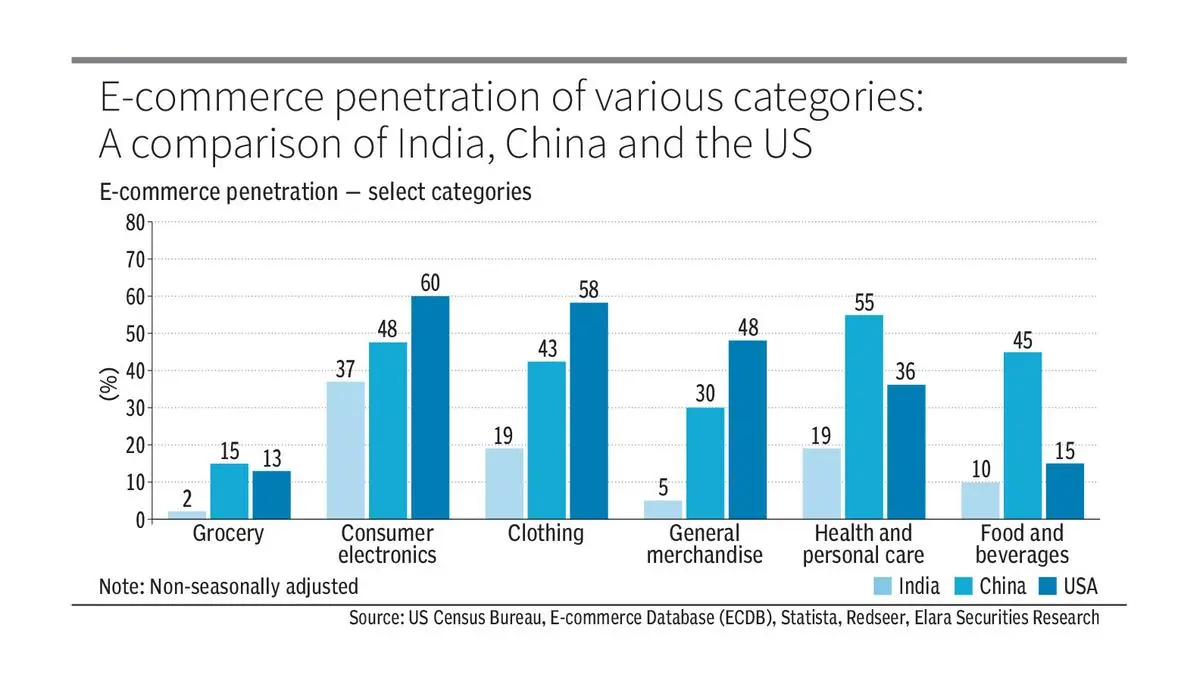
Online grocery penetration in China and the US stands at 15–16 per cent, reflecting a reasonably scaled omni-channel ecosystem, while India remains significantly under-penetrated at less than 5 per cent. As China moved from low- to mid-teen online penetration between 2018 and 2022, the ecosystem saw broad-based margin pressure. FMCG companies faced higher platform commissions, increased trade spends, and a shift away from higher-margin traditional trade, leading to visible compression of gross margin and EBITDA. In the US, during a similar ramp-up phase, margin pressure was largely borne by retailers due to the high cost of order fulfilment and last-mile delivery, while FMCG brands remained relatively resilient as online was primarily a route-to-market shift.
Discovery and discounting
For India, the trajectory is likely to be closer to that of China than the US. With quick commerce driving a large share of online grocery growth, brands are more dependent on platform-led discovery, discounting, and higher channel investments. As penetration scales up from current low levels, FMCG companies are likely to face near-term margin pressure, driven by an adverse channel mix and rising competitive intensity. While growth will accelerate, profitability may remain under pressure until scale efficiencies and supply chain optimisation begin to offset these costs.
Unlike global markets, India has leapfrogged into quick commerce — a model that delivers groceries within minutes. This level of convenience is not present at scale in the US or China. As a result, India is not merely following the global online transition — it is accelerating it. Quick commerce is turning grocery into a high-frequency and impulse-driven category, fundamentally reshaping consumption patterns.
This is already visible in early data points. Categories such as beauty, personal care, apparel, and footwear have achieved 18–20 per cent online penetration, while FMCG and grocery remain under-penetrated. However, of the online grocery penetration, 50–60 per cent is driven by quick commerce. This is a powerful indicator of where the market is headed.
A structural shift is visible in India’s beauty and personal care (BPC) segment. Digital-first platforms such as Nykaa have delivered strong multi-year growth. BPC GMV/revenue growth is trending at 25–30 per cent, outpacing traditional incumbents — for instance, Hindustan Unilever’s BPC segment has grown 8–12 per cent. Notably, HUL’s e-commerce channel (including quick commerce) is growing at about 2x the company average and contributes 10–12 per cent of domestic revenues. However, this growth comes with higher channel costs and mixed impact. There are other trade-offs to the growth.
More competition
First, the rise of quick commerce will lead to more brand fragmentation. The platform-led discovery model, combined with low consumer loyalty in essential categories, enables new-age and D2C brands to scale up rapidly. Unlike traditional retail, where shelf space is constrained, quick commerce allows for faster experimentation and rotation of products. This will result in more winners, but also competition.
For incumbent FMCG companies, this creates incremental pressure. While overall category demand will expand, market share consolidation may weaken, as newer brands capture niche segments and consumer attention.
Second, the channel shift will have direct implications for margins. Quick commerce and e-commerce channels typically operate with lower margins for brands compared with general trade. As FMCG companies have more of these faster-growing channels in the mix, the overall margin profile is likely to be diluted.
Companies will attempt to mitigate this — optimise costs, including rationalising advertising spends, improving supply chain efficiencies, and tightening operating expenses. However, these levers have limitations. In a fragmented and competitive market, reducing brand investments or innovation could be counterproductive.
As a result, even in the best-case scenario, FMCG companies may be able to hold margins only at current levels. The more likely outcome is moderate margin compression in the medium term, particularly as quick commerce continues to scale up.
The pace of disruption will depend on one critical factor: non-metro expansion. Currently, quick commerce remains concentrated in metro markets. If the model scales up effectively in tier 2 and 3 cities — and gains acceptance in grocery — the impact on growth and margins will be amplified. India’s FMCG market could see a faster and deeper structural shift than those of global peers.
Net-net, India is entering a phase where growth and margins are diverging. Quick commerce will drive a sharp acceleration in FMCG consumption, increase category penetration, and expand the overall market. At the same time, it will introduce higher competition, lower loyalty, and sustained margin pressure.
The broader lesson from global markets remains relevant: online penetration does not destroy profitability — it delays it. However, India’s journey could be more intense. With quick commerce acting as a catalyst, the transition may be faster, sharper, and more disruptive than what China or the US experienced.
For companies and investors alike, the message is clear. The near term will be defined by scale, growth, and market capture. Margins, as history suggests, will follow — but only after the ecosystem matures.
India’s FMCG sector is not just digitising distribution, it is also redefining competition and reshaping demand itself.
(Karan Taurani is EVP, Elara Capital)
More Like This
Published on March 30, 2026







