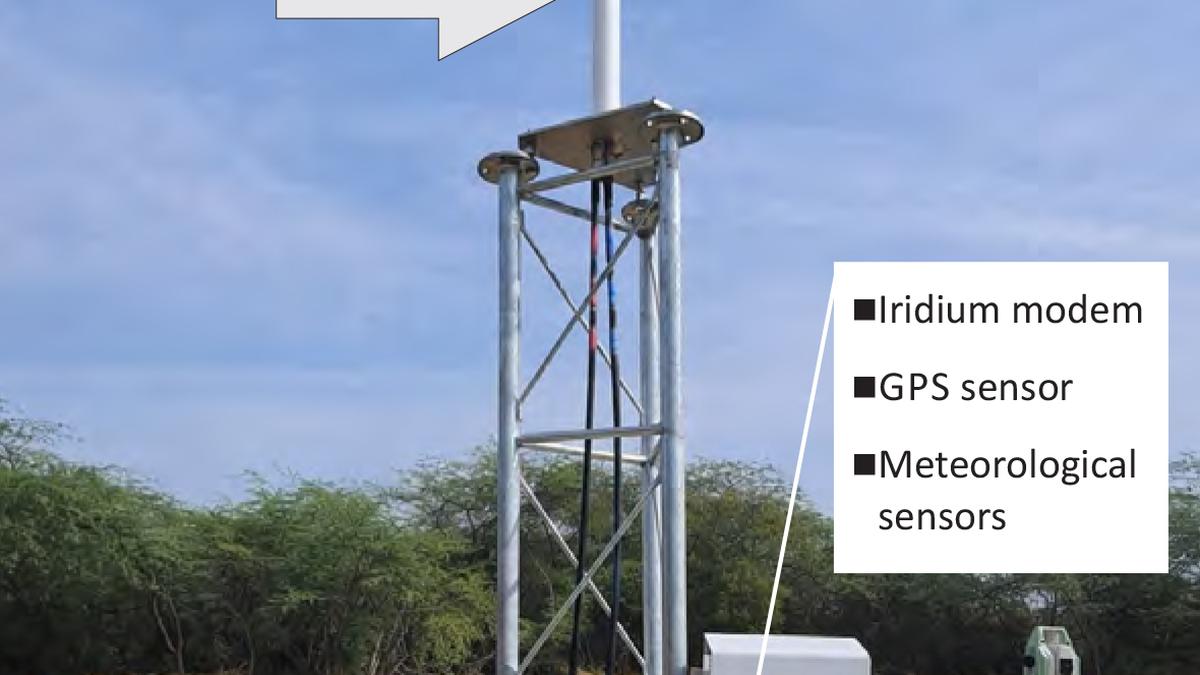
The setting up of India’s first DORIS ground beacon at Indian Institute of Technology, Kanpur, is an important but somewhat under-the-radar step in India’s space and earth observation capabilities. DORIS — short for ‘Doppler orbitography and radio-positioning integrated by satellite’ — is a French system that tracks satellites and ground stations with centimetre-level accuracy.
The beacon at IIT-Kanpur is part of a global network of DORIS ground stations. Satellites carrying DORIS receivers use signals transmitted from these beacons to calculate their own position precisely. Because a satellite moves very fast overhead, the frequency of the signal changes slightly due to the Doppler effect — the same effect that makes a passing train horn sound different as it moves away. By measuring these tiny frequency shifts from beacons around the world, the satellite can calculate its exact position and speed.
This accuracy is crucial for missions involving ocean altimetry, climate studies, mapping the earth’s gravity field, monitoring sea-level rise and glacier movement, tracking tectonic shifts, and precise satellite orbit determination.
A satellite measuring ocean height, for instance, may detect just a few millimetres of change per year. That measurement becomes meaningful only when scientists can know the satellite’s orbit with centimetre-level accuracy. Otherwise, they cannot tell whether the ocean rose, or whether the satellite drifted slightly. DORIS helps remove that uncertainty.
The system has been used in major international satellite missions such as Jason, Sentinel, CryoSat and the Indo-French SARAL/AltiKa.
The beacon at IIT-Kanpur strengthens India’s role in global space geodesy — the science of precisely measuring the earth’s shape, rotation and gravitational behaviour — and deepens Indo-French cooperation in the space sector.
Systems like GPS, VLBI (radio astronomy timing), laser ranging and DORIS together form the backbone of modern earth measurement.
Benefits for India
“The establishment of the DORIS beacon in India represents enhances the national geodetic infrastructure and participation in the global geodetic community,” says Prof Onkar Dikshit of IIT-Kanpur.
“It will help establish a highly accurate and stable national terrestrial reference framework for surveying, mapping, infrastructure development, satellite navigation, disaster management, smart city planning, and other strategic applications,” he said. In addition, the Indian subcontinent is tectonically active due to the interaction between the Indian and Eurasian plates, making continuous geodetic monitoring critically important for understanding crustal deformation, intraplate tectonics, land subsidence, uplift, and seismic hazards, he said.
Accurate geodetic monitoring can aid urban subsidence assessment in rapidly growing cities, improve floodplain mapping, and enhance coastal vulnerability assessments in regions affected by sea-level rise and cyclones. The data products derived from DORIS-supported satellite missions can contribute to precision agriculture, water resource management, glacier monitoring in the Himalayas, and early warning systems for natural hazards such as earthquakes, landslides, and floods.
Enhanced satellite orbit determination also improves the quality of remote sensing products used in weather forecasting, environmental monitoring, fisheries management, and maritime navigation, directly benefiting societal planning and sustainable development initiatives.
Beyond national applications, the DORIS station strengthens India’s contribution to international Earth observation and climate research programmes. The inclusion of India within the global DORIS network fills an important geographic gap in the international space geodetic observing system and enhances the robustness of global reference frame realisation. By hosting such advanced geodetic infrastructure, IIT-Kanpur positions India as an active contributor to the global space geodesy community while simultaneously advancing indigenous capabilities in satellite geodesy, precise positioning, and earth system science.
How IIT Kanpur got in
In 2022, the International DORIS Service (IDS) announced a global call for proposals to establish a new DORIS station, and the proposal submitted by IIT-Kanpur was evaluated by the IDS Selection Committee against several technical and scientific criteria. These included network coverage and tectonic plate contribution, co-location with other geodetic instruments, antenna environment, monument stability, maintenance and security provisions, host institution capability, and prospects for scientific collaboration.
One of the major strengths of the IIT-Kanpur proposal was its strategic geographic location on the northern part of the Indian tectonic plate, addressing a significant gap in the current DORIS network. At present, the only operational DORIS station located on the Indian plate is the MALE station in the Maldives, while the Everest station lies near the Indian–Eurasian plate boundary. The DORIS station at the National Centre for Geodesy (NCG) at IIT-Kanpur will provide improved spatial coverage for monitoring inter-plate and intra-plate tectonic deformation across the Indian region. The station will also enable integrated geodetic studies using both DORIS and GNSS observations for crustal motion and reference frame applications.
A key motivation behind the selection of IIT-Kanpur was the existing technical strength and proposed future plans related to space geodesy at the NCG , along with the significant geographic gap in the existing DORIS network across the Indian region, where no DORIS station is today co-located with other major space geodetic techniques, particularly GNSS.
Published on June 1, 2026







