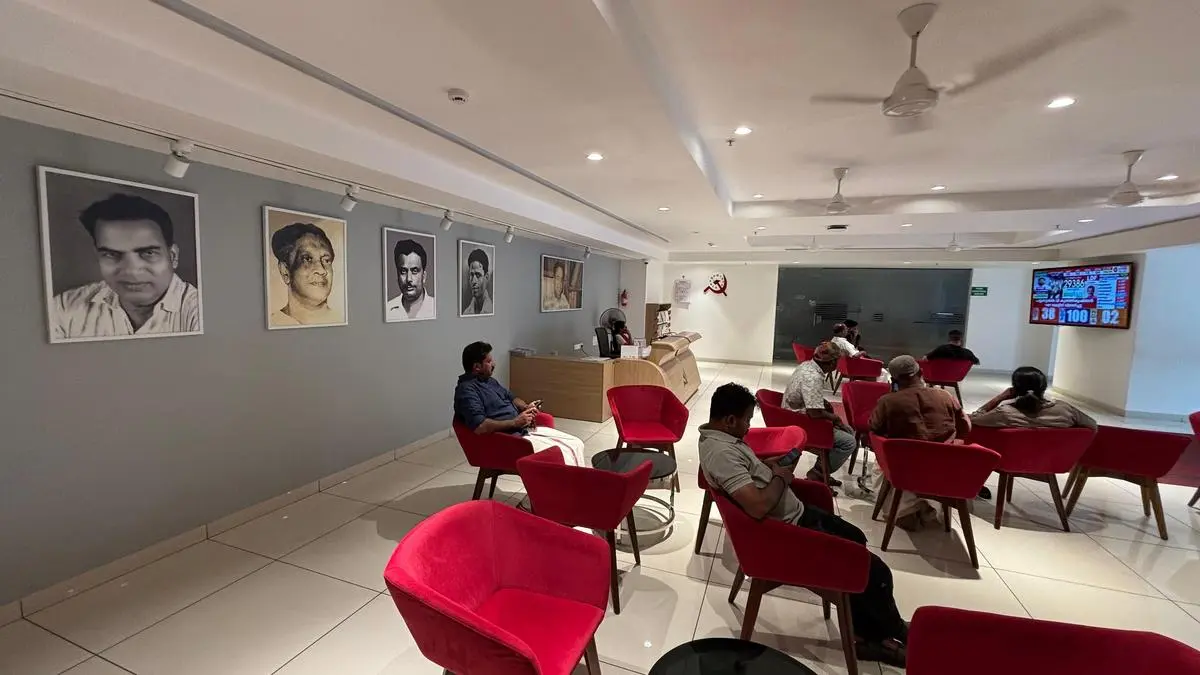
AKG centre – the Communist Party of India (Marxist) state headquarters, following the party led Left Democratic Front’s (LDF) defeat in the Kerala State assembly elections, in Thiruvananthapuram on Monday.
| Photo Credit:
JAYAMOHAN A
Kochi Kerala’s Assembly elections have once again reinforced people power in the State, as an angry electorate booted out the incumbent LDF government with a decisive mandate.
In a striking outcome, as many as 13 ministers of the 21-member LDF Cabinet led by Chief Minister Pinarayi Vijayan were defeated, signalling a clear rejection of its 10-year performance. A widening disconnect between public sentiment and the party’s reading of it appears to have played a crucial role—an evident departure from an earlier era when seasoned leaders had a natural grasp of the electorate’s pulse.
Key losers
Among the key losers was Industry minister P Rajeev who lost to IUML leader V E Abdul Gafoor in Kalamassery in Ernakulam district. Health Minister Veena George lost from Aranmula. Education and Labour Minister V Sivankutty was defeated by BJP state president Rajeev Chandrasekhar in Nemom constituency. Transport Minister K B Ganesh Kumar was defeated by Congress candidate Jyothi Kumar Chamakkala. Higher Education Minister R Bindu lost to Kerala Congress leader Thomas Unniyadan in Irinjalakuda.
A senior technocrat, speaking on condition of anonymity, hinted at widespread governance underperformance, saying that several ministers fell short of expectations. The scale of anti-incumbency revealed in surveys and exit polls remained largely undetected. One of the key factors behind the rout of LDF was the stagnation of productive sectors. While welfare distribution remained strong, it failed to keep pace with the rising aspirations of voters, he said.
Dominic Savio, political consultant and founder of Buzzstop Integrated Communications, said the outcome of the results shows that awareness has now evolved into evaluation, where the voter is no longer influenced by the umbrella of a party but is instead assessing each leader as a standalone offering.
“What has changed is the unit of decision making. Earlier the voter chose the brand, today the voter is choosing the product within the brand”, he said.
Those ministers — by definition are high-visibility products within the political brand — are expected to demonstrate performance, convert policy into experience, make governance tangible, and when they lose despite that visibility, it suggests a breakdown in perceived delivery. “Visibility creates awareness. But awareness without outcome creates disappointment,” he added.
The defeat of high profile ministers, including those seen as articulate and even future leadership material, reinforces this point, because it shows that perception without performance has a limited shelf life.
“In marketing, there is a USP (unique selling proposition. But in politics, the real USP is a unique selling problem, because the leader who identifies a problem sharply and positions himself as the most credible solution is the one who gets chosen.” In other words, politics is no longer about saying what you have done, it is about demonstrating what problem you are solving right now, he said.
Many ministers in this election failed to establish that relevance clearly, either by not defining the problem strongly enough or by not positioning themselves as the solution convincingly.
Performance audit
The defeat of 13 ministers, therefore, is not just about anti-incumbency or political cycles. It is about a shift in how leadership is being perceived by ordinary voters. “Being in power is no longer a shield. It is a performance audit.”
Meanwhile, experts caution that UDF’s victory comes with significant challenges. Fiscal management is likely to emerge as a major test, especially in a context where expectations are high and resources constrained.
Going forward, the State’s policy focus may need to shift towards wealth creation and optimal asset utiliszation—an area where expectations are rising sharply. However, concerns over transparency and corruption have also surfaced, underlining the need for strong oversight and accountability.
Published on May 4, 2026







