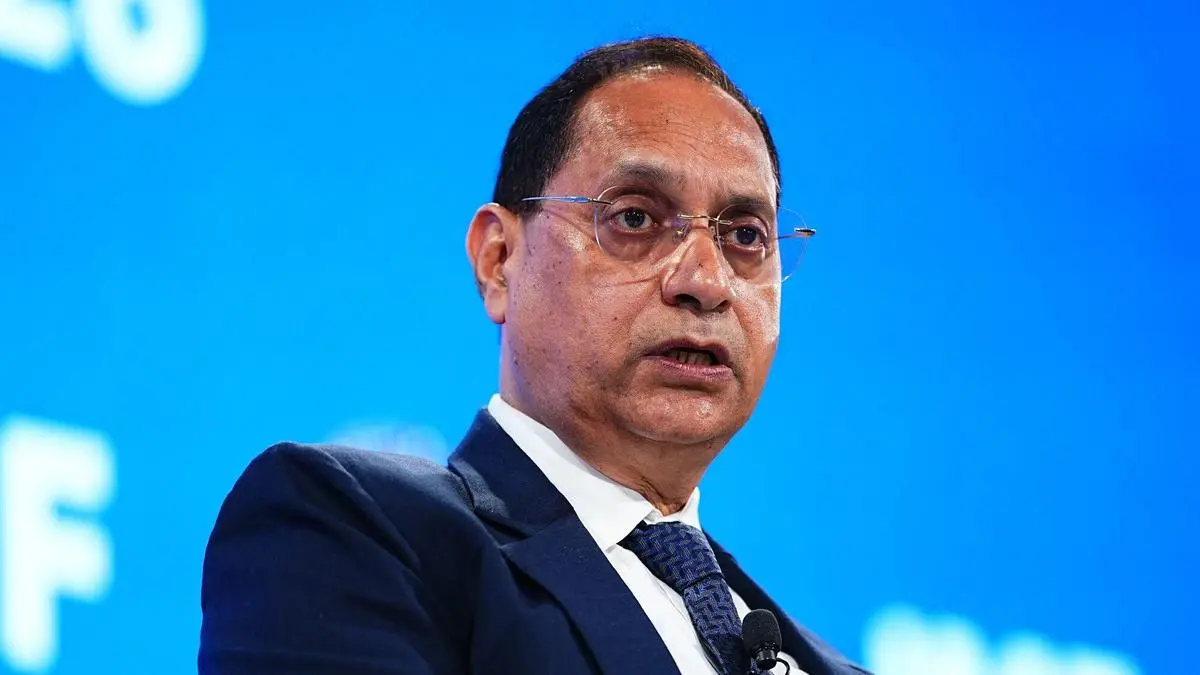
Tuhin Kanta Pandey, Chairman, Securities and Exchange Board of India
India’s capital markets are emerging as a stable and globally competitive destination for long-term capital, even amid geopolitical tensions and market volatility, Tuhin Kanta Pandey, Chairman, Securities and Exchange Board of India (SEBI), said at the IMF-World Bank Spring Meetings
Speaking at an interaction organised by the Confederation of Indian Industry in collaboration with the US-India Business Council, Pandey said India’s markets have evolved into a structural pillar of the financial system, with the ability to mobilise capital at scale.
India is well placed to act as a reliable anchor for global capital in an uncertain environment, supported by strong institutions, a growing domestic investor base and sustained infrastructure investment, he said.
He held discussions with global investors and financial institutions in Washington on India’s regulatory framework and long-term market outlook.
Strong fund mobilisation
India raised over $154 billion through equity and debt markets in FY26, reflecting sustained investor appetite. Mutual fund assets under management are nearing $900 billion, while commitments to Alternative Investment Funds (AIFs) have crossed $175 billion.
Pandey said the depth of domestic participation, alongside steady foreign inflows. Foreign portfolio investors (FPIs) currently hold nearly 17 per cent of listed equity, with assets under management of about $780 billion.
Robust IPO activity and a diversified sectoral base, spanning healthcare, consumer services, energy, commodities and technology, have also supported market growth, he added.
Debt markets
There has been a parallel push to deepen non-equity segments. India’s corporate bond market is approaching $650 billion in outstanding value, while Real Estate Investment Trusts (REITs) and Infrastructure Investment Trusts (InvITs) are gaining traction as vehicles for financing long-duration assets.
These segments are increasingly seen as critical for funding infrastructure and supporting broader economic growth.
Pandey said SEBI’s regulatory approach remains facilitative, risk-based and consultative, with a focus on balancing investor protection, market development and integrity.
Key reforms include the rollout of T+1 settlement cycles, shorter IPO timelines, net settlement for FPIs, and steps to ease market access for global investors. Governance standards for market infrastructure institutions have also been strengthened.
SEBI plans to further streamline capital-raising processes, simplify FPI registration and set up a dedicated digital portal for foreign investors. Harmonisation of KYC norms across regulators and easing compliance requirements for non-resident Indian investors are also on the agenda. The regulator will continue efforts to strengthen equity, debt, derivatives and private capital markets, Pandey said.
Market participants said there is a need to improve secondary market liquidity, expand investor awareness and address taxation issues, particularly in fixed-income markets.
Published on April 17, 2026







