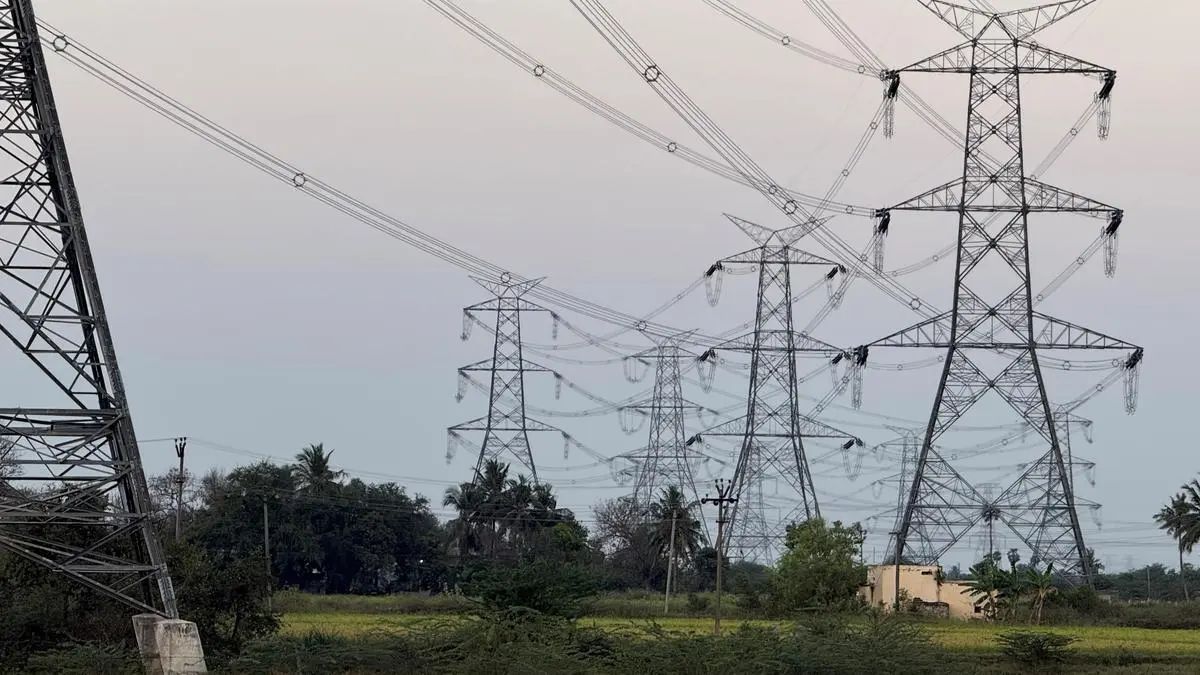
IEX electricity volume grew 23.5 per cent year-on-year in March 2026 and 24 per cent year-on-year in Q4FY26, led by strong real-time market growth
| Photo Credit:
RAGHUNATHAN SR
India’s power demand recovery remains elusive, with growth staying muted in Q4FY26 amid an extended monsoon and slow start to summer. The sector is now looking to FY27 for a potential pickup.
According to Nuvama’s latest report on India’s power sector, demand rose just 1.9 per cent year-on-year in Q4FY26 and was largely flat for the full year. This sets up a subdued base for thermal utilities heading into the next fiscal.
Nuvama expects modest profit after tax growth across its power coverage universe in Q4FY26. “We reckon Nuvama’s power coverage universe shall post modest PAT growth in Q4FY26, driven by weak plant load factor across utilities,” the report said.
“India’s power demand remained muted for yet another quarter (Q4FY26 growth: 1.9 per cent year-on-year) with March 2026 demand rising 0.7 per cent year-on-year,” the report said. “FY26 demand remained largely flat (+0.8 per cent year-on-year) with extended monsoon and slow start to summer adding to woes.”
Power demand grew to 150 billion units in March 2026 and 426 billion units/1,715 billion units in Q4FY26/FY26. It was largely affected by the extended monsoon, slow start to summer and likely weak industrial output.
Peak demand did improve to ~245 GW in Q4FY26 from ~238 GW in Q4FY25, up 2.9 per cent year-on-year. However, thermal plant load factors remained under pressure.
“Thermal PLF remained low at ~70 per cent in March 2026 (73.4 per cent in March 2025) with most utilities posting muted PLFs in Q4FY26,” Nuvama noted. NTPC reported a PLF of 76.7 per cent in Q4FY26 versus 82.7 per cent in Q4FY25, while Tata Power posted 63 per cent versus 72.9 per cent year-on-year. Overall thermal PLF was muted at 69.8 per cent in Q4FY26, down from 73.4 per cent a year ago.
The supply-demand equation is diverging between solar and non-solar hours. “Solar-hour supply outpaced demand with negligible deficiency (IEX prices declined to ₹3.3 per unit in March 2026 versus ₹3.7 per unit in February 2026) while non-solar hours reported stronger demand and reduced supply (prices at ₹5.3 per unit in March 2026 versus ₹3.4 per unit in February 2026),” the report said.
IEX electricity volume grew 23.5 per cent year-on-year in March 2026 and 24 per cent year-on-year in Q4FY26, led by strong real-time market growth. Total volume, including renewable energy certificates, grew ~34 per cent year-on-year in March 2026 and 21 per cent year-on-year in Q4FY26.
The renewable pipeline remains strong, offering medium-term visibility. “RE tendering pipeline as on March 2026 remains elevated at ~368 GW, largely driven by solar plus storage (~65 per cent of total tenders). Total RE addition of ~43 GW year-to-date (till February 2026),” Nuvama noted.
Going forward, a normal monsoon and a pickup in industrial activity will be key to reviving power demand growth in FY27. Until then, utilities with regulated equity growth, strong commissioning, and improving plant availability are better placed. Thermal PLFs remain the key monitorable, along with non-solar hour prices on exchanges, which indicate tightening supply when solar generation drops off. If summer sets in earlier next year, both demand and PLFs could see a cyclical rebound off a low base.
Published on April 15, 2026







