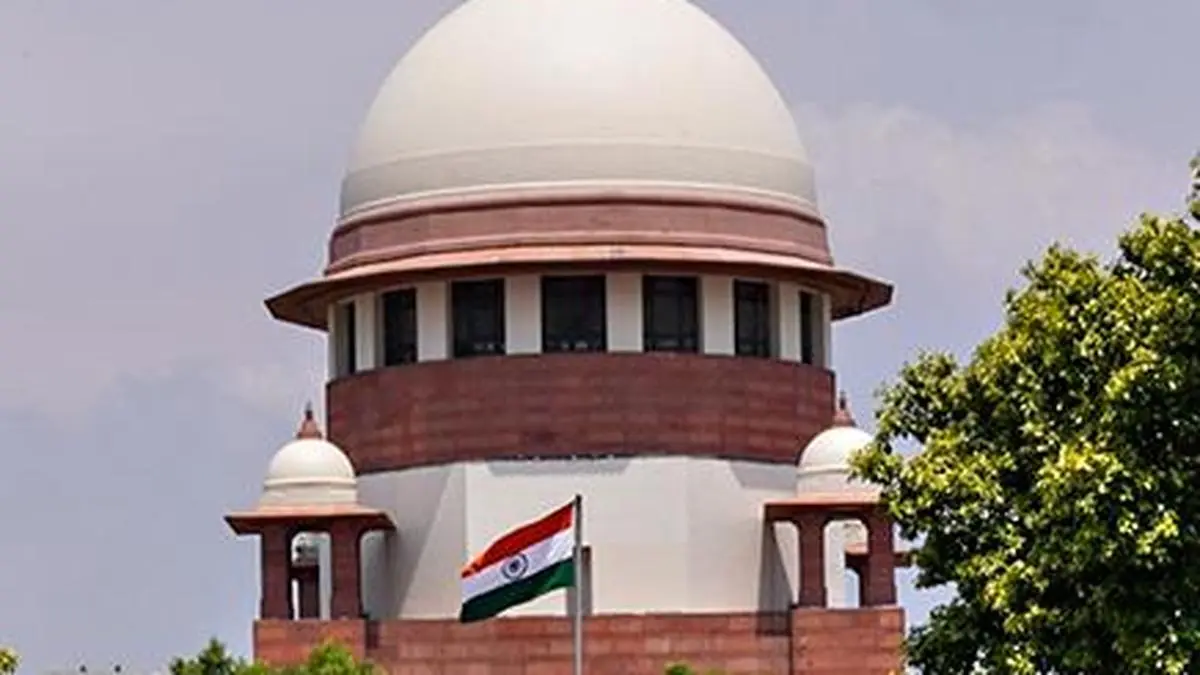
SBI asked the court to reconsider its interpretation of spectrum as an “intangible asset,” arguing logical and factual errors in the earlier judgment.
| Photo Credit:
DEEPIKA RAJESH
State Bank of India has moved the Supreme Court seeking a review of its February judgment that barred telecom spectrum from being treated as an asset under insolvency proceedings, arguing that the ruling contains “errors apparent on the face of the record” and could have far-reaching consequences for lenders and regulated sectors.
In a review petition filed on March 30, SBI, acting on behalf of lenders to the debt-ridden Aircel group, has challenged the court’s interpretation that spectrum — though reflected as an asset in company books — cannot be subjected to proceedings under the Insolvency and Bankruptcy Code, 2016. The bank contended that the judgment failed to adjudicate several key questions, including whether lenders have a valid security interest over spectrum and whether government dues qualify as operational debt.
The SC ruling has hit resolutions of Aircel and Reliance Communications, which are still pending. The ₹23,000 crore resolution plan for RCOM was approved by the lenders in March 2020, while the ₹6,630 core resolution plan of UVARCL for Aircel was approved by the NCLT in June 2020.
‘Intangible asset’
The public sector bank asked the court to reconsider its interpretation of spectrum as an “intangible asset,” arguing logical and factual errors in the earlier judgment.
Earlier, the court had described spectrum as a “natural resource” that is not owned by telcos.
However, SBI argued that the judgment confuses the ownership of a natural resource with the ownership of a statutory and contractual right to the use of said resource.
“Though the Aircel entities do not have ownership rights over spectrum, the bundle of rights over spectrum held by Aircel entities in the nature of right to use spectrum, are distinct rights which are created in favour of the Aircel Entities for a valid consideration, and hence would be considered to be their asset,” said SBI in its plea, citing a 2023 Supreme Court judgement.
Further, excluding spectrum from the asset category substantially erodes Aircel’s enterprise value as well as the value of similar corporates. This hurts the fiscal security created for lenders, including public sector banks. In 2014, domestic lenders like SBI offered loans worth ₹13,729 crore to Aircel Entities encouraged by telecom licences and spectrum usage rights
SBI argued that the court’s ruling overlooked documentary evidence showing that lenders had created enforceable security over the “right to use” spectrum through financing agreements and mortgage arrangements. It said this omission effectively undermines lenders’ claims and could force banks to reassess credit exposure to sectors reliant on government-granted rights such as telecom, mining and infrastructure.
In fact, licence over spectrum waves is the solitary asset that attracts any lender when considering insolvency, Abhishek Swaroop, Partner at Saraf&Partners Law told businessline.
Stating that the February judgement had put lenders in a flux, Swaroop said, “This order directly impacts and affects insolvencies of a telecom or telecom-related operators. If spectrum is taken away, you take away the most-readily realisable asset.”
Regarding the Department of Telecommunications’ (DoT) constitutional right to spectrum, the bank pointed out that the government had voluntarily submitted to and participated in the resolution process (CIRP) and any eventual liquidation of the telco. At the time, DoT had not objected to its license fees being categorised as operational debts.
Further, SBI called out the “artificial” distinction between voluntarily-initiated and creditor-initiated CIRP. Such a distinction implies that Aircel initiated the CIRP solely to evade payment of licence fees, said SBI.
Risk recalibration
According to Akshat Khetan, Founder, AU Corporate Advisory and Legal Services, the plea seeks to recalibrate risk for lenders and companies like Aircel that rely on spectrum for borrowings. Excluding spectrum from asset category weakens a company’s ability to leverage licences/ usage rights to raise long-term capital, leading to higher cost of funds, tighter covenants and potentially reduced access to credit.
“If sovereign or regulatory claims can effectively override insolvency outcomes, banks will need to reprice risk across sectors dependent on government concessions, including infrastructure and natural resources. In the near term, we may see a more cautious lending approach, with greater emphasis on cashflows and alternative security, rather than reliance on licensed rights as collateral,” said Khetan.
SBI has sought an open court hearing and a stay on the operation of the judgment, stating that a reconsideration is necessary to prevent “manifest injustice” to creditors and safeguard the broader financial ecosystem.
Published on April 21, 2026







