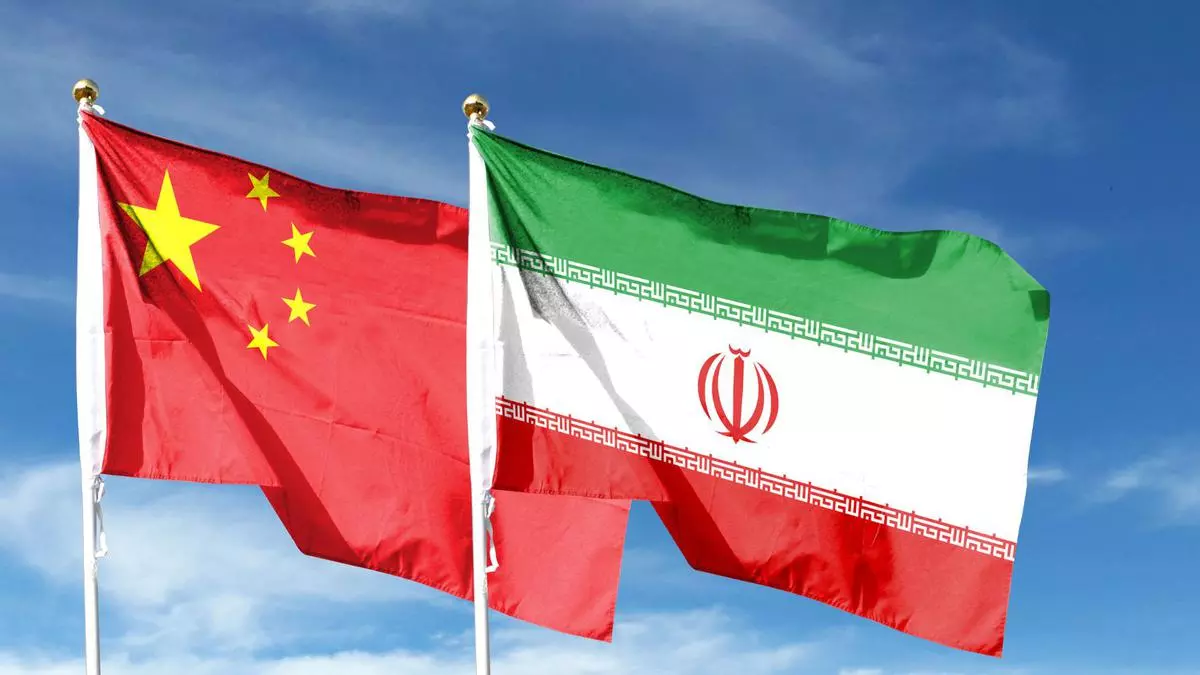
China’s reliance on Iranian oil leaves it exposed to Middle East supply risks

China’s reliance on Iranian oil leaves it exposed to Middle East supply risks


Sanctions have left Iran with limited buyers, allowing China—mainly independent “teapot” refiners—to secure deeply discounted crude.

China, the world’s largest crude
importer, is the main buyer of oil ‍from OPEC producer Iran,
leaving Beijing uniquely exposed to any supply disruption
fromconflict in the Middle ​East.

Beijing, which is also the biggest buyer of oil from ‌Venezuela
and a top importer of oil from Russia, has used ​purchases from
the three countries facing various Western sanctions to save
billions of dollars on its import bill in recent years.

HOW MUCH IRANIAN OIL DOES CHINA BUY?

China buys more than 80% of Iran’s shipped oil, data for 2025
from analytics firm Kpler showed. Iranian oil has limited buyers
due to U.S. sanctions aimed at cutting off funding to Tehran’s
nuclear programme.

China purchased on average 1.38 million barrels ​per day of
Iranian oil last year, according to Kpler. That represented
about ⁠13.4% of the total 10.27 million bpd of oil it imported by
sea.

WHO ARE THE MAIN CHINESE BUYERS OF IRANIAN CRUDE?

Chinese independent refiners known as teapots, clustered
mainly in Shandong province, are ​the main buyers of Iranian
crude, drawn ⁠by its discount to non-sanctioned barrels.
Teapots, which account for roughly a quarter of Chinese refinery
capacity, operate on narrow and sometimes negative margins and
have been squeezed recently by tepid domestic demand for refined
products.

China’s big state oil companies ‌have refrained from buying
Iranian oil since 2018/2019, traders and experts have ‌said.

HOW MUCH CHEAPER IS IRANIAN OIL?

Iranian Light crude has traded at around $8 to $10 a barrel
below ICE Brent on a delivered ‍basis to China since December,
from a discount of about $6 in September, traders said. That
means Chinese refiners save about $8 to $10 a barrel if they buy
Iranian Light rather ‍than non-sanctioned Oman crude, according
to calculations by a trader and Reuters.

Discounts have widened due to ample supply in onshore tanks and floating storage.
Iran has a record amount of oil on the water, equivalent to
around 50 days of output, as China has bought less because of
sanctions and Tehran seeks to protect its supplies from the risk
of U.S. strikes, Kpler said.

ARE U.S. SANCTIONS HAVING AN IMPACT?

Washington reinstated sanctions on Tehran in 2018, and U.S.
President Donald Trump’s administration has imposed several new
rounds ⁠of sanctions on Iran’s oil trade since taking office in
January.

Trump’s sanctions have included penalties on three Chinese
teapots, which has curtailed buying ​from several mid-sized
independents worried about being designated, Reuters reported.

WHAT IS BEIJING’S STANCE ON THE ⁠IRAN OIL TRADE?

Beijing rejects unilateral sanctions and defends its trade
with Iran as legitimate.
Iranian oil imported by China is typically labelled by traders
as originating from other countries, such as Malaysia, a major
transshipment hub, and Indonesia.
Chinese customs data has not shown any oil shipped from Iran
since July ⁠2022.

Published on January 13, 2026


Source link

‘No more 10-minute delivery’: Centre tells e-commerce and q-commerce players

‘No more 10-minute delivery’: Centre tells e-commerce and q-commerce players


The move is aimed at ensuring greater safety, security and improved working conditions for gig workers. 
| Photo Credit:

Responding to sustained demand from gig workers and their unions, Union Labour Minister Mansukh Mandaviya has persuaded major delivery aggregators to drop their 10-minute delivery deadline.

Blinkit is the first to act on the directive. The e-commerce platform has removed the 10-minute delivery promise from its branding and others are expected to follow, said sources privy to the development.

It is learnt that Minister Mandaviya convened a meeting last week to address grievances of gig workers over delivery timelines, flagged repeatedly by various stakeholders in relation to leading platforms including Blinkit, Zepto, Zomato and Swiggy.

“While Blinkit has already acted on the directive and removed the 10-minute delivery promise from its branding, other aggregators are expected to follow suit in the coming days,” said informed sources.

In a BSE filing, Eternal Ltd stated, “Specifically with respect to our quick commerce business Blinkit, there is no change in business model that could have any material impact on the Company.”

Tagline revised

As part of this change, Blinkit has updated its brand messaging, said sources. The company’s principal tagline has been revised from “10,000+ products delivered in 10 minutes” to “30,000+ products delivered at your doorstep.”

Blinkit is the first to act on the directive, removing quick delivery promise from its branding 

Blinkit is the first to act on the directive, removing quick delivery promise from its branding 
| Photo Credit: SHASHANK PARADE

However, other aggregators are still to respond officially about change in their delivery policies.

The move is aimed at ensuring greater safety, security and improved working conditions for gig workers.

The Telangana Gig and Platform Workers’ Union (TGPWU) and the Indian Federation of App-Based Transport Workers (IFAT) welcomed the move.

“This is a significant and much-needed step in protecting the lives and dignity of gig and platform workers. The 10-minute delivery model forced delivery partners into dangerous road behaviour, extreme stress, and unsafe working conditions,” said Shaik Salauddin, Founder President of TGPWU and National General Secretary of IFAT.

Analysts do not believe the development will have any material impact on volumes or growth trajectory of quick commerce platforms. “The removal of the 10-minute delivery catchline is largely optics-driven rather than business-altering. The proposition of quick commerce (QC) continues to be anchored in speed, convenience and proximity-led fulfillment, which remains structurally superior to horizontal e-commerce timelines,” said Karan Taurani, EVP, Elara Capital.

Published on January 13, 2026



Source link

Silver soars to new high of over /oz; spot prices top ₹2.6 lakh a kg in India

Silver soars to new high of over $88/oz; spot prices top ₹2.6 lakh a kg in India


The precious metals complex continued its sparkling run on Tuesday, with gold topping $4,600 an ounce and silver soaring to a new high over $88 an ounce on geopolitical crisis, particularly in the background of the brewing Iranian crisis.

In India, too, silver in the Mumbai spot market ended at a new high of ₹2,63,062 a kg, while March futures on MCX ruled at ₹2,79,419. At 2000 hours IST, silver ruled at $88.47 an ounce and February futures at $88.30. 

Gold ruled at $4,625 an ounce and March gold futures were quoted at $4,635.29. In the Mumbai spot market, gold ended at ₹1,40.284 per 10 gm and February futures on MCX ruled at ₹1,42,858 per 10 gm. 

Light jewellery demand up

Arthi Ramalingam, Founder & CEO, Eternz, said the current surge in gold and silver prices reinforces their role as trusted stores of value for Indian households amid geopolitical and macroeconomic uncertainty. 

“ At Eternz, we’ve seen a 20–30 per cent rise in demand for lightweight jewellery, while wedding and festive demand remains resilient,” she said. 

Renisha Chainani, head of research at Augmont, said gold has decisively broken above its earlier resistance at $4,570, opening the door to higher levels. The next key targets are $4,745–4,750 (78.6% Fibonacci extension, ~₹1,46,000) and $4,966–4,970 (100% Fibonacci extension, ~₹1,52,500).

Complex’s gain in 2026

“Silver’s rally also looks set to extend further. Fibonacci projections point toward $88 (₹2,78,000) and $93 (₹2,93,000) in the coming weeks, while $70 remains a strong support zone,” she said.

Platinum and palladium, too, rose in line with gold and silver. Platinum was quoted at $2,388.50 an ounce and palladium at $1,919.50 an ounce.

Since the beginning of the year, the yellow metal has gained 7 per cent, the white precious metal over 24 per cent and platinum and palladium over 16.5 per cent.

Published on January 13, 2026



Source link

Hit by rising competition & smuggled cigarettes, Indian tobacco farmers say they have been left in the lurch

Hit by rising competition & smuggled cigarettes, Indian tobacco farmers say they have been left in the lurch


Tobacco Board Chairman Yashwanth Kumar Chidipothu

With export market facing tough competition from global players like Zimbabwe and Tanzania, and the domestic market getting flooded with cheap, smuggled cigarettes from across the borders, tobacco farmers find themselves caught between the devil and the deep sea.

They have begun knocking on the Tobacco Board’s doors, seeking its intervention to convince the Union Government to reduce prohibitively expensive taxation, including the Goods and Services Tax (GST) and Excise Duties, which have pushed up cigarette prices by up to 75 per cent.

“I have received several representations from farmers and farmers’ groups. I have brought these issues to Union Commerce Minister Piyush Goyal. We will seek an appointment and take a delegation of farmers from Andhra Pradesh and Karnataka to Delhi and meet the Minister to formally present their demands ahead of the Union Budget,” Tobacco Board Chairman Yashwanth Kumar Chidipothu told businessline.

Empathising with farmers

Yashwanth, who himself is a tobacco farmer, said that he empathised with the farmers’ view that the steep increase in prices of cigarettes could drive the smokers to cheaper, illicit alternatives.

Citing the farmers’ representations, the Chairman said that, as part of the GST 2.0 process, both farmers and industry expected revenue neutrality and believed that the 40 per cent bracket would cover all other taxes (excise duty and cess).

“However, the reintroduction of excise duty has caused significant hardship. Farmers seek a reduction in the newly-imposed excise rates, which he claims are two to three times the revenue-neutral levels,” he said.

The excise duty and NCCD (National Calamity Contingent Duty) were reintroduced (after the GST rejig) at rates ranging from ₹2,050 to ₹8,500 per 1,000 sticks, depending on length.

Encourage smuggling

“Such unexpected and steep increases will have a negative impact on agricultural value chains and are particularly damaging when farmers have already planted, harvested, and brought their crops to auction,” he said.

He wanted the government to reinstate the tax exemption for raw leaf to protect the primary source of income for over 83,000 registered growers.

“Steep and sudden tax increases do not meaningfully reduce consumption; instead, they push consumers toward illegal products. [This] ultimately undermines both public health objectives and national revenue,” he pointed out.

There is a grave fear that high prices will drive consumers to the illicit market. Currently, a legal pack costs roughly ₹340, while smuggled packs are available for as little as ₹50. India is already 4th largest illicit market globally. The Chairman warned that this tax hike will only expand the footprint of smuggled goods that evade taxes and don’t use Indian tobacco.

Export challenges

India is facing stiff competition from African nations such as Zimbabwe, Tanzania, Zambia, Mozambique, Uganda, and Malawi. These countries have significantly lower labour costs and are ramping up production through aggressive contract farming. If Indian tobacco becomes more expensive due to domestic taxes, our export competitiveness will decline, he said.

Published on January 13, 2026



Source link

India’s crude imports drop to lowest levels since first price cap as RIL cuts cargoes by half, says CREA

India’s crude imports drop to lowest levels since first price cap as RIL cuts cargoes by half, says CREA


Another first is Turkey displacing India as Russia’s second largest fossil fuel buyer in almost three years.
| Photo Credit:
YORUK ISIK

Recent sanctions by the US on Russia has started taking effect with India’s December 2025 crude oil imports from Moscow slipping to their lowest levels for the first time, since G7 countries imposed the $60 per barrel price cap on Urals grade (December 2022), as Reliance Industries (RIL) slashed its cargoes by half.

Another first is Turkey displacing India as Russia’s second largest fossil fuel buyer in almost three years.

Finland-based Centre for Research on Energy and Clean Air (CREA) said “India’s Russian crude imports recorded a sharp 29 per cent M-o-M reduction to the lowest volumes since implementation of the price cap policy. These drops occurred despite total imports growing marginally.”

These drops were led by sharp reductions in imports by the RIL-operated Jamnagar refinery (-49 per cent) and a 15 per cent reduction by state-owned refineries in December (2025), it added.

The US sanctions on Russian oil giants Rosneft and Lukoil is the first serious attempt to check energy trade between New Delhi and Moscow. They came into effect on November 21, 2025. For instance, Russia’s monthly fossil fuel export revenues in December 2025 witnessed a 2 per cent M-o-M decline to around $580 million per day—the second lowest figure since the full-scale invasion of Ukraine (February 2022).

Sanctions effect

CREA pointed out that India was the third highest buyer of Russian fossil fuels, importing a total of around $2.68 billion of Russian hydrocarbons in December 2025. Crude oil constituted 78 per cent of India’s purchases totalling roughly $2.10 billion, coal ($495 million) and oil products ($96 million).

“These cuts were led largely by the Jamnagar refinery, which cut its imports from Russia by half in December (2025). The entirety of their imports were supplied by Rosneft, albeit from cargoes purchased before (the US) OFAC sanctions came into effect,” CREA added.

Turkey displaced India as the second largest importer, purchasing around $3 billion of Russian hydrocarbons in December. Refined oil products constituted the largest share at 44 per cent ($1.28 billion) followed by pipeline gas ($1.15 billion). Crude oil ($300 million) and coal ($261 million) constituted the remainder of their imports, the think tank pointed out.

In December, CREA said that five refineries in India, Turkey and Brunei that use Russian crude exported around $1.1 billion of oil products to sanctioning countries, of which almost one-third of the products were refined from Russian crude oil.

There was a 9 per cent M-o-M drop in refineries’ exports to sanctioning countries such as the US, the EU, the UK and Australia. The decrease was led chiefly by the EU and UK, who recorded monthly reductions of 26 per cent and 53 per cent, respectively.

In contrast to those two, CREA pointed out that exports to Australia ($331 million) increased by 9 per cent M-o-M in December. The biggest exporters to Australia were the Jamnagar refinery in India (around $154 million) and the Hengyi refinery in Brunei ($135 million).

“There was a 121 per cent increase (M-o-M) in exports to the US totalling around $220 million. These exports originated in the Jamnagar refinery and the Tupras Aliaga refinery in Turkey,” it added.

The EU floating price cap, which came into force on September 3, 2025, has been effected in a way that it will be 15 per cent lower than the average price of Russian Urals blend over the previous six months.

Published on January 13, 2026


Source link

विदेशी पूंजी निकासी और बिकवाली से शेयर बाजार में कोहराम, 250 अंक गिरकर सेंसेक्स बंद

विदेशी पूंजी निकासी और बिकवाली से शेयर बाजार में कोहराम, 250 अंक गिरकर सेंसेक्स बंद


Stock Market News: विदेशी निवेशकों की लगातार बिकवाली और वैश्विक स्तर पर शुल्क (टैरिफ) को लेकर बढ़ती चिंताओं के बीच मंगलवार को घरेलू शेयर बाजार नुकसान के साथ बंद हुए. प्रमुख शेयरों में मुनाफावसूली हावी रहने से सेंसेक्स 250 अंक और निफ्टी करीब 58 अंक टूट गया.

बीएसई का 30 शेयरों वाला सेंसेक्स 250.48 अंक यानी 0.30 प्रतिशत की गिरावट के साथ 83,627.69 अंक पर बंद हुआ. कारोबार के दौरान एक समय यह 615.38 अंक गिरकर 83,262.79 तक आ गया था. वहीं, एनएसई का निफ्टी 57.95 अंक यानी 0.22 प्रतिशत कमजोर होकर 25,732.30 अंक पर बंद हुआ.

इन शेयरों में गिरावट

सेंसेक्स की 30 कंपनियों में ट्रेंट, लार्सन एंड टूब्रो, रिलायंस इंडस्ट्रीज, इंटरग्लोब एविएशन, मारुति, आईटीसी, अडाणी पोर्ट्स और भारत इलेक्ट्रॉनिक्स के शेयरों में प्रमुख रूप से गिरावट दर्ज की गई. दूसरी ओर, इटर्नल, आईसीआईसीआई बैंक, टेक महिंद्रा, भारतीय स्टेट बैंक और टाटा कंसल्टेंसी सर्विसेज (टीसीएस) के शेयरों में मजबूती देखने को मिली.

जियोजित इन्वेस्टमेंट्स लिमिटेड के शोध प्रमुख विनोद नायर ने कहा कि ईरान के साथ कारोबार करने वाले देशों पर अमेरिकी शुल्क लगाने की चेतावनी से बाजार में चिंता का माहौल बना रहा. इसके अलावा रुपये की कमजोरी, कच्चे तेल की कीमतों में तेजी, अमेरिकी बॉन्ड यील्ड में सुधार और विदेशी पूंजी की निकासी से निवेशक धारणा सतर्क बनी रही.

उन्होंने बताया कि तिमाही नतीजों की कमजोर शुरुआत के बीच प्रमुख शेयरों में मुनाफावसूली का रुझान देखने को मिला, जिससे बाजार पर दबाव बढ़ा. देश की सबसे बड़ी आईटी सेवा कंपनी टीसीएस ने दिसंबर तिमाही में नए श्रम संहिताओं के एकमुश्त असर के कारण शुद्ध लाभ में 13.91 प्रतिशत की गिरावट की जानकारी दी है.

विदेशी निवेशकों की बिकवाली

शेयर बाजार के आंकड़ों के मुताबिक, विदेशी संस्थागत निवेशकों (एफआईआई) ने सोमवार को 3,638.40 करोड़ रुपये के शेयर बेचे, जबकि घरेलू संस्थागत निवेशकों (डीआईआई) ने 5,839.32 करोड़ रुपये की खरीदारी की.

वैश्विक मोर्चे पर, अमेरिकी राष्ट्रपति डोनाल्ड ट्रंप द्वारा ईरान के साथ व्यापार करने वाले देशों पर 25 प्रतिशत शुल्क लगाने की घोषणा से निवेशक सतर्क नजर आए. रेलिगेयर ब्रोकिंग के वरिष्ठ उपाध्यक्ष (रिसर्च) अजीत मिश्रा ने कहा कि भू-राजनीतिक तनाव और वैश्विक व्यापार को लेकर अनिश्चितताओं ने निवेशकों की जोखिम लेने की क्षमता को प्रभावित किया है.

वृहद बाजार की बात करें तो बीएसई स्मॉलकैप सूचकांक 0.46 प्रतिशत चढ़ गया, जबकि मिडकैप सूचकांक 0.16 प्रतिशत की गिरावट के साथ बंद हुआ. सेक्टोरल इंडेक्स में दूरसंचार में 1.18 प्रतिशत, औद्योगिक क्षेत्र में 1.09 प्रतिशत और पूंजीगत उत्पाद खंड में 0.67 प्रतिशत की गिरावट दर्ज की गई.

एशियाई बाजारों में दक्षिण कोरिया का कॉस्पी, जापान का निक्की और हांगकांग का हैंगसेंग बढ़त के साथ बंद हुए, जबकि चीन का शंघाई कंपोजिट नुकसान में रहा. यूरोपीय बाजारों में मिलाजुला रुख देखने को मिला. अमेरिकी बाजार सोमवार को बढ़त के साथ बंद हुए थे. अंतरराष्ट्रीय बाजार में ब्रेंट कच्चा तेल 1.86 प्रतिशत की तेजी के साथ 65.06 डॉलर प्रति बैरल पर पहुंच गया.

ये भी पढ़ें: इस सेक्टर में चीन के दबदबे को भारत की बड़ी चुनौती, 2025 में 4 लाख करोड़ का किया रिकॉर्ड एक्सपोर्ट

डिस्क्लेमर: (यहां मुहैया जानकारी सिर्फ़ सूचना हेतु दी जा रही है. यहां बताना जरूरी है कि मार्केट में निवेश बाजार जोखिमों के अधीन है. निवेशक के तौर पर पैसा लगाने से पहले हमेशा एक्सपर्ट से सलाह लें. ABPLive.com की तरफ से किसी को भी पैसा लगाने की यहां कभी भी सलाह नहीं दी जाती है.)


Source link

YouTube
Instagram
WhatsApp