New sensor to detect cancer

New sensor to detect cancer


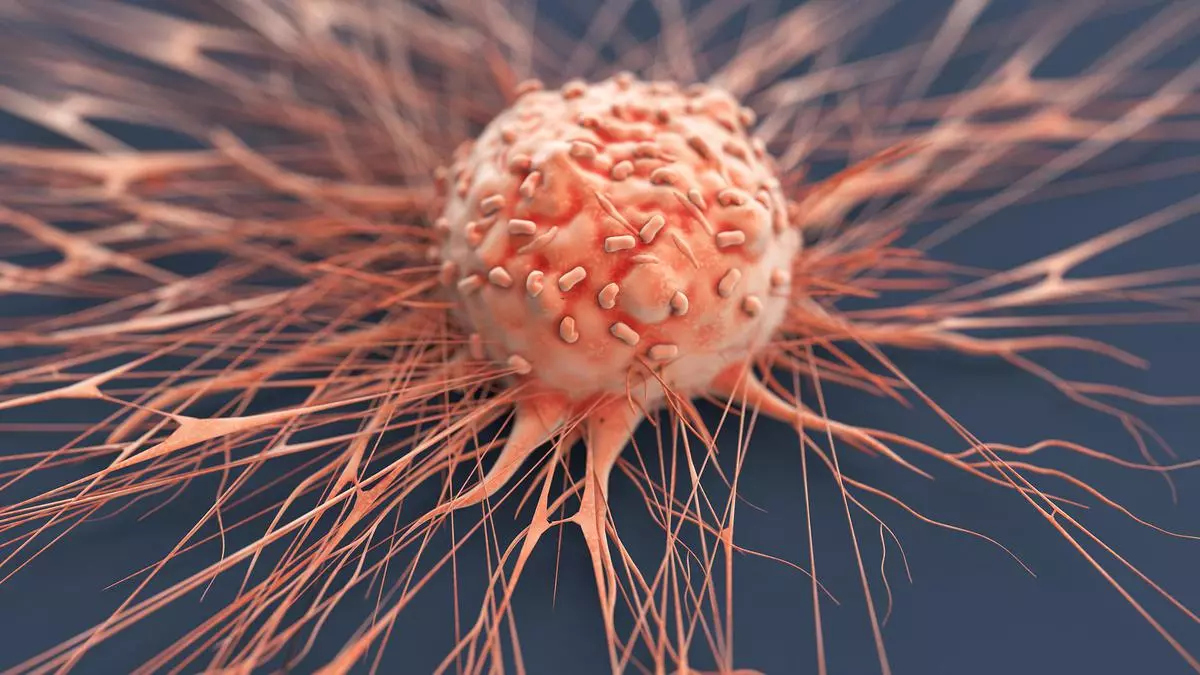
An immunosensor developed with fluorescent nanomaterial can help detect the vascular endothelial growth factor (VEGF), a signalling protein that promotes the growth of new blood vessels and is considered cancerous if found in elevated levels in the blood.

VEGF is a factor that promotes angiogenesis or formation of new blood vessels, which involves migration, growth, and differentiation of the endothelial cells that line the inside wall of blood vessels. It is unregulated in many tumours and hence serves as an indication of the likelihood of cancer. The dynamic interplay of nanotechnology and immunoassay has unlocked an arena for developing next-generation techniques for detecting such biomarkers, which can simplify the detection of cancer, especially breast cancer. Such techniques will ensure rapid point-of-care testing for early detection of cancer.

Prof Devasish Chowdhury and his PhD student Ankita Deb at the Institute of Advanced Study in Science and Technology (IASST) in Boragaon, Guwahati (Assam) fabricated an immunosensor based on the fluorescence phenomenon of biogenic carbon quantum dots, a new class of carbon nanomaterials, for the detection of the biomarker VEGF, which can lead to early detection of the disease.

The potential of this immunosensor was qualitatively assessed using human blood plasma samples, showing promising applicability of the fabricated system in immunoassay techniques, says a press release.


Source link

Many tools on the horizon to predict earthquakes 

Many tools on the horizon to predict earthquakes 


With the gloom of the Turkey-Syria earthquake that has left over 40,000 dead weighing heavily on our minds, the question, which always pops up after every earthquake, is popping up again: why can’t these earthquakes be predicted? 

The narrative always veers around the behavior of birds and animals, which seem to sense the oncoming disaster. If there is something that these creatures sense, why can’t we sense that too? 

The general consensus among experts still is that earthquakes cannot be predicted. Dr. Abhishek Kumar, Associate Professor, Department of Civil Engineering, Centre for Disaster Management and Research (CDMR), IIT Guwahati, tells Quantum that parameters such as in-situ measurements of ground temperature and satellite-based measurements of ground displacement can help identify earthquake-prone regions. However, “the temporal occurrence of earthquakes in such regions is still an area of further study.”  

At best, you can build earthquake-resistant buildings in such areas, but you can’t tell when the earth will shake. 

Recent research papers on predicting earthquakes are more hopeful—perhaps an indication of growing confidence among scientists. In a paper titled Artificial intelligence based real-time earthquake prediction, published in Engineering Applications of Artificial Intelligence, Munish Bhatia et al, note that “with the technological revolution in data acquisition, communication networks, edge–cloud computing, the Internet of Things (IoT), and big data analysis, it is feasible to develop an intelligent earthquake prediction model for early warnings at vulnerable locations.”  

Unique precursor

Some are more emphatic, believing that it is possible to foretell the magnitude, epicenter and time of occurrence of earthquakes. Two such scientists are Manana Kachakhidze and Nino Kachakhidze-Murphy of the Georgian Technical University, Natural Hazard Scientific‐Research Center, Tbilisi, Georgia. In a May 2022 (yet-to-be-peer-reviewed) paper, they say: “To the question ‘is it possible to predict earthquakes?’ we may answer that moderate and strong earthquakes can be predicted.” 

The earth speaks loud and clear before it shakes, albeit in its own language. It speaks in terms of very low frequency and low frequency (VLF/LF) electromagnetic emissions, changes in the intensity of electro-telluric currents (electric currents that move underground or undersea) in the focal area, perturbations of the geomagnetic field in the forms of irregular pulsations, perturbations of the atmospheric electric field, increased intensity of electromagnetic emissions in the upper ionosphere in several hours or tenths of minutes before an earthquake and infrared radiation. Not all of these are necessarily observed before each earthquake, but there is one or the other of these precursors. 

Manana and Nino Kachakhidzes set store by VLF/LF electromagnetic emissions, which they describe as a “unique precursor”, because “it gives the promising possibility of simultaneous determination of moderate and strong, inland incoming earthquake magnitude, epicenter, and time of occurrence.” 

VLF/LF electromagnetic radiation frequency analysis gives the possibility simultaneously to determine all three characteristic parameters necessary for incoming earthquake prediction (magnitude, epicenter, and time of occurring). It is shown that the prediction of moderate and strong earthquakes is possible with great precision. They stress tht VLF/ LF EM radiation “fully meets the Guidelines for Submission of Earthquake Precursor Candidates.”  

Looking at data

While Bhatia and the Kachakidzes are looking into physical parameters, other scientists dunk their dipsticks into another source of precursors: data. But each year, about 500,000 earthquakes happen. We may feel only a very few of them, but each event spews tons of data, out of which some pattern could be discerned. Tomokazu Konishi of the Graduate School of Bioresource Sciences, Akita Prefectural University, Japan, believes that a tool called ‘exploratory data analysis’ (EDA) can help in earthquake prediction. EDA is a method of manipulating data in order to find patterns or anomalies in it. 

Konishi, in his paper on the use of EDA for predicting earthquakes, describes how he used the technique on data on various parameters before the 2011 Tohoku earthquake and spotted three anomalies. These could have been spotted before the earthquake and lives saved. 

Tipping point

In India, Prof R I Sujith at the Department of Aerospace Engineering, IIT Madras (while stressing that he had never worked on predicting earthquakes), says that a tool called ‘critical transitions in complex systems’ might help.  

Prof Sujit has been studying the behaviour of flames in the combustion chamber of an aircraft engine. The heat of flames releases sound waves which reflect back and feed the flames, making it a ‘feedback loop’. At a certain tipping point, it could lead to an explosion. The study of this ‘thermo-acoustic instability’ took Sujit to ‘critical transitions in complex systems’, which is a technique to figure out when a tipping point would occur in a complex system.

In simple terms, the tipping point is the proverbial ‘last straw on the camel’s back’ – the point when a tiny change in input conditions causes a sudden and drastic shift in the state of the system. Nothing, including earthquakes, happens really suddenly-the suddenness is only at the tipping point. ‘Critical transitions in complex systems’ is an emerging area of study that is being applied to a range of problems, from epidemiology to financial markets. Why not earthquake prediction? 

So, in future, it will be possible to build a model that integrates multiple techniques to forewarn people about an oncoming earthquake. 


Source link

Natural emulsifier from ‘apple of Sodom’

Natural emulsifier from ‘apple of Sodom’


Researchers at the Indian Institute of Technology, Madras, have discovered that the sap of  Calotropis procera, a commonly found plant, makes for a natural emulsifier.

The latex sap from this plant (also known as ‘apple of Sodom’) is inexpensive, biodegradable, eco-friendly, and readily available, says an article in the IIT-Madras online journal ‘Tech Talk’.

Hemant Kumar and Madivala G Basavaraj from the Polymer Engineering and Colloid Science (PECS) Laboratory, Department of Chemical Engineering, say that the sap was tried with single, double, and multiple emulsions, and found to be an effective stabiliser. “This is because the latex has colloidal-scale particles which help in the inter-facial adsorption of solid particles,” the article says.

Emulsions are substances containing two or more immiscible (non-mixing) liquids. In order to stabilise such mixtures, substances known as emulsifiers are used. These include surfactants, polymers, colloidal particles, or a combination of these.

It was found that the latex sap from  Calotropis procera is a versatile source for stabilisation of emulsions. The emulsions formed are found to exhibit excellent storage stability.

Prof Guruswamy Kumaraswamy of the Department of Chemical Engineering, IIT-Bombay, observed that “while more work is required to translate this into an industrial application, this work is an important first step in identifying naturally derived green alternatives for emulsifiers”.


Source link

New compound could be key to next-generation energy storage devices

New compound could be key to next-generation energy storage devices


Researchers at the Lawrence Berkeley Lab, California, have developed a promising material for energy storage. Polymer film capacitors made with this ‘polysulphate compound’ can store large quantities of electricity.

Notably, this compound has been synthesised using ‘click chemistry’ — a means of getting two materials to bind together — for which three scientists received the 2022 Nobel Prize in Chemistry.

Capacitors, like batteries, are energy storage devices. Polymer film capacitors are known to be good storage devices, accounting for over half the high-voltage capacitor market, owing to their light weight, low cost and mechanical flexibility. However, their performance suffers with increase in voltage and temperature.

Scientists at Berkeley Lab explored the use of new materials with improved tolerance for heat and electric fields. They then decided to create special polymers.

They cast polysulphates with good thermal properties into flexible films. High-temperature, high-voltage capacitors made with this film show energy storage properties at 150 degrees C. The work has been reported in the latest issue of the  Joule magazine; the paper has been authored by 22 scientists, including Dr Barry Sharpless, the two-time Nobel laureate.

An article shared by Berkeley Lab says such power capacitors promise to improve the energy efficiency and reliability of integrated power systems in applications such as electrified transportation.

“Our work adds a new class of electrically robust polymers to the table. It opens many possibilities to the exploration of more robust, high-performing materials,” said Yi Liu, one of the researchers and the facility director of organic and macromolecular synthesis at the lab’s Molecular Foundry.

A capacitor should be a ‘dielectric’ material — it should not conduct electricity even when high voltages are applied. There are not many materials that can be thermally stable while also maintaining high dielectric strength.

“Improving the thermal stability of existing films while retaining their electrical insulating strength is an ongoing challenge,” says Liu. The big challenge in finding such materials has been the lack of efficient ways of synthesising them. The paper notes that an added reason is the lack of understanding of the relationship between the polymer’s structure and its properties.

Building anew

Polysulphates have outstanding dielectric properties, especially at high electric fields and temperatures. “Several commercial and lab-generated polymers are known for their dielectric properties, but polysulphates had never been considered. The marriage between polysulphates and dielectrics is one of the novelties here,” says He Li, a postdoctoral researcher at the Molecular Foundry and material sciences division, and lead author of the study.

The Berkeley Lab’s write-up describes how scientists zeroed in on the polysulphate compound. Inspired by the excellent baseline dielectric properties offered by polysulphates, the researchers deposited extremely thin layers of aluminium oxide onto thin films of the material to engineer capacitor devices with enhanced energy storage performance.

They discovered that the fabricated capacitors exhibited excellent mechanical flexibility, withstood electric fields of more than 750 million volts per metre, and performed efficiently at temperatures up to 150 degrees C.

In comparison, today’s benchmark commercial polymer capacitors only function reliably at temperatures below 120 degrees C. Beyond that temperature, they can withstand electric fields smaller than 500 million volts per metre, and the energy efficiency is halved.

“We have provided deep insight into the underlying mechanisms that contribute to the material’s excellent performance,” said Wu, one of the researchers.

It is in the synthesising of the polysulphate polymer that ‘click chemistry’ came in handy. The polymer strikes a balance between electrical, thermal, and mechanical properties, which is due to the sulphate linkages introduced by the ‘click chemistry’ reaction.

However, this is not the end of the research. The same method of synthesising polymers can be used to make new polymers with better performance.


Source link

Climate change may end up greening the Thar desert

Climate change may end up greening the Thar desert


Climate change — the phenomenon of global warming — has many deleterious consequences but, here and there, a tiny benefit may also accrue.

Imagine the Thar desert of Rajasthan turning into a lush green forestland! Climate change could bring about such transformation — though not right away.

Two researchers, PV Rajesh of the Indian Institute of Tropical Meteorology, Pune, and BN Goswami of the Department of Physics, Cotton University, Guwahati, have postulated that the demise of the Thar desert is a distinct possibility due to global warming.

Rajesh and Goswami based their theory on rainfall and climate data, with a focus on what is known as the ‘Indian ocean warm pool’, or IOWP.

The existence of this warm region in the Indian ocean has been known for decades and is a source of monsoons. And now, with global warming, the IOWP is expanding westwards.

The IOWP itself is rather fascinating. In a vast open ocean, and around the same latitudes, why should one part be warmer than the rest? “The sun does try to warm everywhere,” Goswami told  Quantum. However, atmospheric winds cool the ocean surface through evaporation, sometimes forcing colder, deep waters to come up — a phenomenon known as ‘upwelling’. This happens near the Somalia coast in the western Arabian Sea during summers. The waters in the region are cooler, leaving a ‘warm pool’ elsewhere.

At the warm pool’s western boundary, evaporating waters rise. The spin of the earth yanks them diagonally across India. As a result, the north-eastern region gets rainfall for 150 days, while the north-western region gets only 70 days, Rajesh and Goswami say.

With the IOWP expanding westward, the ‘length of the rainy season’ would result in “a 50-100 per cent increase in the mean summer rainfall over the semi-arid northwest of India”, the paper says.

In essence, the scientists contend that the Thar desert could receive good rains and slowly green.

But when will this happen? In an emailed response, Goswami told  Quantum: “It is not possible to say whether it will happen in 50 years or in 100 years, but as global warming is likely to continue at least till the end of the century, westward expansion of the Indian monsoon will continue. The length of the monsoon season is expected to increase from about 70 days to about 90 days and annual rainfall to increase from about 45 cm to about 70 cm by that time. The increased rainfall spread over a longer season will help grow taller vegetation.

“However, during the dry winter season, the plants may die unless water is made available through irrigation or uplift of the water table. So, greening could be accelerated if the run-off during the monsoon season could be harvested.”

In the long term, the increased rainfall has the potential to green the desert and significantly increase food productivity in the region. But in the short term, it is necessary to plan for harvesting the excess water to increase groundwater reserves, says Goswami.


Source link

Samsung Semiconductor India Research, IISc partner to boost R&D in semiconductor

Samsung Semiconductor India Research, IISc partner to boost R&D in semiconductor


Samsung Semiconductor India Research (SSIR) and the Indian Institute of Science (IISc) have announced a partnership to promote research and development in an on-chip electrostatic discharge (ESD) protection.

The partnership aims to build an ESD device solution to protect ultra-high-speed serial interfaces in advanced integrated circuits (ICs) and system-on-chip (SoC) products.

The related research will be carried out at the Department of Electronic Systems Engineering (DESE), IISc. According to an IISc release, the solutions derived from this research will be deployed in Samsung’s advanced process nodes.

“We are glad to partner with IISc to boost semiconductor innovation and envisage developing ESD knowledge with the expertise available at IISc. Our goal is also to increase capacity building through postgraduate training programmes, providing opportunities for students to pursue industry internships, and encouraging entrepreneurial ventures by young researchers,” said Balajee Sowrirajan, CVP and MD, SSIR.

ICs and SoCs are sensitive to ESD failures, especially those developed using advanced nanoscale CMOS (complementary metal oxide semiconductor) technologies. According to IISc, the majority of IC chip failures and field returns are attributed to ESD failures.

“We look forward to collaborating with Samsung Semiconductor India Research in the area of advanced nanoelectronics device research. The partnership reinforces our commitment to strengthen industry-academia engagements that can make a significant impact in the coming years,” said Govindan Rangarajan, Director, IISc.

An important element of the semiconductor innovation effort is research and development (R&D) in ESD technology for dependable interfaces and SoCs that function at low power and high speed. “We have been collaborating with semiconductor industries worldwide on advanced nanoelectronics technologies. We have carried out both fundamental and applied research on ESD protection devices, with an emphasis on creating practical solutions for the semiconductor industry in a range of technology nodes,” said Mayank Shrivastava, who heads the MSDLab, and will be leading this collaborative effort.

Samsung Semiconductor India Research, a subsidiary of Samsung Electronics, is the technology hub. It enables innovation in both hardware development and software-powered solutions in semiconductor technologies.


Source link

YouTube
Instagram
WhatsApp