More bio-inspired functional materials pouring out of labs 

More bio-inspired functional materials pouring out of labs 


Euplectella aspergillum is a beauty. It is a greyish-white sponge that is found in the deep waters of the Pacific. Loosely-woven and bottle shaped, they grow in clumps and keep dancing with motion of the waters. The locals know them as ‘venus flower basket’ and are a spectacle to behold. 

Deepak Sharma put a sample of Euplectella aspergillum on his worktable and began regarding it keenly, with folded hands. But its aesthetics appealed little to him. He was more concerned about the ying-yang of the lattice structure. There were vertical and horizontal struts, making several little squares. But while some squares had diagonal struts (closed cells), others didn’t (open cells).  

To most of us, this may not mean anything—we wouldn’t even have noticed these features — but for Sharma, who is doing his doctorate in mechanical engineering, and his guide, Prof Somasekhar Hiremath, of IIT-Madras, saw this peculiar cellular architecture of the Venus flower basket as nature’s way of giving the sponge properties of buckling resistance and impact and vibration absorption. 

Deepak Sharma holding a ‘Venus flower basket’ and a functional material

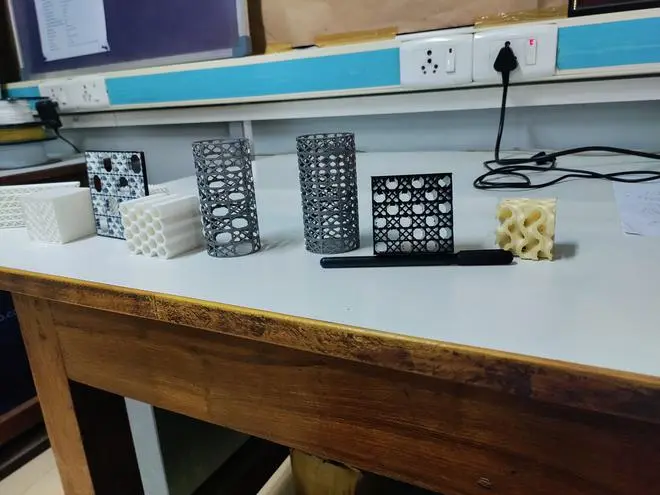
Sharma pulled out a sheaf of papers and made some drawings and scribbled some points. These became the feed material for 3D printers. Presently came an assortment of weird objects, some cylindrical, some cuboid, made of weirdly named polymers. He and Prof Hiremath tinkered with the cellular architecture, making some struts soft (with thermoplastic polyurethane) and others hard (with poly lactic acid). These are meant to impart the engineered material different properties such as energy absorption. These engineered materials are the basic building blocks that can eventually be adopted into automobiles, space, armoured vehicles, bio implants, and so on. “Our bio-inspired structures showed better energy absorption performance than the most commonly used foams and honeycombs for industrial applications,” says Sharma.  

“These structures can be incorporated in the aero-engine components to significantly reduce the weight, increase vibration absorption and for improved heat dissipation control,” Prof Hiremath told Quantum. 

Nature’s wonders

Well, this is an over-simplified description of Deepak Sharma’s work, which actually took years from start to finish, but the underlying theme is an evolving branch of engineering, called bio-inspired materials. (B L Zhou notes in his paper on bio-inspired study of structured materials, that the term “bio-inspired” may be better than the terms “bionic” or “biomimetic”, since the former is relatively easy to be accepted.)
Deepak Sharma holding a ‘Venus flower basket’ and a functional material

Deepak Sharma holding a ‘Venus flower basket’ and a functional material

The hard back of a beetle, the wings of a butterfly, the hairs of sea skaters, the natural spider silk—the list could be endless—all have messages for engineers to make new materials. The beautiful colours of butterflies come from their microstructure interacting with light. Spider silk, for example, has ultra-high tensile strength. In an article in Chemical Engineering Journal, a group of Chinese scientists says how they copied the “nanoconfinement effect of hydrogen-bonded crystalline β-sheets on the soft amorphous protein matrix” and used the same nature’s trick to create similar material with soy proteins and tannic acid, an inexpensive plant-derived polyphenol. 

Another student-researcher in Prof Hiremath’s lab, Priya Ranjan, has drawn inspiration from the rather peculiar, crescent-shaped structures on the insides of a pitcher plant — a plant with pitchers into which insects fall and are duly digested — to give a better surface texture to the cutting edges of machine tools. Ranjan has been able to arrive at the exact dimensions of the ‘crescents’ etched on the machine tools that would give the best results. Surface texturing is altering the topography of the cutting tool’s surface by micro-etching different geometrical patterns on it — the geometrical texture generation enhances the tribological characteristics (friction, lubrication and wear) of the interfaces between the tools and the workpiece.  

Copying nature

‘Bio-inspired materials’, as a science, is not really new, but is gathering momentum, as researchers are seeing that there is so much to learn from nature, to partake of the knowledge accumulated by nature, by its own trial and error, over billions of years. But what happened to accelerate research now? One reason, scientists say, 3D printing. Earlier scientists didn’t know how to copy nature, but with 3D printing, you can make anything, no matter how complex the structure. 

It is not clear as to how much the bio-inspired materials have made their way to the industry, because the distinction between bio-inspired materials and others is not sharp. Some cellular structural materials, such as those of honeycomb structures, are well in use in the industry. But it is safe to say that what has seeped into the portals of the industry is practically nothing compared with what is available. 



Source link

Dealing with drug-resistant pathogens 

Dealing with drug-resistant pathogens 


Disease-causing microbes such as bacteria and viruses developing resistance to the drugs that are meant to kill them is a global, growing health issue. In time, it could dwarf the Covid-19 pandemic in its ability to destroy lives. In a 2015 publication called Global Action Plan on antimicrobial resistance, the World Health Organization gave a stern warning: the world is heading towards a post-antibiotic era in which common infections could once again kill.

 The problem is getting worse because of hospital-acquired infections. And, global warming is known to increase the spread of infectious diseases. 

The conundrum is this: pathogens develop drug resistance and we need to find newer drugs against which they have no defence. But pharma companies are not investing in anti-infectives research because the returns are low. The problem appears to be intractable, but some pathways to deal with them are emerging. 

The first, of course, is to develop newer drugs, or newer classes of drugs.  One good candidate is antimicrobial peptide (AMP), which are peptides that attach themselves to the body of the pathogen and prevent it from entering our cells (See Quantum dated January 9).  

Another drug candidate is ‘bacteriophages’. These are viruses that get into the bacteria and lyse them — break them open inside-out. Bacteriophage therapy has great potential as an alternative to antimicrobials. “Optimal conditions of phage use, including their concentration, the time and sequence of administration and their combination with the appropriate antibiotics, are likely to establish the effectiveness and reliability of this medicine,” says a 2021 scientific paper published in Pharmaceuticals.  

Dr Subramanian Swaminathan, Director, Infectious Diseases, Gleneagles Global Health City, Chennai, tells Quantum that phage therapy is very old, which was given up in the 1940s after antibiotics burst upon the medical scene. Each bacterium has a phage enemy, so you first need to find out which bacterium is causing the disease in order to bring the matching enemy to kill it. This meant need for very personalised treatment. On the other hand, antibiotics could act on a range of bacteria. Thus, in came antibiotics; phage therapy was shelved. But now, the phages are coming back, because “we are running out of antibiotics”, notes Swaminathan. “We are now developing infections which are almost impossible to treat”.  

Out of sheer desperation the world is turning to phages. However, phages have their own ethical and safety considerations. “While it has been tried and tested, it may not be a long-term solution as bacteria can evolve resistance to bacteriophages too,” notes Dr Shankar Manoharan of the Department of Bioscience and Bioengineering, IIT Jodhpur. Also, clinical trials of bacteriophage therapy of bacterial infections are still at an early stage. However, a lot of research is taking place at a frenetic pace in research laboratories. 

Deeper approach 

While finding newer medicines that kill drug-resistant pathogens is one approach to fight AMR, researchers are also looking for a solution at a deeper level. They are trying to figure out how the pathogens are developing resistance, so that the pathways could be blocked. 

For instance, Dr Manoharan’s lab is working on a hospital-associated pathogen, Klebsiella pneumoniae. ( K.pneumoniae is one of the six ‘problem’ microorganisms grouped under the acronym ESKAPE, for Enterococcus faecium, Staphylococcus aureus, Klebsiella pneumoniae, Acinetobacter baumannii, Pseudomonas aeruginosa and Enterobacter bacteria.) 

In collaboration with AIIMS, Jodhpur, Manoharan is working on genome sequencing of highly drug-resistant clinical isolates of K.pneumoniae “to understand the mechanisms behind the resistance.”  

Similarly, Dr Sandhya Ganesan, a researcher at the Indian Institute of Science Education and Research (IISER), Trivandrum, is working on understanding ‘host-pathogen interaction’. Some pathogens enter a host (our) cell and disarm the immune system by secreting certain proteins. A better understanding of this mechanism would help in stopping it. Ganesan aims to use bacterial pathogens to “understand fundamental principles of cell-intrinsic defence and immune dysregulation that drive pathogenesis.” The goal is to identify common and distinct themes in host defence using various infectious disease models. 

Ganesan’s work falls broadly under the theme ‘host-based therapies’. It involves the use of ‘interferon signalling pathways’, she told Quantum. Interferons are a type of protein released by our cells when a virus enters the cell’s vicinity and are a part of the ‘cytokine family’. Essentially, Ganesan’s work takes the same approach as vaccines — teaching the body to develop an arsenal and be ready for an attack. 

Yet, another approach is to go further deeper and prevent AMR. These include technologies that can differentiate between viral and bacterial infections, limiting the unnecessary prescription of antibiotics, notes Manoharan. Yet another strategy is for proper disposal of antibiotics and antibiotic-contaminated material, to prevent environmental contamination and the emergence of AMR. 

Thus, there are plenty of options bubbling in lab beakers; one or more of them should work. But the fundamental question is, how to get the pharma industry interested in antimicrobials. “Bioprospecting antibiotics is difficult, expensive and takes time,” says Manoharan, pointing out that the industry would step in only when it sees promise. “Research into antimicrobials by a few pharma companies is not going to help us in the long run,” feels Manoharan. “We need to amplify the search for new antimicrobials by several-fold.” He believes the way to do that is the method adopted by TinyEarth, which gets thousands of students to study local soil microbes, identify pathogen-inhibiting isolates, share the samples for genomic analysis and then identify antibiotic compounds to combat the “resistance crisis”. In other words, a mass movement. 

Govt concerned 

The government of India is aware and concerned. A National Action Plan on containment of Antimicrobial Resistance (NAP-AMR) has been on since April 2017, under which an AMR Surveillance Network, comprising 30 tertiary care hospitals, has been set up “to generate evidence and capture trends and patterns of drug-resistant infections in the country.”  

The government has been coming out periodically with calls for proposals for tackling various aspects of the problem. One such call, for developing rapid diagnostics, just closed last month. India too is getting ready for a long battle of attrition with the doughty microbes. 


Source link

Manipulating perception with camouflage

Manipulating perception with camouflage


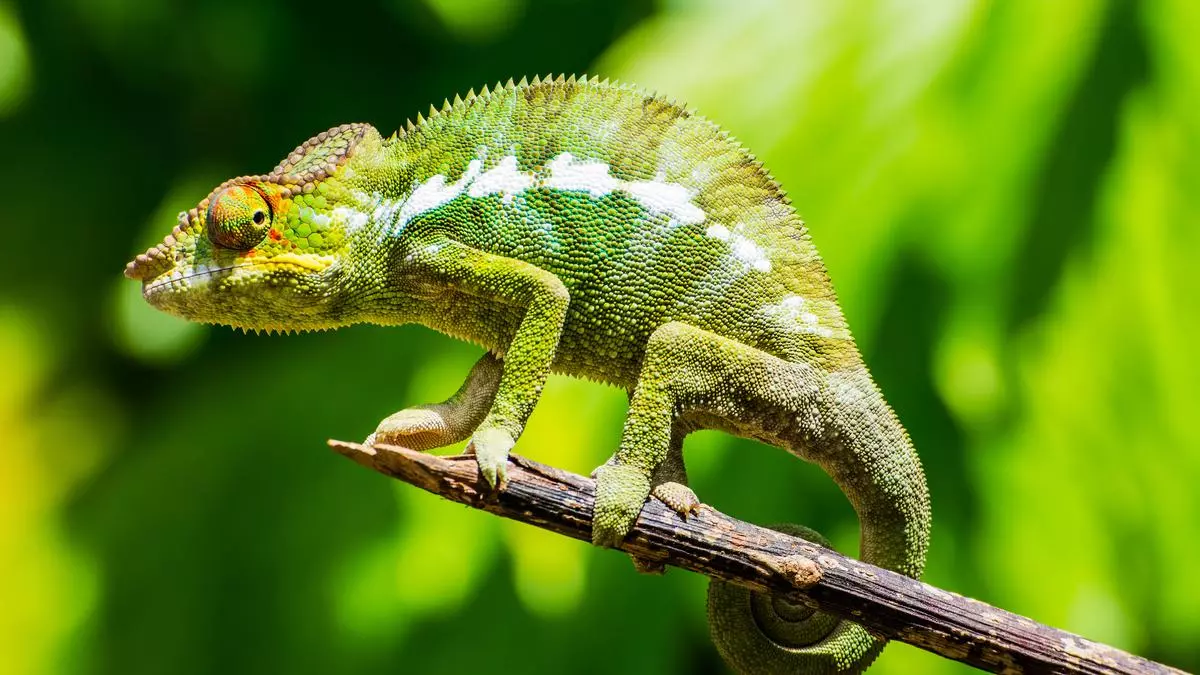
Chameleons are able to change their colour to perfectly blend with the surroundings and thereby hide themselves. How nice would it be, if we could do that too!

Well, you can. The Fraunhofer Institute of Optronics, Systems Technologies and Image Exploitation, has come up with a camouflage clothing that adapts to the environment on its own — you don’t need to do anything to adjust. Sensors embedded in the clothing measure the ambient brightness and predominant colours and transmit the information to intelligently controlled LEDs that are also integrated into the clothing. Then, these LEDs emit light in the appropriate colour and level of brightness, allowing the wearer of the cloth to blend with the background.

Now that such clothing is ready, the institute is taking the experiment forward, trying to develop textiles that can deceive thermal imaging cameras. The institute’s mission is to “manipulate perception”.

The institute’s intentions are noble. The camouflage clothing is meant for soldiers. It says it is currently experimenting with a broad range of new tech­nologies “to enhance protection for our soldiers.” But who knows where it will end up? Taliban or Al Qaeda would love to have it, won’t they?


Source link

How ISM variability led to more showers in the Bay

How ISM variability led to more showers in the Bay


Regions surrounding northern Bay of Bengal (BoB) received higher precipitation than the other parts of India for the last 10,200 years, says a new study that traced the dynamics of Indian Summer Monsoon Rainfall (ISMR) over 10,000 years – a period which witnessed the development and fall of numerous ancient civilisations around the world, many of which were associated with climate instability. “The study can help us understand long-term trends of climate change impacts on the ecosystems and may help mitigate future climate extremities,” says a press release from the Department of Science and Technology, Government of India.

Agriculture in India is heavily dependent on the Indian Summer Monsoon rains (ISMR). The Bengal Basin located at the trajectory of the Bay of Bengal (BoB) branch of the ISM is very sensitive to changes in the ISM strength. Even a minor change in ISM strength may have adverse effects on the agrarian-based socio-economic conditions of the region. However, no systematic long-term record (beyond the range of instrumental period) for the past ISM variability in the region was available.

Birbal Sahni Institute of Paleosciences, Lucknow, reconstructed the history of the ISM variability from this region by using both biotic and abiotic proxies that predates instrumental records (records taken before 19th century). The researchers show that a heavy ISMR was witnessed between 10,200 years and 5,600 years ago by this region, but the ISMR decreased 4,300 years ago. The ISM got strengthened again between 3,700 and 2,100 years following which it switched to a drier mode for a while. The ISM regained its strength some 200 to 100 years ago. Of the weakened phases, the one that occured around 4,300 years back was the most severe one, and had adverse impact of the ecosystem, the study reveals.

Scientists have collected sediment samples from the bed of a dried lake in the northern part of the Bengal Basin. Standard techniques were followed for building the age-depth model of sedimentary sequence and measuring different palaeo-climatological parameters. They also compared the proxy-based results with a few outputs from the palaeo modelling experiments for different time spans to validate the results of this study. The numerical models provided insights into the spatial-temporal dimensions of climate change and helped analyse the dynamic relations between different climatic components under specific boundary conditions. Combining these datasets, they investigated the timing, regional coherence and causes of Holocene ISM variability in the Bengal region.

They explored the drivers influencing the variability of the monsoon in the Indian part of the Bengal Basin and found that while the millennial-scale variations in the ISM rainfall may largely be attributed to changes in solar insolation and dynamics of inter-tropical convergence zone (ITCZ — an area where the northeast and the southeast trade winds converge), the centennial scale variations may be collectively triggered by phenomena like North Atlantic Oscillation, El Nino Southern Oscillation and Indian Ocean Dipole.

Focusing on monsoonal variability in the Indian part of the Bengal Basin, the scientists combined both biotic (phytoliths, NPPs and stable carbon isotopes) and abiotic (environmental magnetic parameters, and grain size data) proxy data to understand the ecosystem response to past hydroclimatic changes. They inferred that changes in lake ecosystem were strongly influenced by the ISM rainfall.


Source link

YouTube
Instagram
WhatsApp