Airtel introduces AI system to warn users of OTP frauds: How it works

Airtel introduces AI system to warn users of OTP frauds: How it works


Telecom operator Airtel has launched a new AI-based security system to help protect customers from bank fraud linked to OTP scams. According to the company, the solution operates at the network level and sends real-time alerts if it detects a potentially risky situation during a phone call. The company said that the aim is to stop users from sharing sensitive banking OTPs with fraudsters while they are still on the call.


The feature is part of Airtel’s wider efforts to curb spam and fraud on its network and strengthen protection against digital scams. The AI-based security system is currently active in Haryana, and Airtel plans to roll it out to all customers across the country within the next two weeks.


Airtel’s AI-powered protection from fraud: How it works


How OTP scams work


Airtel said that fraud related to One-Time Passwords (OTPs) has become increasingly common. Scammers often create a sense of urgency by pretending to be delivery agents, bank officials or service providers. They convince customers that an OTP is needed to complete a simple task, such as receiving a parcel or resolving an issue.


In reality, the OTP is linked to a banking transaction. Once the customer shares it, fraudsters can misuse it to withdraw money or complete unauthorised payments. 


How Airtel’s new AI fraud alert works


Airtel’s new system uses artificial intelligence to identify risky situations during incoming calls. If a bank OTP is triggered while a user is on a potentially suspicious call, the system detects it in real time.


At that moment, Airtel sends a fraud alert to the customer, warning them about the risk of sharing the OTP while still connected to the caller. The alert encourages users to pause and verify before giving consent for any banking-related OTP delivery.


According to Airtel, the idea is to give customers extra time to think and avoid reacting under pressure by combining AI-based detection with user awareness. With this, the service provider aims to reduce the chances of OTP-related bank fraud.


Part of an anti-spam push

Airtel mentioned that the launch of this AI-powered fraud alert is part of Airtel’s ongoing efforts to make its network safer. With OTP scams rising across the country, telecom-level intervention could help prevent fraud before money is lost. The company said the system works in real time and is designed to add an extra layer of protection for customers during suspicious calls. 


The company said that over the past two years, Airtel has introduced several AI-based safety measures, including spam call alerts and blocking of malicious links, to prevent fraud at the network level. 


Source link

India AI Summit: Sarvam AI, 11 other startups building indigenous LLMs

India AI Summit: Sarvam AI, 11 other startups building indigenous LLMs


The India AI Impact Summit, scheduled to begin on February 16 in New Delhi, will bring together stakeholders from India and abroad to discuss developments in artificial intelligence. On the domestic front, attention is expected to centre on 12 Indian startups selected under the IndiaAI Mission to build indigenous foundation models trained on Indian languages and datasets. These companies are working on large language models (LLMs) and multimodal systems designed to address local linguistic, sectoral and governance requirements. The startups involved are as follows:


Sarvam AI


Sarvam AI is developing large language models tailored for Indian languages and contexts. Its work spans multilingual reasoning, voice-based applications and productivity tools for enterprises and public services. Under the IndiaAI Mission, the company is building a sovereign foundation model capable of tasks such as text generation, translation and conversational interfaces across Indian languages.


Soket AI


Soket AI Labs is working on open-source, large-scale AI models optimised for India’s linguistic diversity. The company is focusing on multilingual and multimodal foundation models aimed at use in sectors such as defence, healthcare and education, with support for more than 22 Indian languages.


Gnani AI


Gnani AI is developing a voice-first foundation model focused on multilingual speech processing and real-time voice interactions. The model is designed for low-latency, speech-to-speech communication and is intended for applications in customer support, education, accessibility and public-facing systems.


Gan AI


Gan AI is building a multilingual model with a focus on advanced text-to-speech capabilities. The company aims to deliver voice synthesis quality comparable to leading global systems, supporting use-cases such as audiobooks, voice assistants, content creation and media localisation in Indian languages.


Avaatar AI


Avaatar AI is working on domain-specific AI avatars designed for Indian use-cases. These models can be fine-tuned for sectors such as agriculture, healthcare and governance, supporting applications ranging from crop advisories and patient assistance to public grievance and query response systems.


BharatGen (IIT Bombay-led consortium)


BharatGen is a consortium led by the Indian Institute of Technology Bombay that is developing multilingual and multimodal foundation models of varying scales. These models are intended for applications across agriculture, legal services, education, financial services and healthcare, using datasets that reflect Indian languages and cultural contexts.


Zenteiq


Zenteiq is developing a multimodal foundation model named BrahmAI, focused on engineering intelligence and scientific computing. The model is designed to support technical simulations, optimisation problems and scientific research, with applications in deep-tech and engineering-led innovation.


Gen Loop


Gen Loop is building a suite of lightweight language models supporting all 22 scheduled Indian languages. The portfolio includes a base model, an instruction-tuned model and a moderation model, aimed at efficiency and safety for use in education, social platforms and enterprise applications.


Intellihealth (NeuroDX)


Intellihealth, operating under NeuroDX, is developing an AI model for EEG signal analysis. The initiative focuses on early detection of neurological conditions and advancing research in affordable brain–computer interfaces, with potential applications in clinical diagnostics and healthcare delivery.


Shodh AI


Shodh AI is working on an AI system to support material discovery by integrating artificial intelligence into laboratory workflows. The model is intended to assist in identifying new materials, including advanced alloys and battery components, by automating experimental design and analysis.


Fractal Analytics


Fractal Analytics is building what it describes as India’s first large reasoning model. The system focuses on structured reasoning and domain expertise, particularly in science, technology, engineering and mathematics, with applications in medical diagnostics, analytics and complex problem-solving.


Tech Mahindra Maker’s Lab


Tech Mahindra’s Maker’s Lab is developing a foundation model optimised for Indic languages and dialects, alongside an agentic AI platform for government and enterprise use. The initiative aims to support translation, administrative automation and e-governance workflows.


Source link

Google expands Gemini-powered 'Fitbit Coach' to more regions: What is it

Google expands Gemini-powered 'Fitbit Coach' to more regions: What is it


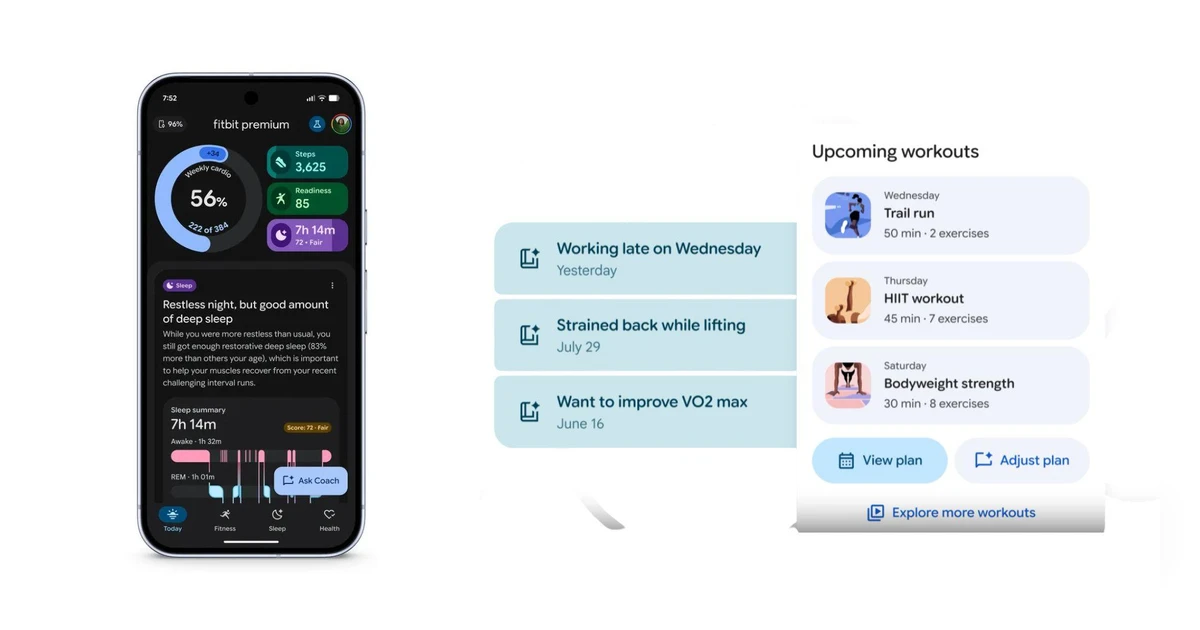
Google is rolling out its Gemini-powered Fitbit Coach to more countries, extending access beyond the US. The AI-driven health coaching tool, first introduced in public preview in October, provides personalised workout plans, sleep insights, and recovery suggestions based on user data. Along with the regional expansion, the Public Preview is also being extended to iOS users, allowing more Fitbit Premium subscribers to access the feature through the redesigned Fitbit app.


Fitbit Coach: Availability

According to Google, Fitbit Coach is now rolling out to Premium subscribers in UK, Canada, Australia, New Zealand, and Singapore. The coach is currently available in English and requires a Fitbit Premium subscription. The current Public Preview will also expand to iOS users in these countries, including the US. 


Fitbit Coach: What is it


Google introduced the AI-based Fitbit health coach at its Made by Google event in August, 2025. The tool acts as a fitness trainer, sleep coach, and wellness advisor. It uses user health data to provide personalised guidance based on individual goals and activity levels. The preview version became available in October, 2025 within the redesigned Fitbit app on supported Fitbit trackers, smartwatches, and Pixel Watches. It offers the below mentioned features:


Personalised training and fitness goals

The health coach offers personalised training by creating workout routines based on a user’s fitness goals, preferences, and available equipment. It also adjusts training schedules automatically using real-time data, such as suggesting lighter sessions after a poor night’s sleep. Users can check in at any time to log their progress, update how they feel, or request changes to their routine when needed. 


Smarter sleep and recovery insights


The updated system includes improved sleep tracking with a more detailed breakdown of sleep stages and duration. It also provides weekly insights that highlight patterns, such as trouble falling asleep or sleep disruptions due to travel. In addition, rest periods can adjust automatically, especially after intense workouts, to support recovery.


Wellness partner

The coach connects with data from Fitbit devices, Pixel Watch, Google Health Connect, and Apple HealthKit to provide a broader view of a user’s health. Users can ask whether they should rest, exercise, or manage stress, and receive advice based on their personal data. The app also identifies long-term trends to help users make more informed daily health decisions. 


Reimagined Fitbit experience


Google explained earlier that the Fitbit app has been redesigned with AI coaching at its core. The app now offers more intuitive layouts, improved syncing, and dark mode. Data visualisation has been simplified, making it easier to access key metrics.


The company has already mentioned that the new coach is “built on a foundation of science and expertise,” with guidance from Stephen Curry’s performance team and Google’s Consumer Health Advisory Panel, which includes medical, AI, and behavioural science experts.


Source link

AI Summit: Apps to models, India's AI stack for population-scale impact

AI Summit: Apps to models, India's AI stack for population-scale impact


As New Delhi prepares to host the India AI Impact Summit from February 16 to February 20, the country is positioning its artificial intelligence strategy around demonstrable, population-scale outcomes rather than broad policy dialogue. While earlier editions in the UK, South Korea and France emphasised safety frameworks and innovation principles, the 2026 edition from India will transition towards technology deployment and measurable societal impact.


This shift is also reflected in India’s AI stack journey. For the uninitiated, the AI stack refers to an end-to-end ecosystem spanning applications, models, compute, infrastructure and energy. Across each layer, the government and industry are pointing to operational deployments intended to extend AI benefits across sectors and regions, aiming to democratise AI for population-scale adoption.


AI applications moving from pilots to deployment


At the application layer, several use cases have moved beyond the pilot stage into sustained implementation.


In agriculture, AI-driven advisory tools are being used to guide sowing decisions, optimise input use and improve yields. State-level deployments in Andhra Pradesh and Maharashtra have reported productivity gains of up to 30 to 50 per cent, according to official notes.


Healthcare is another priority domain. AI tools are being deployed to support early detection of tuberculosis, cancer, neurological disorders and other conditions, strengthening preventive screening and diagnostic workflows within public health systems.


In education, the National Education Policy 2020 has incorporated AI literacy and applied learning through CBSE curricula, the DIKSHA digital platform and programmes such as YUVAi. The stated objective is to build foundational AI skills at scale rather than confining training to specialist institutions.


Judicial administration is also adopting AI-enabled systems. Under e-Courts Phase III, machine learning tools are being used for translation, case scheduling and workflow management, with an emphasis on improving access through vernacular languages.


Meanwhile, the India Meteorological Department is using AI for forecasting rainfall, cyclones, fog, lightning and wildfire risk. Tools such as Mausam GPT are designed to support farmers as well as disaster response agencies.


Indigenous AI models and language technologies


At the model layer, the IndiaAI Mission has extended support to develop 12 indigenous AI models targeting India-specific use cases. Startups are being offered subsidised compute access, with up to 25 per cent of compute costs offset through grants and equity participation.


The BharatGen initiative is working on India-focused foundation and multimodal models at scales ranging from billions to trillions of parameters. In parallel, IndiaAIKosh functions as a national repository for datasets, tools and models. As of December 2025, it hosts 5,722 datasets and 251 AI models contributed by 54 organisations across 20 sectors.


Language technologies remain a central priority. Bhashini, under the National Language Translation Mission, now hosts more than 350 AI models spanning speech recognition, translation, text-to-speech, optical character recognition and language detection.


Startups such as Sarvam AI are also developing large language and speech systems tailored to Indian linguistic diversity. Recently, the startup demonstrated its sovereign AI model-powered Sarvam Vision tool, which it claimed outperformed Google Gemini and ChatGPT in select but critical benchmarks related to document intelligence and speech systems.


Compute capacity and semiconductor ambitions


On compute, the IndiaAI Mission has an allocation exceeding ₹10,300 crore over five years. Its Compute Portal operates on a compute-as-a-service model, offering shared access to around 38,000 GPUs and 1,050 TPUs at subsidised rates intended to support startups and research institutions.


A separate secure national GPU cluster with 3,000 next-generation processors is under development for strategic and sovereign use cases.


Broader semiconductor ambitions are being pursued through the ₹76,000-crore India Semiconductor Mission, under which 10 projects covering fabrication and packaging have been approved. Indigenous processor programmes such as SHAKTI and VEGA are contributing to domestic capability in AI hardware.


The National Supercomputing Mission has already deployed more than 40 petaflops of computing capacity across IITs, IISERs and national laboratories. Systems including PARAM Siddhi-AI and AIRAWAT are supporting workloads such as natural language processing, weather modelling and drug discovery.


Digital infrastructure and data centre expansion


Underlying these capabilities is an expanding digital backbone. A nationwide optical fibre network supports high-speed data transfer, while 5G services are now available across all States and Union Territories, covering nearly all districts and roughly 85 per cent of the population.


India currently accounts for about 3 per cent of global data centre capacity, with installed capacity near 960 MW. Projections indicate expansion to 9.2 GW by 2030, driven by AI and cloud demand. Mumbai–Navi Mumbai remains the largest hub, followed by Bengaluru, Hyderabad, Chennai, Delhi NCR, Pune and Kolkata.


Global technology firms have also announced large investments. Microsoft has committed ₹1.5 lakh crore towards data centres and AI training initiatives, Amazon plans ₹2.9 lakh crore in cloud and AI-led infrastructure by 2030, and Google has outlined a ₹1.25 lakh crore investment for a 1 GW AI hub in Visakhapatnam.


Energy supply as a constraint and enabler


Power availability is increasingly being framed as a prerequisite for AI scale. India met a peak demand of 242.49 GW in FY 2025–26, with energy shortages reduced to 0.03 per cent. Total installed generation capacity stood at 509.7 GW as of November 2025, with non-fossil sources accounting for more than half.


Plans include 57 GW of pumped storage by 2031–32 and deployment of 43,220 MWh of battery energy storage to stabilise grids supporting data centres. The SHANTI Act further positions nuclear power — including small modular and micro-reactors — as a continuous, low-carbon energy source for compute-intensive infrastructure.




Source link

Samsung to launch Galaxy 26 series on Feb 25; pre-reserve now open in India

Samsung to launch Galaxy 26 series on Feb 25; pre-reserve now open in India


Samsung is hosting its first Galaxy Unpacked event of 2026 on February 25, where the South Korean electronics maker will unveil the Galaxy S26 series smartphones. Besides the smartphone, Samsung is expected to introduce the Galaxy Buds 4 series, which would likely feature the Galaxy Buds 4 and Galaxy Buds 4 Pro.


Samsung Galaxy Unpacked: When, where, and at what time


  • Date: February 25

  • Location: San Francisco

  • Time: 11:30 pm (IST)

  • Online livestream: Samsung Newsroom and Samsung YouTube channel


Samsung Galaxy Unpacked 2026: Pre-reservation


Samsung has started pre-reservations for its upcoming devices in India on the Samsung India Store. You can pay Rs 999 (refundable) to reserve, and those who pre-reserve will get an assured voucher worth Rs. 2699, noted the company on its web portal. Samsung mentions vouchers worth up to Rs 50,000 on pre-reservations.


Samsung Galaxy Unpacked 2026: What to expect


Samsung Galaxy S26 lineup is likely to include the Galaxy S26, Galaxy S26 Plus and Galaxy S26 Ultra. The company recently shared videos on Instagram offering a glimpse of what consumers can expect from its upcoming flagship smartphones. In addition to this, Samsung has previewed a new privacy display feature that will debut with its upcoming Galaxy smartphones. 


Galaxy S26 series


The recent teaser shared by the company focuses on one shared detail — the camera bump design. Samsung appears to be introducing a unified camera island across its 2026 flagship lineup. The teasers also highlight camera capabilities, beginning with the words “CLOSER,” “GROOVE,” and “GLOW.” The stretched spelling appears to hint at a triple-camera setup. The company has also teased the new built-in privacy layer for upcoming Galaxy phones that may replace traditional privacy screen protectors. 


In specific to the models, the Samsung Galaxy S26 Ultra is expected to be powered by the Qualcomm Snapdragon 8 Elite Gen 5 for Galaxy chipset and may feature a 200MP main camera, along with 50MP ultra-wide and 50MP telephoto cameras. The smartphone is feature a 5,000mAh battery.


The Galaxy S26 and Galaxy S26 Plus may be powered by either the Qualcomm Snapdragon 8 Elite Gen 5 or Samsung’s Exynos 2600 chipset, depending on the region. Both models are expected to feature a 50MP primary camera, a 12MP ultra-wide lens and a 12MP telephoto camera with 3x optical zoom and OIS.


The Galaxy S26 Plus could feature a 6.7-inch flat LTPO M14 AMOLED display with an adaptive 120Hz refresh rate, while the Galaxy S26 may come with a 6.3-inch display. Battery capacities are tipped at 4,900mAh for the Plus and 4,300mAh for the standard model, with Qi2 wireless charging support expected on both. 


Galaxy Buds 4 series


According to a previous report, in terms of design, the Samsung Galaxy Buds 4 series is expected to feature a curvier, more compact form while retaining the stem shape introduced with the Galaxy Buds 3 series. The Buds 4 Pro, in particular, is likely to drop the Blade Lights found on the Buds 3 Pro. This removal is expected to be countered with improved audio quality, aiming to offer a noticeable upgrade over the previous generation.


Samsung may have also revised the charging case for the new earbuds. Unlike the vertical design used on the Buds 3 Pro, the Buds 4 and Buds 4 Pro cases may sit flat, making it easier to open the case and remove or replace the earbuds.  


As per a report by GizmoChina, FCC filings indicate that the standard Galaxy Buds 4 will support both Bluetooth Classic and Bluetooth Low Energy, though the documents do not reveal finer details such as the Bluetooth version or battery capacity. For the uninitiated, Bluetooth Classic is used for continuous, high-data tasks such as music streaming, calls, and file transfers. Bluetooth Low Energy (BLE) is designed for low-power operations like syncing data, notifications, and background device communication.


Source link

AI Summit 2026: Here are the seven chakras guiding India's AI roadmap

AI Summit 2026: Here are the seven chakras guiding India's AI roadmap


Ahead of the India-AI Impact Summit 2026, India has outlined seven ‘chakras’ to shape global discussions on how artificial intelligence (AI) should be developed and used. These chakras act as thematic working groups that translate broad principles into real policy and on-ground action.


The summit will be held in New Delhi from February 16 to 20 and will be the first-ever global AI summit hosted in the Global South, underlining India’s growing role in global technology governance. The summit has drawn strong international interest. Around 15-20 heads of government, more than 50 international ministers and over 40 Indian and global CEOs are expected to attend.


How the seven chakras shape the summit’s agenda


The summit’s discussions are organised around seven interconnected chakras, each focusing on a key area where AI can drive social, economic and scientific change. These chakras convert the Summit’s guiding principles, known as ‘sutras’, into concrete areas of action across policy, innovation, and real-world applications.


Chakra 1: Human capital


This Chakra focuses on preparing people for an AI-driven future of work. It aims to promote fair skilling, inclusive workforce transitions and equal access to new opportunities created by AI.


Chakra 2: Inclusion for social empowerment


The focus here is on building AI systems that are inclusive by design. The goal is to empower diverse communities and ensure fair representation across societies.


Chakra 3: Safe and trusted AI


This chakra looks at building trust in AI. It seeks globally trusted systems based on transparency, accountability and shared safeguards that support responsible innovation.


Chakra 4: Science


This group explores how artificial intelligence can accelerate scientific research. It focuses on strengthening global scientific collaboration and turning breakthroughs into shared progress.


Chakra 5: Resilience, innovation and efficiency


The emphasis here is on sustainable AI systems. This includes energy-efficient technologies, responsible use of resources, and AI solutions that support climate resilience.


Chakra 6: Democratising AI resources


This chakra promotes fair access to foundational AI tools and infrastructure. The aim is to enable inclusive innovation and sustainable development.


Chakra 7: AI for Economic Development and Social Good


The final Chakra focuses on using AI to boost productivity, innovation, and inclusive growth across economies and societies.


Through these seven Chakras, India aims to influence global AI standards while addressing domestic challenges. The outcomes of the Summit are expected to guide policymakers, investors and industry leaders in the years ahead.


The three Sutras guiding the AI Impact vision


The Summit is anchored in three core principles, known as ‘sutras, which guide global cooperation on AI.


‘People’ focuses on human-centric AI that protects rights, builds trust, improves access to services and ensures benefits reach all sections of society.


‘Planet’ promotes environmentally sustainable AI through energy-efficient systems, responsible resource use and applications that support climate action.


‘Progress’ centres on inclusive economic and technological growth through innovation, capacity building and the use of AI to drive development outcomes.


Source link

YouTube
Instagram
WhatsApp