The fascinating world of metamaterials

The fascinating world of metamaterials


People turning invisible by cloaking themselves in a magic blanket has been the stuff of movies for long — from Indian classics like Maya Bazaar to global bestsellers like Harry Potter. But science is making such magic cloaks a reality.

The principle is simple enough, says Prof Prabhu Rajagopal of the department of mechanical engineering, IIT-Madras. You see me because light from the overhead bulb hits me, gets reflected and reaches your eye. But imagine if I were wearing a cloak that does not allow light to reflect off it and, instead, keeps the light swirling round and round within it until the light becomes heat and dies down — it never reaches your eye. I will be, literally, hidden in plain sight.

Likewise, imagine a device perched on a table in the middle of, say, a conference hall. It absorbs all the sound waves. No discussion is possible because all sounds are captured and absorbed by the device — only silence reigns in the room. Imagine a submarine fitted with such a device. It will never be detected!

Such engineered materials are called ‘metamaterials’, which derive their properties not from what they are made of but their structure.

Metamaterials were theoretically predicted in the late 1960s by a Soviet scientist named Victor Vaselago, who imagined materials of ‘negative refractive index’ — light passing through them will bend backwards. Decades later, in the 1990s, British scientist Sir John Pendry of Imperial College, London, demonstrated a cloak that could make objects invisible, first under microwaves and then, more recently, under visible light, though only if the object was static. Since then, scientists have been working on metamaterials in labs all over the world. There are many such materials in existence today, though mainly in labs; while the technology is not mature yet for commercial applications, it is getting there fast.

The engineering trick

Dr Rajagopal, who has done extensive work on ultrasonic metamaterials, believes it is just a matter of 2-3 years before metamaterials become industry-ready.

The website metamaterial.com notes that metamaterials are functional materials that are made with conventional material such as metals and plastics — they are engineered in a manner that imparts them with special properties. The properties do not come from the base material (metals or plastics), but from the special engineered structure. As such, they are “complex structures patterned in ways that perform a special function, such as blocking light or a specific colour of light or invisibly heating a window in a car,” the website says. The engineering of the material manipulates light, heat or electromagnetic ways in unusual ways.

The precise shape, geometry, size, orientation and arrangement of micro or nanoscaled features impart special electromagnetic or acoustic (ultrasonic) properties to these materials. Scientists give many examples. For instance, a surface coated with engineered gold nanoparticles would appear blue or red under light, rather than yellow, as you would expect. Note that the composition of gold has not changed. Similarly, scientists speak of the possibility of super-lenses that enable you to see objects as small as 200 nanometres (a nanometre is a billionth of a metre).

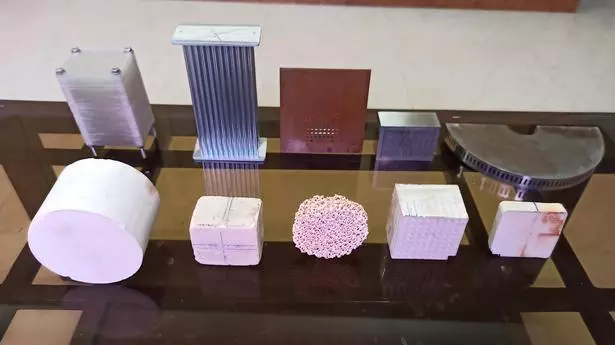
Here is an example of how a metamaterial is ‘engineered’. Among several metamaterials sitting on Rajagopal’s table is a junked 3D-printed part of a catalytic converter. It is a ceramic cylinder, about 8 inches long, whose inside contains about a hundred tiny tubes that are less than a millimetre in diameter. Sound from one end travels to the other through one of the tiny tubes, gets reflected and travels back down the tube only to meet an incoming wave. The two waves, being of the same frequency, merge to become a larger wave, due to ‘constructive interference’. This happens repeatedly and the waves keep growing in amplitude.

Imagine using this principle in an ultrasound instrument. Ultrasound imaging uses sound waves of very short wavelengths and correspondingly high frequencies of 20 kilohertz and above. The waves are bounced off a target (imaged) object and the reflected waves tell us more about the object. With metamaterials, it is possible to image very tiny objects — such as a hairline crack in a pipeline. Just as a lens shows an object bigger than it is, this metalens, when used in ultrasound imaging, ‘magnifies’ the target object.

Applications of the future

Rajagopal showed Quantum a metalens, a device that was nothing more than a bunch of straws used to sip coconut water. “We have always focused on technologies that are scalable and translatable to the field; we are studying concepts that are cost-effective and also easily fabricated,” Rajagopal said.

It is generally accepted in acoustic science that you cannot image an object that is smaller than half the wavelength of the sound wave. However, Rajagopal’s metalens can image objects as small as one-thirty-sixth of the ultrasound wave — the finest resolution reported anywhere in the world.

Rajagopal’s lab has produced an assortment of metamaterials. Hyperlens is one of these, where ultrasound waves enter channels that progressively get broader. Again, this special structure helps in securing a better picture of an imaged object. Rajagopal has also come up with a seismic metamaterial trick to protect buildings or sensitive equipment from earthquakes — a designer metal rod embedded in an autoclaved brick. This can absorb seismic waves. Yet another of Rajagopal’s metamaterial inventions is a device that can focus sound waves on to a point, say, a tiny object. Just as it happens with a lens under light, these sound waves converge on the point, get converted to heat, destroying the object. Such devices can be used to kill cancer cells in a tumour.

Thus, from ‘holey’ materials that can bend waves around a target, to ridges or baffles on a rod that can act as a mechanical filter to damp out or enhance target frequencies of sound, to combinations of materials that could yield extraordinary transmission and focusing of waves in a target media, metamaterials offer “thrilling possibilities” for applications. Rajagopal envisions the use of metamaterials in energy harvesting and quantum computing, for which he was awarded the Government of India’s prestigious Swarnajayanti Fellowship in 2020.

“A completely new type of sensors and devices for applications such as sensing and computing is emerging from phonon-photon coupling, mediated by metamaterials,” he says.

Published on

August 07, 2022


Source link

Eco-friendly food packaging doubles as quality sensor

Eco-friendly food packaging doubles as quality sensor


Scientists at the Institute of Advanced Study in Science and Technology (IASST), led by Prof Devasish Chowdhury of the physical sciences division and his student Sazzadur Rahman, an INSPIRE senior research fellow, have developed a smart biodegradable biopolymer nanocomposite that can detect relative humidity — an invention that is useful in food packaging.

Two biopolymers, guar gum (a variety of beans) and alginate (obtained from brown algae), were blended with carbon dots (nanomaterial) to make a nanocomposite film that was successfully used to detect relative humidity. The smart sensor is based on the fluorescence ‘on-off’ mechanisms against humidity.

The food industry has an increasing need for non-toxic, biodegradable, low-cost, and environment-friendly packaging material to replace petroleum-based material like plastics. Besides, it needs smart and active packaging material to detect and report food quality in real time. Such smart and active packaging systems respond to signals while interacting with the food packaging environment. Perishable packed foods are easily damaged by changes in relative humidity.

The nanocomposite film shows a change in fluorescence in the presence of high humidity. Hence, the fabricated nanocomposite film can monitor the packed food’s freshness using just a UV light source. “Smart and active packaging can help consumers select a fresh product without breaking the pack. Such innovative packaging boosts sales and reduces consumers’ time in identifying fresh food products,” said Chowdhury.

Polyaniline-powered supercapacitors

Supercapacitors or ultracapacitors are energy storage devices; they combine the characteristics of conventional capacitors and batteries to give a sudden kick-start to devices by providing a large amount of power and sustained energy release. A new low-cost, pristine, conducting polymer-based electrode and redox-active electrolyte combination can give enhanced electrochemical performance and cycling stability to supercapacitors, facilitating energy storage and powering in wearable integrated devices.

The electrode materials play a vital role in determining the performance and stability of supercapacitors. Conducting polymers like polyaniline and polypyrrole are excellent candidates for electrode materials due to their flexibility, stability and tunable electrical and electrochemical properties. They are also inexpensive, lightweight and can be synthesised easily. However, supercapacitors fabricated with these electrodes fail to sustain their electrochemical capacitance (ability to store electric charge) after a few cycles of continuous operation. The poor energy density of these devices is another issue that limits their usefulness.

The Materials for Energy Storage and Optoelectronic Devices Group, headed by Dr Sreekanth J Varma of the physics department of Sanatana Dharma College, Alappuzha, has found a means to improve the performance of polyaniline-based supercapacitors and achieve high specific capacitance per unit area, or areal capacitance, and prolonged life. They found that when electrodes made from pristine, porous, conducting and high molecular-weight polyaniline, synthesised through self-stabilised polymerisation (SSDP), are used with an electrolyte powered by a redox-additive (which boosts redox reactions), the energy storage devices deliver incredible performance.

The conducting polymer-based electrode is lightweight and highly stable. The supercapacitors’ enhanced performance and long life are attributed to the binder-free nature, porosity, high and homogeneous molecular weight, and appreciable conductivity of the electrode material, as also the electrode and redox-activated electrolyte combination.

Germ-killer concoction

Over time, air filters become a part of the problem they are supposed to solve, by becoming breeding grounds for microbes. Dr Suryasarthi Bose, associate professor in the department of materials engineering at Indian Institute of Science, Bengaluru, has come up with a concoction that kills the germs in filters.

The plant-based biopolymer, when coated on filters, leads to the formation of hydrogen peroxide, which ruptures the germs. The ability of the coated filters to deactivate germs has been successfully validated at government labs like NABL and they are in use at several hospitals and other organisations in India.

AiRTH, a start-up that was involved in the development of the product, has taken up the manufacture of this biopolymer. “The germ-destroying filters will decrease the burden on the healthcare system, and (help) re-open commercial spaces like offices with confidence and have a safe working environment,” says Ravi Kaushik, CEO, AiRTH.

Therapeutic protein and milk

Therapeutic proteins (TP) have a great role in counteracting diseases like diabetes, arthritis, blood clotting, and several others. However, the exorbitant cost of producing TPs has placed them beyond the reach of the common masses. Insulin, alpha and gamma interferons, blood coagulation factors, and so on, are some of the most important marketable products. Milk-based expression of these therapeutics in livestock animals has the potential to make them affordable.

The National Institute of Animal Biotechnology, Hyderabad, has used mice and rabbits to develop a technology for generating these costly therapeutic proteins in milk. This would reduce the need to import such therapeutics, according to NIAB.

Anti-corrosion coating

Scientists at the International Advanced Research Centre for Powder Metallurgy & New Materials (ARCI), Hyderabad, have developed low-cost iron-based intermetallic powders that can be used as a corrosion-resistant coating for materials exposed to harsher environments like high temperature in thermal power plants, where oxidation, corrosion, and wear-and-tear take place simultaneously.

There is a need to protect the component surface from wear-and-tear using a suitable material for enhanced economic viability.

Such surface coating on a turbine blade can enhance the service life and hence increase the operation hours of the turbine. ARCI scientists have addressed wear-and-tear by synthesising iron-based intermetallic powders and depositing them on the surface using the detonation spray coating (DSC) technique.

Additionally, ARCI has developed gas-atomised iron aluminide powder and used DSC to deposit it on mild steel substrates without any cracks or spalling. The coatings have demonstrated four times increased corrosion resistance in aqueous corrosive media than mild steel.

Published on

August 07, 2022


Source link

Researchers zero in on a special type of RNA to combat cancer

Researchers zero in on a special type of RNA to combat cancer


A certain type of RNA (ribonucleic acid, which is present in our body cells and regulates how genes produce various proteins) is being looked at closely for a cancer cure.

Among the several types of RNAs, the micro-RNA, or miRNA, influences how genes make proteins. In other words, miRNA can kill a cell or help it proliferate. (miRNA is different from mRNA, or messenger RNA, which has been in the news recently as a coronavirus vaccine.)

“Altering miRNA levels in cancer cells has promising potential as a therapeutic intervention,” says a 2020 paper published in the National Library of Medicine of the US government.

So, the miRNA has created a buzz among medical biotechnologists for its cancer fighting role. It works for sure, but there are hurdles, such as stability and how to deliver it into the body.

There is ongoing research to find out which miRNA works best for which type of cancer, how to make it and how to deliver it into the body. This approach to cancer therapy gains even more importance when compared with conventional cancer therapies such as chemo, radiation and surgery, which end up killing the good cells of the body, too.

Now, researchers from two institutions in Chennai have reported a breakthrough. Prof Karunagaran Devarajan of the department of biotechnology, IIT-Madras, and Dr Sandhya Sundaram, pathologist, and Dr Ganesh Venkatraman of the department of human genetics, faculty of biomedical sciences, at Sri Ramachandra Medical College and Research Institute, have reported successfully using a particular miRNA for treating breast cancer.

How it works

As in any cell, the cell wall (membrane) of the cancerous cell is made up of lipids (fatty acids) and proteins.

The lipids are prone to get oxidised (like iron rusting), which is bad; but there is a defence mechanism — anti-oxidants — in the cell that prevents lipids from oxidising.

But if iron accumulates within the cell, the anti-oxidants are busy neutralising the iron, leaving the lipids of the cell walls defenceless.

A protein called SLC7A11 prevents iron from accumulating in the cell. Like other proteins, it is produced by genes.

RNAs in the cell regulate gene expression — the process by which genes make copies of proteins. The micro-RNA miR-5096 “down-regulates” or lowers the production of the SLC7A11 protein.

With not enough SLC7A11, iron accumulates within the cell, which exhausts the defending capacity of the anti-oxidants, leaving the lipids in the cell walls open to external oxidisation (lipid peroxidisation). The lipids “rust away”, the cell wall collapses, and the cancer cell dies. This method of killing a cell is called ferroptosis.

In this cancer, especially among Indian women, a protein called SLC7A11 gets over-produced in the cancer cells. The traditional way of treating this is to use drugs such as sulfasalazine to inhibit the production of this protein. In the latest development, the researchers have identified an miRNA, called miR-5096, as the one that is effective against breast cancer.

miR-5096 was found to induce cell death by suppressing the SLC7A11 protein. “This is the first time miR-5096 has been studied and used to target SLC7A11 in breast cancer cells. The cell death occurs by a process known as ferroptosis,” says an article on the IIT-M website.

Ferroptosis is a way of killing cells (programmed cell death) that was discovered a decade ago, where cells die when iron accumulates inside them. Now, iron means rust, and the anti-oxidants in the body fight this rust. This way, the accumulated iron uses up all the anti-oxidants in the cell, leaving the cell membrane defenceless against the oxidation that happens naturally. Cell membranes are made up of lipids and proteins. The lipids get oxidised (called lipid peroxidation) and the cell membrane collapses, killing the cell.

The researchers demonstrated that miR-5096 targets and inhibits the production of the protein SLC7A11. This protein protects the cell from ferroptosis. When the miR-5096 inhibits the production of the protein, it leads to a pile-up of iron in the cells, ferroptosis, and, eventually, cell death. “The results of the study prove that miR-5096 can effectively kill breast cancer cells,” says IIT-M, adding that they highlight the therapeutic potential of ferroptosis in breast cancer.

Dr Sundaram told Quantum that breast cancer was chosen to test the efficacy of miR-5096 because “this is the commonest form of cancer that I diagnose in my routine practice… the effectiveness in other cancer models has not been tested but further research may yield interesting results”.

She said that to target SLC7A11, which protects breast cancer cells from ferroptotic cell death, “we used bio-informatic target prediction tools like TargetScan, miR-WALK, and got an indication that miR-5096 might target the protein SLC7A11”. The micro-RNA is present in human cells and can be replicated in a lab, she said.

Currently, micro-RNAs have gone into pre-clinical trials; scientists are working with cancer in animals, but that disease is not an exact replica of the human disease, Dr Sundaram said. Further, cancer cells also use several pathological mechanisms to sustain, proliferate and evade treatments, she observed. However, the miR-5096 is a breakthrough; with validation in clinical trials, it can turn out to be an effective cancer cure.

Published on

August 07, 2022


Source link

YouTube
Instagram
WhatsApp




