Outside the rarefied world of agri-business, not many may have heard of Olam Group. Nevertheless, headquartered in Singapore and majority owned by Temasek, it is a global behemoth with revenues exceeding $50 billion. It is one of the world’s major suppliers of food and industrial raw material, with operations in more than 60 countries.
In April, Wipro, India’s fourth-largest IT services company by revenue, secured a massive eight-year, $1 billion-plus strategic transformation deal from Olam. Wipro will deliver end-to-end transformation services using its AI-powered suite, Wipro Intelligence, across Olam’s ‘farm-to-fork’ value chain — farming, forecasting, trading, supply chain operations, and customer engagement.
This deal is not unusual.
The Indian IT services industry currently faces its biggest structural shift, driven by AI. It is changing not just the nature of services firms deliver, but also how they price projects, hire talent, structure teams, and compete globally. As Venu Lambu, CEO and MD of LTM, says, AI is fundamentally reshaping the industry.
At Wipro, for instance, during the company’s Q4 earnings conference call, CEO and MD Srini Pallia highlighted a strategic pivot: “We have launched a dedicated AI-native business and platforms unit to expand beyond a services-only model to a services-as-a-software approach. This unit will operate with dedicated leadership, focused investments, and a distinct operating model to accelerate enterprise-grade agentic AI solutions.
“Together with core services, this creates a dual-engine model, driving transformation at scale while building AI-native platforms that differentiate services, enable repeatable deployments, and unlock non-linear growth,” he said.
Meanwhile, Tata Consultancy Services CEO and MD K Krithivasan has consistently maintained that AI is “an opportunity rather than a threat”. During recent management commentary, he said that “while AI models exist, large enterprises need partners to implement them safely and effectively into complex, legacy systems”.
Threat or opportunity?
The Indian IT industry has been a spectacular success post the 1991 liberalisation of the economy, accounting for nearly 6 million white-collar jobs and contributing about 8 per cent of India’s GDP. IT industry body Nasscom estimates that last year Indian IT services firms cumulatively had revenues of $283 billion, of which $224 billion was exports alone. Between 2010 and 2019, before AI became a buzzword, Indian IT services grew at 10–12 per cent. Now the growth rates have nearly halved.
Over the last few decades, Indian IT scaled up through the classic pyramid model, where a large base of junior engineers was billed on an hourly basis to handle repetitive development, testing, maintenance, and support work. But AI has essentially disrupted this model, as tasks like code generation, testing, documentation, migration, application maintenance, and customer support are increasingly automated.
Five years ago, a large-scale SAP deployment, or a full-scale ERP transformation involving modules across finance, supply chain, manufacturing, HR, and analytics would typically take 24-36 months. Today, with AI, it can be rolled out in 6–9 months.
DD Mishra, VP Analyst, Gartner, notes that decision-making cycles for small-scale GenAI pilot projects have compressed from several months to just 2–4 weeks. Enterprises are eager to fail fast or quickly capture productivity gains, often funding these initiatives through innovation budgets rather than traditional IT allocations. This shift allows projects to bypass lengthy procurement cycles and brings AI deal approvals under the direct scrutiny of CFOs and CEOs.
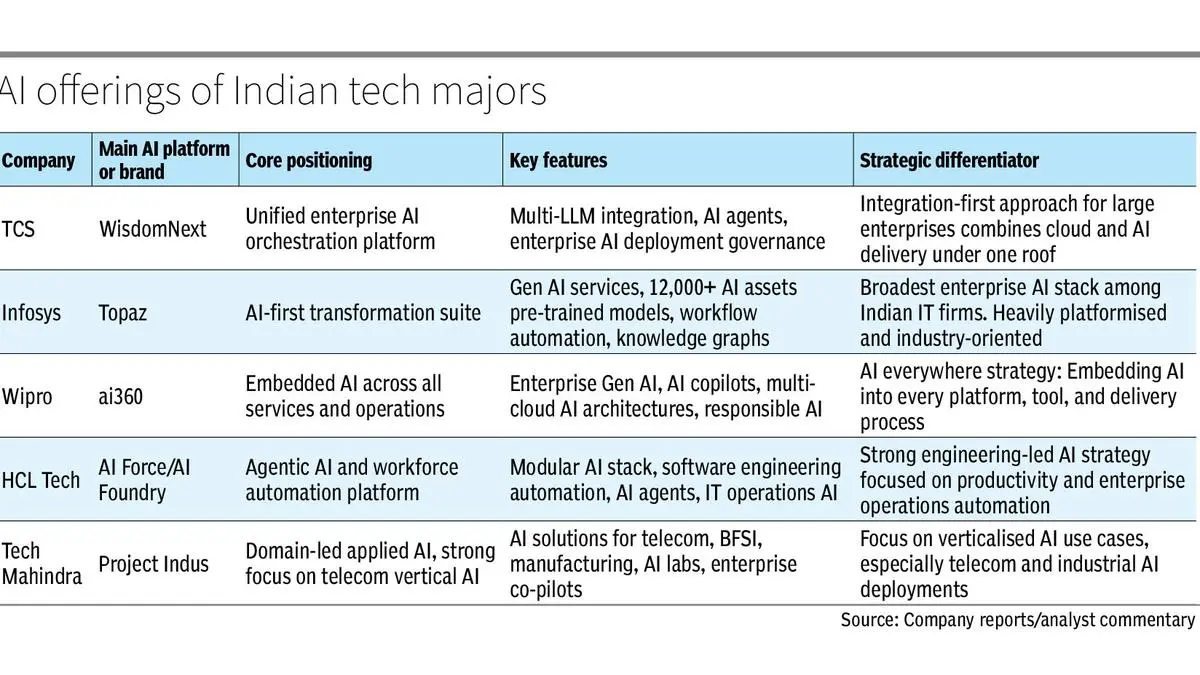
Earlier, in traditional IT services, more people meant more revenue. AI has broken this equation, with clients expecting fewer engineers, lower costs, productivity-linked pricing, and faster delivery. Indian IT companies, therefore, have tried to evolve from mere order takers to AI-led transformation partners. Hitherto dependent on services revenue rather than IP-led or proprietary products, they are now leaning more towards AI orchestration platforms, domain-specific co-pilots, reusable enterprise AI agents, and industry AI stacks.
Mishra says Indian IT companies are rapidly reworking their AI strategies, moving beyond the traditional labour arbitrage model towards platform-driven and outcome-based solutions. Unlike their global counterparts, which are taking a consulting-centric and acquisition-heavy route, Indian firms are emphasising the integration of AI through scalable platforms and measurable outcomes.
Jimit Arora, CEO of Everest Group, observes that the competition is over operating model reinvention capability. “Indian IT firms have a structural advantage in delivery scale and process depth. Global peers like Accenture and the Big Four have an advantage in business advisory and C-suite access. The firms that close the gap are the ones to watch. We are already seeing a K-shaped separation in the growth trajectory of the Tier-1s. Further separation will happen through execution — execution creates trust, which permits getting more business, and drives more execution,” he says.
AI-tagged vs AI-led
According to Biswajeet Mahapatra, Principal Analyst, Forrester, most of the AI offerings are extensions of existing digital, data, and automation practices rather than net-new AI-first service lines.
While there are pockets of genuine AI-led engineering, most client-facing portfolios reflect re-bundling and re-positioning of prior capabilities with incremental AI components embedded into delivery.
“A minority of active pipelines are truly AI-led, where AI is the primary buying driver. A much larger portion is AI-tagged, where AI is positioned as an enhancement to transformation, modernisation, or productivity programmes,” Mahapatra says.
He adds that AI will remain a modest contributor to overall revenues in the near term. Meaningful revenue impact is more likely once AI transitions from feature-level inclusion to operating model and business process transformation at scale. This shift depends on clients funding structural change rather than incremental automation.
Over 3-7 years, there should be significant acceleration for the services space, even as the nature of the winner changes, according to Arora. Every prior service era — outsourcing, offshoring, and digital — followed this exact curve.
“The firms winning in this era will be doing three things simultaneously. Playing defence by managing the run-off in their legacy business intelligently. Playing offence by taking a share in vendor consolidation deals where clients are reducing their supplier count and concentrating spend. Creating new plays by shaping client demand through operating model evolution rather than just responding to RFPs (request for proposals). The race is over how much new growth can be captured through the operating model shift before that ice cube gets too small,” he says.
Over the next 3-5 years, concludes Mahapatra, providers who successfully productise IP, standardise AI delivery, and align AI with industry workflows are likely to emerge as AI leaders than those focused primarily on labour-based scale-up.
More Like This
Published on May 11, 2026







