
Domestic fertilizer production between March 1 and April 26 stood at 59.01 lakh tonnes (lt) this year, significantly lower than 76.09 lt produced during March-April, last year
| Photo Credit:
–
Fertilizer production in the first two months following the Iran war has fallen sharply compared with the same period last year, fuelling anxiety among farmers who are already lining up at retail outlets weeks before the start of kharif sowing.
Official data show that domestic fertilizer production between March 1 and April 26 stood at 59.01 lakh tonnes (lt) this year, significantly lower than 76.09 lt produced during March-April, last year.
Even after adding an estimated 4-5 lt output for the remaining days of April, total production for March-April is expected to reach only about 64 lt, nearly 12 lt lower year-on-year.
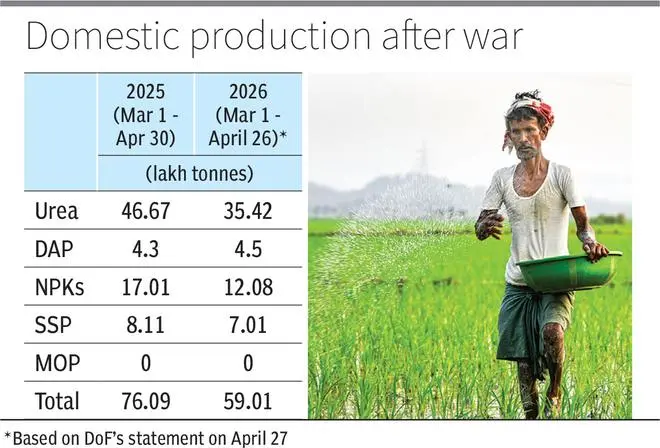
The decline has been most pronounced in urea, the key nitrogenous fertilizer used widely during kharif. Urea production dropped to 35.42 lt this year from 46.67 lt in March-April last year, a fall of over 24 per cent. Industry sources attribute the decline mainly to disruption in liquefied natural gas (LNG) supplies, the primary feedstock for urea manufacturing, after the Iran war.
The production shortfall is already being felt on the ground. Farmers in several regions have begun queuing up at fertilizer outlets earlier than usual to secure supplies before sowing begins, pushing up sales compared to last year. Urea sales touched 8.53 lt in April 1-17 this year, up from 7.71 lt in the comparable period last year, while sales of DAP, complex fertilizers and SSP have also risen noticeably.
Govt Version
The government, however, has sought to reassure farmers and State administrations, maintaining that fertilizer availability remains “strong, stable and well-managed.”
According to the Department of Fertilizers, total fertilizer stocks stood at 190.21 lt as of April 27, equivalent to about 49 per cent of the estimated kharif 2026 demand of 390.54 lt, significantly higher than the 33 per cent stock level at the same time last year.
Officials said there are currently no major issues in the availability of key raw materials for producing urea and phosphatic fertilizers. They also noted that LNG supply to urea plants has improved to about 97 per cent of requirement after dropping to 50-60 per cent immediately following the war.
The government further emphasised that retail prices of major fertilizers remain unchanged despite a sharp spike in global prices, with urea continuing to be sold at ₹266.5 per 45-kg bag, DAP at ₹1,350 per 50-kg bag, and TSP at ₹1,300 per 50-kg bag.
However, with production lagging behind last year’s levels and farmers stocking up early, industry officials say the coming weeks before peak kharif sowing will be critical in determining whether the government’s confidence translates into smooth on-ground availability.
Published on April 28, 2026







