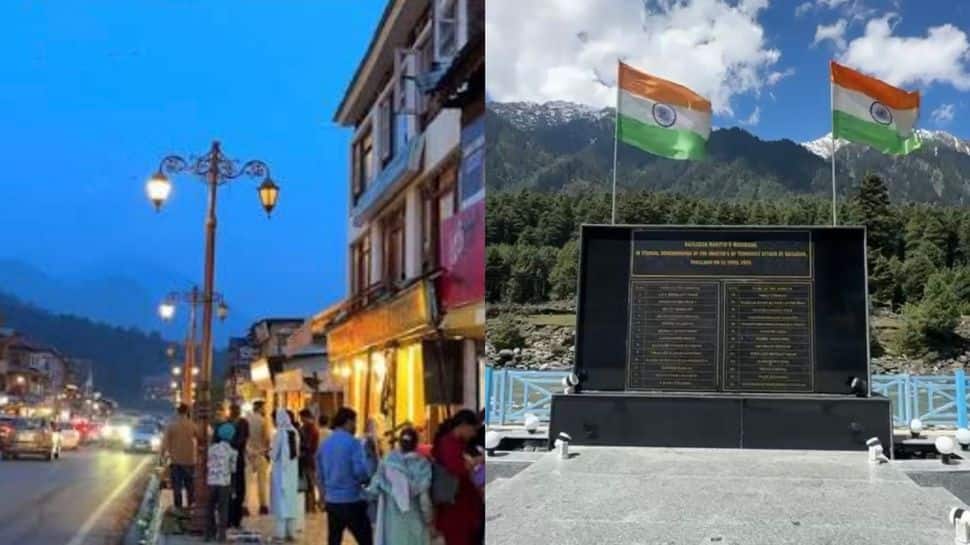
One year after the tragic terrorist attack that struck Pahalgam on April 22, 2025, claiming the lives of 26 people, the Kashmir Valley is witnessing a tremendous resurgence in tourism as the first anniversary of the incident approaches. While the event had caused a drastic decline in tourist numbers during 2025, Pahalgam and other renowned tourist destinations are now once again bustling with crowds, signaling a robust comeback for the tourism sector.
As the first anniversary of the April 22, 2025, terrorist attack draws near, a special memorial has emerged as a focal point for both tourists and locals to pay tribute to the 26 victims.
This memorial—commissioned by the government and often referred to as ‘Shaheed Marg’ (Martyrs’ Path)—is situated along the banks of the Lidder River, near Pahalgam’s famous “Selfie Point.” It stands as a permanent tribute to the 25 tourists and one local pony-puller who were killed in the ambush attack that took place in the meadows of Baisaran. The memorial bears the names of all 26 victims, allowing visitors to offer flowers, light candles, and offer prayers. Tourists visiting Pahalgam now consider it an essential part of their itinerary to stop at this “Martyrs’ Memorial”; as they read the names of those who were lost, their mood shifts from lighthearted leisure toward deep contemplation and solemn peace.
Arun Goyal, a tourist visiting the martyrs’ memorial to pay his respects, said, “When we arrived here, we came to know that this is a memorial dedicated to the martyrs of the Pahalgam attack. We came here and paid our tributes to them. The very presence of this memorial ensures that their memory will live on forever; it is a great honor bestowed upon them.”
In a boost to tourism, government statistics reveal that in the last month alone, over 250,000 tourists visited Srinagar’s renowned ‘Indira Gandhi Memorial Tulip Garden.’ This massive influx of visitors underscores the fact that Kashmir remains an incredibly attractive and essential destination for tourists even today. Officials and locals alike view this heavy turnout as a befitting reply to the terrorists—and their handlers across the border—whose objective was to destabilize the region’s peace and cripple its tourism-dependent economy.
The large numbers of returning tourists are expressing their complete faith in the security forces. Many visitors stated that their decision to visit was based on current ground realities rather than past incidents; describing the region as safe, many also lauded the hospitality of the local people. A comparison of tourist arrival data reveals a stark contrast: last April—following the attack—Pahalgam recorded zero bookings, whereas this April, bookings in Pahalgam stand at 90%. Tourists observe that the atmosphere has undergone a complete transformation, shifting from one of fear to one of trust.
Urusha Jamwal, a visitor from Australia, said, “It is a coincidence that we happen to be here on the very days when the attack took place last year—an incident that was truly tragic. However, honestly speaking, we have been here for four days, and we haven’t even felt as though we are in Kashmir, or that any such incident ever occurred here. While the administration is certainly vigilant, the local people have also proven to be incredibly cooperative. We are just two women traveling alone, yet not once did we feel unsafe.”
This newfound sense of trust and security is the direct result of the measures implemented by the administration and the local community to bridge the trust deficit and reinforce security across the region. A unique digital identification system—utilizing QR codes—has been introduced in Pahalgam for all tourism service providers. By scanning these codes, tourists can instantly verify the authentic identity, registration status, and police clearance status of pony operators, shawl vendors, shopkeepers, and various other individuals associated with the tourism sector.
To further bolster security and transparency, the administration has implemented this QR code-based tracking mechanism. These codes have been issued to taxi drivers, shopkeepers, hotel staff, and tourist guides. The system also incorporates GPS-based monitoring capabilities, thereby adding an additional layer of security.
Ejaz Ahmed, President of the Pony Association, stated, “This is an excellent initiative. Tourists will feel secure once the information obtained from the QR codes confirms that the individuals accompanying them are both registered and police-verified. This will not only deter unscrupulous elements but also lead to an increase in our business.”
Tourists, too, acknowledge the benefits of this initiative, noting that it will afford them greater freedom to explore the region. Rakesh Manhas, a tourist from Maharashtra, remarked, “This makes us feel secure and allows us to freely enjoy this paradise. Knowing that the individuals we are engaging with have been verified by the police significantly enhances our sense of safety.”
Following the attack, approximately 48 tourist sites were temporarily closed for security reasons. Most of these locations have now gradually reopened, and the government aims to have all sites fully operational by the end of 2026. However, some locations situated in dense forest areas remain closed.
Baisaran Valley—often referred to as “Mini Switzerland”—officially remains closed to the public. While tourism is once again flourishing in Pahalgam town and other surrounding areas, this meadow—the site of the tragic terrorist attack on April 22, 2025—is still designated as a “No-Entry Zone” for security reasons, according to security forces.
The path leading toward Baisaran currently ends at a junction where the Jammu and Kashmir Police and the CRPF have erected a barricade to prevent anyone from proceeding further uphill. Tourists attempting to venture forward along the muddy trail are turned back by police and CRPF personnel. For security reasons, photography or videography is also strictly prohibited even at this security barricade. However, other nearby attractions—such as Betaab Valley and Aru Valley—remain open and are witnessing a heavy influx of tourists amidst heightened security.
Ahead of the first anniversary of the terrorist attack that occurred on April 22, 2025, security has been significantly bolstered across Pahalgam and other tourist destinations within the Kashmir Valley. Authorities view this anniversary as a highly sensitive occasion and have deployed a multi-layered security apparatus to preempt any potential disturbances.
In addition to a QR code-based system, security forces have intensified their day-and-night patrols. Surveillance at major tourist hotspots has been further tightened. Security agencies remain on high alert following intelligence reports. These reports have raised apprehensions regarding new threats that could once again derail the tourism sector. Consequently, strict measures are being enforced concerning foreign nationals and the implementation of the Immigration Act.
Tourists visiting Pahalgam feel remarkably safe here; they attribute this sense of security to the presence of deployed security forces, as well as the installation of CCTV cameras and FRS (Facial Recognition System) cameras at key tourist sites. Whether at the entry points to Pahalgam or at other tourist destinations, checkpoints have been established everywhere.
Officials view this surge in tourism not merely as an economic recovery, but also as a strong message against terrorism. As thousands of people return to savor the natural beauty of this paradise, Pahalgam now stands as a symbol of recovery—a place where cherished memories and new beginnings now go hand in hand.







