“Mo-Mo Understanding”: Congress Leader Claims PM Modi-Mamata Banerjee Pact

“Mo-Mo Understanding”: Congress Leader Claims PM Modi-Mamata Banerjee Pact


Congress’s mega foot march started last year in September (File)

New Delhi/Kolkata:

Congress MP Adhir Ranjan Chowdhury today took a jibe at Prime Minister Narendra Modi and West Bengal Chief Minister Mamata Banerjee, claiming they have a pact to weaken Congress.

Adhir Ranjan Chowdhury, who is also the West Bengal Congress Chief, said Mamata Banerjee will not do anything to upset the Prime Minister.

“Several leaders have appreciated Congress MP Rahul Gandhi’s Bharat Jodo Yatra, but not her,” Mr Chowdhury said.

“There’s ‘Mo-Mo’, an understanding between Mamata Banerjee and Modi ji. When Modi ji says- Congress-Mukt Bharat, then Mamata ji also says Congress should be removed from Bengal,” he claimed.

This is not the first time the Congress MP has made such a claim. Earlier, Mr Chowdhury had claimed that there was a “secret understanding” between PM Modi and Ms Banerjee to “save Trinamool Congress leaders” from the central agencies.

“Mamata Banerjee wants to weaken Congress by becoming informer of Prime Minister Narendra Modi. She bowed her head in front of Modi ji to save her party leaders from CBI and ED,” he had said.

Mr Chowdhury had also claimed that BJP’s “polarisation politics” to damage the Congress had helped Mamata Banerjee’s TMC sweep the 2021 Assembly Elections in West Bengal,

With an eye on Lok Sabha elections, Congress started its mega foot march last year in September from Tamil Nadu.

The party has invited 21 opposition parties for the grand finale of the yatra in Jammu and Kashmir on January 30.

Last month, the Prime Minister virtually flagged off the Vande Bharat Express connecting Howrah and New Jalpaiguri in West Bengal, the day his mother died.

Ms Banerjee condoled PM Modi’s mother’s death and thanked him for joining the event in spite of suffering such a huge personal loss. 

Featured Video Of The Day

Video: Chairs, Metal Rods Fly In Midnight Fight At Noida Market


Source link

“Guides, Like A North Star”: Chief Justice On Basic Structure Doctrine

“Guides, Like A North Star”: Chief Justice On Basic Structure Doctrine


Chief Justice made the remarks while delivering the Nani A Palkhivala Memorial Lecture. (File)

New Delhi:

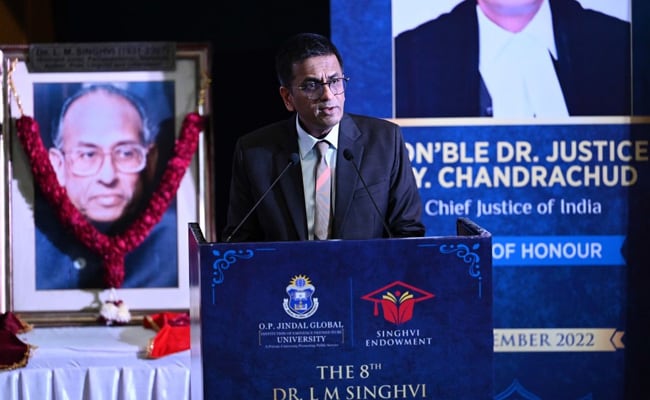
Chief Justice of India DY Chandrachud on Saturday called the basic structure doctrine a North Star that guides and gives certain direction to the interpreters and implementers of the Constitution when the path ahead is convoluted.

The remarks by the CJI came against the backdrop of the recent remarks by Vice President Jagdeep Dhankhar who questioned the landmark 1973 Kesavananda Bharati case verdict that gave the basic structure doctrine. Mr Dhankhar had said the verdict set a bad precedent and if any authority questions Parliament’s power to amend the Constitution, it would be difficult to say “we are a democratic nation”.

Delivering the Nani A Palkhivala Memorial Lecture here, the CJI said craftsmanship of a judge lies in interpreting the text of the Constitution with the changing times while keeping its soul intact.

“The basic structure of our Constitution, like the north star, guides and gives certain direction to the interpreters and implementers of the Constitution when the path ahead is convoluted,” he said.

“The basic structure or the philosophy of our Constitution is premised on the supremacy of the Constitution, rule of law, separation of powers, judicial review, secularism, federalism, freedom and the dignity of the individual and the unity and integrity of the nation.”

The CJI said that from time to time, we require people like Nani Palkhivala, who was an eminent jurist, to hold candles in their steady hands to light the world around us.

“Nani told us that our Constitution has a certain identity which cannot be altered.” He said the doctrine of basic structure has shown that it might be beneficial for a judge to look at how other jurisdictions have dealt with similar problems for them.

The basic structure principle became the ground for setting aside several Constitutional amendments, including the quashing of the Constitutional amendment and the corresponding NJAC Act on the appointment of judges in the higher judiciary.

Mr Dhankhar, who is the Rajya Sabha chairman, recently said he does not subscribe to the Kesavananda Bharati case verdict that Parliament can amend the Constitution but not its basic structure. He had asserted that parliamentary sovereignty and autonomy are quintessential for the survival of democracy and cannot be permitted to be compromised by the executive or judiciary.

Addressing the 83rd All India Presiding Officers Conference in Jaipur on January 11, he said the judiciary cannot intervene in lawmaking.

“In 1973, a wrong precedent (galat parampara) started.

“In 1973, in the Kesavananda Bharati case, the Supreme Court gave the idea of basic structure saying Parliament can amend the Constitution but not its basic structure. With due respect to the judiciary, I cannot subscribe to this,” Mr Dhankhar, who has been a Supreme Court lawyer, said.

Mr Dhankar’s statement came against the backdrop of a raging debate on the issue of appointment to the higher judiciary with the government questioning the current Collegium system and the Supreme Court defending it.

In his lecture, Justice Chandrachud said the identity of the Indian Constitution has evolved through the interaction of Indian citizens with the Constitution, and has been accompanied by judicial interpretation.

“The craftsmanship of a judge lies in interpreting the text of the Constitution with the changing times while keeping its soul intact,” he added.

The CJI also observed that India’s legal landscape has undergone a significant change in the recent decades in favour of removing “strangulating regulations, augmenting consumer welfare and supporting commercial transactions”.

He said the emerging world economy has erased national boundaries, and companies no longer stop at the border.

“In recent decades, India’s legal landscape has also undergone a significant change in favour of removing strangulating regulations, augmenting consumer welfare and supporting commercial transactions.”

The CJI noted that legislations such as the Competition law and the Insolvency and Bankruptcy Code have been enacted to promote fair market competition. Similarly, the Goods and Services Tax (GST) has sought to streamline indirect taxation on the supply of goods and services in India, he added.

“If you look at the Constitution, it does not favour unbounded economic liberalism. Rather, our Constitution seeks to find the right balance.”

The CJI further said the Constitution allows the state to change and evolve its legal and economic policies to meet societal demands.

He said that when individuals have the opportunity to exercise their liberties and to be fairly rewarded for their efforts, then economic justice becomes one of the many inter-related dimensions of life.

Ultimately, we share common faiths and destinies to the point that development of each individual fosters social justice in the entire world, he added.

“We have come a long way from the time when getting a phone required you had to wait for a decade, and buying your car even longer at times. We have come a long way from the time of the control of capital issues,”he added.

Talking about Palkhivala and several prominent cases in which he was involved, the CJI said the eminent jurist was at the forefront of preserving the very identity and cardinal principle embedded in the Constitution.

“Nonetheless, the larger picture of legal culture and local dimensions of law, which are dictated by the local context, should never be obfuscated. Law is always grounded in social realities.”

(This story has not been edited by NDTV staff and is auto-generated from a syndicated feed.)

Featured Video Of The Day

“Bankey Bihari Not The Only Temple…”: BJP MP Hema Malini On Mathura Corridor


Source link

“Wrestling Chief To Step Aside Till Probe Over”: Minister On #MeToo Charge

“Wrestling Chief To Step Aside Till Probe Over”: Minister On #MeToo Charge

Sports Minister Anurag Thakur met athletes for seven hours

New Delhi:
BJP MP Brij Bhushan Sharan Singh will step aside from India’s wrestling body for four weeks during which an oversight committee will look into allegations of sexual harassment against him, Union Sports Minister Anurag Thakur told reporters today.

Here’s your 10-point cheatsheet to this big story

  1. After a meeting that lasted seven hours and went past midnight, Mr Thakur, flanked by some of India’s most celebrated wrestlers, in a news conference assured that the government will support the wrestlers at every step of their battle.

  2. “An oversight committee will be set up. It will take four weeks to give a report. Any allegation, whether sexual harassment or financial wrongdoing, we will dive deep and investigate them. We will take action after that,” Mr Thakur said.

  3. After meeting Mr Thakur, the wrestlers called off their protest against alleged sexual harassment and misappropriation of funds.

  4. “Till the time the investigation is not complete, a committee will see to the day-to-day working (of the Wrestling Federation of India)…I thank the athletes for speaking to me,” Mr Thakur said.

  5. Olympic medallist Bajrang Punia said the minister has assured he is with the wrestlers at every step. “Prime Minister Narendra Modi has also always supported our athletes,” Mr Punia said.

  6. The Indian Olympic Association has also announced a seven-member panel to investigate the allegations against Mr Singh. The panel will have noted athletes Mary Kom, Dola Banerjee, Alaknanda Ashok, Yogeshwar Dutt and Sahdev Yadav as members.

  7. Mr Singh has denied the allegations and refused to resign. “If I speak, there will be a tsunami…I am not here because of someone’s charity. I have been elected by the people,” he told reporters in Uttar Pradesh’s Gonda.

  8. Earlier, Mr Thakur had dialled Mr Singh and cautioned him against making any statement to the media.

  9. Ahead of the meeting on Friday night, the wrestlers had sent a letter to PT Usha, the head of the Indian Olympic body, seeking action against Mr Singh.

  10. “Vinesh Phogat was mentally harassed and tortured by the WFI chief after she missed out on an Olympic medal in Tokyo. She almost contemplated suicide,” the wrestlers wrote in their letter to Ms Usha, adding “they fear for their lives”. Ms Phogat has agreed to reveal the identity of the sexual harassment survivors to the Indian Olympic Association committee.


Source link

“Should Have Known”: Court Pulls Up IIT Kharagpur Director Over Student’s Death

“Should Have Known”: Court Pulls Up IIT Kharagpur Director Over Student’s Death


The Calcutta High Court had ordered the Director to be present at this hearing of the petition.

Kolkata:

The Calcutta High Court today pulled up the Director of Indian Institute of Technology (IIT) Kharagpur, the premiere engineering college that made headlines for the death of a student in campus, saying he should have been aware that children with superior abilities come to the institute from different social or economic backgrounds, and may not be able to freely mix with students from other backgrounds. It also observed that counselling sessions at the college should reach “lowest levels”. The court had on December 1 last year reprimanded him for not acting on a ragging complaint, which was followed by the death of the student.

“We can’t see any soft peddling in this matter. It is a humble request from this court. Please don’t take any sides,” the court told the police today.

A detailed report was presented in court today addressing the lacunae, replacing the earlier “casual report” filed by the Director. The court had earlier slammed the college’s vague report on action taken following a ragging complaint of 23-year-old Faizan Ahmed from Tinsukia in Assam in February, months before his decomposing body was discovered in a hostel.

A high-powered committee is to be set up if its guidelines are in harmony with the order of the Supreme Court on ragging, the court said.

“It is submitted that a meeting of the Board Of Governors has been fixed on February 10. It is expected that stern and deterrent measures are taken by the IIT Kharagpur not only in this incident but also to prevent recurrence of aforesaid incidents in future,” it further stated.

Consideration of the status of investigation shall be on February 6, and the court must be apprised of it on the same day, the High Court said, adding that the role of the IIT and the direction on them shall be considered on February 13, when the matter will be next heard.

The Calcutta High Court had ordered the Director to be present at this hearing of the petition filed by third year Mechanical Engineering student Faizan Ahmed’s parents, who have alleged that their son’s death at the premises of the institute was a ‘clear case of murder’ and he was subject to ragging even after complaints to the authorities.

Faizan Ahmed’s decomposing body was recovered from a hostel room on October 14 last year. The court had asked for a report from the IIT Director and after going through it, it said the report of the Director is “thoroughly misleading” if not an attempt to cover up.

What was initially believed to be a case of death by suicide by one of the students at IIT Kharagpur, due to academic pressure was alleged to be a case of murder by the student’s family, with Calcutta High Court ordering the police to check whether the Supreme Court’s anti-ragging guidelines were followed at the premier higher education institute.

In view of the large number of discrepancies pointed out by the parents of Faizan Ahmed, the court had earlier ordered the police to present the case diary and instructed the district’s top police officer to conduct a detailed investigation.

Featured Video Of The Day

Video Shows Delhi Women’s Panel Head Confronting “Drunk Car Driver”


Source link

YouTube
Instagram
WhatsApp